FREE TRIAL VERSION. DON'T MISS OUT. |
FREE TRIAL VERSION. DON'T MISS OUT. |
|
|
Donald Trump and the Deconstruction of America |
By David Corn August 2, 2025 |
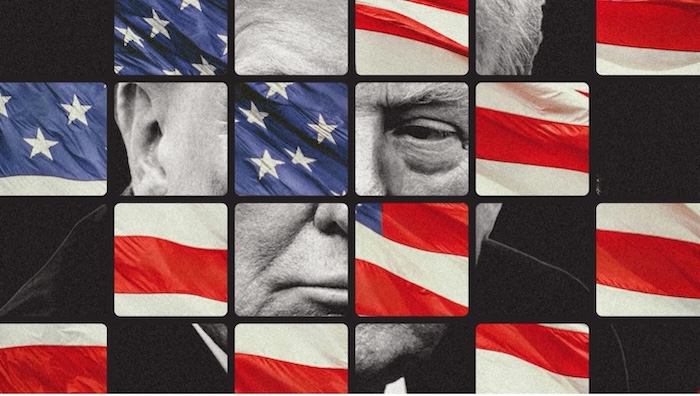
Mother Jones illustration; Daniel Torok/White House/ZUMA; Unsplash |
|
|
You're reading a free promotional version of Our Land, and we hope you enjoy David's exclusive writing and don't want to miss out on what's next. Sign up to start receiving a free 30-day trial of Our Land and enjoy all of the behind-the-scenes reports and interactive features with each issue.
|
|
|
Every day, Americans are bombarded with the bad news of Trump 2.0: concentration camps; cruel ICE raids targeting law-abiding residents; health insurance being yanked from millions; elite universities, media companies, and law firms yielding to mob-like extortion; crypto deals and other brazen grifting tied to a corrupt White House; rampant abuses of governmental power and threats of sham criminal prosecutions against the administration’s critics and political foes; drastic cuts in food assistance; assaults on women’s rights; the withholding of disaster relief; the reckless shutdowns and eviscerations of crucial government services and agencies that will result in hardship (and, in some cases, death) for Americans and people overseas.
This is, of course, a partial list. And it is exhausting to keep track of and absorb each new outrage. That is the clear intent. The Trump transgressions come so fast they distract from each other. Public attention rarely remains focused on any one atrocity. We’re bludgeoned by the never-ending stream of misdeeds and affronts—which each day come wrapped in propaganda extolling a new Golden Age and assorted false glories of Dear Leader. When one is caught in the crossfire, it is hard to see, let alone address, the big picture.
That is to Donald Trump’s advantage. For a long time, commentators have noted that he relishes generating chaos and believes he can exploit disorder for political advantage. It’s an escape route for him. The dizzying whirlwind he creates places critics and opponents off-balance. And perhaps best of all for him and his crew, it hides their overall plan and inhibits the development and promotion of an overarching counternarrative. Their foes are stuck decrying the individual acts of villainy, one at a time, without doing what is most necessary in American politics: telling a story.
|
|
|
Trump and his gang are deconstructing America. This is their purposeful goal and an obvious one, if you look past the daily barrage of absurdity, indecency, corruption, wrongdoing, and abuses of power. It is the story that must be conveyed to the citizenry.
For years, Trump’s lieutenants and allies—folks like alt-right leader Steve Bannon and the arch-conservative eggheads at the Heritage Foundation—have decried what they call the “administrative state” and urged its abolition. By this, they meant the permanent civil service that does the work of government, such as enforcing laws and implementing policies, regulations, and safeguards. It’s been a long-term desire of right-wingers to smash the state and disempower these public servants—and make way for an economically libertarian and socially conservative regime that, in the case of Trump, would be ruled by an autocrat. Government would no longer have the potential to be a countervailing force to the power of corporate interests and wealth. This is the dream shared by Elon Musk and the reason he jumped aboard the Trump train. Like many of his Silicon Valley brethren, he envisions a world in which profit-driven tech overlords plot our collective future free of the pesky meddling of government.
To achieve something of this sort, Trump, following the playbook of Project 2025, is attempting to shift the basic balance of power in the United States and revoke a fundamental agreement of American society: The rich and the powerful get to be rich and powerful, while government constrains their excesses and looks out for the common interest of the rest of us. Under Trump, that deal—which often in American history has been executed shoddily and not infrequently ignored—is null and void. Look at artificial intelligence. Last month, Trump gave free rein to the tech firms to develop this new technology—which might present a risk to humanity—as they wish. There will be no consideration of the public interest or public safety.
But Trump’s master plan—of which he is hardly the main author—extends far beyond government. He is seeking to weaken and intimidate other influential sections of society that might provide a check on him and a corporate-friendly state. Embracing a decades-long crusade of the right, he has assaulted the media, looking to discredit news outlets and undercut their ability to hold him and his allies accountable. And big guns of corporate media—ABC News and Paramount, the owner of CBS News—have buckled, agreeing to pay Trump millions of dollars in extortion fees. A wave of baseless defamation suits from Trump and his confreres have sent chilling waves through the media. Brendan Carr, the chair of the Federal Communications Commission, has issued not-so-veiled threats against news organizations and media companies that rely on broadcast licenses issued by the federal government.
Trump has gone after powerful law firms in the same Sopranos-like manner, several of which settled and agreed to pay huge fees though they had committed no wrongdoing. Now big law firms are more reluctant to take on cases that might offend Trump. This week, Reuters published an investigation that concluded, “Dozens of major law firms, wary of political retaliation, have scaled back pro bono work, diversity initiatives and litigation that could place them in conflict with the Trump administration...Many firms are making a strategic calculation: withdraw from pro bono work frowned on by Trump, or risk becoming the next target.”
The Trump White House also zeroed in on Ivy League schools. So far, Columbia, the University of Pennsylvania, and Brown have settled bogus cases deployed against them by the administration. Columbia will pay $200 million directly to the government and be subjected to an independent monitor. Brown escaped such an intrusion and agreed to pay $50 million over 10 years to workforce development organizations in Rhode Island. Harvard, which initially seemed to be a front of resistance, is now reportedly in negotiations to forge an agreement with Trump that could entail a payment of $500 million. Universities and colleges across the nation are undoubtedly watching all this and discussing how to avoid the wrath of Trump.
As is Corporate America. Trump has been good to many executives and firms by slashing their taxes and weakening regulatory enforcement, especially for polluters and financial firms. (Tariffs are another matter.) But the men and women in the C-suites are no fools and realize that a price will be paid if they end up at odds with Trump. (See Jeff Bezos and the Washington Post.)
Trump has annihilated one of the centers of influential thought in the nation: the scientific research community. Slashing billions of dollars in funding for medical research and other scientific endeavors, he is wiping out a generation of science and scientists. One of the driving engines of American society and the US economy is being deprived of fuel. The United States is on its way to losing its preeminent standing in the global scientific community. That means lower likelihoods of breakthroughs in the search for treatments and cures for cancer, diabetes, Alzheimer’s, and other diseases, as well as increased challenges once the next pandemic strikes. Dramatic reductions in NASA’s budget will cause a severe decline in basic scientific research. Trump and his posse are waging an inexplicable war on science. Is that because they see science as a fount of liberalism, as if reality has a political bias?
With his mass deportation effort, Trump has turned a slice of American law enforcement into a police state. He has spread fear through many towns and communities, as his masked marauders round up law-abiding residents and threaten small businesses. Why go after people who are working hard, paying taxes, and contributing to their communities? It’s difficult not to see a racial motive and a desire to reverse the demographic diversity that is a key and dynamic ingredient of American society. At the same time, Trump has moved to make the United States less secular. His IRS issued a ruling to allow churches and other places of worship to become more directly involved in elections. On Monday, his Office of Personnel Management released new guidance that would allow federal employees to display religious items in the workplace, pray in groups, and proselytize their fellow workers.
What Trump and Co. are doing brings to mind Christian dominionism. Fundamentalists who adhere to this theology believe that Christians ought to have dominion over the vital sectors of society: family, religion, government, education, media, business, and arts and entertainment. Trump is striving for such domination. He even seized control of the John F. Kennedy Center for the Performing Arts. (Republicans have proposed renaming it the Donald J. Trump Center for Performing Arts.) His White House has muscled the Smithsonian Institution to eschew exhibitions that in the Trumpers’ view reflect DEI concerns. As a result of pressure from the administration, the Smithsonian’s National Museum of Art History removed references to Trump’s two impeachments from an exhibit on impeachments in US history. In 1984, the Party has a slogan: “Who controls the past controls the future. Who controls the present controls the past.”
It's an everything-everywhere-all-at-once strategy to reshape America to the fancy of an autocrat and far-right advocates who crave blowing up the foundations of America they regard as liberal, woke, or otherwise at odds with their MAGA theology. And it entails amassing political clout unlike a president has ever done, with Trump illegally assuming powers he doesn’t possess (such as to impose tariffs and deport people without due process) and trying to rig the system (see the latest gerrymandering by Texas Republicans).
One huge question is how to tell this story? The individual components are so troubling they warrant their own headlines, and the conventional media is not adept at consistently portraying overarching narratives in a down-to-brass-tacks fashion. The key word in the last sentence is “consistently.” In today’s fractured and bubble-ized media ecosystem, plotlines don’t punch through unless there’s repetition and force in the presentation. It’s too easy to be distracted. Each day we are hit by thousands of impressions—social media posts, ads, emails, news stories, videos. How does an idea—such as, Trump is deconstructing American society—cut through the immense and never-ending clutter and register with a large number of people?
Before you quickly say, “The Democrats should be doing this,” I’ll note that, yes, the Democrats should be doing this. But let’s be real. There are few Democrats these days who have a national platform from which they can broadcast such a message. That’s not only because most are awful as communicators in the digital age, but also because the party locked out of the White House and the congressional majorities usually has difficulty gaining the attention of those Americans who don’t obsessively pay attention to politics.
The challenge of how to reach voters who do not engage with news or politics is the No. 1 problem for Democrats. You can’t rebrand if no one sees you trying to rebrand. Trump, a creation of reality TV and celebrity culture, commands attention—and even did so when he was not in office. There’s no Democrat with such standing. Thus, no Democrat is well positioned to inform Americans of the grand scheme underway.
That’s not to say that Democrats shouldn’t try. If enough of them use the daily outrages to illuminate the larger narrative and do so repeatedly, the message will reach some people. But this would require much repetition and discipline, as well as imagination and creativity regarding how to connect with people not looking for connections with politicians. At the moment, beating the Epstein scandal drum probably seems more effective for many Democrats, as they try to ride a wave of protest and upset created by Trump’s own base.
Reporters and commentators in the media could help share this story. But that might require breaking free of certain industry conventions. The gravitational pull within much mainstream media is toward neutral language and presentation. That aids bad-faith actors. It was shocking that when Trump recently said, “Whether it’s right or wrong, it’s time to go after people,” this remark did not lead to front-page headlines and days of high-octane coverage. The president of the United States was acknowledging he would use instruments of state power—in this instance, the intelligence community and the Justice Department—to try to lock up his political enemies. Richard Nixon musing about such things on the Watergate tapes was a massive scandal. Nowadays, it’s just another Tuesday.
|
|
|
Perhaps “deconstructing America” is not the best phrase for this task. “Destroying America” seems a touch vague and for some it might come across as hyperbolic. The “No Kings” slogan that apparently arose organically via national protests against Trump caught on, and it works as effective shorthand. But it may be too personalized, fixating on Trump’s pathological appetite for authoritarian rule, without sufficiently covering the transformational and wide-ranging attack on the nation that he and the right are perpetuating. I’m open to suggestions.
The point remains: The full impact of Trump’s rule has not seemed to register with most Americans, even as he slips in the polls. It is a frightening tale. He and his co-conspirators are forcing profound changes upon the nation—policies that do not have the support of the majority and that will cause much damage and be difficult to remedy. This is the narrative that needs to be conveyed, for if the people do not understand the sweeping dark reality of Trumpism, they will not be able to stop it.
Got anything to say about this item—or anything else? Email me at ourland.corn@gmail.com |
The Next Our Land Zoom Get-Together: August 6 |
As previously announced, the next Our Land Zoom get-together will happen on August 6 at 8 p.m. ET. We can gather in little boxes to voice our concerns, vent our frustrations, and drink our self-made cocktails. You know the drill. The day of the event, you’ll be sent a Zoom link. Just click on it at the right moment, and our bouncers, who used to be stunt doubles for the original Batman television series, will let you in. Remember: These events are open only to premium subscribers to this newsletter—those noble folks who send us a few bucks each month so we can produce Our Land. Only they will receive the Zoom link.
Without our premium subscribers, this publication would cease to be. It’s that simple. And they receive the full version of this newsletter, which includes more behind-the-scenes reporting on politics, current affairs, and the media; other features (including Dumbass Comment of the Week, Inspiration of the Week, and MoxieCam™); reviews of movies, music, television shows, and books; and the interactive Mailbag. (You write in; I respond.)
Is that too much content? Premium subscribers are not obligated to consume all this extra material. They can skip these special features and be happy to know that they are doing their bit to keep Our Land up and running. If you’d like to join this band and support the kick-ass reporting and analysis of Our Land, click here. If you sign up now, you can gather with me and your fellow Our Landers on August 6. See you soon. BYOB.
|
|
|
Dumbass Comment of the Week |
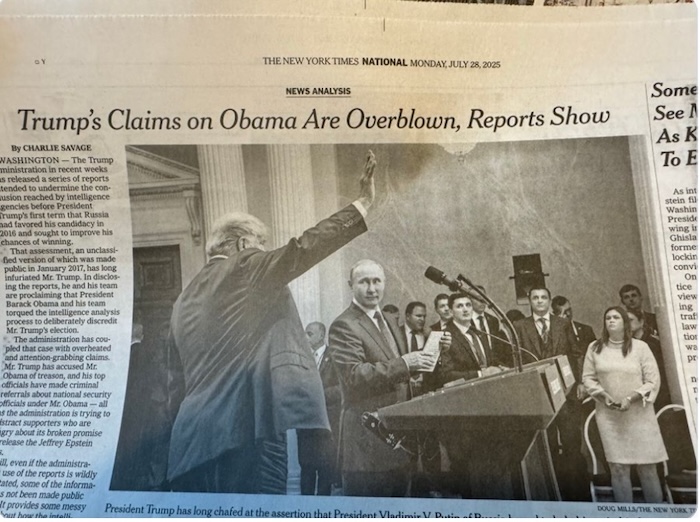
Donald Trump has been claiming that Barack Obama committed “treason” by rigging an intelligence report so that it concluded Russia had attacked the 2016 election to help Trump win. As the judges reminded me, I recently wrote that this was complete batcrap. No intelligence report was faked and Vladimir Putin had indeed intervened in that campaign in part to assist Trump. Yet this is how the New York Times reported the story:
|
The article got it right, exposing Trump’s falsehoods. But “overblown” means exaggerated. Trump’s claims were lies and fabrications. The judges know the difference—and so should the editors at the Times.
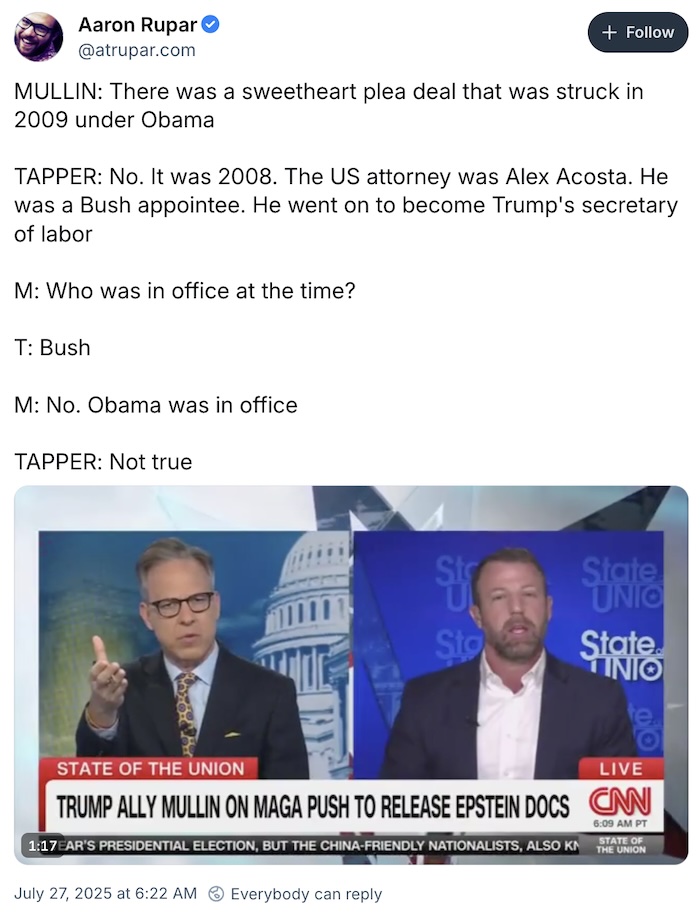
Sen. Markwayne Mullin (R-Okla.) made a true ass of himself when he appeared on CNN recently. He uttered a false claim about the Jeffrey Epstein case, blaming Obama (of course) for the non-prosecution agreement that was part of Epstein’s 2007 plea bargain deal, which included a light punishment for this sex crime offender. Jake Tapper called Mullin out. Here’s the exchange:
Mullin: In 2009, there was a sweetheart plea deal that was made underneath the Obama administration with Epstein and that sweetheart has not been exposed. Tapper: It was 2008. The US attorney at that time was a guy named Alex Acosta. He was a Bush appointee. He went on to become President Trump’s secretary of labor. It all took place in 2008.
Mullin: Who was in office at the time? Tapper: George W. Bush. |
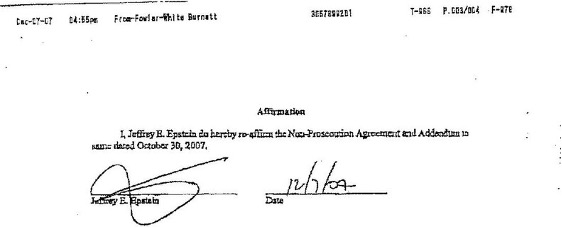
Despite being corrected, Mullin pushed his fake news and insisted: “No, 2009 was when the case came out and Obama was in office.” Tapper said, “It’s not true,” and then he moved on. The judges wonder why news shows put on guests who stick with lies, even when corrected. By the way, Epstein signed the plea deal in late 2007. Here’s his John Hancock on the agreement: |
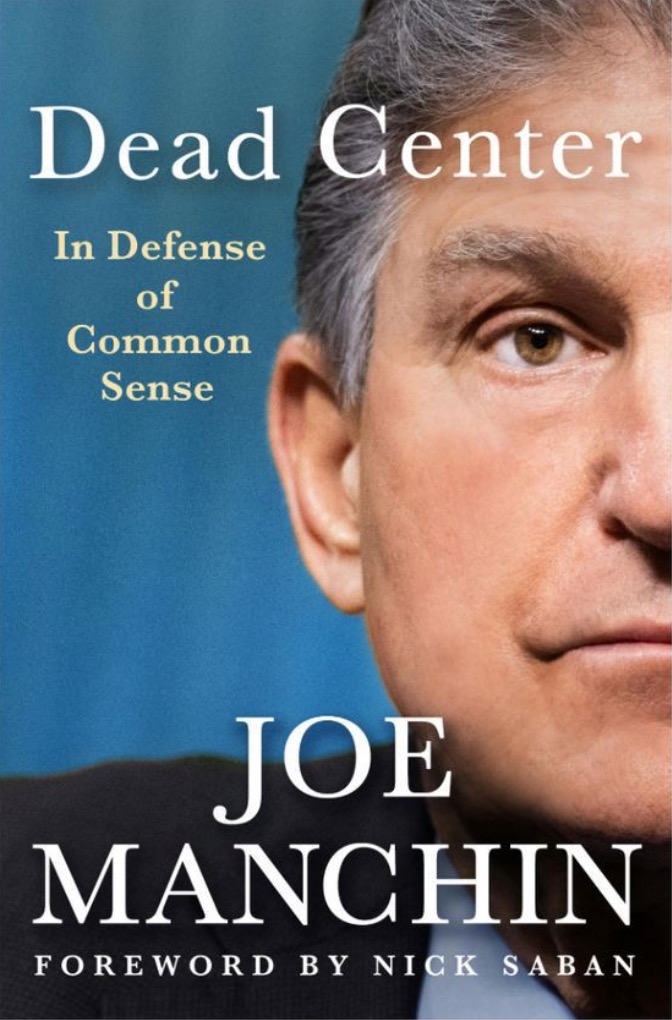
The judges have never nominated a book title for this award. So it’s an auspicious moment for former Sen. Joe Manchin (D-W.V.). They wonder how many meetings were held with how many editorial employees at Macmillan Publishers in which nobody said, “Uh, maybe this title doesn’t mean what we think it means?” |
By the way, the jacket only shows the right half of Manchin’s face. Which is appropriate.
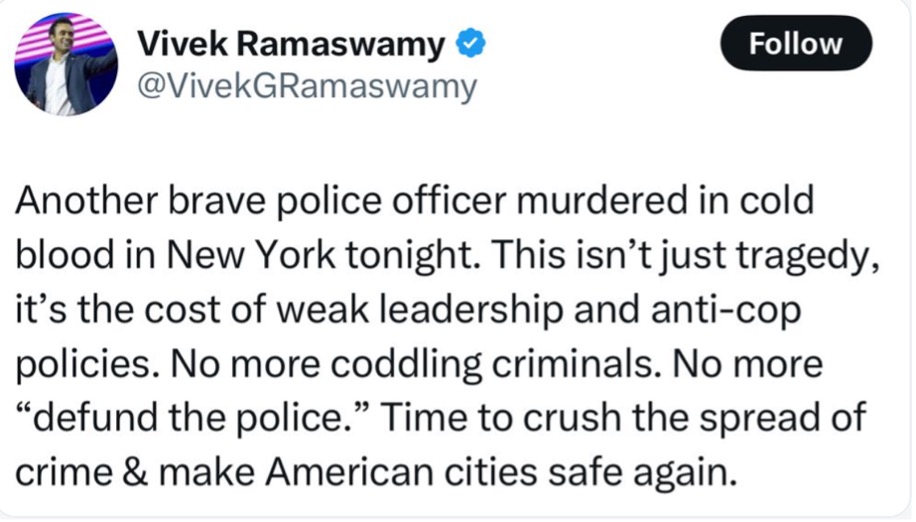
Is there a special place in hell for politicians who crassly exploit tragedies? If so, it must be awfully crowded. But the folks down there ought to save a chaise lounge and cool drink for Vivek Ramaswamy. After the horrific mass shooting in New York City of four people in a Manhattan office building, apparently by a troubled young man who believed he had a brain injury from having played football, Ramaswamy tweeted: “Another brave police officer murdered in cold blood in New York tonight. This isn’t just tragedy, it’s the cost of weak leadership and anti-cop policies. No more coddling criminals. No more ‘defund the police.’ Time to crush the spread of crime & make American cities safe again.”
|
This seemed a dig at state Assembly member Zohran Mamdani, the Democratic candidate for mayor in New York City. But this shooting happened during the administration of Mayor Eric Adams, a former cop, and, more important, it was completely unrelated to any law enforcement policies in New York City. The alleged shooter bought an AR-15 in Las Vegas and drove to New York, parked outside the building, walked in, and began firing, hoping to kill people at the offices of the NFL. Yet Ramaswamy, the failed presidential candidate who is running for governor in Ohio, jumped on this to attack unrelated policies and score political points. It was craven and dumb. The judges would prefer not to think about the smarmy Ramaswamy. This week, he gave them no choice—and won the prize. |
|
|
Readers tended to share the concerns I recently expressed about Trump’s decision to let the tech companies run wild on AI. Linda Jack wrote:
I know it wasn't the point of your article, but another issue with AI and the construction of data centers is their massive drain on both power and water (for cooling.) If tech firms, as you write, “will be allowed to develop AI free from bothersome regulations and safeguards," what will stop them from declaring their facilities are “in the national interest” or “necessary for national security”? Either designation would justify diverting power and water from residential or agricultural use to their data centers. We can generate more electricity, but fresh water is a finite resource and already in short supply in many areas. Currently, 31 percent of the lower 48 states are in drought. The state of Georgia is already affected by AI's tremendous need for water and power.
Megan Ardyche emailed:
Thank you for your hard-hitting journalism. I just read your issue on Trump and AI in which you asked, “What could go wrong?” That is, of course, true for virtually all of Trump's pronouncements and executive orders. AI is a big one, though. Anyone who thinks the tech billionaires will have citizens' best interests at heart are seriously delusional. Amid all this Epstein BS, though, I fear the mainstream media has lost sight of everything else Trump is doing, like deregulating AI, or deregulating financial institutions, or deregulating the fight against climate change, or kidnapping people off the street, or...or...or… I didn't know about the AI executive orders because everyone is so focused on Epstein. Thank you for not getting distracted. There really is too much to pay attending to these days.
That was my point above. Readers also responded to the issue that reported on Director of National Intelligence Tulsi Gabbard’s effort to gin up a fake scandal to ensnare Obama and national security officials in his administration.
Allen McNichols made this point: Although the Trump-Gabbard scheme should be taken seriously, it is still another in a long line of smokescreens that Trump is throwing out there in an attempt to get the Epstein story off the front pages.
This phony scandal was concocted as an obvious distraction. But as I noted, it still is rather dangerous, since it has led to a Justice Department investigation that could give us show trials of former Obama aides. Sarah Wall observed:
Every time 47 says “hoax” it’s his “tell” that anything he’s referring to is a lie. Of course, most of us already know that whenever his lips are moving, he’s lying, tell or not. Are you sure you didn’t read my recent article “Donald Trump: The Boy Who Cried Hoax”?
Lois Melina shared this:
One thing that frustrates me is that I don’t think journalists are going far enough. Stories/Substacks/commentary seem to end with, “we’re close to authoritarianism.” Or, “capitulation by media/universities/institutions is bad for democracy.” Or “That comes close to being a bribe.” As if the reader knows why authoritarianism is bad or capitulation is bad or payoffs are bad. I see stories that say “this is exactly how Orban did it.” As if the reader knows what it’s like in Hungary now.
What I’d like to see more of is a vision of American under authoritarianism. People in America do not know what it’s like to have to pay a bribe to get their car licensed or get a building permit. You refer to a “show trial” for Obama. What is it like to go on trial knowing you are innocent and that no amount of evidence will free you? You know who knows? Brittney Griner.
For example, I see a lot of talk about the midterms and 2028 elections, with a lot of that talk being whether Democrats will have the right candidates, turn out the right voters, have the right messaging. I don’t see very many people discussing what elections are like under authoritarians. How do authoritarians control elections? Where are we seeing early signs of that? Who is poised to challenge it? How does this work in Turkey, Hungary, Russia? I think readers need to be treated like Ebenezer Scrooge or George Bailey and shown a picture of what the future looks like under authoritarianism.
It's hard to motivate people by saying this might happen and drawing a picture. What seems to move people are depictions of the worst manifestations of the moment, such as the starving children in Gaza or ICE's brutal roundup of law-abiding residents. But I'll keep your idea in mind. Rock Johnson conveyed a piece of constructive criticism:
Your content is good and would benefit from an editor to tighten it up. I will let the editor of this newsletter know. |
“This will be a good photo for your book jacket, Moxie.”
“I don’t ever want to write a book.”
“Why not?”
“Well, if you write a book, it seems you have to ignore the people and dogs you love the most.”
“[Cough, cough].” |
|
|
Congratulations, you read all the way to the end! It's a great time to say "I'm in" and start your free 30-day trial. Make sure you don't miss out on what's next: Sign up to start getting Our Land in your inbox each week. We also want to hear from readers (especially those who read the whole thing!). So let us know what you think so far or share something interesting with David at ourland.corn@gmail.com.
|
|
|
|