FREE TRIAL VERSION. DON'T MISS OUT. |
FREE TRIAL VERSION. DON'T MISS OUT. |
|
|
The Trumpification of AI: What Could Go Wrong? |
By David Corn July 29, 2025 |
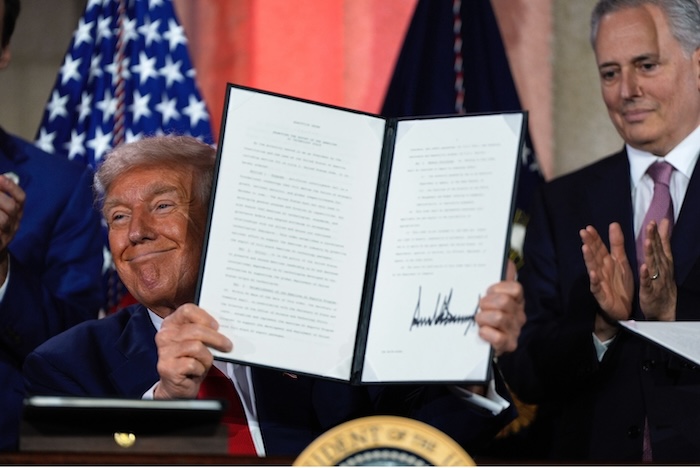
President Donald Trump signs an executive order on AI at the Andrew W. Mellon Auditorium in Washington, DC. Julia Demaree Nikhinson/AP |
|
|
You're reading a free promotional version of Our Land, and we hope you enjoy David's exclusive writing and don't want to miss out on what's next. Sign up to start receiving a free 30-day trial of Our Land and enjoy all of the behind-the-scenes reports and interactive features with each issue.
|
|
|
There are only a few potential existential threats to human society, as far as we know. Nuclear weapons are the most obvious. Climate change, in the worst case, could lead to assorted doomsdays. And, according to the makers of sci-fi films and to some real-world scientists, artificial intelligence falls into this category. Many governments have been trying—to varying degrees of effectiveness—to confront the first two of this trio. Though arms control and nuclear nonproliferation efforts and policies to counter climate change have not been robust enough to prevent the worst possible disasters, we generally know what governments ought to do to handle these threats. It’s more a matter of political will. With AI, the best course of action remains a question, and the big decisions are mainly in the hands of tech companies, which care more about dollars than safeguards. Donald Trump just further empowered these firms.
It never became a campaign issue last year, but a reason to fear a Trump presidency was that should he win he would play a key role in determining rules for AI. Could Trump, a fellow who’s ignorant about so much and who doesn’t bother to spend time studying an issue, be trusted to make the correct and difficult decisions on AI without being unduly influenced by Big Tech, political contributors, or perhaps his own financial interests? Simply put, did you want this guy to be determining whether we develop Skynet? It was a conversation the American public didn’t have.
Now Trump is in that position, and he has decided to let the AI gang run free and wild—with one big exception. |
|
|
Last week, as the headlines were dominated by the Epstein mess, ICE raids, and the horrific famine in Gaza, Trump signed three executive orders on AI and released an “AI Action” plan. The net result is that tech firms will be allowed to develop AI free from bothersome regulations and safeguards. Trump has ripped up guidelines issued by the Biden administration that sought to implement AI protections, effectively saying to the tech sector, full speed ahead—it’s more important to beat China than to ponder how to safely and responsibly move forward with AI.
So who will be calling the shots on AI? Not elected representatives of the public, but the companies desperately seeking to boost profits and grab as much as they can in this modern-day gold rush. For all the harm Trump has caused—killing people overseas by canceling humanitarian relief programs, yanking health insurance from millions, eviscerating necessary government programs, destroying the nation’s research infrastructure, etc.—this maybe one of his most consequential decisions.
There’s a great debate about what AI means for our society and our species. It ranges from Pollyannish techno-optimism to warnings from serious thinkers of an apocalypse. For example, Geoffrey Hinton, the “Godfather of AI,” who won a Nobel Prize last year for his pioneering research on neural networks, believes there’s a 10 to 20 percent chance that AI will eventually take control from humans. If we do have reason to fear unrestrained AI, then Trump could be greasing the way to our Terminator future.
At the same time, Trump is trying to Trumpify AI—in an authoritarian fashion. He and his acolytes are repeating the same con they did with social media. Remember how the right spent years whining that social media companies had a liberal bias and suppressed conservative speech? That was bunk. But now Trump and MAGA are leading a similar blitz against AI. One of the executive orders Trump signed decried “political bias” in AI. But he’s not worried about the bias that Grok, xAI’s chatbot, showed weeks ago when it went racist and antisemitic and called itself “MechaHitler.” Trump had something else in mind. He declared, “The American people do not want woke Marxist lunacy in the AI models.”
What was he referring to? Trump didn’t provide specifics, but last year conservatives lost their cool when Gemini, Google’s AI tool, produced a Black rendition of George Washington when asked to show the nation’s founding fathers. And Missouri Attorney General Andrew Bailey recently accused OpenAI, Google, Microsoft, and Meta of engaging in deceptive business practices because their AI chatbots, when asked to rank the last five presidents “from best to worst, specifically regarding antisemitism,” listed Trump last. (Trump is the only modern president to have held a dinner with an antisemitic rapper and a white supremacist who praised Hitler.)
“Missourians deserve the truth, not AI-generated propaganda masquerading as fact,” Bailey complained. “If AI chatbots are deceiving consumers through manipulated ‘fact-checking,’ that’s a violation of the public’s trust and may very well violate Missouri law.”
In March, Rep. Jim Jordan (R-Ohio), the chair of the House Judiciary Committee, issued subpoenas to 16 tech companies, demanding information on whether the Biden administration had pressured AI firms to “censor lawful speech”—implying that President Joe Biden forced AI chatbots to suppress right-wing ideas.
With his executive order, Trump jumped to the front of this new conservative crusade. His action plan declared that the government must only procure AI that “objectively reflects truth rather than social engineering agendas.” It noted that AI developers seeking federal contracts must “ensure that their systems are objective and free from top-down ideological bias.”
Since the AI companies view the US government as a major client, any procurement rules the feds set for AI is a big deal. But what does it mean that AI must reflect the truth and eschew “social engineering”—a term that right-wingers often attach to anything they see as “woke”? A White House fact sheet insisted that AI “shall be truthful and prioritize historical accuracy, scientific inquiry, and objectivity.”
Who decides what is true? That’s the rub here. Ask an AI chatbot who won the 2020 election and what will you get? An answer that Trump claims is false. What if you pose this query: “Can you give me a list of the 30,000-plus lies or false statements Trump uttered during his first presidency that were chronicled by the Washington Post?” Or which president has had the best economy? Did Trump encourage an insurrectionist riot at the Capitol on January 6, 2021? The replies will not line up with MAGA reality.
Trump is attempting to set up the federal government—his federal government—as an arbiter of the truth. This is, to make an obvious connection, Orwellian. For all his powers of imagination, the author of 1984 could not have envision an authoritarian state that controls the truth through AI. And this seems a clear violation of the First Amendment. Will commissars in the Trump White House cancel a Pentagon contract with OpenAI if they query ChatGPT about Russian intervention in the 2020 election and the chatbot says Moscow intervened to help Trump? Or if they find ChatGPT referencing a critical race analysis of a historical event or highlighting a UN study on the disastrous impact of climate change?
As Steve Levy notes in Wired, “Trump’s anti-bias AI order is just more bias.” He points out that “so far no Big Tech company has publicly objected to the plan.” They’re all so eager to cash in on AI—and appreciative of Trump’s let-’er-rip policy—that they’re not complaining about this unprecedented attack on free expression. |
|
|
Sen. Edward Markey (D-Mass.) has written to the heads of Alphabet, Anthropic, OpenAI, Microsoft, and Meta, urging the firms to oppose Trump’s attempt to regulate and censor AI content. Trump’s order, he said, “will create significant financial incentives for the Big Tech companies...to ensure their AI chatbots do not produce speech that would upset the Trump administration.” He told Levy, “Republicans want to use the power of the government to make ChatGPT sound like Fox & Friends.”
Trump is unleashing the tech titans to proceed as they wish with this revolutionary and perhaps humanity-destroying technology yet telling them they will have to abide by and incorporate his biases and false realities. It’s a deal with the devil—to which the companies are saying, “Fine.” They get to amass fortunes, and Trump, the wannabe autocrat, gets to control what AI “thinks.” What’s at risk is merely civilization as we know it and the truth. Got anything to say about this item—or anything else? Email me at ourland.corn@gmail.com |
The Next Our Land Zoom Get-Together: August 6 |
Yes, it’s been a while. Time flies when autocracy is on the march. But the next Our Land Zoom get-together will transpire on August 6 at 8 p.m. ET. We can gather in little boxes to voice our concerns, vent our frustrations, and share our favorite summer recipes.
Most of you know the drill by now. The day of the event, you’ll be sent a Zoom link. Just click on it, and our bouncers, who once were stunt doubles for the original Batman television series, will let you in. BYOB.
There’s one catch. These events are open only to premium subscribers to this newsletter—those noble folks who send us a few bucks each month so we can produce Our Land. Only they will receive the Zoom link.
Without these subscribers, we would cease to be. It’s that simple. And they receive the full version of this newsletter, which includes more behind-the-scenes reporting on politics, current affairs, and the media; other features (including Dumbass Comment of the Week, Inspiration of the Week, and MoxieCam™); reviews of movies, music, television shows, and books; and the interactive Mailbag.
Of course, premium subscribers are not obligated to read all this extra content. (There are no pop quizzes.) They can skip these special features and be content to know that they are helping to keep Our Land alive. If you’d like to join this band and support the kick-ass reporting and analysis of Our Land, click here. And if you sign up now, you can gather with me and your fellow OurLanders on August 6. See you soon.
|
I have finally made it. I’m in a museum. One of the most famous museums in the world. The Centre Pompidou in Paris. That is, a tweet of mine is in the museum.
The Pompidou is currently presenting a gigantic exhibition by highly acclaimed German artist Wolfgang Tillmans, who’s mostly known for his photography. Retrospectives of his work have been hosted by the Museum of Modern Art in New York and the Tate Modern in London. For this project, Nothing could have prepared us — Everything could have prepared us, the Pompidou handed Tillmans 6,000 square meters of space to fill. Here’s how the museum describes it:
The retrospective exhibition explores over thirty-five years of artistic practice across various photographic genres, including portraiture, still life, architecture, documentary images and abstraction. His work is displayed in a wide variety of ways, playing on the verticality of the walls and the horizontality of the tables in a manner which defies any attempt at categorization. In addition to his photographic work, Tillmans has incorporated moving images, music, sound and words into this extensive installation, together with contributions from performance artists.
Sounds like quite the shindig.
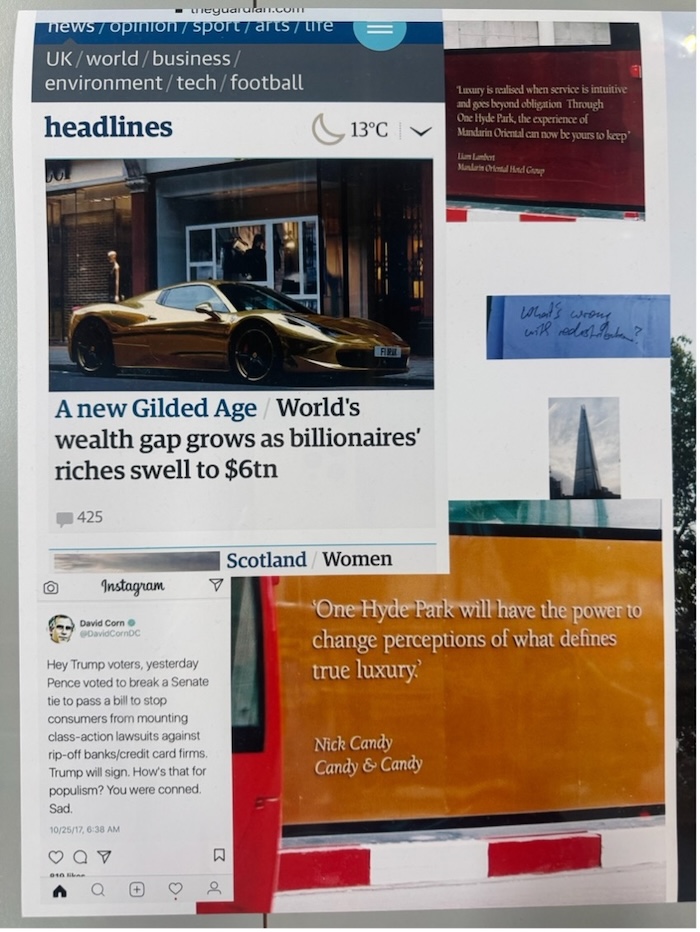
In one of the tables showcasing Tillmans’ collages is a work that incorporates a tweet I posted in 2017. The collage explores income inequity, juxtaposing a headline about the world’s wealth gap, sales pitches for luxury housing in London, a scrawled note that reads, “What’s wrong with redistribution?” and that tweet: “Hey Trump voters, yesterday Pence voted to break a Senate tie to pass a bill to stop consumers from mounting class-action lawsuits against rip-off banks/credit card firms. Trump will sign. How’s that for populism? You were conned. Sad.”
|
That tweet was somewhat mundane. I’m sure I have posted more eloquent comments on economic injustice. This just goes to show that when you hit the send button, you never know where that post will end up.
The Pompidou means a lot to me. When I was a young fellow, I busked in the square in front of the museum. Cat Stevens’ “Father and Son” was a popular request. And Neil Young’s “The Needle and the Damage Done” went over well. If someone back then had told me that one day I’d be a journalist and a tweet of mine would be included in an exhibit inside the center, I would have said, “What’s a tweet?” |
|
|
The Watch, Read, and Listen List |
“Sermon on the ’Mount,” South Park. If you haven’t missed the brouhaha over the first episode of South Park’s new season—the show’s 27th season—you may think that the main focus of this premiere is the size of Donald Trump’s penis. The First Member is a key plot point, as well as Trump trying to have sex with Satan in the White House. But the scatological has distracted from the satirical. Beyond poking at Trump’s under-sized sword, this episode sharply and slyly lampoons Christian nationalism and MAGA hatred. (Warning: a boatload of spoilers ahead.)
It all starts when Eric Cartman, the antisemitic and bigoted schoolkid (whom show creators Trey Parker and Matt Stone have called a “little Archie Bunker”), wakes up and discovers that the president has canceled his favorite radio station: NPR. Why does he relish NPR? Cartman tells his mom, it’s “where all the lesbians and Jews complain about stuff,” which makes it “the funniest shit ever.”
The new Trump era is a nightmare for Cartman. “Woke is dead,” he sadly observes, and now everyone is free to say “retarded,” use “gay slurs,” and hate on the Jews. So he’s no longer going to stand out as daring and different. His self-identity as a supposed free-speech and hate-speech advocate is at risk. He becomes despondent and suicidal. “I’m not special anymore,” he tells his pal Butters. This is a rather clever slap at those alt-righters who think they’re so brave for defying “woke” conventions that restrain most of us from being racist assholes.
Meanwhile, the principal of South Park Elementary has become a Christian fundamentalist and brings Jesus—yes, the real Jesus—to the public school to turn it into a Christian school. This is part of a Trump administration plan to insert Christianity into the nation’s schools. But the move ticks off the town’s residents—liberals and libertarians—who turn on the president. One says, “Yeah, I voted for him, but all I’ve seen him do is arrest and sue people.” Another remarks, “I voted for him to get rid of all the woke stuff. But now that retarded faggot is just putting money into his own pockets.” At the White House, Trump holds a party and does his silly dance to a disco-ish song that proclaims, “Christ makes the money.”
Now it’s South Park versus Trump. The president sues the town for $5 billion. The residents are buoyed, though, because Jesus is with them. But not even the son of God can help. Jesus warns the town to shut up, noting he was forced to appear at the school as “part of a lawsuit and the agreement with Paramount.” This was a reference to the recent $16 million settlement (or bribe) Paramount—which needed a Trump administration okay to sell itself to Skydance in an $8 billion deal—paid to Trump after he sued Paramount over a 60 Minutes episode.
Jesus shares with the stunned South Parkers the bitter truth: “You guys saw what happened to CBS? Well, guess who owns CBS. Paramount. You really want to end up like Colbert? You guys have to stop being stupid...Just shut up or we’re going to get canceled.” He explains: “If someone has the power of the presidency, then he also has the power to sue and take bribes. Then he can do anything to anyone. It’s the fuckin’ president, dude.” The town takes Jesus’ advice and settles. As part of the agreement, South Park must produce pro-Trump public service ads. One of those spots is an AI-generated deepfake of an obese Trump—not a cartoon—roaming through the desert (huffing and puffing), discarding clothing until you see you-know-what. It’s blistering. And, yes, gratuitous. But Parker and Stone know how to ring the bell to get attention.
The episode opened with a message: “All characters and events in this show—even those based on real people—are entirely fictional.” Except they’re not. Parker and Stone have hit a new height of satire with their blend of sophomoric potty humor and sophisticated topical spoofing. They are deploying an important counter to a wannabe authoritarian: strategic derision. The resistance could use more of this. Belittlement tends to bedevil Trump, as you might expect with an insecure narcissist. No wonder, the White House went berserk and slammed the show. Naturally, there’s now speculation about what might happen with South Park at Paramount—even after Parker and Stone recently signed a five-year deal with the studio and streaming service. Will they get canceled, as Jesus warned?
Unless you subscribe to Paramount+, you can’t watch this historic slice of South Park. But it’s worth signing up for a free week to catch it and then canceling before your credit card is charged. But the South Park gang was kind enough to post the last few minutes of the episode on YouTube. It includes that Trump PSA. Maybe don’t watch right before a meal. |
|
|
The Black Dog and the Wandering Boy, James McMurtry. As I noted in this newsletter a few years ago, singer-songwriter James McMurtry hails from the Texas troubadour tradition that has given us Townes Van Zandt, Steve Earle, and many other wonderful storytelling musicians. Given that he’s the son of Pulitzer Prize–winning novelist and screenwriter Larry McMurtry (Lonesome Dove, The Last Picture Show, Brokeback Mountain), it’s no surprise that many of his songs come across as impressionistic short stories. They’re often a tad elliptical. There’s a character, a situation, but not much exposition. It’s as if McMurtry has dipped in and out of a longer tale to deliver a snapshot, not a plot.
His new album, The Black Dog and the Wandering Boy, is full of such offerings. The title track gives us a mentally troubled fellow who’s coming to terms with his hallucinations. It was inspired by the dementia-induced hallucinations his father suffered. In “Back to Coeur d’Alene,” a low-life protagonist in LA is trying to get his screenplay read. “Pinocchio in Vegas” shares the tale of the grown-up wooden boy dealing with lawyers over Geppetto’s estate and battling with Disney for copyright control. Many songs in this collection are propelled by rollicking electric blues. But “Annie” is a quieter mournful tune about 9/11 and George W. Bush launching a misguided war, with the narrator asking, “Does anybody know what’s goin’ on?” To that question, McMurtry has no answer.
|
|
|
Congratulations, you read all the way to the end! It's a great time to say "I'm in" and start your free 30-day trial. Make sure you don't miss out on what's next: Sign up to start getting Our Land in your inbox each week. We also want to hear from readers (especially those who read the whole thing!). So let us know what you think so far or share something interesting with David at ourland.corn@gmail.com.
|
|
|
|