FREE TRIAL VERSION. DON'T MISS OUT. |
FREE TRIAL VERSION. DON'T MISS OUT. |
|
|
|
Will Elon Musk Be the October Surprise? |
By David Corn October 20, 2026 |
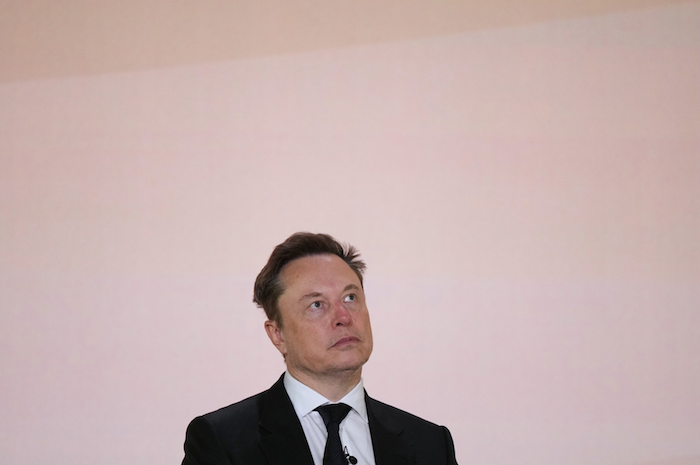
Elon Musk at an event to mark the launch of America.gov on September 29 in Washington. Mark Schiefelbein/AP |
|
|
|
You're reading a free promotional version of Our Land, and we hope you enjoy David's exclusive writing and don't want to miss out on what's next. Sign up to start receiving a free 30-day trial of Our Land and enjoy all of the behind-the-scenes reports and interactive features with each issue.
|
|
|
|
As I’ve noted in previous issues, I’m now co-hosting a pop-up video podcast on the midterms called Stress Test with award-winning video producer Garrison Hayes. (You can catch the latest episode here.) The name refers to the challenge American democracy is currently facing. With an authoritarian demagogue in the White House, can the United States conduct free and fair elections that produce results that will be widely respected? Can the US political system reject the Donald Trump virus that undermines the rule of law and threatens the constitutional republic? Will it survive the stress placed upon it by a president who tried to overturn a previous election and who has already begun to subvert this one with false accusations of fraud?
In each episode, Garrison and I ask our guests what’s stressing them out about the midterms. My answer, as of today, is the possibility of a last-minute intervention of big money and disinformation, yielding an October surprise that influences one or more of the House and Senate races determining which party ends up controlling Congress. And standing at the intersection of obscenely huge campaign donations and potentially harmful false narratives is a jerk named Elon Musk.
Last week, there was much coverage of the news that Musk has injected $366 million into the midterm elections to aid Trump and the Republicans. (It appears likely his total tab will exceed half a billion dollars.) Much of this money has gone to bolster GOP Senate candidates, particularly the corruption-scarred Ken Paxton in Texas. As pundits and political chatterers pondered the impact of Musk’s millions, my colleague Anna Merlan wisely observed that Musk posed another threat and tagged him the “biggest election disinformation risk.”
|
|
|
|
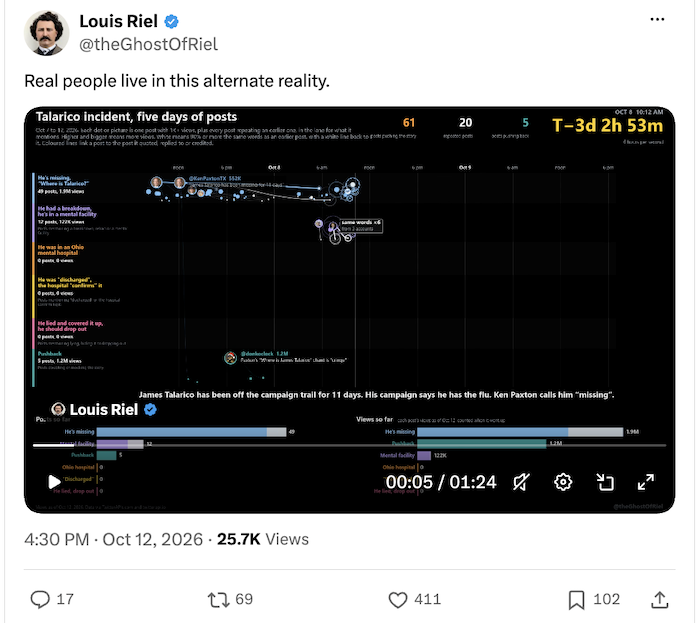
She characterized Musk this way after he played a crucial role in spreading the false claim—cooked up by MAGA influencers—that James Talarico, the Democratic Senate candidate in Texas, had been absent from the campaign trail because he had checked himself into a mental health hospital in Ohio. The story was 100 percent bullshit. Talarico, according to his campaign, had contracted a nasty bout of the flu, and, after nine or so days out of sight, he was back in public view at the time these MAGA doofuses were asserting he had been in the Ohio facility (which eventually denied Talarico had ever been treated there). Yet the phony tale caught fire and zipped across the internet, largely due to its amplification on the Musk-owned X.
Here’s a fascinating visual depiction of how this crap flew across X: |
Musk, as Merlan points out, was a key amplifier of this fraud. He tweeted to his 241.5 million followers—an audience about 100 times the size of Fox News—that the “Talarico campaign is hiding something big that voters ought to know about.” In another post, he maintained, “The Talarico campaign is not being honest about what’s happening.” When the story fell apart, he did not acknowledge he had been wrong. Nor did the MAGA influencers and other right-wingers who had peddled this phony story.
This idiotic assault on Talarico is not likely to lessen his chances of becoming the first Democrat to win a statewide race in Texas in 32 years. But it illustrates a standard play: Start an unfounded and scurrilous rumor about a candidate and use Musk’s platform—perhaps Musk himself—to spread it quickly. If done closer to Election Day, there might not be sufficient time for a candidate to beat back the false accusation. And super-PACs with plenty of cash—from Musk or others (including other Big Tech plutocrats in the AI and crypto fields who are pouring gobs of money into this election)—can do the same: Drop negative ads boosting false allegations in the final week of the campaign. It’s even possible these days for billionaires to use corporate cutouts to finance attack ads anonymously.
With so much at stake—Musk himself has billions of dollars in government contracts he wants to protect or land—it would be surprising if the final days of this campaign were free of disinformation skullduggery and campaign-cash chicanery. (The Russians, too, have started meddling in this election to help the GOP. See the next item.)
The South Africa–born Musk holds an unprecedented position in American politics. With his donations this year, he has made the largest known personal financial contribution to an election, and he controls a social media platform through which political news and disinformation flow, reaching millions of voters—and he himself generates some of that disinformation.
Naturally, Musk warrants continuous scrutiny—especially since he’s a dishonest fellow who’s been promoting the most ludicrous allegations and conspiracy theories for years. During the 2024 campaign, he repeatedly posted the false claim that large numbers of noncitizens were voting, even going so far as to declare that Democrats were flying asylum seekers into swing states and fast-tracking them for citizenship so they could vote. His false or misleading allegations about that election racked up 1.2 billion views on X. He received 134 million views when he reposted an AI-manipulated deepfake video of Kamala Harris supposedly making offensive remarks.
Musk’s conspiracism has extended far beyond election disinformation. He claimed that DEI was the cause of errors in the Los Angeles Fire Department’s response to wildfires and that “white genocide” was underway in South Africa. (Neither allegation was true.) He amplified the fake story that Haitian immigrants in Springfield, Ohio, were eating pets. He’s resorted to antisemitic tropes to attack George Soros. He falsely charged that millions of dead people were collecting Social Security. (This genius misread the data.) He boosted Russian disinformation that claimed USAID was paying Hollywood celebrities millions of dollars to visit Ukraine, and he put up posts saying USAID funded bioweapons research that included Covid-19. He seconded a meme that proclaimed Pizzagate was “real.” Earlier this year, he amplified a post that said that during the 2020 election, “Pennsylvania sent out 1,823,148 mail-in ballots but received back around 2.5 MILLION mail-in ballots.” This charge—long a mainstay of Trump’s election deniers—has been repeatedly debunked.
That’s a mere sampling. Musk is a nutter. He recently endorsed a social media post that said only men with high testosterone and people with autism should be allowed to engage in governmental “decision making”—sorry, all you gals—and he has shared assorted racist sentiments. |
|
|
|
Yet when you’re a trillionaire, your racism, misogyny, antisemitism, ignorance, and conspiracism don’t matter. Republicans have tried to make a scandal of far-left influencer Hasan Piker’s campaigning with Abdul El-Sayed, the Michigan Democratic Senate candidate, during the primary contest. Yet Musk’s direct aid to a wide range of GOP candidates has not sparked as much of a hullabaloo. Only certain associations seem to be worthy of outrage.
Musk’s influence in the midterms is unparalleled. There’s a lot that could happen in the waning days of this election. Trump, no doubt, is contemplating actions that could cause chaos or spark a crisis. MAGA activists have been urging him to declare martial law—though that would not technically permit him to seize ballots or block elections. Such extreme options aside, an October surprise is more likely to involve disinformation and money. So in the coming weeks, keep your eye on Musk. And in the long run, Americans are going to have to figure out how to keep a schmuck like this from having so much sway in US politics.
Got anything to say about this item—or anything else? Email me at ourland.corn@gmail.com. |
Speaking of Disinformation… |
Not long ago, I reported that a Russian disinformation network that targeted the Democratic ticket in the 2024 election—which I cover in my new book, How Russia Won: Donald Trump, Vladimir Putin, and the Fight for America—had initiated an operation to influence the midterm elections and had posted on X fake videos featuring me that smeared Democratic candidates. These videos were falsely attributed to CNN and Mother Jones. Our lawyer at Mother Jones got X to take them down. Then another group of fake videos went up—again incorporating me and spreading outrageous accusations about Democrats. One was a purported CNN video falsely reporting that I had embezzled money. We got those taken down, too.
It was beginning to feel like Whac-A-Mole.
A few days ago, this group posted another phony Mother Jones video in which I supposedly report that Ukrainian President Volodymyr Zelenskyy “has become a completely unmanageable and dangerous asset” and that the Democrats “will eliminate him.” I am further quoted: “For the Democrats, Volodymyr Zelenskyy is living proof of their failure in Europe. He is a drug-addicted sociopath who knows too much, and his fate is sealed.” I obviously never said anything like that. Before we could contact X, the account that posted this video was suspended. We don’t know whether these videos have been published elsewhere or have been zapped out by other bot accounts on X. It’s hard to track this stuff. Which is the point. But more may be coming as Election Day approaches.
One interesting twist: For this fake video of me dissing Zelenskyy, the Russian disinfo operatives used snippets of a video we made at Mother Jones about an article I wrote with Dan Friedman revealing that FBI Director Kash Patel received a $25,000 payment from a Kremlin-linked propagandist to participate in a documentary that falsely contended that Moscow did not meddle in the 2016 election. Yes, Patel helped amplify Russian disinformation, and our video report on that is now being used in…Russian disinformation.
Here’s the real McCoy: |
|
|
|
The Watch, Read, and Listen List |
Widow’s Bay. I wasn’t going to dive into this, but so many people of late have told me they are gaga for Apple TV’s Widow’s Bay, and I don’t understand why. It’s a highly derivative though well-executed mashup of Jaws and Stephen King, an enjoyable watch for a scary show. But I don’t see the genius. And winning an Emmy for Outstanding Comedy Series? First off, it’s not a comedy, and it’s not superior to The Bear—also not a comedy—which it beat out. Hacks and Shrinking, two other nominees in that category, were each more deserving of the top comedy series honor.
Matthew Rhys is indeed excellent in the lead role of Tom Loftis, the mayor of Widow’s Bay, a sleepy island town off the New England coast. Loftis has big plans for the picturesque burg. He wants to make it the next Martha’s Vineyard, and all he must do, he figures, is get a New York Times reporter to write up Widow’s Bay as a hidden getaway gem. He pulls that off. But what’s the No. 1 rule in a horror story? Be careful what you wish for. In Jaws, the rapacious mayor of that beach town did not want the police chief to close the beaches when the first signs of a great white shark appeared at the start of the ever-so-profitable Fourth of July weekend. He could at least feign ignorance, for it was not immediately clear that an apex predator was summering in their waters. Perhaps the visiting tourists were not actually at risk of becoming chum.
Loftis, a well-meaning fellow, caring neighbor, and doing-the-best-he-can single dad, is a different case. He pooh-poohs the local lore that Widow’s Bay is cursed—a place “where bad things happen”—but he must know there’s something off about the island on which murderous manifestations of evil emerge from time to time. Still, he overlooks the danger so he can transform quaint Widow’s Bay into a hotspot for Sunday Times readers and bring in much-needed revenue for the town and its folk. Of course, that doesn’t turn out as he plans.
The show is a mix of supernatural and gothic horror. People die. A suicide occurs. Dark secrets are revealed. A mysterious fog encircles the island. A church bell rings on its own. Something—someone?—may be prowling subterranean tunnels below the town. A Jason-like murderer is on the loose. And, as could be expected, a bunch of teenagers—including Loftis’ son—are imperiled. The season one finale suggests more villagers must lose their lives.
I don’t recall laughing much—or ever. Even calling this a black comedy would be a stretch. But the main problem with Widow’s Bay is that the danger at hand is so obvious that it’s tough to feel sympathy for Loftis, who should have seen all this trouble coming. You can’t ignore or wish away an evil force, even if you’re nobly striving to bolster the economic fortunes of your community. Most important, endeavoring to do so will jeopardize your family. Hasn’t he ever read a King novel?
|
|
|
|
“I Remember Everything,” John Prine. A few weeks ago, I noted how I had stumbled across a lovely duet of John Prine and Kurt Vile performing an old Prine tune, “How Lucky.” After reading that issue of this newsletter, a buddy sent me a video of the last song that Prine recorded, the aptly titled “I Remember Everything.” It was posted two months after Prine died due to complications from Covid. On YouTube, it has 5 million views. It’s a great way to remember him.
|
|
|
|
Congratulations, you read all the way to the end! It's a great time to say "I'm in" and start your free 30-day trial. Make sure you don't miss out on what's next: Sign up to start getting Our Land in your inbox each week. We also want to hear from readers (especially those who read the whole thing!). So let us know what you think so far or share something interesting with David at ourland.corn@gmail.com.
|
|
|
|
|