FREE TRIAL VERSION. DON'T MISS OUT. |
FREE TRIAL VERSION. DON'T MISS OUT. |
|
|
|
Ignoring the Russian Threat |
By David Corn October 10, 2026 |
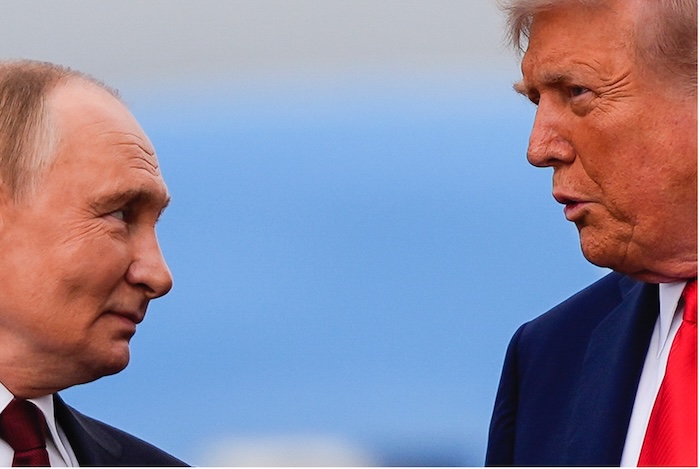
President Donald Trump and Russian President Vladimir Putin meet at Joint Base Elmendorf-Richardson, Alaska, in August 2025. Julia Demaree Nikhinson/AP |
|
|
|
You're reading a free promotional version of Our Land, and we hope you enjoy David's exclusive writing and don't want to miss out on what's next. Sign up to start receiving a free 30-day trial of Our Land and enjoy all of the behind-the-scenes reports and interactive features with each issue.
|
|
|
|
Not too long ago, I was speaking with a reporter for a prominent news outlet, who told me that it was hard to get a story on Russian disinformation operations past their editors. “They think it’s old news,” this journalist said.
That was an indicator of a big problem. We know that President Donald Trump and his MAGA minions have strived for years to smother all talk of Russian assaults on the United States with false cries of “hoax” and “witch hunt.” (There’s a new book by someone you know that covers this.) And Democrats largely stopped talking about Vladimir Putin’s unrelenting information warfare against American elections (which has benefited Trump) after special counsel Robert Mueller did not establish a case that Trump criminally conspired with Moscow’s operatives in their attack on the 2016 election. (For a full account of how the Democrats lost the messaging war on the Trump–Russia scandal, see this recent piece from me.) Moreover, the major media, while reporting intermittently on individual Russian operations when they are revealed, have failed to fully and steadily tell the story of Putin’s ongoing shadow war against the West and the United States.
The bottom line: In the United States, Putin’s not-so-secret covert operation to subvert Western democracies is no big deal. |
|
|
|
That’s not true in Europe. For years, government officials and national security experts there have been warning that Russia is pursuing a twilight war against the West that has come to include acts of sabotage and drone assaults. And in recent weeks, these warnings have been loud and clear.
When Andy Burnham, the new British prime minister, addressed the United Nations last month, he did not mince words:
Russian agencies have used every means at their disposal to spread lies and disinformation and prey on people’s fears. They’ve used bots and fake websites. Falsified newspaper articles. Forged the branding of 28 British organizations, including universities and the BBC. They’ve amplified far-right narratives. And we have evidence that they tried to interfere with the 2019 general election. We also know that they have tried to stoke tensions and unrest in the wake of horrific events. The idea that anyone would try to use such things to their advantage is just repulsive—but it is what they do.
Burnham continued:
The Kremlin spends around £1.3 billion each year on manipulating information. We’re talking about an insidious campaign that reaches into people’s homes and twists what they feel about their own country and community—creating a narrative of decline, stoking division, and sowing despair. On top of that, we have seen cyberattacks on our companies and institutions. And we know that AI will multiply the threat. We have tiptoed around this for too long. Over the last decade, we have given too much ground to those who want to run a negative, corrosive narrative about life in Britain, which bears no resemblance to reality. Well, no more.
The PM noted his government intended to act on this front:
Today, I am tasking our security chiefs to begin work on a new National Centre for Information Defence—to detect, attribute, and disrupt these kinds of hostile state information attacks. To support and defend our democracy. And I know this is a shared challenge. So we are going to use our experience in the UK—and the fact that we have already been through this shock—to help other countries. We have already supported Moldova to protect its elections from Russian interference. As more elections approach across Europe, more nations are grappling with these issues—some for the first time. So we’re ready to share our understanding of how these actors work and how we can respond—because this is vital for our collective security and resilience.
This was not the first warning from the UK. Last year, when Blaise Metreweli, the first woman to lead the British Secret Intelligence Service, or MI6, delivered her first public speech as the spy chief, she chose to spotlight one critical danger: “Alongside the grinding war [in Ukraine], Russia is testing us in the gray zone with tactics that are just below the threshold of war…I am talking about cyberattacks on critical infrastructure; drones buzzing airports and bases; aggressive activity in our seas, above and below the waves; state-sponsored arson and sabotage; propaganda and influence operations that crack open and exploit fractures within societies…The export of chaos is a feature, not a bug, in this Russian approach to international engagement.”
Two days after Burnham’s address to the UN, the Danish Defense Intelligence Service issued an “assessment of the threat from Russia.” It outlined the danger:
Russia has intensified its use of sabotage, destructive cyberattacks, and is attacking targets in Europe with drones. The hybrid war is escalating. A case in point is the foiled drone attack on the Leipzig/Halle Airport, which, according to German authorities, had been planned by Russia over a period of several months. Russia has become more willing to take risks. Russian drones and, in some cases, even missiles have impacted NATO countries bordering Ukraine. In Denmark, the Danish Security and Intelligence Service (PET) has publicly warned that Russia is planning and preparing sabotage on Danish soil against defence companies. Russian forces are increasingly acting aggressively toward NATO military units in the Baltic Sea region.
Putin, the Danes said, was becoming more desperate:
Russia is under more pressure than it has been at any other point during the war against Ukraine. Ukraine’s sustained long‑range attacks are causing still more extensive damage deep inside Russia. Russia is suffering heavy losses for marginal territorial gains in Ukraine. At the same time, the Russian economy is on the brink of a major crisis, driven by military expenditures, international sanctions, and Ukrainian strikes on Russian energy infrastructure. Danish intelligence analysts concluded that beyond trying to weaken Europe to undercut its support of Ukraine, Russia also is aiming to head off European efforts to develop “an autonomous military capability”—which would be much needed if Trump tries to pull the US out of NATO (an idea he has floated in the past). And they believe that Moscow will be boosting its operations against the West and intensifying its cyber- and sabotage attacks:
Until recently, Russia’s hybrid attacks against targets in the West have mainly been aimed at creating fear and weakening public support for aid to Ukraine. Russia has increasingly begun to directly seek to prevent support from reaching Ukraine, for instance, by conducting sabotage against defence companies or against railway transport carrying military equipment to Ukraine. The Danish Defence Intelligence Service (DDIS) assesses that Russia will intensify its hybrid war by carrying out more frequent attacks against the West and NATO, with greater consequences for the targeted countries than in the past. This could include destructive cyberattacks that cripple critical societal functions as well as sabotage attacks that carry a high risk of casualties.
The Danes concluded it is “highly unlikely that Russia will launch an invasion” of a NATO country. But they reaffirmed a 2025 assessment that within two years, Russia will “pose a credible threat to one or several NATO countries and thus be ready for a regional war against several countries in the Baltic Sea region,” and that within five years, “Russia will be ready for a large-scale war on the European continent.” But for now, Russia can be expected “to escalate against the West in the coming months, either by carrying out more frequent and more severe hybrid attacks or by carrying out limited military attacks against one or several NATO countries bordering Russia.”
This is quite the contrast to Trump’s warm embrace of Putin. Not only has he championed Russia denialism for a decade, but he has guided the MAGA movement and much of the GOP toward Putin appeasement.
Last year, his administration released its National Security Strategy, a document periodically prepared by an administration to list its top concerns and its policies addressing them. Trump’s version, naturally, ridiculously praised Trump for “having cemented his legacy as the President of Peace” and described his foreign policy as “pragmatic without being ‘pragmatist,’ realistic without being ‘realist,’ principled without being ‘idealistic,’ muscular without being ‘hawkish,’ and restrained without being ‘dovish.’” Whatever that means.
Absent from the document was a restatement of Trump’s 2017 National Security Strategy assertion that “China and Russia want to shape a world antithetical to US values and interests.” Instead, in this new version, China was cast as mainly an economic competitor, and Russia was not mentioned at all as a threat. The document even chastised many Europeans for viewing Russia as an “existential threat.” That is, the only problem presented by Russia was that the Europeans were overly worried about Russia. There was not a single word about the dangers Putin and Russia posed. The strategy said nothing about Russia’s culpability for the death and destruction in Ukraine. It did not address the gray-zone war that Putin was prosecuting against the United States and the West.
In her speech, Metreweli remarked, “The greatest danger we face is to misunderstand the nature of the problem.” Trump and his team have refused to acknowledge the problem. |
|
|
|
This means that Putin has a wide-open field for his assault on America. As I note in How Russia Won: Donald Trump, Vladimir Putin, and the Fight for America, the Trump administration has shuttered the units of the FBI, the intelligence community, and State Department that tracked Russian disinformation (and disinformation aimed at the United States by other foreign adversaries). FBI agents who worked on previous investigations of Russia have been forced out. This week, the Trump administration successfully pressured several countries to withdraw from a major European conference on disinformation. (The State Department objected to a panel titled “USA as a FIMI threat: acknowledge, adapt, push back.” FIMI stands for “foreign information manipulation and interference.”) And Trump has invited Putin, who has been ostracized by Western leaders, to attend the G20 meeting being held at his Doral golf club and resort in Florida.
As I’ve reported recently, Russian disinformation operatives have begun to target the midterm elections, posting fake videos made to look like news reports from CNN and other media organizations (including Mother Jones) that spread scurrilous allegations about Democratic candidates. European targets of Putin’s clandestine operations are calling him out and attempting to fight back. But not Trump and his administration. Do we even have to wonder why?
Got anything to say about this item—or anything else? Email me at ourland.corn@gmail.com. |
James Carville, Al Hunt, and How Russia Won |
You can watch my conversation with Democratic strategist James Carville and political journalist Al Hunt about How Russia Won, in which I tell Carville that I don’t think there’s a “pee tape” and explain that while Moscow may possess other compromising material on Trump, Putin probably has not had to use it. |
Stress Test: The Big-Money Politics of the Midterms |
Mother Jones recently launched a new podcast called Stress Test that is covering the midterm madness and that I’m co-hosting with Garrison Hayes, an award-winning video producer. The first episode covered possible election interference that might come from Trump. The latest episode digs into the role of big money in these elections and what’s different about it this year. Check it out. And please subscribe at youtube.com/motherjones and leave a comment letting us know what you think and what we might be able to do better.
|
|
|
|
Dumbass Comment of the Week |
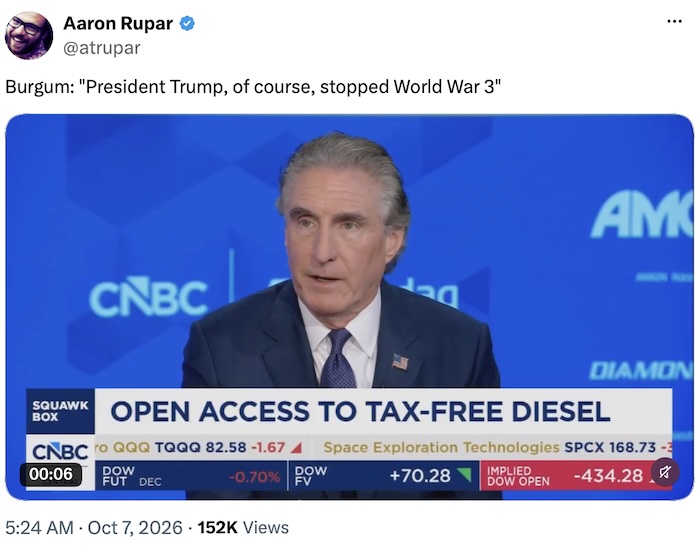
It’s fair to say there has never been a presidential Cabinet as absurdly sycophantic as the one Trump has assembled for his second White House stint. Interior Secretary Doug Burgum was out there this week, per usual, heaping ludicrous praise upon Dear Leader. He started off by claiming in a CNBC interview that the “underlying fundamentals [of the economy] are so strong,” which is what every administration says when it confronts economic troubles. (Sen. John McCain lost the 2008 presidential election to Sen. Barack Obama in part because he said exactly that as the economy crashed.) And then Burgum hailed Trump for “of course, stopping World War III by…” He didn’t finish the sentence. So viewers were left to wonder how Trump, who has launched a stupid war in Iran that has spread violence through the region, has prevented a third world war. Perhaps Burgum realized how idiotic that sounded and stopped himself from completing a dumb thought.
|
On the campaign trail for Republican candidates—and probably not doing them much good—Trump has been spouting a lot of idiotic remarks. At one point, he said he knows more about inflation “and everything” than “anybody anywhere in the world.” Such a statement is unlikely to persuade the 7 out of 10 voters who now disapprove of him; it probably only confirms for them the need to vote against Republicans who embrace this delusional wannabe autocrat.
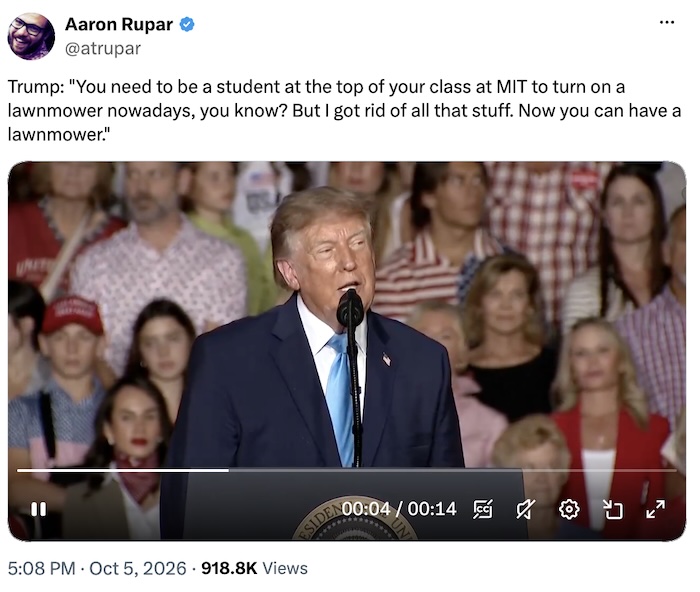
But the statement the judges want to nominate this week was nuttier. At a campaign rally, Trump bellowed: “You need to be a student at the top of your class at MIT to turn on a lawnmower nowadays, you know? But I got rid of all that stuff. Now you can have a lawnmower.” |
Yes, the affordability crisis continues, the pointless Iran war continues, the cruel mass deportation continues, and Trump’s reign of corruption continues, but at least our long national nightmare (of complicated lawnmowers) is over. By the way, when was the last time Trump had to “turn on” a lawnmower? They’re not that hard to start.
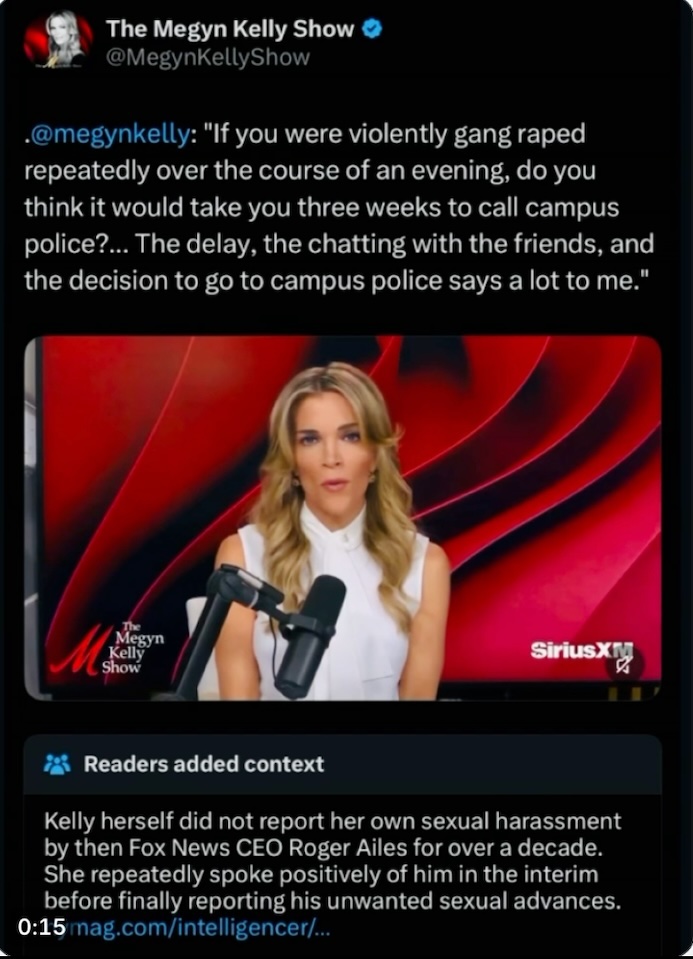
Right-wing commentator Megyn Kelly, always eager to be a culture-war provocateur, challenged the credibility of the unidentified woman who has accused seven former Cornell students of having sexually assaulted her, noting that this woman waited three weeks before filing a report with campus police. But it seems Kelly ought to have been more understanding of this delay. |
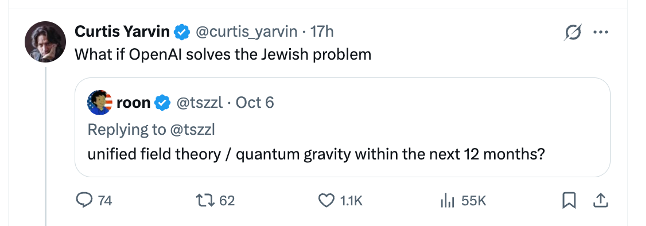
Curtis Yarvin, a self-proclaimed political theorist of the far right who denigrates democracy and celebrates monarchy, has been cited by JD Vance and Peter Thiel as a thinker who influences them. Which is worrisome. Just look at this recent profound thought Yarvin shared on X: |
Uh, what is the Jewish problem? By the way, under a pseudonym, Yarvin has suggested that Hitler’s invasions were acts of self-defense. And this guy is respected by Vance?
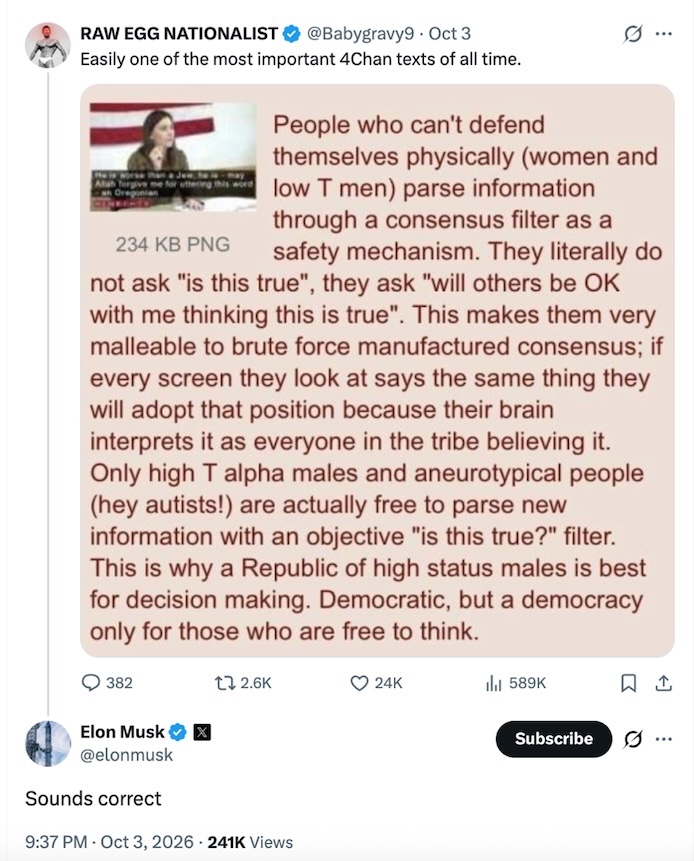
In a close battle for first place with the reactionary Yarvin, Elon Musk won the contest by using only two words. When an X user posted a comment from a 4Chan chat that argued that women and men with low testosterone cannot defend themselves and cannot be free thinkers and, thus, only “high T alpha males and aneurotypical people (hey autists!)” should be allowed to participate in a democracy, Musk replied, “Sounds correct.”
|
Musk was seconding the misogynistic view that a “Republic of high status males is best for decision making.” That’s certainly not a democracy. And, don’t forget, this fellow is injecting at least $100 million into the midterms to elect Republicans—meaning a host of GOP candidates are accepting help from a plutocrat who says it would be best if women (and low-T men) were not allowed to vote. The judges wonder why that isn’t yet an issue in the elections. |
|
|
|
Many readers have been writing in to share their reflections and reactions after reading How Russia Won. Many thanks to those who have. I truly relish hearing what people think of the book. David Buehrer emailed:
I just finished reading your new book, which is an incredible summary of the complicity of Trump and the Republican Party with Putin and Russia’s undermining of US democratic institutions. But to me, the most maddening part of the Russian plot is the failure of the Democratic Party to counter it and keep that Republican treason alive in the public consciousness. Yes, I know there have been individual voices, like those of Sens. Ron Wyden and Sheldon Whitehouse, who continue to speak out and expose these nefarious connections. And I realize, as Whitehouse mentions, that Democrats don’t have the same political clout now nor the kind of concentrated media infrastructure in place to mainline their messaging into the body politic as Republicans have done so effectively for the past decade. Still, when you write that, apropos Patel’s nomination process as FBI Director, for instance, Democrats “steered clear of his years-long disinformation campaign to erase the Trump-Russia scandal. The Democrats had long ago given up on that subject” (p. 326), I’m left angrily asking, “Why?!”
Likewise, in your chapter “Treason,” when you address CIA director John Ratcliffe and then-Director of National Intelligence Tulsi Gabbard’s attempt to cast Russian interference as actually benefitting Clinton as opposed to Trump in 2016, you write: “But because the Democrats had long ago dropped the whole Trump-Russia matter—Trump’s dogged promotion of his ‘Russia, Russia, Russia’ fiction had triumphed—there were few voices in the political arena to raise this point or to challenge the Trump administration’s latest fabrication of a bogus Russia narrative” (p. 357). I can’t help but feel enraged here about the Democrats’ surrender of “this information battlefield” to “Trump and his foot soldiers,” as you rightly put it. And perhaps it’s this lack of fight and failure of messaging by the national Democratic Party that’s driving many voters to abandon so-called centrists and drift toward DSA candidates.
Anyways, sorry for the long reply, but just wanted to add my two cents to reviews of your new book How Russia Won, which is a sobering if fascinating read. Thanks for keeping this important story alive.
David, thanks for such a thorough reading of the book and for sharing your sharp observations. And that was a point I wanted to make. The problem has not just been Trump and the GOP’s complicity with the Russian attack and their malfeasance, but also Democratic nonfeasance. You cannot win a battle you do not fight. See my recent piece on this in The New Republic.
Charlotte Dunham wrote:
I started listening to your book. My first reaction is how could American voters be so gullible to fall for this obvious con, not once but twice. One answer must be too many people were voting like they were picking someone for a date and not someone for a job. I wouldn’t hire a guy to mow my lawn with all the baggage Trump had. Not only did too many voters ignore the warning signs; they refused to believe them.
I am listening to your book in my car while I drive to get out the vote meetings. We are planning picnics and free rides to the polls on the first day of early voting in the Black and Brown areas of Lubbock. We are going to turn Texas blue. People who you would never expect are saying they are voting for Democrats. Looking forward to hearing more about Russia.
Thanks for reading (or listening to) my book, Charlotte. Don’t let it get you too angry while you’re driving. Readers had a strong reaction to the recent issue about those demagogic Trump television ads paid for by the US government. Scott Sage shared this: Since the Justice Department or the Federal Election Commission can’t/won’t do anything about this. Perhaps the media can bring this to the forefront and not have it show up only in newsletters. NBC or ABC news shows need to be blazing the outright crimes happening. The Supreme Court won’t do anything. Nobody will except us.
Many in the media are trying to shine a light on the wide array of Trump corruption. But there’s so much, and it is easy to lose track. Yet there was enough press attention to these ads that Trump flipped and declared future ads will be paid by him or his political operation, not the taxpayers. But he did not say he would repay the US Treasury for the ads already broadcast. Of course.
Ralph Gary Walker, observing that in the ads Trump proclaims, “This is the final battle,” asked this: Is this the message? Is this a call to action a la January 6? Is this a “stand back and stand by” announcement?
That is certainly the tone of these ads. Since Trump has already declared that the only way the Ds can win the midterms is by cheating, he has established a foundation for not accepting results if the GOP loses. I assume if he adopts that stance, he will call for some sort of action. Cynthia Evans had a message for Moxie:
Please tell Moxie we adore her. If she is ever in Alexandria, Virginia, she is welcome to stop by. Our Sam would be thrilled to meet her. He is a bit goofy and quite the barker, but overall a sweetie. Of course, he doesn’t have the vocabulary Moxie has, but his waggy tail says it all. I will convey that kind invitation to Moxie. She sends her best to Sam. Speaking of which… |
“Moxie, what are you doing?”
“Looking off into the distance.”
“So not much then?”
“That’s not what I said.” |
|
|
|
Congratulations, you read all the way to the end! It's a great time to say "I'm in" and start your free 30-day trial. Make sure you don't miss out on what's next: Sign up to start getting Our Land in your inbox each week. We also want to hear from readers (especially those who read the whole thing!). So let us know what you think so far or share something interesting with David at ourland.corn@gmail.com.
|
|
|
|
|