When I began the publicity push for How Russia Won: Donald Trump, Vladimir Putin, and the Fight for America, a friend who until recently worked for a major national news outlet offered me advice: Try to get on Fox News or Joe Rogan’s podcast. You’re not likely to change the mind of anyone in their audiences, she said, but you might gin up controversy that would draw attention to the book. And don’t you think, she added, they would welcome the chance to take the Trump-Russia story head-on?
 
FREE TRIAL VERSION. DON'T MISS OUT.

FREE TRIAL VERSION. DON'T MISS OUT.

FREE TRIAL VERSION. DON'T MISS OUT.

FREE TRIAL VERSION. DON'T MISS OUT.


My Weird Book Interview on Michael Cohen’s Podcast

By David Corn  October 6, 2026

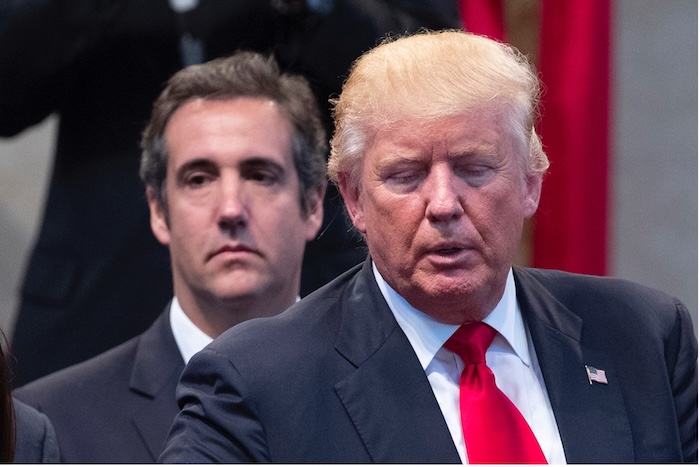
Michael Cohen, a middle-aged Caucasian man, stands behind Donald Trump's right shoulder as Trump speaks. Both men are wearing dark suits.

Donald Trump and Michael Cohen during a campaign event on September 21, 2016. Evan Vucci/AP


You're reading a free promotional version of Our Land, and we hope you enjoy David's exclusive writing and don't want to miss out on what's next. Sign up to start receiving a free 30-day trial of Our Land and enjoy all of the behind-the-scenes reports and interactive features with each issue.

Start My Free Trial
 

When I began the publicity push for How Russia Won: Donald Trump, Vladimir Putin, and the Fight for America, a friend who until recently worked for a major national news outlet offered me advice: Try to get on Fox News or Joe Rogan’s podcast. You’re not likely to change the mind of anyone in their audiences, she said, but you might gin up controversy that would draw attention to the book. And don’t you think, she added, they would welcome the chance to take the Trump–Russia story head-on?

She was wrong. The publicist at the publishing house contacted Fox and Rogan’s show. I sent a note to a Fox host with whom I’ve had a cordial relationship. I also sent Rogan an email—and I did the same with Theo Von, a podcaster who draws an audience similar to Rogan’s. No one responded.

That was no surprise. Fox is not interested in good debates or deep dives. Its business strategy is to sling red meat to its viewers, and that includes disinformation, hyped-up falsehoods, conspiracy theories, and other nonsense. Examining—let alone challenging—the audience’s fervently held beliefs, such as the view that the Trump–Russia scandal is nothing but a Deep State scheme (hoax! witch hunt!), doesn’t fit into the model. And Rogan, who has hosted and embraced purveyors of this hogwash, including Kash Patel and Tulsi Gabbard, was unlikely to book a guest who would show he had been duped (as I once explained in an article).

Advertisement

How Russia Won: On sale now

The one path I found to perhaps reach a conservative audience was Michael Cohen. The onetime Trump fixer who became a fierce Trump critic and who recently returned to being a Trump chum was game.

Cohen’s dramatic 180 has generated much scorn among Trump detractors. The guy who turned on Trump and called him a racist, liar, and sleazebag is now back in the fold, chatting with his old boss and hosting a radio show that is part of a pro-Trump lineup on WABC-AM in New York City. I asked if he wanted to interview me about the book. He invited me on his podcast.

It was a bizarre experience. I don’t know why Cohen reversed himself on Trump. Some have cited this as evidence that he’s just a grifter. I wonder if he was afraid that Trump’s Justice Department, seeking revenge for Cohen’s testimony against Trump in the porn star/hush money case that ended with Trump being convicted on 34 felony counts, might investigate him. But as an author desperate for attention for his book (see here), I steered clear of that topic so we could focus on How Russia Won.

During the podcast, Cohen was in full defense-of-Trump mode. He opened by declaring it was good Trump was buddy-buddy with Putin. “Trump’s whole pitch is pragmatic realism,” he said. “You talk to people like Putin at the G20. You host meetings in Alaska, so you keep a dialogue open so that you don’t end up in World War III. I mean, if keeping lines of communication open prevents direct military conflict and paves the way for a deal with Ukraine, why paint that as appeasement, rather than basic hard-headed diplomacy?”

That might be a decent take if Trump’s cozying up to Putin resulted in progress toward ending the war the Russian tyrant launched against Ukraine. But it hasn’t. And, as I noted, my book shows that Putin has for a decade been waging a shadow war against the United States with influence and disinformation operations that benefit Trump—and Trump has been aiding Putin by denying any of this has been occurring. Worse, he’s been in cahoots with the Russians. I pointed out that when Rudy Giuliani was Trump’s personal attorney in 2019 and 2020, Giuliani colluded with a Russian intelligence agent to smear Joe Biden.

Cohen replied: “You’re 100 percent correct…I’m not going to argue with you about that. Rudy Giuliani is not Donald Trump. Let’s be clear.” But, I countered, Giuliani was Trump’s lawyer at that time. “That doesn’t mean Trump was involved,” Cohen replied.

That was a strange defense of Trump. I shot back: “US intelligence told Donald Trump that Rudy Giuliani was a target of Russian intelligence and Donald Trump did nothing. He never told him to stop…Donald Trump even ended up tweeting some of the Russian disinformation [about Biden] that Rudy Giuliani was putting out there. He was part of this.” Cohen’s answer: “I don’t know if [Trump] was part of this. Maybe he was just trying to support Rudy.”

Trump merely trying to support his lawyer who was collaborating with a foreign intelligence operation to tarnish Trump’s political rival? Gee, what a guy. (Remember, Trump and Giuliani also together pressured Ukrainian President Volodymyr Zelenskyy to manufacture dirt on Biden.)

Now hewing to the party line, Cohen insisted the Trump–Russia scandal was a “hoax,” even as he referred to me as a “very prestigious journalist, somebody who knows a lot.” He maintained Trump had “nothing to do with Russia in 2016, to the best of my knowledge.” But Cohen knows that in June 2016, Donald Trump Jr., Paul Manafort, and Jared Kushner met with a Russian emissary who was supposed to pass them derogatory information on Hillary Clinton after being told this go-between was part of a secret Kremlin effort to help Trump’s campaign. And Cohen knows that during the 2016 campaign, Trump was pursuing a big deal to develop a Trump Tower in Moscow. Cohen was the point man for this endeavor, which involved negotiations with Russian businessmen with possible ties to Russian intelligence (according to a bipartisan 2020 Senate Intelligence  Committee report).

When I mentioned that over the past year and a half, the Trump administration has shuttered units within the FBI, State Department, and  intelligence community that track and try to thwart Russian disinformation aimed at the United States (as well as disinformation operations mounted by other foreign governments), Cohen countered that conservatives “look at these same intelligence agencies…and they see bloated, partisan operations that spent years, years chasing rumors…Isn’t it fair to say that cutting those units down to size is just good governance and draining the swamp than leaving our doors unlocked to Moscow?”

Uh, no. Trump seems to be purposefully leaving the door wide open for Russian interference in the current elections.

I described the disinformation and influence operations Putin directed at the United States in the 2020 and 2024 elections. Cohen contended that there’s no evidence Trump was personally involved. “He denies Russia has done anything,” I responded, “even though his own intelligence community and Treasury Department in his first term identified Russian operations aimed at the 2020 election to hurt Joe Biden.”

“Fair point,” Cohen said. Now he was agreeing with me?

After I again criticized Trump for dismantling the anti-disinformation offices, he said: “That’s one way to look at it. Another [for Trump] is that ‘They were helping me, so I don’t personally give a shit. Let them do whatever they want. I’m not going to interfere if someone wants to help me.’” His position was that it’s fine for Trump to let Putin attack a US election. That’s not very America First-ish.

Then Cohen derided the recent news reports that Moscow is meddling in the midterms, noting it’s “just the same political playbook” every election. I explained these reports come up each campaign season “because it keeps happening again and again. And Donald Trump refuses to recognize this because it’s happening often to his benefit…He’s been denying it all this time, which is why it keeps happening.”

We went back and forth on Trump’s actions regarding Ukraine, with Cohen maintaining that his former employer was not soft on Putin. He asked why voters ought to care about the fuss over Trump and Russia. I contended that a foreign adversary subverting a US election was a prominent national security concern. And he stupefied me with this comment: “The premise of your book is accurate. I’m not going to argue with the premise of the book. Now do I think, again, that Trump is allowing Putin to win? No more than Obama wanted to play into the hands of the Iranians when he sent over $9 billion in an airplane in cash.”

You cannot say my book is accurate and Trump has done no wrong—though that’s what Cohen did. And his attempted deflection referring to Iran made no sense. (It was $1.7 billion that the Treasury Department paid Tehran to settle a long-standing breach-of-contract claim pending before the Iran–US Claims Tribunal at The Hague, an arrangement that coincided with the multilateral Iran nuclear agreement.)

We argued over whether Trump’s refusal to acknowledge Putin’s assaults on the United States was an important matter. “One hundred percent and it is,” Cohen eventually said. But he quickly added, “It is one person’s opinion.” Presumably mine. He then remarked: “I applaud you. I applaud the writing of this book. I agree with the premise: Russia, bad; America, good.”

That’s not the premise of the book. But why was he hailing a book that depicts Trump as a useful idiot for Putin who has betrayed the United States? It seemed Cohen was having trouble sticking to his new Trump-friendly stance when confronted with facts.

Toward the end, Cohen said: “The beauty of having you, David, come on is the fact that you and I can have a respectful and an open conversation about differences of opinions…That’s what I believe is needed today in America in order for us to actually start to become Americans again.”

I replied, “I wish that sentiment was held by your friend the president.” I stated that Trump routinely “denigrates people he doesn’t like as communists, radicals, enemies of the state…He’s a demagogue, and he uses the bully pulpit actually to divide America…I hope now that you’re pals, he will listen to you and that you will spend all your energy and your great strength to convince him to drop the bullshit and try to unite the country so we can have these conversations.”

Cohen didn’t take the bait. He said: “I appreciate you. I respect you. I wish you the best of luck with your book. I recommend people read it.” I couldn’t argue with that.

Advertisement

How Russia Won: On sale now

Cohen had wiggled his way back into Trump’s good graces, but here he was telling his listeners to read a book that shows that Trump has been complicit in Putin’s twilight war against the United States. I was confused, but I concluded that Cohen’s recent reversal had caused him some whiplash and he, too, was confused about how to be pro-Trump, appear fair-minded, and not go full MAGA. Good luck with that.

At one point, I kiddingly remarked that I hoped Trump reads How Russia Won. “Send me the book,” Cohen said. “I’m going to go see him, and I’ll hand it to him.” I asked my publisher to mail Cohen a copy. What are the odds he keeps that promise?

Got anything to say about this item—or anything else? Email me at ourland.corn@gmail.com.

Update on the Russian Disinfo Campaign Starring Me

Last week, I wrote about how I’ve been dragged into a disinformation operation being run by one of the Russian disinfo networks I wrote about in How Russia Won. These Putin operatives posted on X a series of phony videos that purported to be Mother Jones reports in which I disclose scurrilous allegations about Democratic candidates in the midterms that are supposedly drawn from a book I had just released called Enemies of Democracy for Dummies. The charges were all outlandish and false—one candidate recruited Girl Scouts for sex parties; another sold crack to college students, killing 17 of them; a third embezzled public funds to finance his lavish and closeted gay lifestyle. And my nonexistent Enemies of Democracy for Dummies, according to these sham videos, revealed another 300 crimes committed by Democratic candidates.

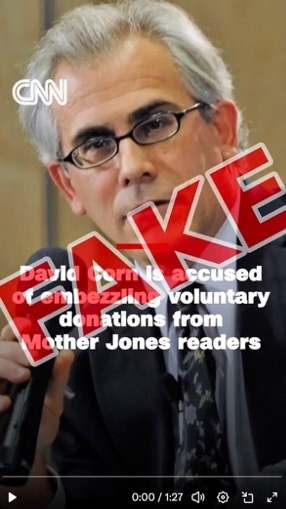
A lawyer for Mother Jones contacted X, and the platform took down the posts we had identified as forgeries and killed the bot accounts that had published these fakes. So far, so good. But then this Russian unit put up on X another slew of phony Mother Jones videos with similar allegations about other Democratic candidates, citing me and the book that doesn’t exist as the source. Included in this round was a fraudulent CNN report stating that I had been accused of embezzling from Mother Jones in a scheme too convoluted to explain. (It involved a paywall, and Mother Jones has no paywall.)

A fradulent video report claiming to be from CNN bears the heading,

X took down this latest batch of bogus posts. As far as I can tell, none of this crap has gone viral. But this disinformation operation does signal that Putin has once again instructed his cyber operatives to intervene in an American election for Trump’s benefit—and proves the premise of my actual book: Moscow is waging shadow warfare against the United States. I expect there will be more of this in the coming weeks. 

A brief reminder that you're reading a free promotional version of Our Land. If you appreciate David's smart takes on the news and all the extra features, sign up to start receiving a free 30-day trial of Our Land directly in your inbox.

Start My Free Trial

The Watch, Read, and Listen List

Lucas Museum of Narrative Art. One of the many interesting things about the Lucas Museum of Narrative Art that opened two weeks ago in Los Angeles is that it has less George Lucas in it than you might expect. The filmmaker and his wife, businesswoman Mellody Hobson, spent more than a billion dollars to land this gorgeous spaceship-shaped building on what was a three-block-long asphalt strip next to the Los Angeles Memorial Coliseum. No one would have begrudged Lucas if he had filled it with Star Wars from top to bottom.

Instead, the collection on display is a delightful potpourri of visual arts that extends from reproductions of cave paintings dated 35,000-15,000 BCE (that’s some range) to recent Banksy wall stencils and a statue he made of a man-eating lion that…ate a man. There’s a single gallery with models, costumes, and props from Lucas’ space Westerns. (Look, there’s Luke Skywalker’s X-34 landspeeder!) But the Star Wars stuff—obviously the big draw for the crowd—is a small fraction of the works on display that are largely drawn from Lucas’ personal collection of over 40,000 objects.

The throughline is how stories are conveyed via visual representation. The first gallery, which is adjacent to the lobby, is titled “The History of Narrative Art: Heroes, Myths, the Sacred,” and it runs from statues and carvings from ancient civilizations to Michelangelo’s Sistine Chapel (a beautiful, high-quality reproduction), prints of Japanese samurai, Rembrandt, and American narrative painters of the early 20th century. On the second, rather lengthy floor are galleries featuring specific artists (Norman Rockwell, N.C. Wyeth, Thomas Hart Benton); comic strips (Krazy Kat, Doonesbury, and 19th-century French satirists); graphic stories, a.k.a. comic books (Jack Kirby’s Captain America); science fiction and fantasy art; manga; and a glorious photography collection (Henri Cartier-Bresson, W. Eugene Smith, Margaret Bourke-White, Dorothea Lange, Richard Avedon, Imogen Cunningham, Gordon Parks).

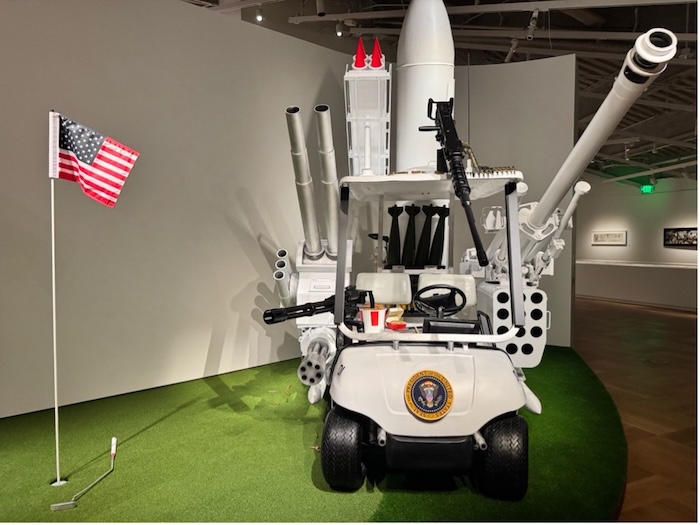
On display are a storyboard from the pioneering French filmmaker Georges Méliès’ A Trip to the Moon, a Picasso line drawing that looks like a messy comic strip, and a massive Diego Rivera mural. The museum smoothly skips from a Frida Kahlo to a satirical 2026 piece by Darren Cullen (who works under the name Spelling Mistakes Cost Lives) in which an actual golf cart bearing the presidential seal is converted into a missile carrier with a Big Mac, a bucket of KFC, and a Diet Coke on the front seat. It’s titled “Golf Cart One.”

Lucas and his curators are chronicling the long arc of visual storytelling, and eclecticism is the point. Every corner turned within Lucas’ grandest storyboard offers a delight. The joy experienced by the visitors is palpable. People will come to ooh and aah over the Star Wars material. They will receive much more—which may make this Lucas’ most important production yet.

A blue sky is visible through a round opening overhead in the white, futuristic building of the Lucas Museum of Narrative Art.
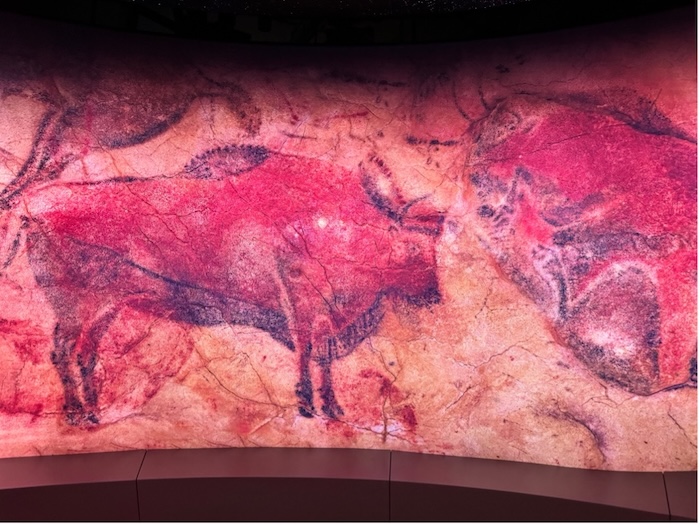
A red-tinged reproduction of a cave painting depicts oxen.

A reproduction of a cave painting from Altamira in Spain

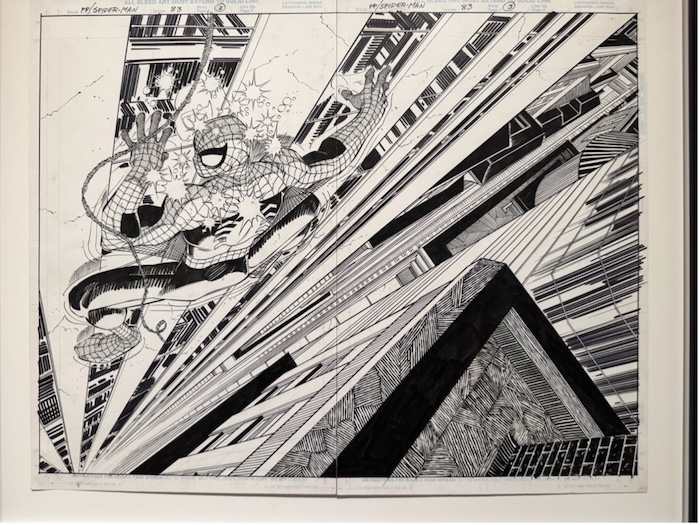
A black-and-white piece of graphic art shows Spider-Man climbing a tall building's exterior.

"Spider-Man" by John Romita Jr.

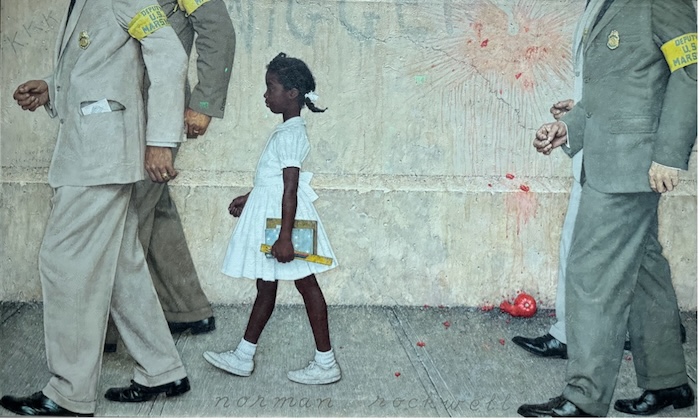
A photograph shows a young Black girl in a white dress carrying books and ruler. She walks between men in suits, shown from the chest down, who are wearing yellow armbands that say

"The Problem We All Live With" by Norman Rockwell

Spacecraft props from

Speeder bikes and costumes from Star Wars: Episode VI—Return of the Jedi

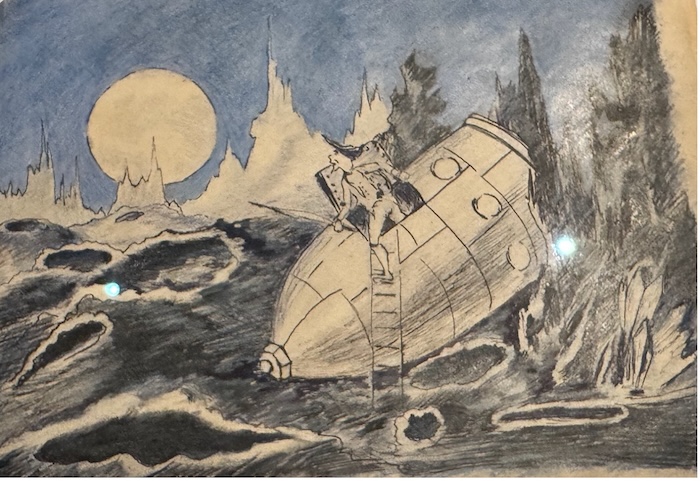
An illustration shows a person climbing down a ladder out of a crashed spacecraft on a barren, mountainous landscape.

A storyboard from Georges Méliès’ A Trip to the Moon

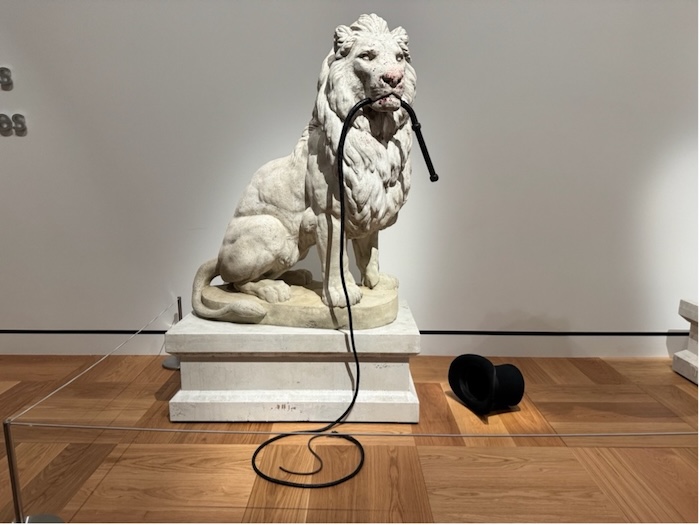
A stone statue of a lion with a tamer's whip in its mouth and a black top hat on the floor.

Half of Banksy's "Pair of Ornamental Garden Lions With Added Parts"

A golf cart with a presidential seal is outfitted with heavy weaponry and fast food on the front seat. It's parked on a putting green with a small American flag planted in the hole.

"Golf Cart One" by Darren Cullen

Advertisement

How Russia Won: On sale now

So Much for Goodbyes, Billy Strings. Billy Strings is a onetime bluegrass prodigy with a love of hard and indie rock who has bagged three Grammy Awards for Best Bluegrass Album since 2021. That makes the 34-year-old—who has played with Phish, Widespread Panic, Molly Tuttle, and Del McCoury—something of a musical powerhouse.

In late August, he released his fifth studio album, So Much for Goodbyes, co-produced by Strings and T Bone Burnett, and, no surprise, it has drawn much critical acclaim. When I recently heard on the radio “Lucid Daydream,” a track off the disc, while fighting traffic in LA, I had to pull over to Shazam the tune. It’s a stunning song of bitter lyrics with a bluegrass spine surrounded by folk, rock, and experimental elements. This collection is full of exquisite picking and haunting and beautiful melodies and harmonies. There are songs about trains, floods, truck stops, and yearning, as Strings honors tradition and makes bluegrass as modern as it can be.

Play 
 

Congratulations, you read all the way to the end! It's a great time to say "I'm in" and start your free 30-day trial. Make sure you don't miss out on what's next: Sign up to start getting Our Land in your inbox each week. We also want to hear from readers (especially those who read the whole thing!). So let us know what you think so far or share something interesting with David at ourland.corn@gmail.com.

Start Receiving Our Land
 

Our Land

This message was sent to example@example.com. To change the messages you receive from us, you can edit your email preferences or unsubscribe from all mailings.

www.MotherJones.com
PO Box 8539, Big Sandy, TX 75755