All authors are thirsty. After toiling for a lengthy stretch—often a mostly solitary endeavor—a book writer yearns for people to buy and...
 
FREE TRIAL VERSION. DON'T MISS OUT.

FREE TRIAL VERSION. DON'T MISS OUT.

FREE TRIAL VERSION. DON'T MISS OUT.

FREE TRIAL VERSION. DON'T MISS OUT.


Confessions of a Desperate Author

By David Corn  September 22, 2026

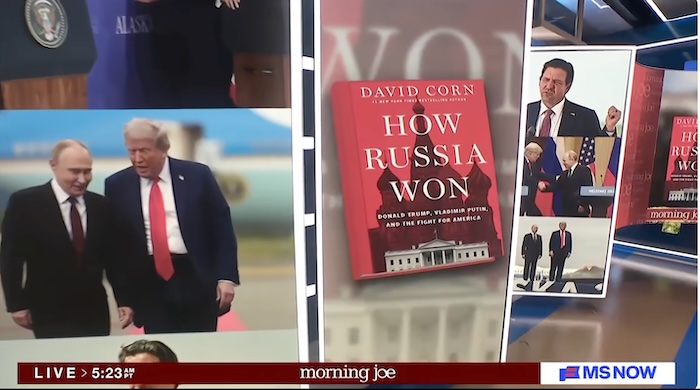
A screenshot from the September 15 edition of MS NOW’s Morning Joe.

A screenshot from the September 15 edition of MS NOW’s Morning Joe.


You're reading a free promotional version of Our Land, and we hope you enjoy David's exclusive writing and don't want to miss out on what's next. Sign up to start receiving a free 30-day trial of Our Land and enjoy all of the behind-the-scenes reports and interactive features with each issue.

Start My Free Trial
 

All authors are thirsty.

After toiling for a lengthy stretch—often a mostly solitary endeavor—a book writer yearns for people to buy and read the work once it is published. You want the world to recognize your accomplishment and perhaps even be slightly changed by your effort. Book sales offer validation and, yes, money—and the chance to obtain a contract (and advance) for the next book. The release of a book is exhilarating and nerve-wracking. It’s a measure of success (the book is out!) and an opportunity for disappointment (why is that celebrity memoir selling more copies?).

As you know, last week my new book, How Russia Won: Donald Trump, Vladimir Putin, and the Fight for America, was published by HarperCollins. So I was in a book-launch frenzy, meaning I did whatever I could to draw attention to the book. I appeared on every television and radio show and podcast that would have me. (There are so many podcasts.) And I had to resist the impulse to run down the street, grab people by the lapels, and tell them that I have a book out—an important book—and that they should buy it…now. But in the modern world, I could do the equivalent on social media, posting constantly about the book, about the media appearances related to the book, about the website for the book, about the promotional video for the book (narrated by Nick Offerman), and about the articles, columns, and, uh, newsletters I wrote that drew from the book and promoted it.

Advertisement

Stealing Elections, American Style by Congressman Nikema Williams

I’ve been through this process several times, and this release felt different. There seemed to be more headwinds. I wonder if the ever-increasing amount of content bombarding all of us renders it even more difficult to win notice for a book. A book author these days is asking a reader to take a break from the firehose of information—the important news, the outrages, the trivialities—aimed at us daily and spend hours with a single subject in a way that does not supply dopamine fixes. Reading a book entails stepping off the internet and social media merry-go-round. My hunch—I’m not bothering with data for this observation—is that this has become a harder ask. I’d be delighted to be proven wrong.

I’ve managed to rack up media and podcast appearances that placed the book before millions of potential readers. No complaints. But is the same percentage of them purchasing nonfiction books as before? I shall find out.

What makes the book sales environment particularly tough now is that many publishers decided that the last two weeks were the time to release books related to politics. There’s much competition. It was a bit awkward to be in the green room at MS NOW, about to go on a show to pitch the book, and in walks Alex Wagner or Jacob Weisberg. “Oh, you have a book out this week, too?” Polite conversation ensues. “What’s yours?…Sounds real interesting…That should do well.” But we all know there’s only so much room on The New York Times bestseller list, and we’re all vying for a slot. “Good luck!”

Note to my publisher: Next time, let’s not release a book two months before an election.

That said, it is rather gratifying to see a book be taken seriously and become part of the discourse—and to receive positive feedback. On his podcast, Benjamin Wittes, the editor-in-chief of Lawfare, a fellow who knows the subject matter of my book as well as anyone, said he found How Russia Won “genuinely shocking.” He also shared an interesting theory to explain why the Trump-Russia story has faded over the years, suggesting this happened because many in the media did not want to keep pursuing the subject out of fear of coming across as obsessive and being seen as modern-day McCarthyites searching for Russians under every rock. Wittes pointed out that until this book, no one had connected the dots to fully show that Putin has waged a decade-long twilight war against the United States and that Trump and his MAGA minions have been complicit in this assault. I felt seen.

On the Deep State Radio podcast hosted by foreign policy analyst and author David Rothkopf, Edward Luce of the Financial Times observed that Trump’s “Big Lie No. 1” was that the 2020 election was rigged against him but that his second Big Lie was his never-ending string of denials of Russian intervention in US elections. That’s the point of the book.

On The Court of History podcast, hosted by Princeton history professor Sean Wilentz and author Sidney Blumenthal, Wilentz remarked, “The biggest story of what is going on…has been the way in which…Vladimir Putin has manipulated the United States…The type of warfare that no one thinks of as warfare…That is the big story.” And Blumenthal added, “Putin has achieved the greatest intelligence coup in Russian history in his handling of Donald Trump…It is a blockbuster book. It’s a brilliantly reported book and history.” Blumenthal and Wilentz devoted five episodes of their podcast to How Russia Won—a tremendously deep dive. It was rewarding to spend hours talking to them for this series.

With How Russia Won, I’m trying to reclaim the Trump-Russia narrative after Trump succeeded in smothering this story with his ceaseless braying that it’s nothing but a Deep State “hoax” and “witch hunt” and his dismissal of it as “Russia, Russia, Russia.” I realize that’s ambitious. Yet many reviewers and commentators got this and supported the mission. On MeidasTouch, Ben Meiselas called How Russia Won “very important” and commented, “Russia’s plan has been implemented…We’re living it now…This is what you’ve been warning about.” On his podcast, Brian Tyler Cohen said the book is “monumentally helpful in understanding what is going on right now.”

Writing about the book for Zeteo, John Harwood, the former White House correspondent for CNN, observed,

[Putin and Trump’s] undeclared alliance has proven infinitely more consequential than Trump fleecing students of his “university,” stiffing creditors, or escaping the Vietnam draft. Reciprocal back-scratching has helped him gain wealth and power, corrupted his political party, and boosted an authoritarian adversary while weakening America and the free world. The two men’s audacity begs the question: how did they pull this off? 

In his gripping new book How Russia Won, David Corn catalogs depressing, if unsurprising, answers. Behind a giant shield marked “Hoax,” Trump and Putin have prospered through nonstop repetition, shameless lying, and relentless battering on America’s political and cultural divisions.

A fun moment came when I appeared on Morning Joe. In the anchor chair was Jonathan Lemire, a co-host of the show and a staff writer for The Atlantic. The segment opened with footage of him at a press conference with Trump and Putin in Helsinki in 2018, where he asked Trump a question that brought an answer that would trigger headlines around the world: “Just now President Putin denied having anything to do with the election interference [in 2016]. Every US intelligence agency has concluded that Russia did…Who do you believe?…Would you denounce what happened in 2016 and would you warn him to never do it again?”

Trump answered that query by echoing Putin’s denials—a response that was met with outrage in the United States, even among Trump’s own aides (which I detail in the book). It was as if a scene in the book were being acted out.

It’s great that the book has resonated with those who have read it. As supportive friends and colleagues have told me, How Russia Won is the definitive account of Putin’s attack on American democracy and Trump’s complicity and will likely remain so for a while, no matter how many copies are sold.

Which reminds me of a funny moment that occurred while I was frantically promoting the book. One stop was SiriusXM for an extended interview with John Fugelsang, who hosts an afternoon show for the network. The interview was in a studio at the main office in New York City, a place that has an MTV-in-the-’90s vibe. Celebs and musicians are constantly popping in and out, and the reception area is full of hip-looking people.

After my time with Fugelsang, I walked out of the studio. I needed to hit the head but was blocked in the hallway by rapper/actor Ice-T and his entourage. I heard Ice-T saying that when he produces music he doesn’t think about how to make it appealing for a large audience. “I’m just doing it for one fan,” he said. When his group moved on, I found my way to the bathroom. Inside, “Super Freak” was playing. As I stood at the urinals, Ice-T entered and took the spot next to me. No one else was there. “Good line about the fan,” I said. He replied, “Some people think I'm garbage. But as long as there's one fan, I'm good.”

Of course, Ice-T can afford to say that now. But it’s a lovely thought to keep in mind.  

Advertisement

Stealing Elections, American Style by Congressman Nikema Williams

Here are some of those media and podcast appearances:

Morning Joe

Play 

The Court of History

Play 

Deep State Radio

Play 

MeidasTouch

Play 

Got anything to say about this item—or anything else? Email me at ourland.corn@gmail.com.

A How Russia Won Book Event

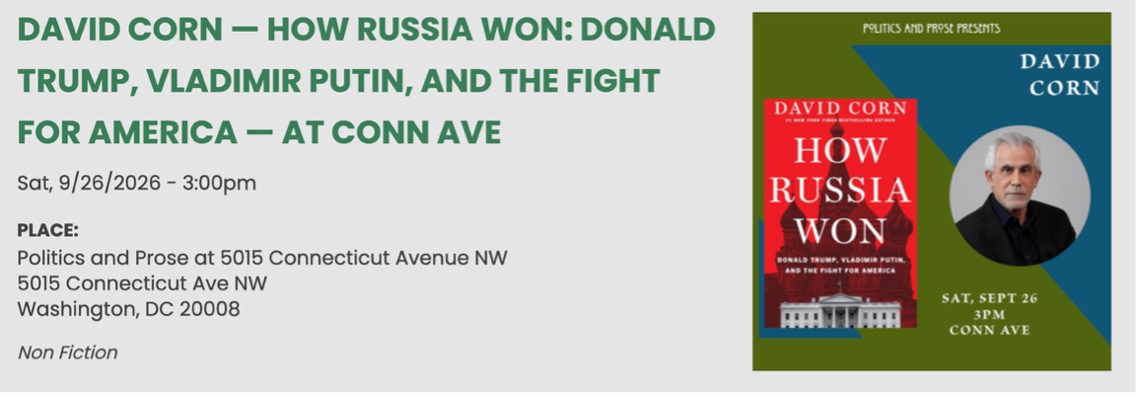
This is for anyone in the Washington, DC, area. Politics and Prose, a great independent bookstore, will host a book talk and signing for How Russia Won on September 26 at 3 p.m. It will be at the main outlet on Connecticut Avenue NW. Hope to see you there.

A How Russia Won Book Event, Saturday 9/26/26 at Politics and Prose in Washington, DC.

A brief reminder that you're reading a free promotional version of Our Land. If you appreciate David's smart takes on the news and all the extra features, sign up to start receiving a free 30-day trial of Our Land directly in your inbox.

Start My Free Trial

The Watch, Read, and Listen List

Mayday. The two directors of Mayday, John Francis Daley and Jonathan Goldstein, were obviously trying to recapture the crackling pizzazz of 1980s action buddy films, perhaps best represented by the magnificent Midnight Run, which paired Robert De Niro with Charles Grodin in a cross-country chase caper. And with Ryan Reynolds as a US Navy pilot shot down over the Soviet Union in 1987 and Kenneth Branagh as the repentant KGB officer who finds him in the woods and tries to guide him to safety, Daley and Goldstein had a decent shot at it. But despite this surfeit of acting talent—these two thespians know how to deliver a line—the movie falls short.

Mayday is supposed to be a roller-coaster ride, as the American and the Russian flee state police and military units to bring the flyboy to Moscow, where the US embassy will take him in. Despite the witty repartee zapping back and forth—and a zany chase scene with a nuclear missile carrier—there’s an overall meh-ness to the flick. And what are the odds that an American top gun crash-lands in the Soviet wilderness near a cabin inhabited by a former KGB officer who loves America and whose prized possession is a bootleg copy of Top Gun, which he has watched scores of times? But if you’re looking for a playful diversion, Mayday might be on target.

What’s most interesting about the movie is that its seven producers includes David Ellison. He’s the son of Larry Ellison, the Trump-friendly founder of Oracle, and he heads Paramount Skydance, which is in the process of gobbling up Warner Bros. Discovery. Ellison the Younger has claimed his politics are moderate, and he has supported Democrats in the past. But like his pop, he has cozied up to Trump, and his attempt to acquire WBD—which includes CNN—has prompted concern that he and his dad might impose a political agenda on the entertainment and news content their conglomerate kicks out.

Mayday, though, is chock-full of liberal themes. Reynolds’ character starts out as a stalwart Cold Warrior who believes that the Soviet Union is indeed the evil empire Ronald Reagan dubbed it and that the Soviet people are to be feared. But his encounters with normal Russian folk force him to rethink that hawkish prejudice.

Moreover, he comes to see that the US government ain’t as heroic as it presents itself. The US embassy—which doesn’t want to acknowledge that an American pilot flying a covert surveillance mission over the Soviet Union was shot down—is not so keen on helping him. It tells him: If you can make it to the embassy in Moscow on your own, then we’ll be there for you. Plus, US officials refuse to offer asylum to the former KGB officer assisting him.

Not only is this top gun betrayed by his own government. During his run to Moscow, he learns—courtesy of the KGB—that the US Navy knowingly exposed American shipyard workers to carcinogenic asbestos, which is why his father now has cancer.

Team America doesn’t look that grand in Mayday. This is the type of film that used to prompt conservatives to grouse about the libs of Hollywood. Ellison gave a green light to this in 2023—before Trump returned to the White House. Does that tell us anything about his politics? Perhaps. Still, a film that shows an American partnering up with a Russian to defy US officials might be exactly right for Trump.

Play 

Advertisement

Stealing Elections, American Style by Congressman Nikema Williams

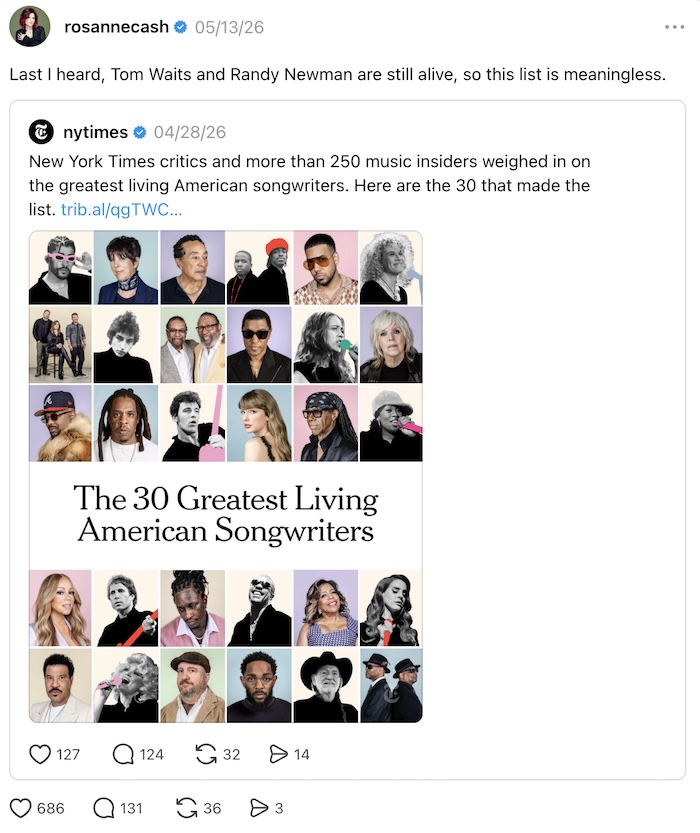
“The Fall of Troy,” Tom Waits. In April, The New York Times published a list of the “30 greatest living American songwriters.” It was a gimmick. Why 30? Not 10 or 25 or 34? Or 67? And most were predictable choices: Bob Dylan, Paul Simon, Jay-Z, Stevie Wonder, Dolly Parton, Taylor Swift. Of course, on social media, people argued about who was on and who was off the list. The best response I saw came from Rosanne Cash: “Last I heard, Tom Waits and Randy Newman are still alive, so this list is meaningless.”

Rosanne Cash on Threads

Right on, Rosanne. And not just because those two songwriters are my personal favorites.

Seven years ago, Cash recorded a lovely cover of Waits’ “Time” for a tribute album, Come On Up to the House, of women artists performing Waits compositions. That disc highlighted Waits’ songwriting genius. I don’t see why the Times folks couldn’t have expanded the roster to include these two gents.

This month, Waits put out an acoustic version of his song “The Fall of Troy” that originally appeared on the soundtrack for the movie Dead Man Walking. As he notes, the song, co-written with his wife, Kathleen Brennan, was based on a news article about two youths involved in a shooting in New Orleans. This recording was made for an Italian documentary on homelessness in the United States, The Last Ride, which featured Waits’ music.

The cut didn’t make it into the film, but it’s out on its own and showcases Waits’ poetic lyrics and his deep empathy for the outcasts and losers among us. I once heard Waits say, “Remember, the little people are as big as you are—whoever you are.” His songwriting has always been true to that sentiment.

Play 
 

Congratulations, you read all the way to the end! It's a great time to say "I'm in" and start your free 30-day trial. Make sure you don't miss out on what's next: Sign up to start getting Our Land in your inbox each week. We also want to hear from readers (especially those who read the whole thing!). So let us know what you think so far or share something interesting with David at ourland.corn@gmail.com.

Start Receiving Our Land
 

Our Land

This message was sent to example@example.com. To change the messages you receive from us, you can edit your email preferences or unsubscribe from all mailings.

www.MotherJones.com
PO Box 8539, Big Sandy, TX 75755