FREE TRIAL VERSION. DON'T MISS OUT. |
FREE TRIAL VERSION. DON'T MISS OUT. |
|
|
|
Trump Endorsed an Infomercial Pushing Third-Term Schemes |
By David Corn August 11, 2026 |
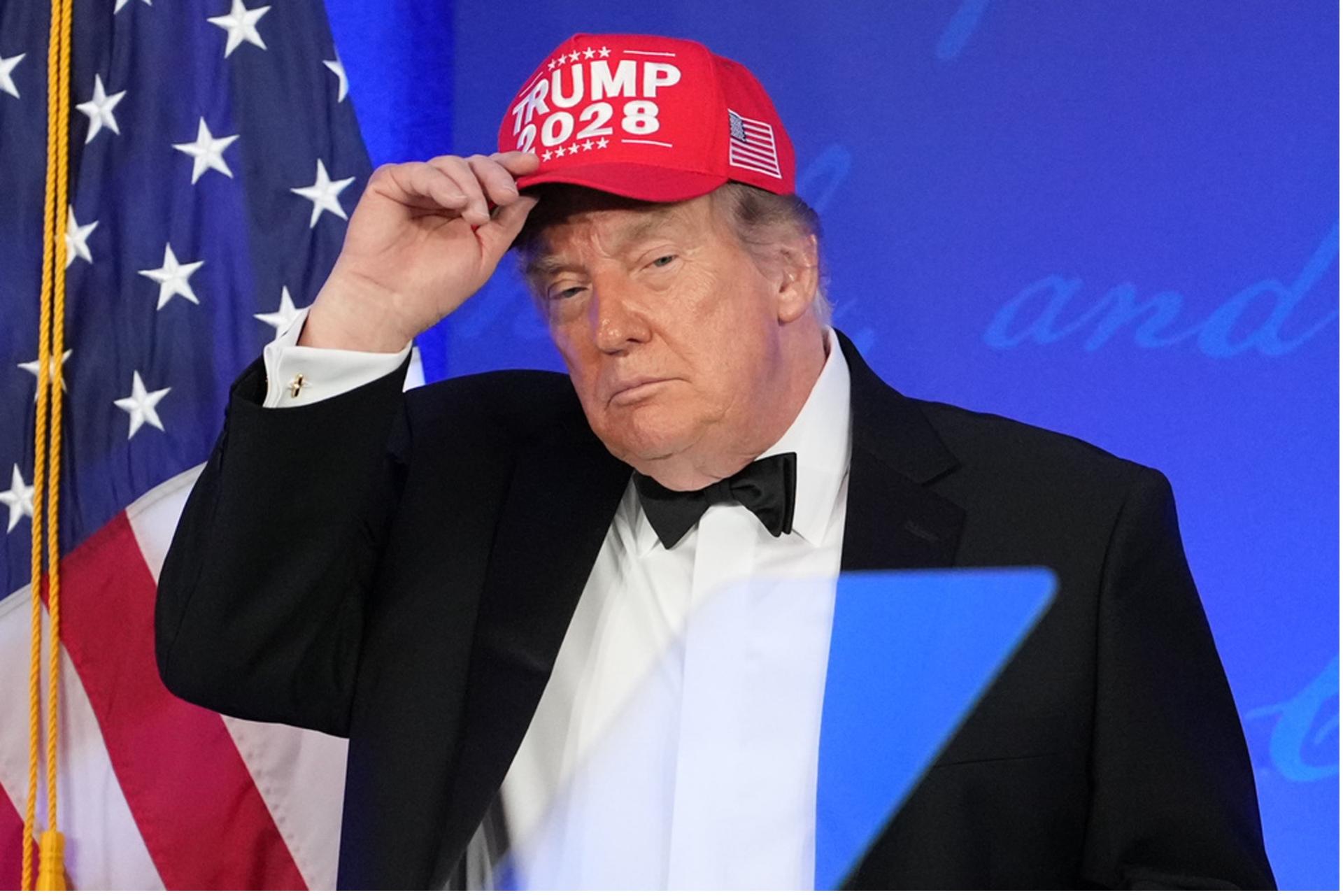
President Donald Trump speaks at the White House Correspondents' Association dinner on July 24. Mark Schiefelbein/AP |
|
|
|
You're reading a free promotional version of Our Land, and we hope you enjoy David's exclusive writing and don't want to miss out on what's next. Sign up to start receiving a free 30-day trial of Our Land and enjoy all of the behind-the-scenes reports and interactive features with each issue.
|
|
|
|
At the end of his nasty and pathetic speech at the White House Correspondents’ Association’s re-do dinner last month, Donald Trump donned a “Trump 2028” red baseball cap. It was his way of trolling the press and Democrats. It’s easy to dismiss his intermittent references to a possible (and unconstitutional) re-reelection bid as a bad joke and a mean-spirited Trump effort to push a button to provoke his detractors. But might it be more?
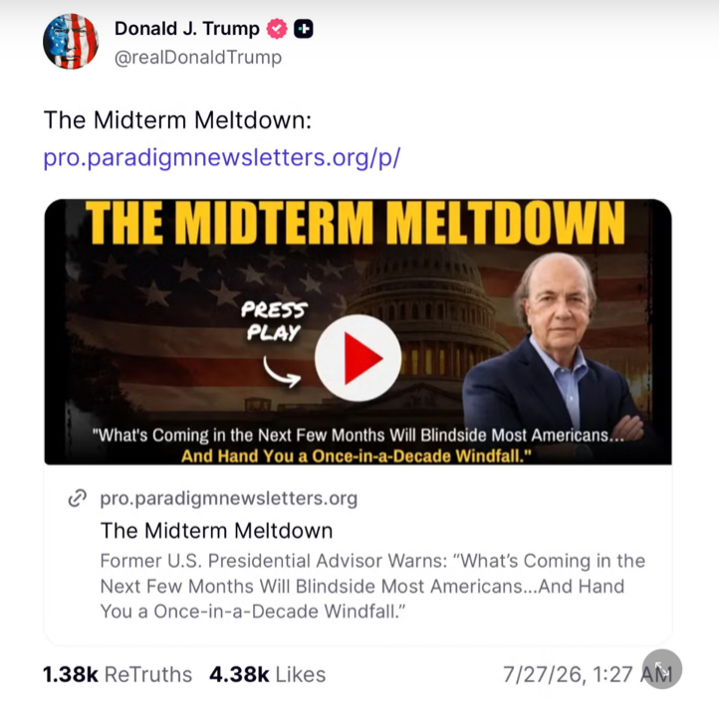
Three days after that speech, Trump posted a link on Truth Social, his money-losing platform, to a set of plans that would allow him to gain a third term as president. As far as I can tell, Trump’s amplification of a third-term scheme largely escaped media notice. (MeidasTouch News picked up on it.) Whether or not Trump was just being a jerk, an authoritarian-minded president hyping such a move ought to be covered by the media. After all, it’s not as if this guy hasn’t previously attempted to subvert the constitutional order to retain power. Any sign from him that he’s even considering another move to undermine the republic—any—is newsworthy.
|
It was 1:27 a.m. on July 27 when the president of the United States posted a link to an infomercial for a financial newsletter peddled by a fellow named Jim Rickards. The video has the grifter-ish tone of such fare, with Rickards boasting that he foresaw the 2008 economic implosion, predicted Trump’s 2016 victory, and “wrote about the Covid crash weeks before the market plunged in March of 2020.” He claims he’s a “former advisor” to the CIA, the Pentagon, and four White House administrations. And he has a warning: “A collision of political, legal, and military forces [will all be] converging on a single date. November 3rd, 2026.” That’s Election Day.
|
|
|
|
Rickards writes: “My research indicates…we’re entering the most chaotic, volatile, and dangerous period in American history. I’m talking about the kind of turmoil that most of us have never experienced. With massive street violence in major cities…Criminal prosecutions of some of the most powerful people in Washington…A constitutional crisis that echoes the darkest chapter in American history.”
He adds, “What’s coming between now and November 3rd could be far more dangerous than most people realize.” But don’t fear, he says, because he can show you “how to protect yourself and your money.”
In this infomercial, Rickards claims he has inside info that Trump is on the verge of indicting “some of the most powerful people in Washington”—including “members of the Biden family’s inner circle”—and that trials will begin this summer, and convictions will come in the fall. Moreover, he says, a dozen states will soon be mounting an “insurrection” against the federal government by resisting ICE’s mass deportation crusade, with the left encouraging violent confrontations that Trump will quash by arresting state officials.
All this chaos, obviously, will have economic consequences. But if you sign up for Rickards’ financial newsletter, he will show you how to buy gold and invest in certain stocks to profit from such disruption.
And there’s another reason, he points out, why you need the financial advice he offers in his newsletter and reports. In addition to the criminal trials of major political players and the violence in the streets, as well as the ongoing war in the Middle East, another development will soon rock the markets: Trump’s attempt to pave the way to a third term.
Rickards notes there are three different paths for Trump. He points out, as other Trump fans have, that the 22nd Amendment states, “No person shall be elected to the office of the President more than twice,” and he emphasizes the word “elected.” There’s nothing here, he contends, to prevent Trump from returning to the White House through means other than being elected president. One course is for Trump to run as vice president on a ticket with JD Vance in 2028. If Vance wins, he resigns immediately, and Trump becomes president without having been elected to the post.
Another option: Vance and Marco Rubio campaign as a ticket and win, and, presuming the GOP controls the House, Trump is subsequently elected as House speaker. (The speaker does not have to be a member of the House.) At that point, Vance and Rubio resign, and—presto!—Trump, as the next in line, inherits the presidency. The third way is for Trump to run in 2028 and win, and his Electoral College delegates abstain from voting. In that event, no candidate earns a majority of electoral votes, and the House gets to decide. If the GOP controls a majority of state delegations, the House selects Trump.
Much of this is far-fetched. (Would Vance really resign the presidency for Trump?) And none of these schemes takes into account that Trump is currently setting records with his low approval rating. The GOP might not be hankering for a third Trump term. The American public sure ain’t.
It’s not my intention to whip up fear that Trump is already plotting to stay in power beyond January 20, 2029—especially when there is now justifiable concern regarding steps he might take to interfere with the midterms. But Rickards ties all this potential conniving to the coming congressional elections.
He notes that Trump’s “path to 2028 stays open” only if the Republicans hold the House in November. That’s why, he says, the midterms are the “most important election in modern American history…These midterms aren’t just about 2026. They’re about whether one man holds the presidency for the next seven years.”
Actually, he’s wrong. For two of those three schemes to have a shot, the Republicans would have to win the House in 2028. But that’s beside the point. The real question for Rickards is whether you will pay $49 a year for his newsletter (discounted from $299!) so he can tell you how to survive the coming conflagration by buying gold, following his stock picks, and receiving a special report on “Trump’s Explosive Third Term.” |
|
|
|
The big story here is that Trump essentially endorsed Rickards’ pitch, its promotion of the assorted third-term strategies, and his claim that the midterms are a key component of this skullduggery. In the middle of the night, Trump gave his thumbs-up to a goldbug pushing the notion that Trump ought to pursue another four years in the White House and the idea that the Republicans need to win the midterms to keep alive the possibility of a Trump third term.
As I’ve noted, there are far too many Trump outrages these days to keep up with. (On Sunday, a New York Times investigation raised the prospect that someone—a person, government, or company—used a shady businessman who was raised in Shanghai to slip $100 million to Trump’s crypto company.) But any oxygen Trump supplies to another potential assault on the Constitution warrants attention. He signaled to his 13 million Truth Social devotees that they should take Rickards and his BS seriously—including the supposed importance of the midterms for third-term scheming. This is more than trolling. It’s a dangerous sign that Trump wants this potential threat to the republic to be in play and to motivate his base in November.
Got anything to say about this item—or anything else? Email me at ourland.corn@gmail.com. |
The lost Hiroshima memoir on The World |
Last week, I wrote about how I came to edit the memoir of Hiroshima survivor Kiyoshi Tanimoto, which had been lost for decades. This harrowing eyewitness account of the first act of nuclear warfare and the weeks and months that came afterward was published last week by Random House’s Modern Library, under the title Hiroshima 8:15: The Lost Memoir. You can hear me discuss Tanimoto’s remembrances, how the book came to be, and the relevance of Hiroshima for us today on public radio’s The World.
|
|
|
|
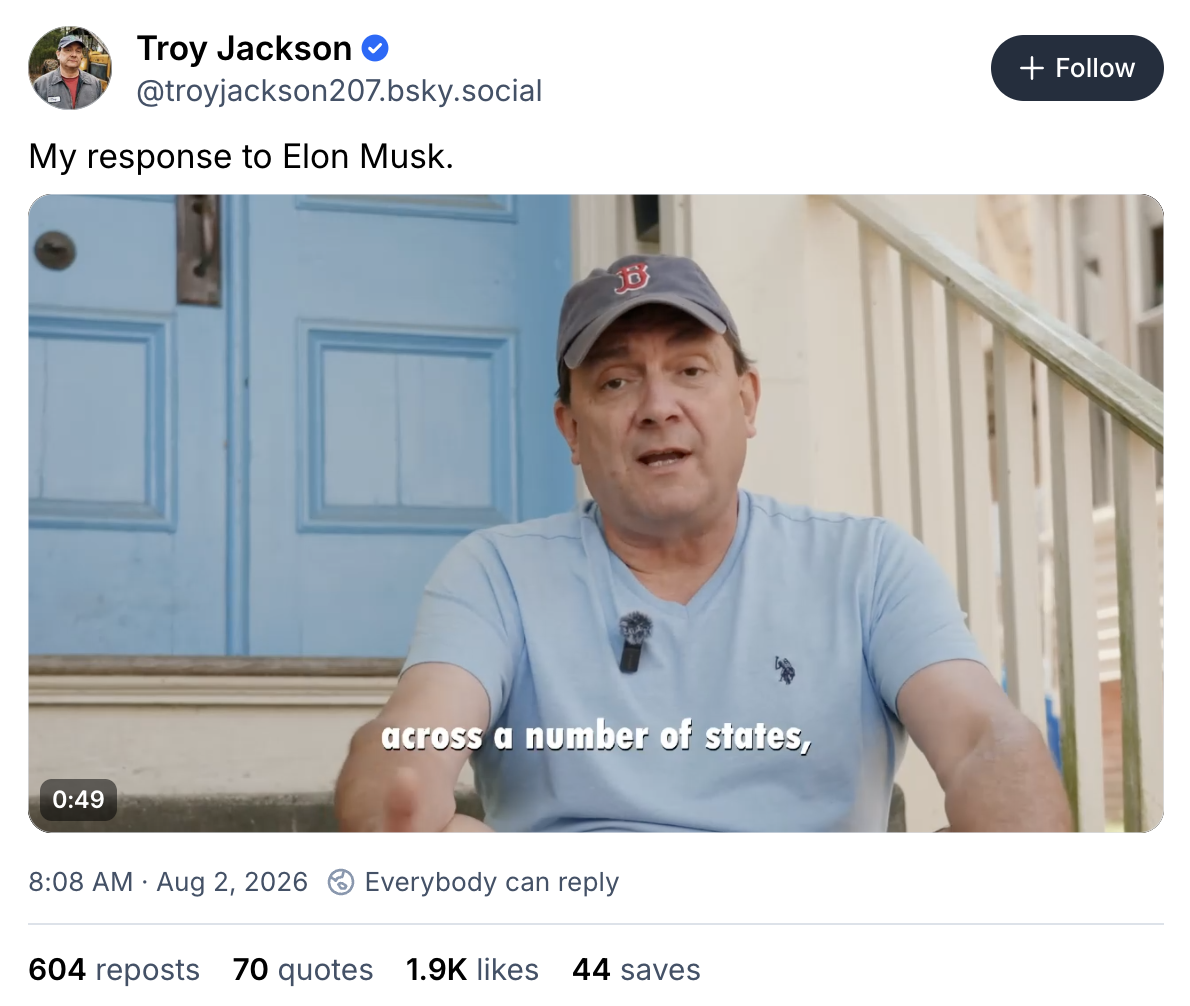
Political ads are usually not a source of inspiration, but one released by Democrat Troy Jackson, who’s challenging GOP Sen. Susan Collins in Maine, came close because of its simplicity. He filmed it after the news broke that ex-trillionaire Elon Musk plans to spend $100 million to help GOP candidates in the midterms, including Collins. |
No flash. No pizzazz. The ad offers a straightforward “get lost, Elon” message, and in a simple, down-to-earth fashion, Jackson bemoans the power of big-money politics. More of this, please. |
The Watch, Read, and Listen List |
The Odyssey. Generals, it’s been said, are always fighting the last war. Perhaps that’s true for film directors. In Christopher Nolan’s The Odyssey, he presents us with an ancient Greek hero who ends up bearing a striking similarity to Robert Oppenheimer. Both men, through the deployment of their unique skills and abilities, helped bring about tremendous military victories—Odysseus with his Trojan Horse and Oppenheimer with the atomic bomb—but then wrestled with the horrific consequences of what they wrought.
Toward the end of the blockbuster film, in a confessional speech to his wife, Penelope, Odysseus, in disguise as an old man, bemoans his sly maneuver at Troy, noting that it led to a massacre. He had witnessed his fellow Greeks barbarously murder the citizens of Troy. And his trickery with the horse had made it possible. He had broken a social code—“violated all that’s ever sacred between people”—by presenting the Trojans an “offering of peace” that was an act of treachery that led to “fires, anarchy, and pain.” He goes so far as to say this single action brought about an end to civilized relations between different people.
It’s a heavy load, and the disguised Odysseus suggests this is why it took Odysseus 10 years to return home. At Troy, he had lost his way.
This speech—the most moving moment in the movie—does not occur in Homer’s epic poem. And this is certainly not the Odysseus that Homer spoke of. That Odysseus was long a warrior before his campaign in Troy and presumably was intimately familiar with the excesses of war. In the introduction to her excellent translation of The Odyssey, Emily Wilson notes that while Odysseus is recounting his exploits to the Phaeacians, he describes, in a matter-of-fact manner, his assault on Cicones: “I sacked the town and killed the men. We took their wives and shared their riches equally among us.” That doesn’t seem like a guy who regrets the Trojan Horse stratagem and the ensuing bloodbath at Troy.
But Nolan is providing us the Odysseus we need. For much of the three-hour-long film, it’s hard to discern the emotional center of Matt Damon’s Odysseus. Why does he not head straight home after the war—after being away for a decade? How much does he care for his men, who all perish along the way? What is his odd relationship with Calypso the nymph? (His other extramarital adventures in the poem are not depicted in the movie.) Who is this guy? Yet this speech gives both Odysseus and us closure.
Should we care if this is not the O.G. Odysseus? Nolan’s film demonstrates brilliant filmmaking, but the story sometimes seems like a trek in search of a map—until that moment between Odysseus and Penelope. Wilson penned a scathing review of the movie, and she questioned many of Nolan’s choices. But Nolan’s true achievement is that he took a story written 3,000 years ago and made it relevant for today. If nothing else, this highlights the bonds that exist between us moderns and our ancient ancestors. Despite all the changes across three millennia, commonalities—including our appreciation of a good yarn—remain.
Wilson concludes the introduction to her translation with a similar sentiment:
Reading The Odyssey with fresh, curious, and critical eyes may help us not only rethink our assumptions about people in the past, but also break down some of our modern distinctions and assumptions. Odysseus is a migrant, but he is also a political and military leader, a strategist, a poet, a loving husband and father, an adulterer, a homeless person, an athlete, a disabled cripple, a soldier with a traumatic past, a pirate, a thief and liar, a fugitive, a colonial invader, a home owner, a sailor, a construction worker, a mass murderer, and a war hero. Immersing ourselves in his story, and considering how these categories can exist in the same imaginative space, may help us reconsider both the origins of Western literature, and our infinitely complex contemporary world.
That’s what Nolan tried to do. He used Homer’s poem to prompt us to think about today, not the past. It was an epic task. |
“Volver a Celaya,” Steve Earle and Los Lobos. For half a century, Steve Earle has been writing songs, and his powers remain as potent as they’ve ever been. Exhibit A: the single he released last week, “Volver a Celaya,” which he recorded with Los Lobos, the great East Los Angeles band and national treasure.
The song tells the story of a Mexican migrant to San Antonio, who years ago finagled his way into a crew framing houses, raised a family (sending two sons off to war), honored and achieved the American dream, and now cannot believe what has become of this nation. He decides to leave the United States and return to his home in Mexico. It’s a poignant and melancholic tune, with the heartbreak accentuated by Los Lobos’ instrumental accompaniment.
Earle says the character is based on guys he worked with right after he dropped out of high school in 1971. “These days, with the word ‘immigration’ on the tip of everyone’s tongue, I found myself wondering where Cruz, Armando, and Eusebio are today and what they would make of this mess,” he notes, “so I set to putting words in their mouths.” While Earle and Los Lobos have toured together, they had never worked together in the studio until he sent them this track. This obvious partnership paid off. No Depression notes, “Though he’s been making commercial music for more than 50 years across 21 studio albums, the new song is easily some of Earle’s best work.” Perhaps the best news is that Los Lobos’ Steve Berlin says, “We look forward to future collaborations.”
|
|
|
|
Congratulations, you read all the way to the end! It's a great time to say "I'm in" and start your free 30-day trial. Make sure you don't miss out on what's next: Sign up to start getting Our Land in your inbox each week. We also want to hear from readers (especially those who read the whole thing!). So let us know what you think so far or share something interesting with David at ourland.corn@gmail.com.
|
|
|
|
|