FREE TRIAL VERSION. DON'T MISS OUT. |
FREE TRIAL VERSION. DON'T MISS OUT. |
|
|
|
The Lost Hiroshima Memoir |
By David Corn August 4, 2026 |
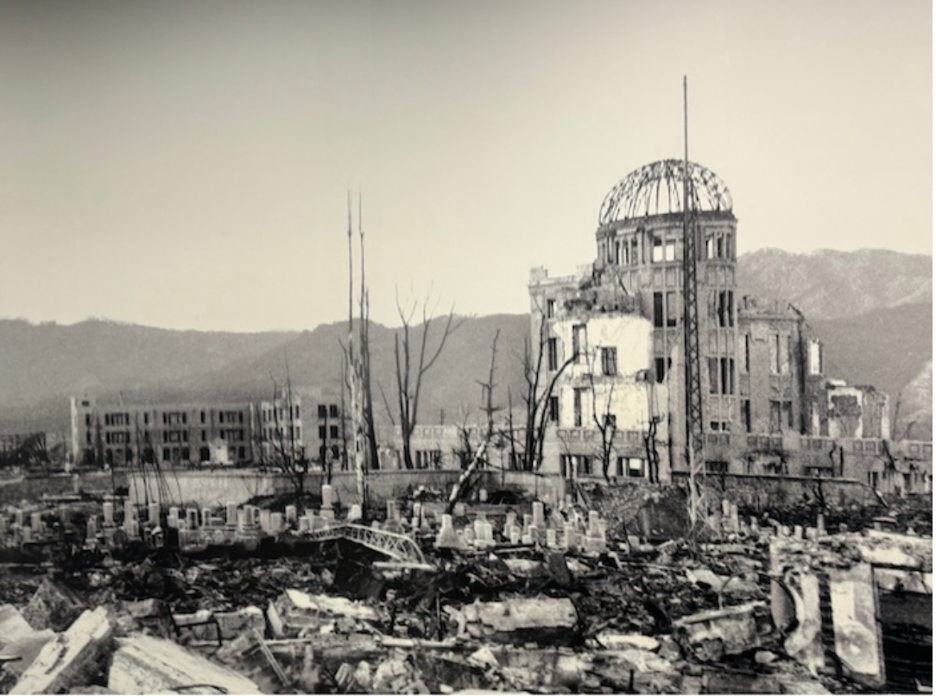
A section of a panorama on display in the Hiroshima Peace Museum composed of photos taken by US military personnel soon after the bombing. |
|
|
|
You're reading a free promotional version of Our Land, and we hope you enjoy David's exclusive writing and don't want to miss out on what's next. Sign up to start receiving a free 30-day trial of Our Land and enjoy all of the behind-the-scenes reports and interactive features with each issue.
|
|
|
|
At 8:15 on the morning of August 6, 1945, Kiyoshi Tanimoto, a minister who presided over a Methodist church in Hiroshima, was two miles outside the city, when a tremendous flash occurred in the sky. Uninjured by the blast, he rushed toward his home and his family, passing hordes of the dead and the gravely wounded—people severely burnt, some holding their eyeballs in their hands—and scenes of horrific devastation, as an immense conflagration consumed his city. He didn’t know what had happened. No one did. This level of destruction was incomprehensible. Tanimoto also couldn’t know at that moment, as he feared for his wife, young daughter, and his parishioners, that he would become one of the best-known survivors of this first act of nuclear warfare and devote the rest of his life to preventing a recurrence of such a hellish catastrophe.
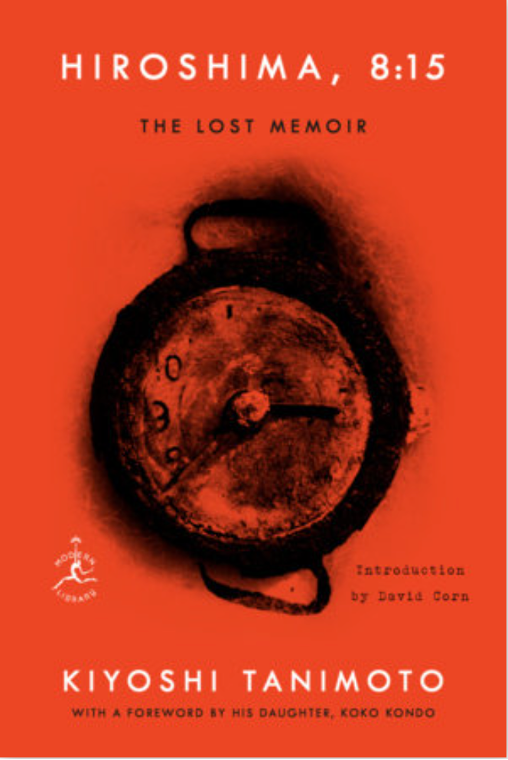
Though I never met Tanimoto, I feel as if I know him. That’s because about two years ago, I was asked to edit his poignant and gripping memoir of that horrible day and the weeks and months that followed, an account that had been lost for decades. This week, the book is being published by Random House’s Modern Library under the title Hiroshima, 8:15: The Lost Memoir. It’s a harrowing tale of the atomic bombing from ground zero and details the heroic action—though Tanimoto never called it that—he took to ferry the wounded across a river, using a small boat he found and only a pole to push it along, so these victims might find medical attention. As the city burned and he tended to survivors who had lost much of their flesh—many would not live long—he kept repeating to himself, “These are human beings.” The horror was numbing. An eyewitness later called Tanimoto a “rescuing angel.”
Kai Bird, a co-author of American Prometheus, the biography that inspired Christopher Nolan’s film Oppenheimer, praises Tanimoto’s work as a “stunning historical discovery and a heartrending testimony of human suffering.” Tanimoto bore witness to one of the most significant days in human history, and his remembrances—as gruesome and disturbing as they are—ought to be read by all. |
|
|
|
My involvement in bringing his memoir to the public began with a trip I took to Japan two years ago. Early in my journalism career, I focused on arms control and nuclear proliferation issues—and then moved on to other topics after a year or two of having nightmares about nuclear attacks. In Japan, I felt compelled to visit Hiroshima, where I was moved by how the city had rebuilt, creating a Peace Park at its center, and dedicating itself to the abolition of nuclear weapons. The memorials to the estimated 140,000 killed by the atomic bomb were inspiring because they were free of bitterness and promoted a never-again message.
Upon my return to the United States, I wrote an essay for this newsletter, in which I observed, “Hiroshima is certainly a reminder that we live in a world imperiled by nuclear arsenals and that we have yet to fully address that danger—and that human cruelty can be excessive and that the total annihilation of human civilization remains a possibility. But the city’s commemoration of the tragedy has a beautiful side.”
A few months later, I was contacted by Donald Rosenfeld, a veteran film producer who as a young man was president of Merchant Ivory Productions (Howards End, A Room with a View, Jefferson in Paris, The Remains of the Day). He informed me he was currently developing a feature film dramatizing one of the greatest journalistic feats of the 20th century: John Hersey’s article on Hiroshima published by the New Yorker a year after the bomb was dropped.
This 30,000-word account—written after Hersey visited the devastated city—consumed a full issue of the magazine and was the first comprehensive depiction in Western media of what happened to the residents of Hiroshima that day, as well as how they were affected by radiation poisoning in the months afterward. For a year, the media had generally shied away from fully describing what had befallen the people of Hiroshima, and the military had downplayed—even dismissed—the injuries and deaths resulting from the bomb’s radiation. The American public had mostly been exposed to images of rubble, not photographs or accounts that showed the pain and suffering of the civilian victims.
The coverage was incomplete—or sanitized—for a variety of reasons. The US military, then occupying Japan, controlled access to the city and was not keen to have reports on the gruesome effects of the bomb, and anti-Japanese racism and antipathy toward a WWII enemy inhibited sympathy for those vaporized, crushed, or wounded in the atomic bombings of Hiroshima and Nagasaki.
Hersey changed all this. His article, which would soon be a bestselling book, told the separate stories of six Hiroshima residents who had survived. The piece recreated the day from each of their vantages—a just-the-facts recounting of the horror, no adjectives. His intent was to let readers envision what would happen to them and their loved ones if their city or town were hit by an atomic bomb. One of the six witnesses was Tanimoto. |
Hersey’s work was an instant phenomenon. The issue sold out. His article prompted stories in newspapers and magazines around the globe. It was serialized on the radio. Albert Einstein asked the New Yorker for a thousand copies that he could distribute. But no copies were left. Hersey made the world see—and understand—what an atomic blast truly did. It was one of the most consequential acts of journalism in modern history. Already a Pulitzer Prize-winning novelist and much-acclaimed war correspondent—he was only 32—Hersey went on to a long and illustrious career as a journalist and writer. He died in 1993.
Rosenfeld was looking to make a movie covering Hersey’s pursuit of the Hiroshima story—there are twists and turns to the tale—and he asked if I wanted to be part of the project. Of course, I did. While we were figuring out my role in this endeavor—I read an early script and gave notes—he informed me that among Hersey’s papers stored at Yale University was a 221-page manuscript in English that Tanimoto had written in 1947 chronicling his experiences in Hiroshima. It was a more detailed accounting than what had appeared in Hersey’s article, told from the Japanese minister’s distinct perspective. At some point, Tanimoto, who passed away in 1986, had sent the typewritten manuscript to Hersey, and for years it had sat in a folder in a box. Tanimoto’s own family did not know it existed. Only a few researchers and scholars had come across it, and then Hersey’s grandson, Cannon Hersey, spotted the manuscript in late 2022.
As a side project to the Hersey film, Rosenfeld hoped to publish Tanimoto’s memoir. He asked if I would edit it and compose an introduction. I immediately said yes. What an honor it would be to help bring Tanimoto’s story to the public. Rosenfeld’s aim was to try to find a publisher for the memoir, but if that failed, he had a small publishing company of his own that could publish the work. I didn’t foresee huge market potential for the memoir but believed it would be a good deed to turn this forgotten manuscript into a book, no matter what happened after that.
So as the second Trump administration began, I found an escape from that chaos in editing Tanimoto’s terrifying reminiscences of August 6, 1945, and the months afterward, during which he contended with severe health problems, strove to rebuild his church, and headed toward what would be a decades-long career as an international peace activist.
Tanimoto had studied at the Candler School of Theology at Emory University in Atlanta prior to World War II and knew English. But passages in the memoir were written in a stiff English, some tough to understand. The manuscript included loads of details about routine church affairs. My goal was to make his memoir readable so this act of witnessing would have a chance to reach a wide audience. I dug up old maps of Hiroshima to check the names of streets, neighborhoods, rivers, and other geographic features. (In the memoir, Tanimoto notes his spelling skills were lacking.) I had to make sense of sections with confusing chronologies.
I did what editors do—and preserved Tanimoto’s straightforward recounting of the apocalyptic scenes he experienced, his rescue efforts, the many tragedies he saw, and the hardships he and other Hiroshima residents endured long after the bombing. In his memoir, he contemplated the morality of the nuclear attack—without bearing any ill will against the Americans—and its impact on human society. He described how he came to see his duty to spread the Christian faith as intertwined with his mission to prevent any more atomic bombings. As I note in an introduction to the book—which serves as a biography of Tanimoto and covers his long-lasting relationship with Hersey—Tanimoto encountered many travails as an antinuclear campaigner. His projects did not always pan out. But he stayed true to this cause until his last days.
Tanimoto’s memoir is more than a historical document. It’s a warning that the existential threat posed by the nuclear arsenals held by nine nations remains. We all live in peril, and human extinction—and global destruction—is only a few bad decisions away. That prospect is hard to grasp and absorb into our daily lives. As did Hersey, Tanimoto shows us the ghastly and inescapable reality of nuclear war—an alert that cannot be sounded often enough. The editors at Modern Library agreed. They acquired the memoir and are now enthusiastically promoting it widely.
|
|
|
|
As for the Hersey movie, the project is moving forward. Director Phil Joanou has written a script, and Rosenfeld is lining up financing. Tanimoto is a main character in the film, which, if it comes to be made, will further spread his crucial testimony. Until then, this book will share the simple but profound message to which he devoted his life: Do not forget.
In a moving foreword, his 81-year-old daughter, Koko Tanimoto Kondo, who as an infant survived the bombing because her mother managed to push her through an opening in the burning wreckage of their home that had collapsed on them, writes, “Human memory is fragile. It’s so convenient to forget unpleasant things, much easier than facing them. But if nuclear weapons are never used again, it will only be because of the memory of what happened to the people of Hiroshima and Nagasaki in 1945. My father was one of the first to understand this clearly.” Tanimoto spent decades prodding people and governments throughout the world to not permit the memory of Hiroshima to fade. With this book, he is still reminding us.
Got anything to say about this item—or anything else? Email me at ourland.corn@gmail.com. | Our Next Our Land Zoom Get-Together Is Tomorrow Night |
Here it comes: August 5, 8:00 p.m. ET. Once again, the Our Land clan will assemble on Zoom. As you know, these gatherings happen almost monthly and allow Our Landers to vent, kvetch, share their observations (and obsessions), and ask me questions. It’s like a cable news panel—but you get to participate. And, yes, we can talk about my forthcoming book, How Russia Won: Donald Trump, Vladimir Putin, and the Fight for America. If you insist. (Click here to preorder a signed copy of the book. Click here to learn why it’s important to preorder.)
These Zoom sessions are only open to premium subscribers—that much-appreciated band of Our Land readers who kick in a few bucks each month to receive the full version of this newsletter, which contains additional behind-the-scenes reports and analysis and a boatload of extra features, such as Dumbass Comment of the Week, Inspiration of the Week, the interactive Mailbag, and reviews of movies, TV shows, podcasts, books, music, and other cultural fare. And there’s MoxieCam™.
Let me be blunt: This newsletter only exists because of premium subscribers. Without their support, it would shut down. So please consider joining this noble group. We need you. If you’d like to receive those extra features, participate in our Zoom get-togethers, or just help us keep the lights on, you can sign up for the full version here. I am grateful for those readers who do, for they allow me to continue this modest venture—and they make it possible for others to receive the limited version.
|
|
|
|
The Watch, Read, and Listen List |
Disclosure Day. Steven Spielberg knows how to make exciting movies with thrilling chases, going back to his 1971 feature film debut Duel. Disclosure Day, his latest flick, is essentially one long chase, and it’s damn fun. But—to be a killjoy—I wonder if it reaffirms a Deep State narrative that’s not productive for American democracy these days. Normally, the message of a popcorn movie doesn’t mean much. But this is Spielberg. So…it does.
Disclosure Day, which harks back to E.T. and Close Encounters of the Third Kind, opens with Daniel Kellner (Josh O’Connor), a cybersecurity expert, on the run. He works at a secretive corporation called Wardex, which monitors alien encounters, recovers technology from crashed UFOs, experiments on captured extraterrestrial beings, and, most important of all, prevents any of this from becoming public, as part of a conspiracy involving the Pentagon, the intelligence community, and military contractors—but not the president, who’s kept in the dark. Kellner is something of an Edward Snowden figure who has swiped an archive of footage revealing that we are not alone, as well as a piece of alien technology that affords humans seemingly supernatural powers. His plan: Let the people know. But Noah Scanlon (Colin Firth), the head of Wardex, and his small army of security goons are after Kellner to stop him.
Meanwhile, Margaret Fairchild (Emily Blunt), a meteorologist at a local television station in Kansas City, Missouri, suddenly comes to possess psychic abilities. She can speak any language, including alien. And someone or something is guiding her in Kellner’s direction. She’s obviously part of a larger plan she doesn’t fathom. When she meets up with Kellner, the Wardex squad has two targets to race after. One scene involving two speeding trains is a wonderful throwback to classic movie chases and reminiscent of the car-in-a-tree set-piece in Jurassic Park.
There are nail-biting pursuits, but not a lot of suspense. It seems clear from the start—and the title—that Spielberg is going to get what he wants: disclosure. And therein lies the rub. What’s being disclosed here—and affirmed—is basically every UFO conspiracy theory. The stolen footage shows that the infamous Roswell incident was indeed a UFO crash, with ET bodies recovered, and that a secret cabal for decades has been reverse-engineering alien tech and using samples from these beings in biological experiments. And, yes, alien abductions are real. In recent years, we’ve learned that the US government has kept secret the existence of videos and accounts of what’s now called Unidentified Anomalous Phenomena, but nothing revealed so far has suggested aliens with big heads, gigantic eyes, and spindly limbs and fingers are among us.
Spielberg appears to believe they are—or adopts that view for this film—and serves up the full megillah. The movie endorses the notion that a diabolical Deep State is in charge and can get away with anything—that is, until Kellner goes rogue and the aliens awaken Fairchild’s powers. Yes, it’s just a movie. And plenty of great films have been based on the premise of secret government conspiracies. (I wrote a novel in that vein.) But at this moment in time, I’m not sure we need more paranoia injected into the national conversation.
The film does explore a big question that the recent real-life disclosures have prompted: If evidence were to emerge that intelligent life existed beyond Earth, what impact would that have on us humans? Would it be too much to handle? Would it challenge people’s faith and subvert certain religions? Might it bring Earthlings across the planet closer together? There’s been a sharp discussion about this on the right, which I wrote about a few months ago. It’s obvious what Spielberg thinks. In the movie, the world is on the brink of nuclear war for a not fully explained reason—it has something to do with North or South Korea—and all the action takes place against the backdrop of potential annihilation. With the superpowers heading toward nuclear confrontation—it’s DEFCON 2!—what might save the day? You don’t have to guess.
|
Days of Unrest, Margo Price. When I first heard Margo Price’s “Oval Room,” a track off her recently released mini-album, Days of Unrest, I thought she had written the song with Donald Trump in mind. (“He's the president / But I don't care / He's a businessman / He got business ties / He got dollar signs… In the desert sands /And the jungle deep /He thinks everything /Is his to keep / He's a real cowboy /With his makeup on.”) But checking the credits for the tune, I discovered it was composed by country music singer-songwriter Blaze Foley in 1984. He was poking at Ronald Reagan, yet, as Price demonstrates in her honky-tonkish version, it also applies to the current inhabitant of the Oval Office, which she makes clear in the video for the song.
Price is a country musician whose voice evokes comparisons to Loretta Lynn and Tammy Wynette and who blends country, rock, psychedelia, and other genres. She’s long been a fixture on the Nashville scene and has performed on Saturday Night Live and hit the No. 1 spot on the UK country chart. She’s also an activist, serving on the board of Farm Aid and supporting the ACLU and Oxfam. It was no surprise last month when she put out this collection of politically relevant songs.
The album includes a rendition of “De Colores,” the traditional Spanish-language song of unknown origin long associated with the United Farm Workers, and a poignant take on Woody Guthrie’s “Deportee (Plane Wreck at Los Gatos),” with Joan Baez joining Price on the vocals. It’s quite sad how this song resonates so sharply 78 years after it was written. Days of Unrest also delivers a high-octane rocking version of Bob Dylan’s “Maggie’s Farm.” Price imbues her music with a ton of sass, passion, and concern—and does kickass country the best way possible.
|
|
|
|
Congratulations, you read all the way to the end! It's a great time to say "I'm in" and start your free 30-day trial. Make sure you don't miss out on what's next: Sign up to start getting Our Land in your inbox each week. We also want to hear from readers (especially those who read the whole thing!). So let us know what you think so far or share something interesting with David at ourland.corn@gmail.com.
|
|
|
|
|