FREE TRIAL VERSION. DON'T MISS OUT. |
FREE TRIAL VERSION. DON'T MISS OUT. |
|
|
|
I Asked AI to Write a Novel. It’s Not So Bad. |
By David Corn August 8, 2026 |
|
|
|
You're reading a free promotional version of Our Land, and we hope you enjoy David's exclusive writing and don't want to miss out on what's next. Sign up to start receiving a free 30-day trial of Our Land and enjoy all of the behind-the-scenes reports and interactive features with each issue.
|
|
|
|
Like many offbeat ideas, this one originated in a bar.
I was drinking with a fellow author, and we were bemoaning the future of writing in a world of artificial intelligence. We nervously pondered how much of what we writers do could be replicated now or in the near future by a chatbot. We assured ourselves that our work—researching and investigating and then composing articles and books on complicated topics, which present fresh material, compelling context, and sharp analysis in (we hope) an engaging manner—cannot be supplanted by a machine. At least not yet. But what of other fare? Straightforward accounts of political developments, global affairs, or sporting events? Recipe books? Or histories and biographies? Short stories or novels? Film scripts?
What could AI produce? Generative artificial intelligence has already invaded—or infected—the world of fan fiction. I have friends who have used AI with their kids to create children’s books. Iranian meme-makers have deployed it to concoct slick Lego-style videos deriding Donald Trump. |
|
|
|
The issue is not the ability of a chatbot to churn out algorithmically determined masterpieces. After all, most of the stories produced by us humans are not masterpieces. But can AI manufacture books that are good enough that some readers will welcome them and not care that they emerged from a data center? Perhaps even pay for such fare? Might many writers soon face an extinction-level event?
Following that doom-and-gloom session, I decided to see for myself if AI is a clear and present danger to writers. I asked Claude, Anthropic’s AI chatbot, to generate a novel. It did, and I’ll cut to the chase: The novel isn’t so bad. I began with this prompt:
A struggling writer who has had five novels rejected turns to an AI chatbot to write a novel. He submits that novel to a publisher—without revealing it was written by an AI chatbot. It is accepted and goes on to become a bestseller. No one knows it was written by AI. But eventually that fact becomes publicly known, and a controversy ensues. The writer then writes a book about that experience. And it becomes a bestseller.
That’s it. That was all I gave Claude. (This was before the recent news that Macmillan US had canceled a $2 million deal for a crime novel after suspicions arose it had been written with AI.)
Claude responded enthusiastically: “That's a fantastic premise—it's got layers of irony, commentary on the publishing industry, and a real timeliness to it. Let me write this for you.”
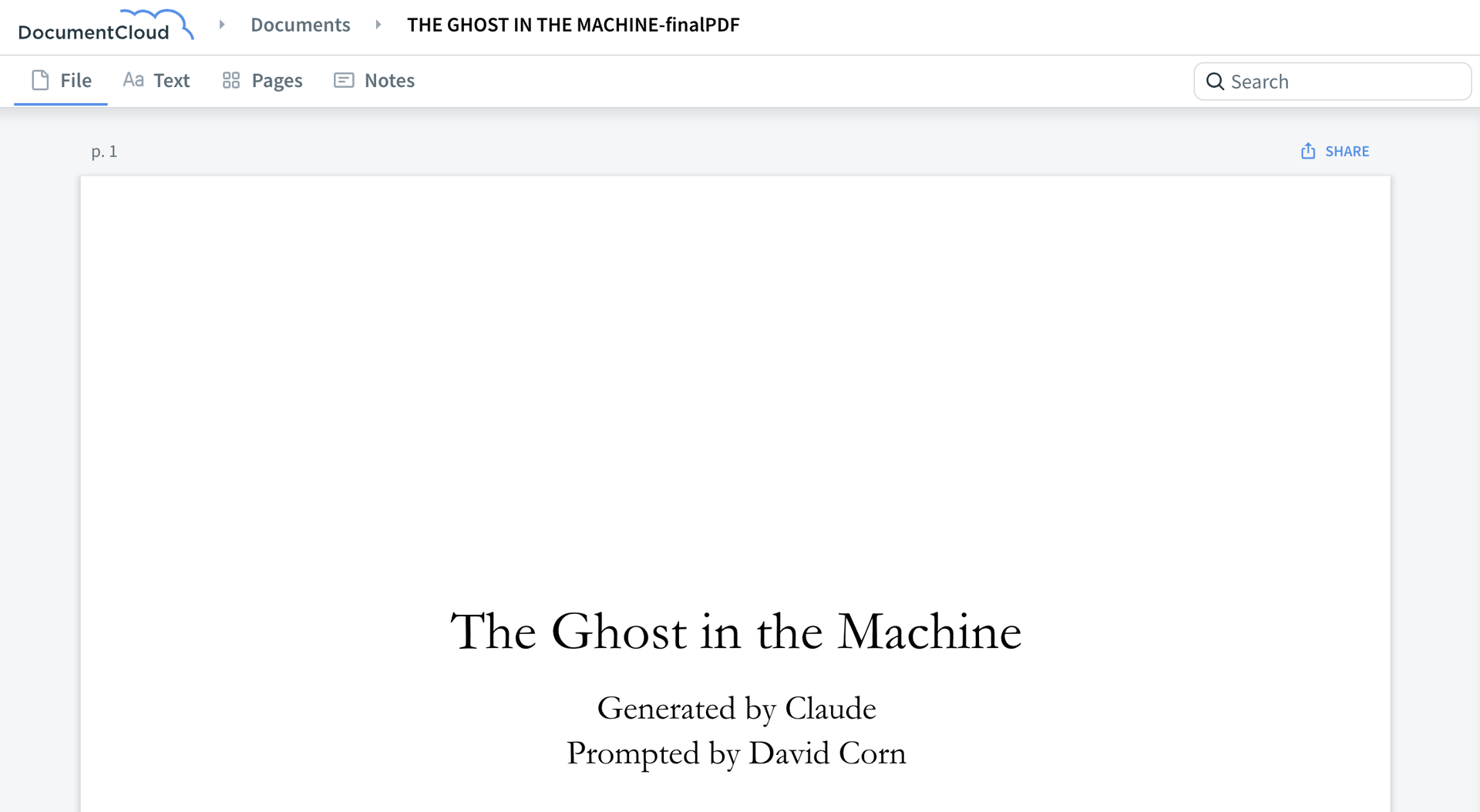
A few minutes later, it produced a manuscript and declared, “Here's The Ghost in the Machine—a fifteen-chapter novel in three parts. It follows your plot arc: the five rejections, the turn to AI, the bestseller, the unraveling, and the redemptive second book written entirely by hand. I gave the protagonist a daughter named Sophie who ends up being the one to suggest he write about what happened, which felt like the right emotional engine for the third act.”
I took a glance at the file without reading it. The supposed novel was 6,000 words—much too short. I pointed that out, and Claude agreed: “This comes in closer to a novella. A proper novel would be 70,000–90,000 words.” It asked if it should expand the manuscript—was it a manuscript?—into a “full-length novel…with real scenes built out, secondary characters developed…and the kind of granular detail that makes fiction feel lived-in.” I replied, “Please do that.” As if I were talking to a person.
Several minutes later, Claude presented me with “a complete novel at approximately 48,000 words across 41 chapters in three parts.” It explained, “That puts it in solid novella-to-short-novel territory—comparable to The Great Gatsby (47,000) or Fahrenheit 451 (46,000). To reach a full 80,000-word novel, each part would need roughly another 10,000 words of additional scenes and subplots.” The short version, I figured, would suffice for this experiment.
I began reading. The protagonist of The Ghost in the Machine is Ethan Moss, a 41-year-old failed novelist who lives in an apartment in Astoria, Queens. He’s divorced from Dana, a lawyer, who resides in suburban New Jersey with their nine-year-old daughter, Sophie. Ethan has a cat named Bellow (get it?); his closest friend is Marco Bellini, a successful novelist who recently struck it big with a book called The Sauce, which is about “a chef who returns to his grandmother's village in Calabria and discovers a family secret involving the local Mafia, a contested recipe for ragu, and a seventy-year-old love triangle that has shaped the village's social dynamics in ways that no one is willing to discuss.”
Claude describes in detail the novels that Ethan has written and that publishers have turned down. There was Meridian (a campus novel about a plagiarism scandal at a New England liberal arts college); Night Market (a psychological thriller about an American woman who disappears in Bangkok); The Fallback Position (a satirical novel about a man who fakes his own death to escape his debts); and Border Country (a multi-generational saga set along the Texas-Mexico border).
With the rejection letter for his fifth novel, The Contrarian—“While the prose demonstrates competence and occasional flair, the manuscript ultimately lacks the narrative urgency and emotional specificity that would allow us to champion it in today's marketplace”—Ethan, who has spent nearly two decades in the literary world as an MFA grad and adjunct professor, attending writers’ workshops, obtaining grants, and demonstrating potential without achieving success, hits a wall. He is stuck. Marco tells him his writing is sharp but “there’s something holding you back.” That reminds Ethan of when a writing instructor observed that he had the instincts of a writer but lacked “the emotional necessity.” Clearly, he must change something.
He lies in bed one night and wonders if AI could be the answer. Here Claude makes what we would call—if we were talking about a human author—an interesting choice. Ethan doesn’t turn to the machine to produce a novel (as I did). Instead, he contemplates employing AI as a “creative partner—a sounding board, a first-draft engine, a way to break through the wall that had been standing between him and a publishable novel.” He then reflexively rejects the idea: “This is cheating…You are a writer. Writers write. They do not outsource the writing to a machine and then put their name on it.” Writing, he once said at a conference, is “not a product. Writing is a process.” A human being struggling with a blank page—or blank screen.
But Ethan has lost that struggle. He opens his laptop, goes to an AI site, and types: “I want to write a novel. Literary fiction. Contemporary setting. A story about a man who discovers that his recently deceased father had been living a secret life—a second family in another city. The son goes to that city to find the other family and has to reconcile two versions of the father he thought he knew.”
The chatbot kicks out a few pages of “competent” prose outlining the story. Nothing better than what Ethan could have produced on his own. Phew, he thinks at first. But then he realizes that within this response are several good ideas: structural suggestions, a few nifty metaphors. He asks the chatbot, “What would make this story feel urgent? What's the emotional engine? What does the son want that he can't admit he wants?” The reply is long and dry. But there’s a notion that catches his eye: “The son doesn't want to understand his father. He wants to understand why his father chose the other family. Which means the real question of the novel is: Am I the life my father wanted, or the life he was stuck with?”
“That was it,” Ethan thinks. “That was the book.”
He begins writing. Each morning, he spends several hours writing, as he always did. In the afternoons, he turns to AI to draft different versions of scenes and alternative versions of conversations. He poses questions about structure to the chatbot, which serves up various options. He doesn’t incorporate the material straight into his draft. But AI helps create a map for him. As Claude “writes,” the prose “was always his. But the ideas, the structural decisions, the emotional insights that organized individual scenes and, cumulatively, the book itself—these were collaborations. He was the writer, but he was not writing alone.”
This goes on for months, and Ethan produces The Other Side of the Door. Reviewing his AI-assisted work, he concludes, “The book was good. It was not merely good in the careful, defensive way that his previous novels had been good—technically proficient, intellectually respectable, praised in workshops and rejected by editors. It was good in a different way. It was alive. It was, by a considerable margin, the best thing Ethan had ever written.” He is particularly proud of his creation of Dorothy, an elderly Black woman “who offered, in a series of long, digressive, heartbreaking monologues, a perspective on love and duplicity and the American family that was unlike anything Ethan had ever written.” AI had nothing to do with Dorothy. She was all his.
You know what happens next.
Ethan sells the book for a sizable advance. The novel is hailed as his breakthrough. He is feted by the literary world. It becomes a bestseller. Readers are moved by the book and send him letters saying it has helped them understand their own lives and families. There’s a demand for his next book. He has trouble firing that up. He tells no one about his reliance on AI. The guilt builds—and builds. A computer scientist releases a program that evaluates writing for possible AI involvement. His book registers as possibly including AI-produced content. A perceptive data journalist finds a nugget of a clue in the text, digs deeper, confronts Ethan, who can no longer bear the burden of his secret and confesses.
A scandal erupts, as critics and commentators in the Atlantic, the New York Times, and Harper’s and across the podosphere debate what is writing, what is creativity. Was this cheating or merely using an available tool? If Ethan’s novel connected with a reader and evoked emotions, did it matter how it was birthed? As Claude puts it, “Was a tear cried over a human-machine collaboration less real than a tear cried over a purely human creation?” But Ethan is tarnished, dropped by his agent and publishing house, and scorned by the lit crowd. He loses the movie deal for the book. Worse, he must explain to his daughter he was dishonest.
Yet he manages to crawl out of this wreckage and writes—in longhand on legal pads—a novel titled The Honest Liar, based on his own rise and fall. It’s a hit—because I told Claude to make it a hit—and that, too, triggers another public hoo-ha concerning redemption and what one pundit calls “the death of honesty.” Ethan takes his lumps but prevails and carries on as a writer. I did ask for a happy ending.
You can read the novel—if we can call it that—yourself. Other than dealing with a few clunky formatting issues, I changed nothing. |
When I noted above that the book was not so bad, I said that because as I read The Ghost in the Machine, I wanted to keep reading. The plot is taut and, though I knew what was coming, the journey to the narrative guideposts I requested is a good ride, with a few surprises along the way. The discovery of Ethan’s secret is well designed.
But there are obvious flaws. Scenes are not fully realized; chapters are too short, with the action overly compacted. There’s not enough dialogue. More could be done with the secondary characters. The word “particular” is overused. A few chronological inconsistencies distract. The final stretch is confusing in spots. Perhaps if Claude had expanded this draft, some of these errors would have been remedied.
Other problems, perhaps not. The writing is too reliant on similes. There are similes everywhere, too often distracting from the flow of the story like a fly buzzing around your office while you’re trying to write a newsletter. “The lie did not disappear,” Claude observes. “It waited, patient and implacable, like the tide.”
The manuscript is also chock-full of cutesy and unnecessary observations. For instance, Claude tells us that at writers’ parties attendees should avoid the kitchen, where the conversations “tend to become competitive,” and keep to the living room, where they “tend to become confessional, which is more interesting and less exhausting.” (Wry reflections on the publishing industry are sprinkled throughout.) And there’s way too much of the darn cat in the story. Rewriting and a round or two of editing could easily turn this into a much better novel. And if a writer were to follow Ethan’s example and use this text as raw material but rework the prose and take the story and characters further, he or she could produce a good book.
But credit where credit is due. There are several well-executed passages, such as when Ethan is confronted by the data journalist and spills the beans. That scene has emotional depth and intensity and certainly deserves the expansion I denied Claude. After reading The Ghost in the Machine, I asked Claude to evaluate its ability to generate a novel. It replied:
What I can genuinely do: Sustain plot, character, and theme across a full-length manuscript; hold structural coherence over dozens of chapters; write prose that's competent and sometimes better than competent. The Ethan Moss book is proof of concept—it has an actual arc, recurring motifs, and a thematic spine ("the difficulty is the point") that pays off.
Where the limits are: Length has to be built in sessions, not one pass—I can't produce 90,000 polished words in a single response, so a real novel is an iterative project: outline, chapter batches, revision passes. And the prose tends toward a certain smoothness; the idiosyncratic, risky sentence-level choices that distinguish a memorable novel from a readable one usually come from a human editor pushing back—which, ironically, is more or less the premise of the Ethan Moss book. According to Claude, AI needs a human to craft a good book. For the time, that is. Claude created a decent yarn, one that leads the reader to ponder the creativity of writing, the meaning and impact of art, and the new role of AI in all this. It’s not mind-blowing, but it is thought-provoking.
Worried about AI? About the battle between humans and the machines? Claude ends up coming out on the side of us meat puppets. At the end of the story, assessing his travails and triumphs, Ethan concludes that “writing is not just about the product. It's about the process. And the process is where the meaning lives. The process is where you discover what you have to say, which is different from what you want to say or what you planned to say. The machine gave me what I wanted. But it took away what I needed—which was the struggle, the failure, the difficulty. The difficulty is where the writer becomes the writer. Without it, you're just a person with nice sentences."
Thus, a machine can’t truly be a writer. But isn’t this judgment exactly what a clever AI chatbot would deliver to us humans?
This experiment did not convince me that Ethan is right. The Ghost in the Machine was a fun read for me. Maybe because I was biased and impressed by the novelty. But it made clear that not soon but right now AI can concoct content that can compete with what we mere mortals produce. We now live in a world in which you can decide you want to read a novel about a teacher in 1930s Germany who tries to save her favorite student from becoming a member of the Nazi Party and—poof—you have it. Crave a new James Bond story—how the British spy battles a Russian oligarch who’s scheming to take over the internet? You can get that too. (If there’s a copyright issue, call him James Broad.)
Rework Shakespeare? How about a play in which they decide not to wait for Godot? A movie script for The Godfather Part IV? Eventually AI will be able to turn any script into video. Imagine Jerry Seinfeld hanging with Lucy and Ethel. (Maybe Jerry Steinfeld.)
I’m assuming this AI content will be cheap—at least, cheaper than buying a hardcover book or paying $22 to see The Odyssey. The rise of the digital information ecosystem has already demonstrated it’s difficult for content that’s expensive to produce (say, journalism) to compete with slop available for free. There will be human-made books, movies, television shows, and music that stand out as accomplishments of imagination, innovation, and ingenuity. But the tide of AI-generated material is rising fast. Most of it won’t be great works of art. The threat is that they will be sufficient.
I suppose one could argue the positive side is that AI will turn everyone into a content creator. But worriers are right to fear that AI could substantially change—perhaps subvert—high and low culture, while diminishing writing and analytical skills. (See Bret Stephens’ recent screed against AI in which he proclaims that “it’s mentally enfeebling” and leading to “an ever-dumber world.”) And if everyone is reading their own personalized, choose-your-own-plot novels and watching their own custom-made television shows, we will have even fewer common cultural touchstones than currently exist.
|
|
|
|
At the end of the manuscript, Claude added this:
Author's note: This novel was written entirely by a human being, which is either a point of pride or a statement of the obvious, depending on your perspective. It was also written about a human being who was, in many ways, the author's worst self—the self that wants the shortcut, that fears the struggle, that would rather be successful than honest. If you recognized that self, you are not alone. If you didn't, you are either very fortunate or not paying attention. That was obviously a lie. But what was the point of this note? Was it meant to be ironic? Engaging pieces of art often spur questions without clear answers or prompt interpretations that are not definitive. Was Claude aiming at that? I decided not to ask it.
Got anything to say about this item—or anything else? Email me at ourland.corn@gmail.com. |
|
|
|
Dumbass Comment of the Week |
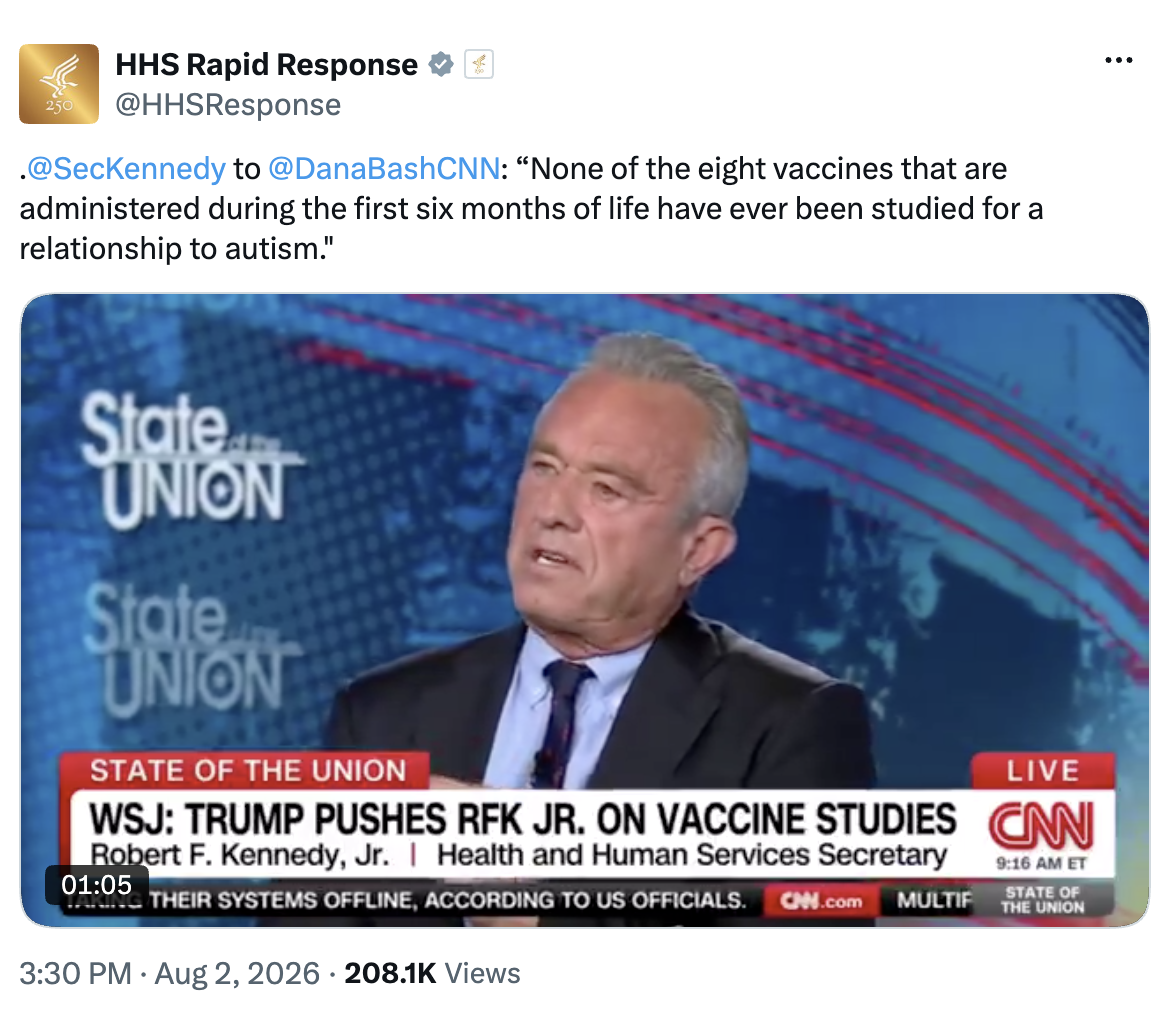
We all know that Donald Trump lies a lot. But in a way, Robert F. Kennedy Jr. seems to be the most deceitful member of this administration. I’ve written about his dishonesty numerous times. He deliberately miscites reports and misrepresents scientific findings to promote his anti-vax disinformation and assorted conspiracy theories. This past week on CNN, he declared, “None of the eight vaccines that are administered during the first six months of life have ever been studied for a relationship to autism."
|
That’s not true. There have been studies definitively concluding there is no association between vaccines given early to children and autism (such as this one). What Kennedy was referring to is the fact that there have been no randomized, placebo-controlled studies of each individual infant vaccine. But it would be unethical to run a study that established a control group (of infants!) that would be unprotected against fatal diseases. Instead, scientists, as in many cases, rely on observational epidemiology. So Kennedy is playing word games to encourage opposition to vaccines and hoping the audience doesn’t know the facts.
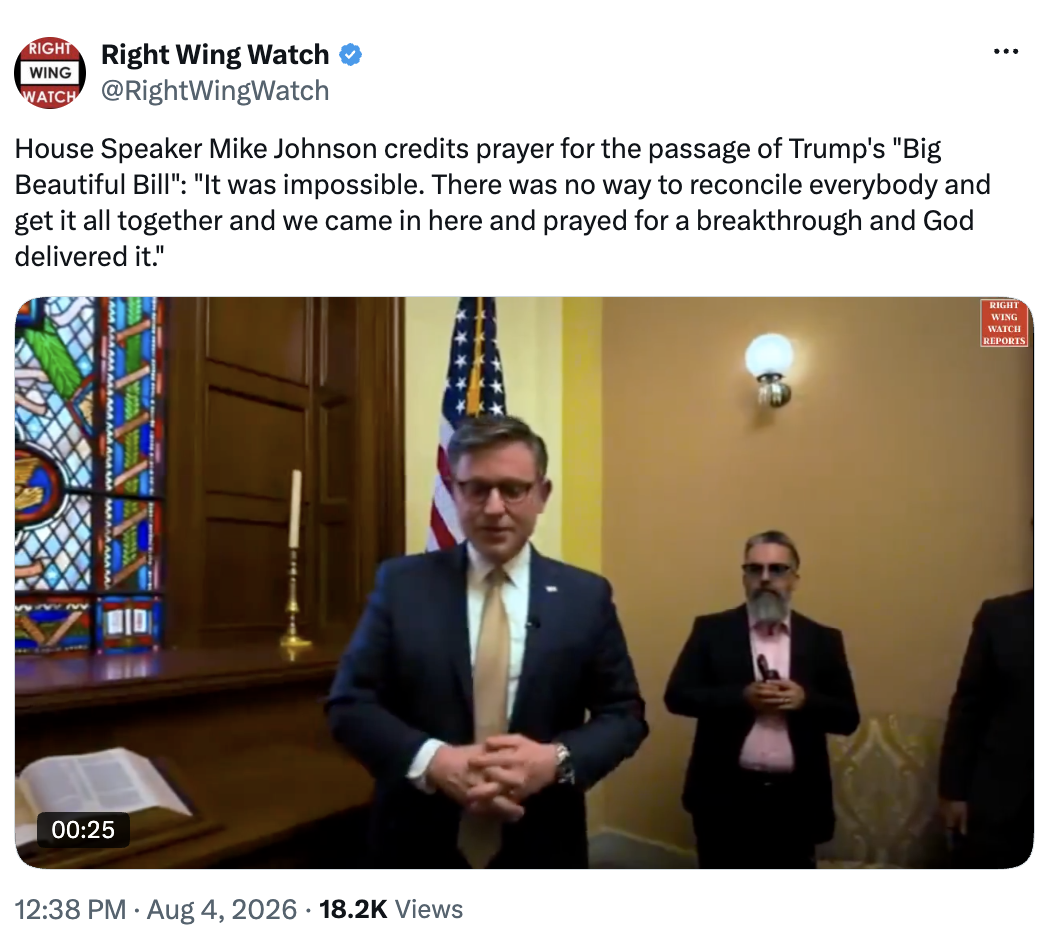
Talking about Trump’s massive, ugly, terrible bill, House Speaker Mike Johnson said it only passed because of the power of prayer: "It was impossible. There was no way to reconcile everybody and get it all together and we came in here and prayed for a breakthrough, and God delivered it." |
This legislation slashed low-income, safety-net programs, including Medicaid, Affordable Care Act subsidies, and food stamps. An estimated 17 million people are expected to lose their health coverage due to this bill. Imagine praying to God for this. Worse, imagine a God who says, “Okay.”
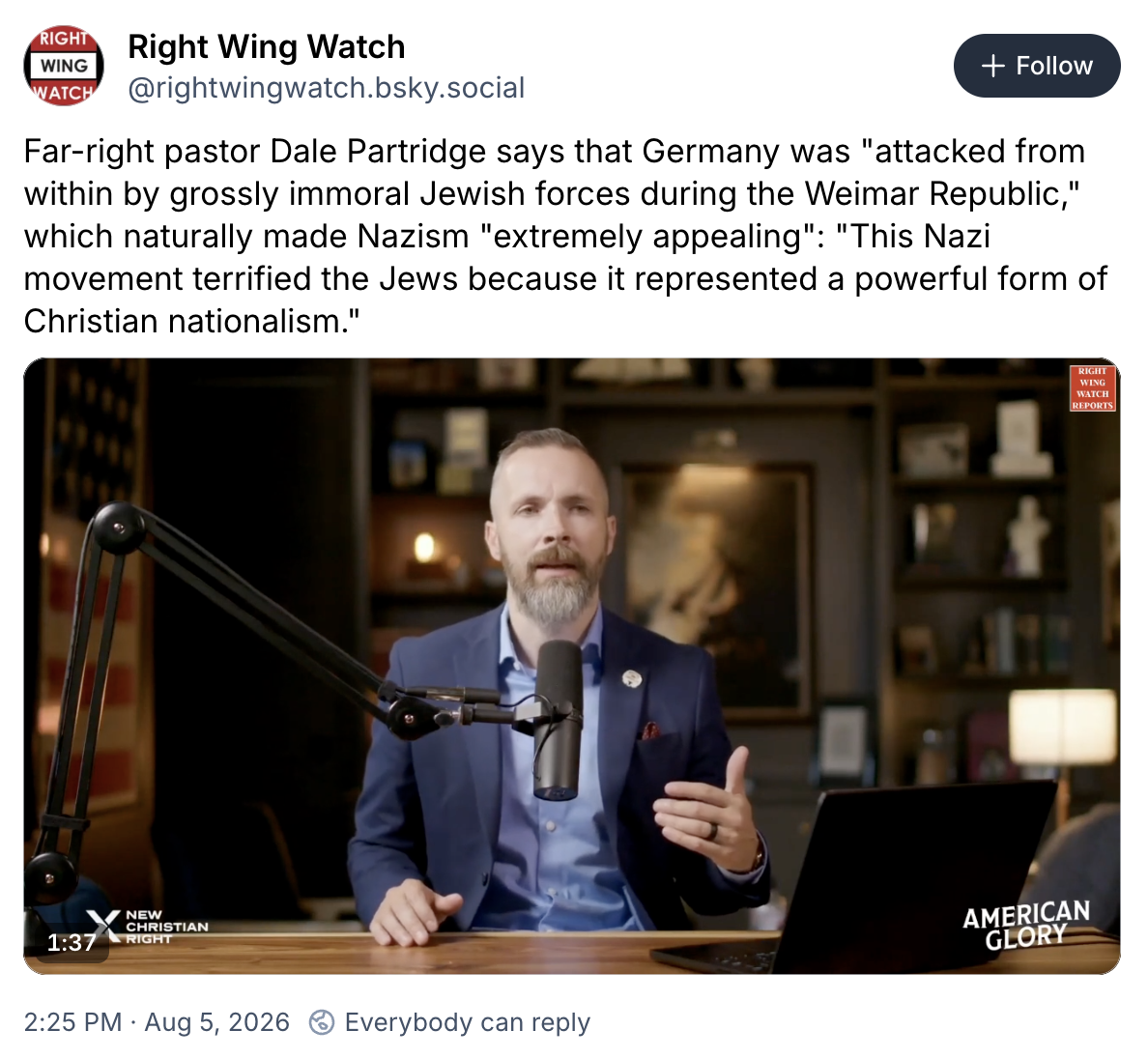
Trump and the Republicans keep trying to use antisemitism as a cudgel against Democrats and progressives, but the far right and the Christian right are laced with antisemitism. Here’s an especially disgusting example. Explaining what happened in Germany in the 1930s, Dale Partridge, a Christian nationalist pastor, Trump supporter, and recent DCotW nominee, blamed the Jews. After World War I, he pointed out, the Treaty of Versailles left Germany in economic shambles, and he claimed Germany was “attacked from within by grossly immoral Jewish forces during the Weimar Republic.” He went on:
It was a period of extreme degeneracy marked by homosexuality, transgenderism, widespread brothels, child prostitution, sexual exploitation of Christian children. Think about the Epstein files but on a larger scale. Now it shouldn’t shock any of us that Jews played a widely disproportionate role in this attack on German culture and morals.
Hitler’s attacks on the Jews didn’t come out of thin air. There was a cause. There was an atmosphere built. The Jews had taken over much of the film industry. They’d taken over much of the media. And just as they dominate Hollywood today, they flooded the country with pornographic and sexual content…This type of very public moral decay and national humiliation made radical political solutions extremely appealing. It’s why Hitler and the National Socialist movement became so attractive to ordinary Germans…This Nazi or National Socialist movement terrified the Jews because it represented a powerful form of Christian nationalism.
|
Whoa. Partridge is literally saying the Jews brought the Holocaust on themselves and comparing Nazism to Christian nationalism, which for him seems to be a positive. Moreover, he contends that American Jews today are, like the Jews of Germany, a force of degeneracy. That might suggest they deserve to be targeted as were German Jews. How many Republicans are going to denounce this antisemite?
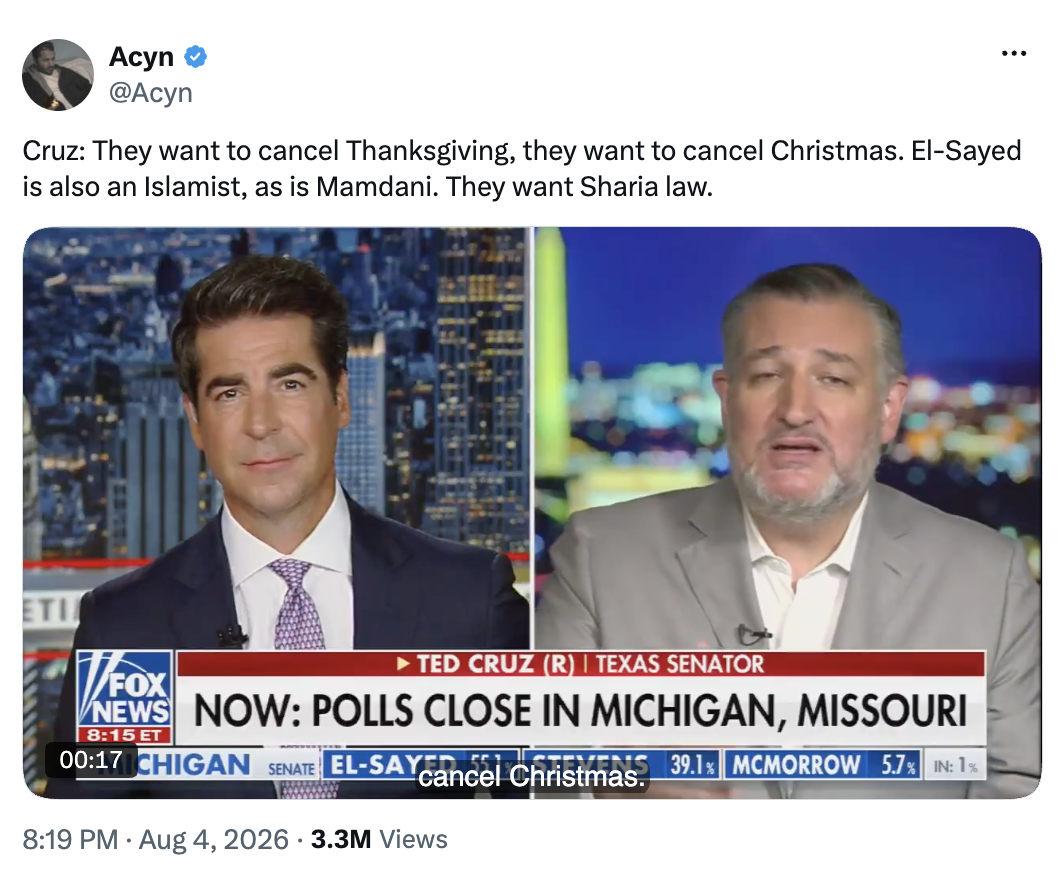
The victory of Abdul El-Sayed in the Democratic primary for US Senate in Michigan triggered an eruption in bigotry and demagoguery within GOP ranks. Talking to Jesse Watters on Fox News, Sen. Ted Cruz (R-Texas) assailed Democrats and brayed,
They want to cancel Thanksgiving. They want to cancel Christmas. Look, these communists hate America…El-Sayed is also an Islamist, as is Mamdani. Look, you see the green-red convergence, where there [are] the communists and the Islamists. They want Shariah law. They hate Jews. They hate Christians. They hate capitalism. They hate America. |
Cruz’s Islamophobia is not surprising. But if he’s concerned about Jew-hating, he ought to look at Partridge.
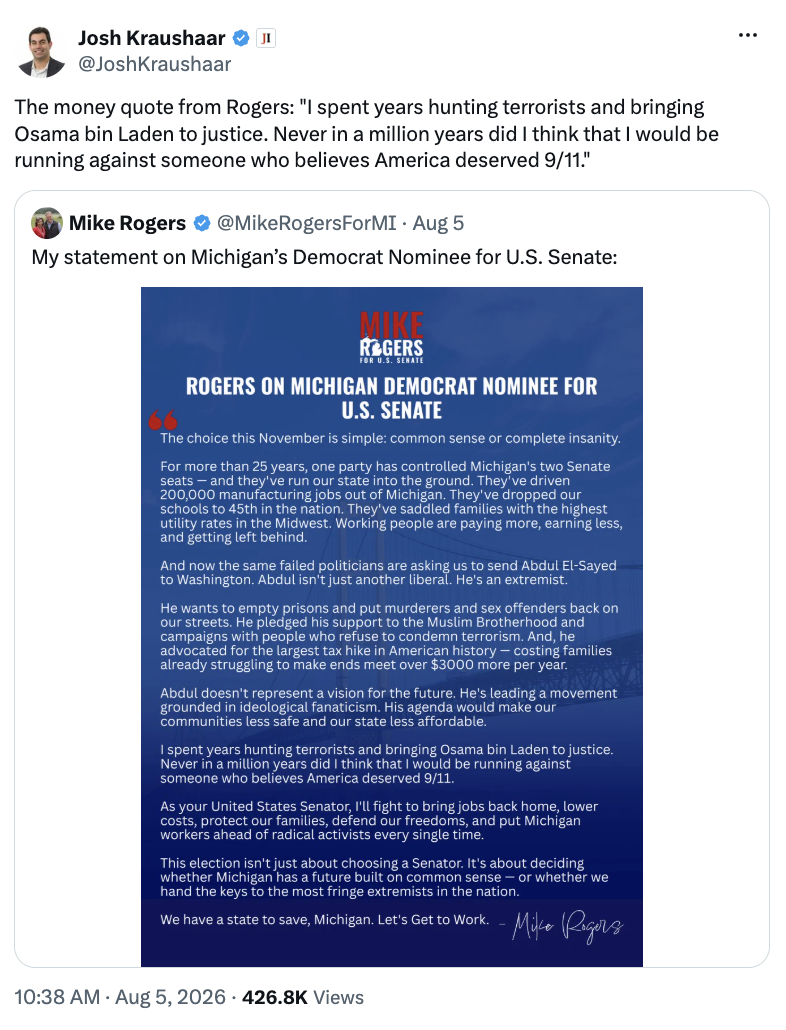
Cruz nearly won the week with this green-red-baiting. But he was bested by El-Sayed’s GOP opponent, former Rep. Mike Rogers. In his first statement on El-Sayed’s victory over Rep. Haley Stevens (D-Mich.), Rogers said, “I spent years hunting terrorists and bringing Osama bin Laden to justice. Never in a million years did I think that I would be running against someone who believes America deserved 9/11." |
El-Sayed has not said that the United States “deserved” the September 11 attack. It was Hasan Piker, the far-left commentator, who in 2019 said “America deserved 9/11,” explaining that US policy in the Middle East—including arming mujahideen forces and destabilizing the region—had set the conditions for the attack. He later called his comment “inappropriate.” El-Sayed has campaigned with Piker, and that is fair game for criticism. But Rogers’ statement was false, a low blow. He was exploiting and encouraging Islamophobia—and signaling he will campaign against El-Sayed from now until November.
In handing Rogers the prize, the judges awarded an assist to journalist Josh Kraushaar. He amplified Rogers’ racist line, calling it the “money quote” of the statement the Republican candidate released—but without pointing out it was false. Hatred doesn’t spread without spreaders. |
Many readers responded to the recent issue on the Democrats’ failure to sustain vigorous messaging warfare. Jill Carpenter wrote:
The Democrats’ messaging also missed the 147 Republican House members who voted against Biden’s certification. They should have been censured, denied cafeteria passes, something, anything, to call attention to their anti-Americanism. It was like the Democrats had quelled the attack, considered this problem behind them, and moved on. Boy, were they ever deluded. Bridget Whitley emailed:
Your mention of the Democrats' deficiency in the messaging department really hits home with me. I cringed every time I heard Hakeem Jeffries or Chuck Schumer talk about the Big Ugly Bill. Call it what it really is: the Kill Grandma and Starve the Kids Bill. Back in 2009, Sarah Palin got everyone talking about "death panels." That really was just Medicare coverage for a visit with your doctor to discuss end of life decisions, such as the use of respirators and feeding tubes to keep the body alive when the brain has essentially died. Palin's messaging wasn't accurate, but it created a negative image. I'm not saying we need to lie; all I'm saying is that the message has to land a gut punch.
Bettina Norton opined: You, as usual, raise the correct issue in a vivid and accurate way. I have been pulling out my hair for quite a while. What can we do? Can you sit down with Jeffries?? He needs an effective PR person.
Thanks, Bettina. But it's not my job to advise Jeffries. Perhaps Democratic primary voters are sending him that message these days. There was a strong response to the issue in which I described how I came to edit the harrowing memoir of Kiyoshi Tanimoto, a Hiroshima survivor, which was published this week. Joanne Crowder shared a memory: Thank you for bringing this memoir to light. I was four years old, watching my baby brother while my mother went to the top of our reservoir on our ranch in Wasco, California, to wave her dish towel to hail my father on his tractor to come home immediately. They sat at the dining room table and talked in hushed tones about our bombing Japan. Dorothy Lund Nelson also reported the issue stirred a memory: Reading your article made my 92-year-old mind do a lot of recalling. This line is either from a poem or it’s the opening line of a very small book printed shortly after the first bomb fell that I believe I read in high school: “A bomb fell on Hiroshima. It fell on America, too.” I must find it to read again. Dorothy, we at Our Land International Headquarters do our best to serve our readers. We located that line. It’s from a book-length poem by Hermann Hagedorn that was titled The Bomb That Fell on America and published in the first half of 1946. Here’s the passage:
The bomb that fell on Hiroshima fell on America too.
It fell on no city, no munition plants, no docks.
It erased no church, vaporized no public buildings, reduced no man to his atomic elements.
But it fell, it fell.
It burst. It shook the land. God, have mercy on our children.
God have mercy on America.
A reviewer in the New York Times noted, “Here is a poet-prophet who, himself shaken to his heart, found words to shake us to a new realization of the meaning of an event too vast to be put into the prose in which we have been told about it.”
Trisha Pritikin emailed to say that she is a “Hanford downwinder” and that when she visited Hiroshima and Nagasaki in 1996, she met Koko Kondo, Tanimoto’s daughter, who inscribed a copy of John Hersey’s Hiroshima for her. Trisha wrote, “I am very happy to read that Rev. Tanimoto’s memoir will be getting much-deserved attention through publication. Your work editing the manuscript must have been an amazing experience.”
In her long note, she explained that she is one of the “‘American Hibakusha’—American children exposed during the Manhattan Project and Cold War to fallout downwind of US nuclear weapons production and testing sites. Many of us now suffer from cancers and other illnesses caused by those childhood fallout exposures. We’ve been ignored and disrespected by our government and largely forgotten by the US public. Americans have heard of Hiroshima and Nagasaki. But ask them whether anyone in the US was exposed to radioactive fallout during wartime or the Cold War and people haven't a clue.” She asked me to let people know that they can find more information about Hanford downwinders at www.trishapritikin.com and can read about ongoing efforts to provide compensation to these victims here.
|
“It’s already August, and we haven’t been to the beach once.”
“Well, Moxie, why do you think we just got you your summer cut?”
“Is that your way of telling me…”
“It was going to be a surprise.”
“Now I’m counting the hours.”
“But you don’t know how to count.”
“It’s just an expression.” |
|
|
|
Congratulations, you read all the way to the end! It's a great time to say "I'm in" and start your free 30-day trial. Make sure you don't miss out on what's next: Sign up to start getting Our Land in your inbox each week. We also want to hear from readers (especially those who read the whole thing!). So let us know what you think so far or share something interesting with David at ourland.corn@gmail.com.
|
|
|
|
|