FREE TRIAL VERSION. DON'T MISS OUT. |
FREE TRIAL VERSION. DON'T MISS OUT. |
|
|
By David Corn April 11, 2026 |
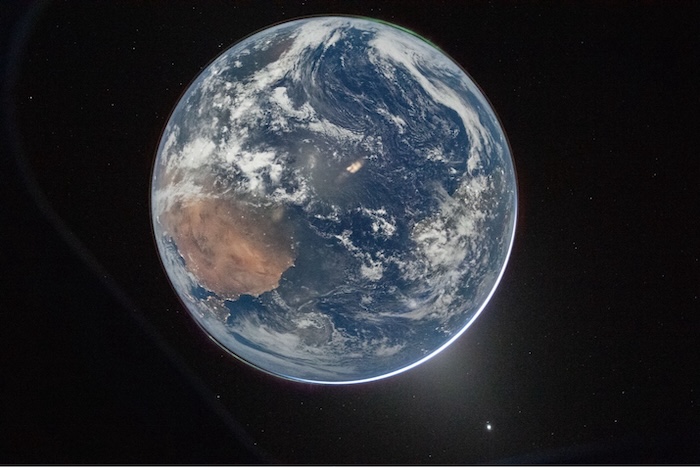
NASA astronaut and Artemis II Commander Reid Wiseman took this picture of Earth from the Orion spacecraft's window on April 2, after completing the translunar injection burn. Reid Wiseman/NASA |
|
|
You're reading a free promotional version of Our Land, and we hope you enjoy David's exclusive writing and don't want to miss out on what's next. Sign up to start receiving a free 30-day trial of Our Land and enjoy all of the behind-the-scenes reports and interactive features with each issue.
|
|
|
It was late on a summer evening. Our counselors roused us out of our beds and brought us to the main dining hall. On a rolling AV stand was a television. We had never seen a television before in the hall—or anywhere else at this sleepaway summer camp near the small New Hampshire town of Freedom. The longtime owner of the camp, a 70-year-old man named Andy Friedman who looked like a tall leprechaun, stood next to the television. Once all of us campers were seated, he told us that this was a special night and that he did not want us to miss a historical moment.
It was July 20, 1969. Neil Armstrong was about to become the first human to step on to the moon. For many of us at the all-boys camp, the single TV was hard to see from across the room. But when the time arrived, we all gasped in wonder at the blurry image of an American astronaut hopping on to the lunar surface. I believe we were then served ice cream.
For those of us of a certain age, the voyage of Artemis II brings back memories of the days of the Space Age and the feelings of awe and pride that were engendered by the near miraculous achievements of NASA. My earliest public memory of life beyond our small apartment in Yonkers, New York, is of John Glenn becoming the first American to orbit Earth. It occurred on my birthday. We watched the liftoff on television, and then several of my toddler friends and I rushed to the window to see if we could spot Glenn in the sky.
|
|
|
The 1960s was a time of societal upheaval. Vietnam. The antiwar movement, the civil rights movement, and the women’s rights movement. The assassinations of JFK, RFK, MLK Jr., and Malcolm X. Student protests. Urban uprisings. Woodstock, then Altamont. The Cold War and the fear of nuclear war. Adjacent to that turmoil and a rising concern for social justice, there was a legitimate debate over the wisdom of spending so much money on sending a tin can containing humans to the moon. In a 1967 speech, Martin Luther King Jr. said, “If our nation can spend $35 billion a year to fight an unjust, evil war in Vietnam and $20 billion to put a man on the moon, it can spend billions of dollars to put God's children on their two feet right here on earth.” That critique is uncannily relevant this week.
Yet the space program—born out of competition with the Russkies—signaled that if we could work through all the conflicts and challenges of that turbulent decade, glorious achievements would lie ahead. Stanley Kubrick’s 2001: A Space Odyssey promised us space tourism. You’d be able to fly Pan Am to the moon and stay in an orbiting hotel. Star Trek promised us a multiracial and multinational society seeking to collaboratively explore new worlds and boldly go where no one had gone before (where everyone spoke English). And The Jetsons promised us flying cars.
The space program fueled these dreams. When the nation was mired in Vietnam and locked in a twilight battle with evil communism, it delivered us astronaut heroes. In troubled times, it was a message that the future could be bright. And those photos of our Earth as a blue marble floating in a dark expanse helped spark the environmental movement.
Then came Watergate, the oil embargo, inflation, defeat in Vietnam, and the rise of even nastier and more divisive politics that exploited racism and hot-button social issues. After more astronauts walked on the moon, drove a lunar buggy on its surface, and hit a golf ball several hundred yards, public interest waned. Budget pressures in the 1970s—driven in part by spending on Vietnam—led to the cancellation of the Apollo program. Besides, the Americans had won the race to the moon. Wasn’t that the point? The contest was over. Space exploration lost its shine. It was just…another government program in a tumultuous nation.
Artemis II, with its four-member crew, lifted off while an unnecessary war of choice launched by Donald Trump raged in the Middle East. The crew was in the middle of their amazing journey—flying farther than any human ever has—when Trump threatened to destroy an entire civilization. There are many headwinds against inspiration that might come from this mission.
After all, we’ve been let down before. We never got vacations in space, global peace and cooperation, and those flying cars. Instead, we now have the planetary threat of climate change and the fear of artificial intelligence either stealing our jobs or subsuming humanity. (HAL was a warning sign!) A multiracial and multilateral international order seems rather distant, particular as globalization spurs economic dislocation and authoritarianism and jingoistic nationalism spread here and abroad.
So I don’t begrudge anyone saying, “We won’t get fooled again,” and refusing to be jazzed by this return drive-by to the moon. Nostalgia is a cheap emotion. I feel its tugs as I gaze at the images Artemis II zaps back to us—which hold more power than pics snapped by people-free probes. But this is a different time, and a space program is not going to excite and galvanize, as it once did. With Trump causing so much chaos, violence, and death—and threatening our democracy—it’s hard to be part of any celebration that he leads, especially one focused on winning a new race to the moon against China and other nations.
Even in space, Artemis II cannot be viewed in a vacuum. My friend David Grinspoon, a renowned astrobiologist who is excited about the scientific research that can be done on new trips to the moon, captured this sentiment—what he called “ambivalence”—in a roundtable discussion for the New York Times: I’ve been a space geek all my life and I can honestly say my trajectory in life was shaped by the Apollo program when I was young. But when I hear the rhetoric about beating China to the moon as a major motivation, I find it distasteful and likely antithetical to long-term success at creating an orbital community and economy.
We already won the race to the moon once! Now we are going to win it again? Setting it up as a short-term race is just asking for the public to lose interest again in a few years and decide to cut the budget and end the program, which would be such a shame. One of the lessons of Apollo and the early space age was the need to care for our planet and unite as one humanity. Yet look at the world today. It’s so fragmented, fractious and seemingly unable to marshal the global-scale responses needed to solve our global-scale problems.
So my excitement about Artemis, my admiration for the amazing engineering and bravery and scientific potential, is tempered with sadness and regret for the lost potential…On this centenary of Robert Goddard’s first liquid-fueled rocket flight we are rightfully in awe and proud of the fact that we can now launch spacecraft beyond the solar system and humans to the moon. Yet that same technology produced the V-2 and the ICBM. We humans are not living up to the promise I saw as a kid enthralled by Apollo, and so I dearly hope, but am not convinced, that this can help re-spark more than just cool rocket rides.
For most of human existence—which emerged between 150,000 and 300,000 years ago—people did not think much about the future. That is, there was no expectation that the future would be much different than the present. But at some point—at the start of the Industrial Revolution or earlier?—we Homo sapiens, looking at the new whiz-bang technology being developed, began believing the future would bring new marvels that could dramatically change our lives for the better. The World of Tomorrow—which was the theme of the 1939 World’s Fair in New York—became a real thing that might indeed happen.
Even after the horrors of the Holocaust, the violence of World War II, the devastation of Hiroshima and Nagasaki, and the terror of the new nuclear age, the space program of the 1960s epitomized that positive futurism. It embodied hope. It captured imaginations. And that didn’t last. No one expects new manned (and womanned) space exploration to revive such uninhibited exhilaration—not even if it brings us back to the moon. But if I could make a wish about Artemis II, it would be that this mission—and the images these four people are sending to the 8 billion of us here on terra firma—reminds us of the vastness of the cosmos and our place within it.
|
|
|
We are all in a very small bubble, protected by an extremely thin layer of atmosphere, which you can see in the photo above. Whether you believe God created this tiny pocket of life in a far-off corner of a too-big-to-conceive universe or it came about through cosmological coincidence, we share a minuscule speck of a speck of a speck (times a billion or more, I’m not doing the math). Keeping in mind our relationship to the rest of everything—I mean, everything—is critical to the long-term survival of our species and of our planet.
Artemis II and subsequent missions to the moon and beyond will not offer us expansive visions of a magnificent future. (Let Elon Musk hawk that hype.) My hope is that this journey and others to come will provide us perspective about our life here. If we realize and recognize our place in the grand cosmic scheme, perhaps we, as individuals and societies, can make better decisions. This is a bit dreamy, I know. But these four people, zooming through the emptiness more than a quarter of million miles from the protection of Earth, have showed us what we look like to rest of the universe. That’s the gift of Artemis II, if we can see it.
Got anything to say about this item—or anything else? Email me at ourland.corn@gmail.com. |
|
|
The Biggest Trump Grift Yet? |
In February, I reported on Trump’s so-called Board of Peace, taking a good look at the paperwork for the global outfit, and I noted that this organization’s absurd rules make Trump its chair for as long as he wants (even after he leaves the presidency) and award him the full authority to pick his successor (who could be anyone) and complete power over the disbursement of the board’s funds. Since Trump has been muscling countries that want to join this private club to kick in $1 billion, he will have full control of a gigantic slush fund and be answerable to…nobody. Not even a board of directors. As I noted, this was essentially a plan for Trump to become the king of the world and pass the crown to one of his children or a favorite crony. It’s ludicrous.
This group was supposed to oversee the rebuilding of Gaza, but the charter declares it will do more and seek to “promote stability, restore dependable and lawful governance, and secure enduring peace in areas affected or threatened by conflict.” That is, anywhere in the world.
Recently, Semafor reported that the “State Department has drawn on funds for international disasters and peacekeeping to transfer $1.25 billion to President Donald Trump’s Board of Peace.” That means Trump’s government has taken over $1 billion from important programs and handed it to, uh, Trump. Semafor only cited one anonymous source for its report, and I haven’t seen this confirmed elsewhere. But if this is what’s happening, it’s an enormous grift and possibly (probably?) an improper act. That means fodder for a congressional investigation—if not now, then if the Democrats win one of the houses of Congress. Let’s not forget.
|
Dumbass Comment of the Week |
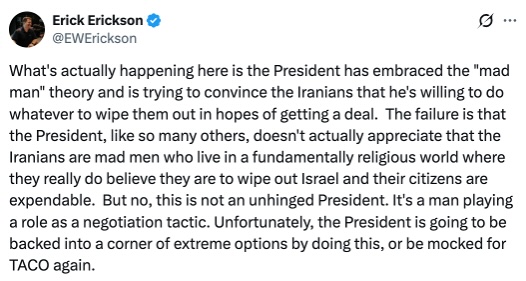
Whenever Donald Trump says something really dumb, a tsunami of stupidity follows. That, of course, happened after he threatened Iran with massive strikes on civilian targets and declared on his social media platform that a “whole civilization will die tonight.” The judges are not going to examine all the possible nominations that followed. But they did roll their eyes at one from conservative commentator Erick Erickson.
Erickson, who often discusses his Christian faith and who believes it is a sin to approve of homosexuality, was once a Never Trumper who called Trump a “fascist” and a “racist.” But he endorsed him in 2020 and 2024, while still criticizing him for particular policies. In response to Trump’s destroy-a-civilization post, Erickson rushed to absolve Trump of immorality and justified it as a tactical move. |
That was far too charitable. Threatening war crimes and mass destruction is probably not what Jesus would do.
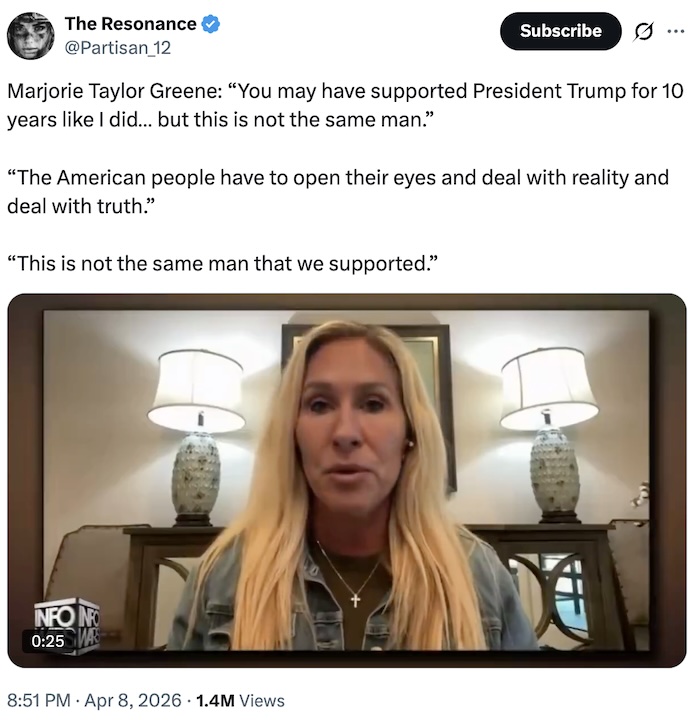
As you probably know—and as I recently wrote about—key figures of MAGA are abandoning Trump over the Iran war and calling him all sorts of ugly names. This includes Tucker Carlson, Candance Owens, Megyn Kelly, and Marjorie Taylor Greene. This week, the former MAGA congresswomen went on Alex Jones’ network to denounce Trump. She said, “You may have supported President Trump for 10 years like I did…but this is not the same man.”
|
Fact-check: This is the same man.
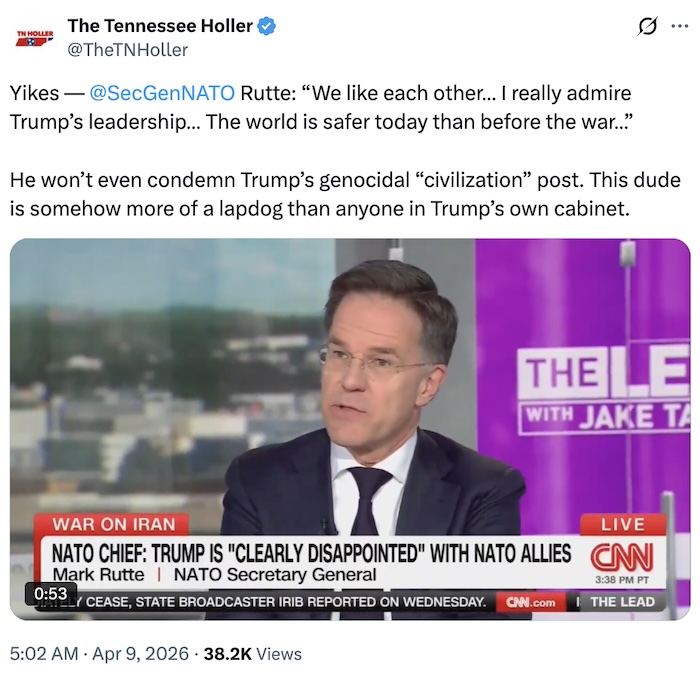
Mark Rutte, the secretary-general of NATO and former Dutch prime minister, has a tough job. He must keep sucking up to Trump to prevent him from trying to pull the United States out of the alliance. And that’s what transpired this week. On CNN, during a visit to Washington, he said of Trump, “We like each other…I really admire Trump’s leadership.” When Jake Tapper asked if the world was safer now than before Trump launched the war, Rutte, without pause, exclaimed, “Absolutely.” |
There is absolutely no way to know that at this moment. And I’m relatively certain Rutte realizes that. When Tapper asked if Trump’s threat to kill an entire civilization bothered Rutte, he said, “What leaders are saying—I’m not commenting on everything. I support the president.” It was a Mike Johnson-like dodge.
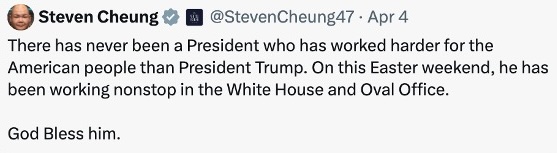
Looking to hype the work ethic of his boss, White House Communications Director Steven Cheung on Easter Sunday tweeted, “There has never been a President who has worked harder for the American people than President Trump. On this Easter weekend, he has been working nonstop in the White House and Oval Office. God Bless him.” |
There was a war going on that he started. Trump gets no points for "working" while he's sending the US military into combat and the world into chaos. Does he deserve a trophy for showing up as commander in chief? By the way, in 2025, Trump visited one of his golf clubs 88 times—meaning he spent almost one-quarter of the year playing golf and hanging out at his clubs. Working hard or hardly working?
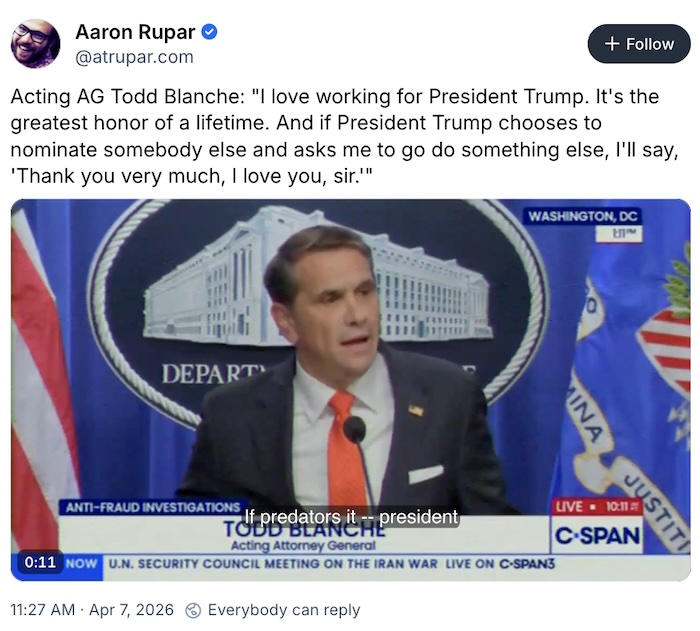
Todd Blanche, the deputy attorney general who was promoted to acting attorney general after Trump canned Pam Bondi, made a dangerous and ridiculous statement this week. He declared that Trump has the right to influence investigations of his political foes. This is a reversal of 50 years of a post-Watergate norm that calls for a degree of separation between the White House and the Justice Department, especially when it comes to criminal investigations.
Remember how the right and Fox News went crazy in 2016 when former President Bill Clinton had an unplanned conversation with then-Attorney General Loretta Lynch on a runway at the Phoenix airport? At the time, the FBI was investigating Hillary Clinton’s use of a private server for her email when she was secretary of state. This encounter was treated as a major scandal, as if the two were scheming to interfere in the probe. Now, there’s not a peep from Republicans when Blanche proclaims Trump can involve himself in DOJ investigations of his enemies.
This week Blanche, who once was Trump’s criminal defense attorney, also gushed: I love working for President Trump. It's the greatest honor of a lifetime. And if President Trump chooses to keep me as acting that’s a an honor, if he chooses to nominate me, that’s an honor, if he chooses to nominate somebody else…that’s an honor…[If] he asks me to go do something else, I'll say, “Thank you very much, I love you, sir.”
|
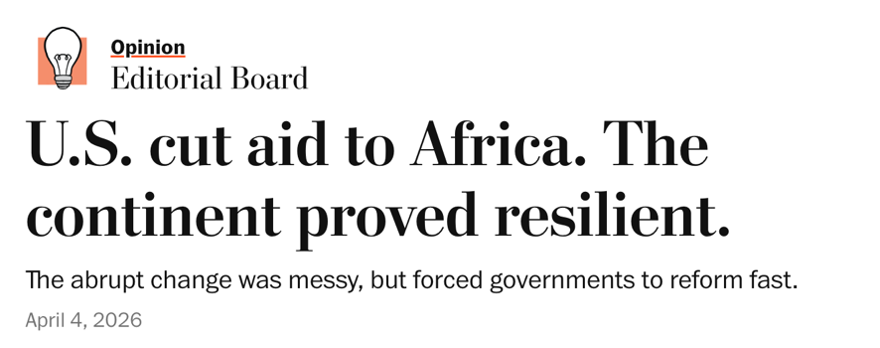
There are some loves that really shouldn’t speak their name. That includes an AG’s love for the president. Though Blanche had two comments in contention, he lost out to the Washington Post editorial page. Jeff Bezos’ team delivered this headline: |
The editorial told readers that they ought not be too pained by Trump’s decrease in overseas assistance to Africa: “The Trump administration’s sharp reduction in aid to Africa last year seemed likely to cause a continent-wide crisis of apocalyptic proportions. While there has been pain, particularly in health care, many African nations displayed remarkable resilience.” Bully for those African nations! Bezos’ freedom-loving editorialists suggested these countries are fortunate to have been cut off: “Countries are better off when their leaders are focused on growing the economy rather than winning more aid dollars.”
According to the ImpactCounter.com, as of this week, the demolition of the US Agency for International Development has led to the estimated deaths overseas of more than 262,000 adults and 518,000 children. For finding the positive angle of this catastrophic story—more free enterprise!—Bezos’ band wins this week. |
|
|
I’m not a big fan of organized religion, but I’m liking this new American pope. When Trump threatened to destroy an entire civilization, Pope Leo was not shy. He said,
Today, as we all know, there has also been this threat against the entire people of Iran. And this is truly unacceptable! There are certainly issues of international law here, but even more, it is a moral question concerning the good of the people as a whole, in its entirety…We have a worldwide economic crisis, an energy crisis, and a situation in the Middle East of great instability, which is only provoking more hatred throughout the world.
He called for negotiations and said, “Let's remember, especially, the innocent: children, the elderly, the sick, so many people who have already become, or will become, victims of this continued warfare—and to remind all that attacks on civilian infrastructure are against international law, and that they are also a sign of the hatred, division, and destruction that the human being is capable of." He even urged Americans to contact members of Congress and press them to “reject” Trump’s war.
This past week, the Free Press reported that in January, senior Pentagon officials, during a meeting with a Vatican diplomat, delivered a harsh lecture, “warning that the United States has the military power to do whatever it wants—and that the Church had better take its side.” The Pentagon claims this is not how that conversation went down. Still, it was encouraging to see the pope stand up to Trump’s genocidal rhetoric. He likely may have to do that again.
|
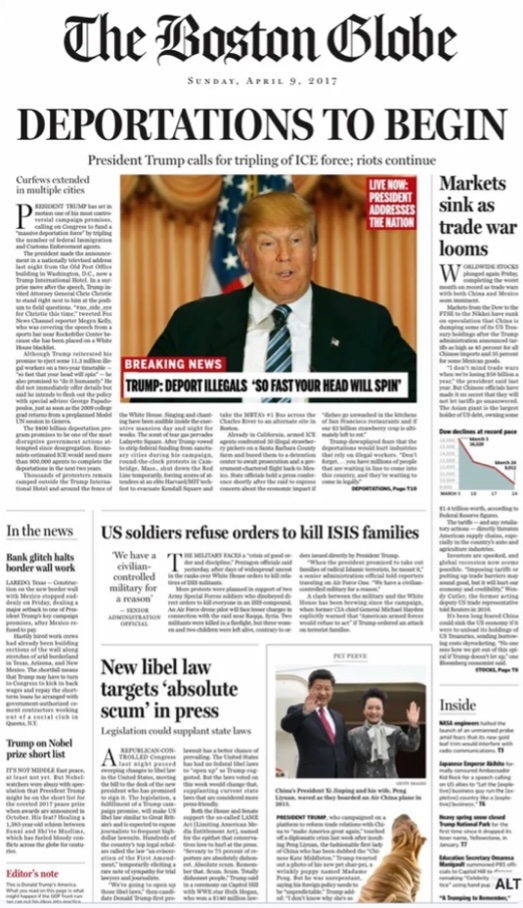
In April 2016, the Boston Globe produced a parody front page that imagined life during a Trump presidency. Nailed it. |
Many readers approved of my naming Defense Secretary Pete Hegseth the worst member of Trump’s Cabinet. But a few had other ideas. Kenneth Nova wrote: I like your case for naming Pete Hegseth, as the worst cabinet member, especially with the departures of Bondi and Noem. Much of the damage that Hegseth is doing certainly manifests domestically, but it largely wrecks our standing in the world. I’d like to make a case for Hegseth to share the “honor” with RFK Jr.
RFK and the minions he has installed in the healthcare apparatus of our country are doing severe harm to the health of our country. Their anti-vaccine rhetoric is poisoning the well-established scientific understanding of the incredible benefits of vaccines. Whatever admittedly inadequate infrastructure we have in our country to deal with the next pandemic, it has been rendered completely and abysmally ineffective. As a senior, I am terrified by the inevitability of our country, and certainly of the current regime, to even begin to address the perils of another pandemic. It will take us a long time to repair the harm that they’ve done. Therefore, I offer my nomination of RFK for the worst cabinet member.
Rebecca Rabinowitz agreed with that:
I can easily nominate another equally appalling, dangerously incompetent, and completely unhinged candidate to your list of "the next to go." That would be RFK, Jr., whose daily assault upon our nation's previously stellar public health infrastructure is catastrophic. His firing of the entire Advisory Committee on Immunization Practices, replaced by anti-vax crackpots and conspiracy-mongering loons, has caused a huge spike in measles outbreaks, outbreaks of the Hib bacterial infection in young children, the near total meltdown of the CDC and FDA, and worse. I think those two—Hegseth and RFK, Jr.—should be booted to the curb.
The problem, of course, is that their replacements will be just as bad, if not worse. The nominee for surgeon general is not even a licensed M.D., but instead, a "wellness influencer," whatever the hell that "Means." (Forgive the pun!) Never. (That was a reference to Casey Means.) Philip Johnson weighed in, too:
I was bemused by your recent column, deliberating over which current Cabinet member is the worst of the worst. Until the last few weeks, I would have placed Hegseth behind FBI Director Kash Patel and Kennedy in the race for second place, in terms of actual long-term damage being done. The ghastly shenanigans in Iran certainly make Hegseth a stronger candidate.
However, this too shall pass, even if the damage lasts for decades. (Well, unless we start using nuclear weapons, in which case all bets are off.) The impact of global warming will last 1,000 years. The heavy metals, toxins, and plastics spreading through the biosphere will also be with us and our descendants long after that current political situation alters. I would therefore assert that EPA Administrator Lee Zeldin, while not nearly as colorful as the others, is in fact the deadliest of Trump's minions.
Good points from all these correspondents. There's plenty of room at the top of this list. Janice Darling emailed:
Many people accuse Hegseth of cosplay in regard to his work at the Department of Defense. But in looking up the characteristics of cosplaying, I see that one trait of the genre is that the person be an expert on the character they are playing. One reads up, gets tutored by those in the know, embodies the character’s body of knowledge and experience in their depiction. In this, Hegseth is clearly deficient. No secretary of defense or learned military leader who has earned his or her stars would ever act like Hegseth does, speak like he does, or conduct an armed conflict/war like he does. So he does not merit the descriptor “cosplay.” He does merit the descriptor fake, or impersonator, or amateur or failed.
I apologize to cosplayers everywhere. Alyssa Owens had a question:
Has anyone written about the problem of voting by mail since Trump stooge, former Postmaster General Joy DeJoy, basically destroyed any semblance of efficiency at USPS? As things stand now, the service is very slow, and it cannot be trusted for timeliness during elections. Plus, Trump and the oligarchs want it privatized.
The issue now is an executive order that Trump recently signed to limit and throttle voting by mail. It seems plainly unconstitutional, but lawsuits against it are the fight of the moment. Joan Lobell also had a question:
Do you know what the limits are for Trump's immunity? Not all his criminal enterprises could be considered "official acts" could they? Like ignoring judicial orders, especially from SCOTUS. Or acting to put his image on our currency. Or deconstructing the White House without any required protocol. Or starting a family-owned Bitcoin business, or consorting with enemies like Putin and etc.
There are supposed to be limits on Trump's presidential immunity, according to the ridiculous Supreme Court decision that granted him such immunity. But they were not specified by the court. And they won't be defined until a case against Trump is prosecuted and hits the courts. Which will not happen while he's in office and controls the Justice Department. |
“Where are you going?”
“Just running to the store, Moxie. I’ll be right back.”
“That’s what you said last time, and you were gone three weeks.”
“I was at the office. Just for the day.”
“It felt longer.” |
|
|
Congratulations, you read all the way to the end! It's a great time to say "I'm in" and start your free 30-day trial. Make sure you don't miss out on what's next: Sign up to start getting Our Land in your inbox each week. We also want to hear from readers (especially those who read the whole thing!). So let us know what you think so far or share something interesting with David at ourland.corn@gmail.com.
|
|
|
|