FREE TRIAL VERSION. DON'T MISS OUT. |
FREE TRIAL VERSION. DON'T MISS OUT. |
|
|
Donald Trump’s Plan to Be King of the World |
By David Corn February 3, 2026 |
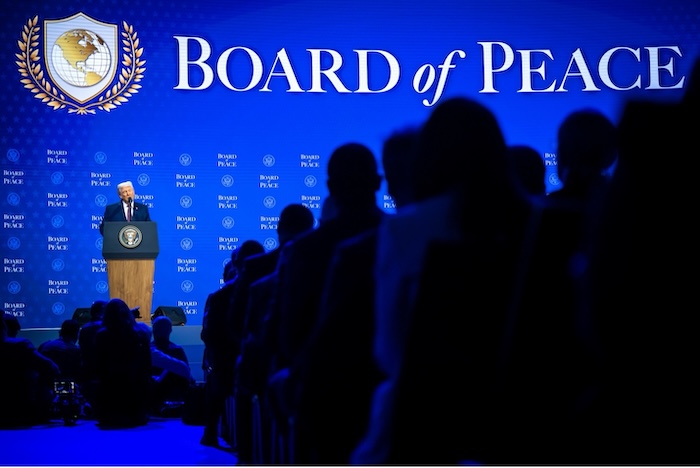
President Donald Trump speaks at the Board of Peace meeting during the World Economic Forum in Davos, Switzerland, on January 22. Gian Ehrenzeller/Keystone via AP |
|
|
You're reading a free promotional version of Our Land, and we hope you enjoy David's exclusive writing and don't want to miss out on what's next. Sign up to start receiving a free 30-day trial of Our Land and enjoy all of the behind-the-scenes reports and interactive features with each issue.
|
|
|
With so much going on these days—ICE murders, Venezuela, Epstein documents, and Melania—one development has not gotten enough attention: Donald Trump’s plan to become king of the world.
Last month, Trump announced he was establishing a so-called Board of Peace to oversee the rebuilding of Gaza, and the chair of this august group would be...him. And the executive board would include Trump envoy Steve Witkoff, Trump son-in-law Jared Kushner, Trump Secretary of State Marco Rubio, Trump Deputy National Security Adviser Robert Gabriel, and Trump donor and billionaire investment banker Marc Rowan, as well as former British Prime Minister Tony Blair and World Bank head Ajay Banga.
Not a very independent board, is it? By the way, the latest release of Jeffrey Epstein documents shows that Rowan, the CEO of Apollo Global Management, according to the Financial Times, had “wide-ranging discussions” with Epstein, though Apollo previously insisted it had not done any business with the sex criminal. (Former Apollo chief Leon Black resigned his position in 2021 after an independent review showed he paid $158 million to Epstein for financial services.) And fun fact about Gabriel: During the January 6 riot, when he was a White House speechwriter, he sent a text message saying, “Potus im sure is loving this.”
|
|
|
Each member of the executive board, the White House said, will oversee “a defined portfolio critical to Gaza’s stabilization and long-term success,” and a Gaza Executive Board within the Board of Peace will also be set up, with Kushner, Witkoff, Blair, and Rowan as members, along with several others, including a Cypriot-Israeli billionaire, an Egyptian intelligence official, and a UN official. No Palestinians were recruited for either of these boards.
So it looked as if this Board of Peace would be a Trump-dominated, crony-ish operation deciding the fate of 2 million Gazans. Not surprising. But it’s turning out to be much more.
Shortly after the White House unveiled this outfit, it released the charter for the Board of Peace. Oddly, the document said nothing about Gaza. It proclaimed that the Board of Peace would seek to “promote stability, restore dependable and lawful governance, and secure enduring peace in areas affected or threatened by conflict.” That is, anywhere in the world. Under the rules presented in the charter, Trump would be the chairman and the US representative to the Board of Peace...forever. That is, until he resigns or is booted due to “incapacity”—which would require a unanimous vote by the executive board. And, according to the charter, he decides who’s on the executive board. Each member serves entirely at his pleasure (and whim).
Even after he leaves the White House, Trump will rule this competitor to the United Nations (which now is in danger of financial collapse). And the charter gives him “exclusive authority” to “appropriate,” which seems to mean total control over the funds. Also, he determines what nations can join. Nations can only serve a three-year term, subject to renewal by, of course, Trump. But if a country ponies up $1 billion (in cash) to the Board of Peace, the three-year limit is waived.
Trump is essentially cooking up a global slush fund over which he will exert complete control. Countries that get in early—while he’s president—will certainly be in a strong position to request preferential treatment in state affairs. The opportunities for graft and grift are immense. He will probably ask Congress to kick in the $1 billion pay-to-play membership fee to guarantee he’ll have a pot of money to spend (or pocket) at his fancy.
That’s not all. How will Trump’s successor as chair be picked? Silly to ask, right? By Trump, naturally. Per the charter, he will designate a successor who “shall immediately assume the position” if Trump leaves or is—ha ha ha—pushed out because he cannot do the job. The charter, as I read it, doesn’t say how long the successor will reign—presumably, under the same terms as Trump. What’s to prevent him from naming Ivanka Trump his successor? Or Don Jr.? Or Jared? (Talk about a succession battle!) Under this charter, Trump could establish an international monarchy of sorts. Hail King Barron!
At the recent World Economic Forum shindig in Davos, Trump held a charter signing ceremony for the Board of Peace, with representatives from Argentina, Turkey, Hungary, Bulgaria, Bahrain, Kazakhstan, Kosovo, Qatar, Armenia, Azerbaijan, Morocco, Paraguay, and Pakistan. Not to be condescending, but this is not the A-team, and many of these nations have assorted human rights problems—an issue absent from the charter. Israeli Prime Minister Benjamin Netanyahu, who backs this Trump venture, couldn’t be there because he’s subject to an arrest warrant from the International Criminal Court for alleged war crimes in Gaza. He was present in spirit, no doubt. Conspicuously missing from the lineup were the United States’ most important allies.
To add to the absurdity, Trump has invited Russia and China to join. Offering a spot on the Board of Peace to Vladimir Putin while his invasion force is killing civilians in Ukraine is quite a bad joke—and an insult to those Ukrainians losing their lives and their loved ones to combat Russia’s aggression.
In fact, the whole thing is a bit of a joke. As Charbel Antoun, a writer who specializes in foreign policy, points out, “The Board of Peace lacks the basic components of a functioning international institution: no defined legal status within existing international law; no enforcement tools or dispute resolution procedures; no accountability mechanisms; a mandate that drifts from Gaza reconstruction into a vague promise to ‘address global crises.’” It can’t really do anything. Except be a platform for you-know-who.
|
|
|
Meanwhile, it’s unclear what the Board of Peace will be doing about Gaza. At Davos, Kushner unveiled a Gaza development plan that called for glittering high-rises on the coastline and gigantic data centers and industrial parks inland. He had a nifty PowerPoint presentation but apparently had not consulted with any Palestinians. He arrogantly signaled this scheme was not open to discussion, remarking, “There is no Plan B.” Kushner did not say who would finance this makeover—or profit from it.
Trump’s Board of Peace is another Trump scam—though much grander than Trump Steaks or Trump’s meme coin (which has dropped about 90 percent in value since being launched a year ago). Trump is looking to shake down nations that want to earn his favor—it’s only a billion bucks!—and set up an outfit he can exploit once he has wrung the Oval Office dry. The charter calls for an official seal for the organization—and the logo Trump approved shows only half the world—but it left out what Trump really wants: a crown.
Got anything to say about this item—or anything else? Email me at ourland.corn@gmail.com. |
|
|
The Watch, Read, and Listen List |
Marty Supreme. Marty Mauser is a real asshole. In 1952, he’s working as a salesman in his Uncle Murray’s shoe store in New York City. But he’s also a ping pong player of immense talent. And, dammit, he’s going to win the world title—no matter how many people he must cheat, lie to, or con to get there. He manages to reach the finals at the world championship in London, but he’s denied what he believes is his destiny. So it’s back to New York City and his Jewish tenement neighborhood, as he schemes for another chance to make it to the top.
Marty Supreme, based on the 1974 memoir of real-life ping-pong champ and hustler Marty Reisman, was directed by Josh Safdie, who co-wrote the script with Ronald Bronstein. These two accomplished filmmakers were part of the team that gave us Uncut Gems, the 2019 gritty crime thriller starring Adam Sandler as a shady jeweler and gambling addict in a helluva jam. Marty Supreme tries to fuse a similar sense of menace with a Rocky-ish tale of athletic quest. Mauser ends up in one perilous situation after another—including a shootout over a stolen dog—as he tries by hook and crook to gather the money he needs to finance his trip to the next big tournament.
The movie is well made. The direction is crisp, the sets and costumes marvelous. Timothée Chalamet nails it as the lead and obviously has a shot at an Oscar for his performance. The film is in the running for Best Picture. But the flaw with Marty Supreme is that it’s hard to root for Mauser. He’s not a likeable rogue. In Uncut Gems, Sandler’s sad-sack character was no winner, but his pathetic desperation made you feel for the schlub. Mauser’s arrogance (supreme confidence?) doesn’t engender sympathy. That’s why it’s puzzling that a past-her-prime-but-still-famous Hollywood actress played by Gwyneth Paltrow has an affair with him. Paltrow’s character is not put to the best use by Safdie and Bronstein in a missed opportunity.
The few problems with Marty Supreme stand out because so much of the film works. It’s a taut roller-coaster of a ride, with Chalamet showing he’s one of the best in the biz. It’s just too bad Marty cares a lot more about Marty than you might. |
|
|
“Streets of Minneapolis,” Bruce Springsteen. On January 24, Alex Pretti was gunned down by federal agents while he was observing and protesting ICE raids in the Twin Cities. That day, Bruce Springsteen wrote “Streets of Minneapolis” to commemorate the killing of Pretti and Renée Good and to support the anti-ICE resistance. (“It’s our blood and bones / And these whistles and phones /Against Miller and Noem’s dirty lies.”) Three days later he recorded the track, and he posted it online on Wednesday, while outrage over the Pretti shooting was running high. The Boss’ speedy response to these state-sponsored executions prompted a question: Why don’t other musical artists engage with current events in this fashion—especially now that the technology exists for rapid recording and distribution?
The fast production of “Streets of Minneapolis” was reminiscent of one of the most important political protest songs in American history: “Ohio,” by Crosby, Stills, Nash, and Young. On May 4, 1970, National Guard troops at Kent State University shot and killed four students during an antiwar protest against the expansion of the Vietnam War into Cambodia. (Only two of the four students were part of the demonstration.) After seeing photos of the tragic event in Life magazine, Neil Young wrote the lyrics for the song (“Tin soldiers and Nixon’s comin’ / We’re finally on our own”), and the band recorded it on May 21. The track was released several weeks later. That was incredibly fast at the time, and “Ohio” became an anthem for the antiwar movement. Over the years, Young has noted that he initially worried he was exploiting the deaths of the students but that he eventually realized the song was an important chronicling of a pivotal moment.
Here’s another example of a quick turnaround protest song. In May 1985, President Ronald Reagan visited a military cemetery in Bitburg, West Germany, and laid a wreath there—an action that drew much criticism because SS troops were buried at the site. Holocaust survivor and author Elie Wiesel, for one, had urged Reagan not to go there, saying, “That place, Mr. President, is not your place. Your place is with the victims of the SS.” Outraged by Reagan’s trip to Bitburg, Joey Ramone, with help from his fellow Ramones, wrote an acerbic tune called “Bonzo Goes to Bitburg” that castigated Reagan. (“You're a politician / Don't become one of Hitler's children.”) It was released weeks after the Bitburg trip and remains one of the best songs from those pioneering punks.
We sure could use more quick-response songs. I hope Springsteen, who traveled to Minneapolis last week to share his new composition at a benefit concert staged by Tom Morello of Rage Against the Machine, inspires others to follow in this tradition. |
|
|
Congratulations, you read all the way to the end! It's a great time to say "I'm in" and start your free 30-day trial. Make sure you don't miss out on what's next: Sign up to start getting Our Land in your inbox each week. We also want to hear from readers (especially those who read the whole thing!). So let us know what you think so far or share something interesting with David at ourland.corn@gmail.com.
|
|
|
|