FREE TRIAL VERSION. DON'T MISS OUT. |
FREE TRIAL VERSION. DON'T MISS OUT. |
|
|
Whose Populism Is the Winning Populism? |
By David Corn October 21, 2025 |
|
|
You're reading a free promotional version of Our Land, and we hope you enjoy David's exclusive writing and don't want to miss out on what's next. Sign up to start receiving a free 30-day trial of Our Land and enjoy all of the behind-the-scenes reports and interactive features with each issue.
|
|
|
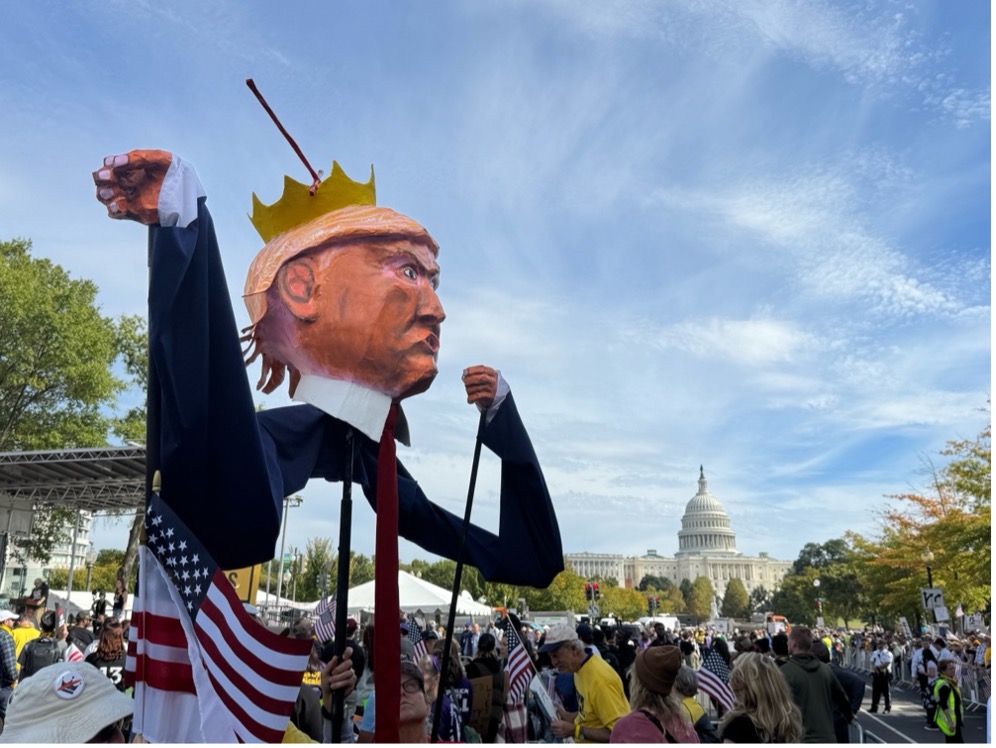
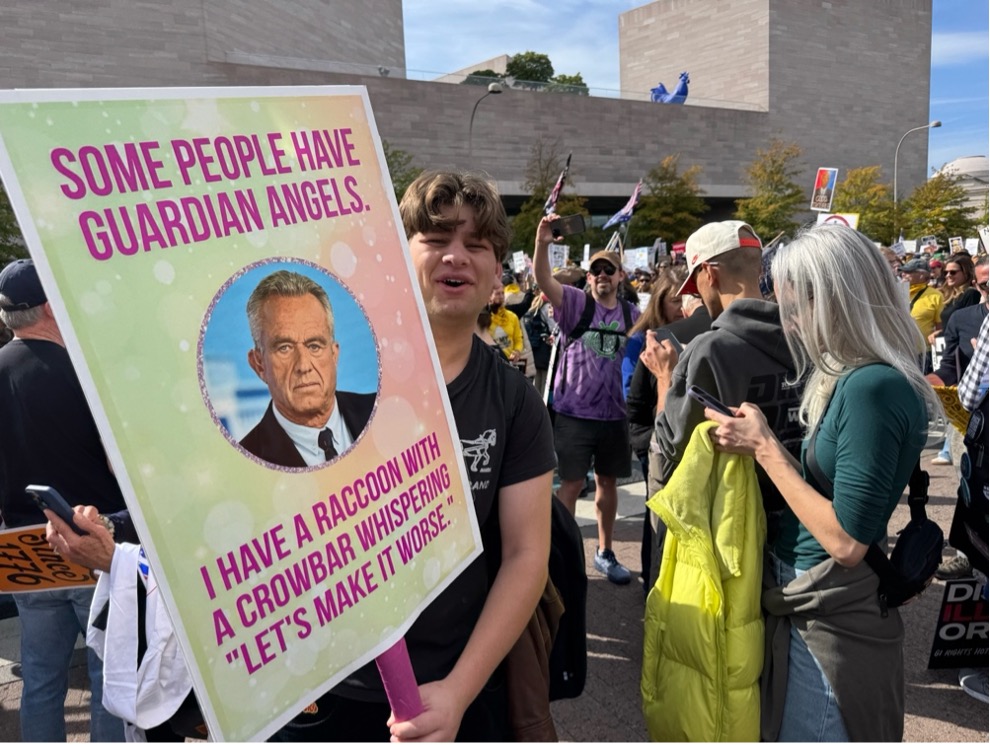
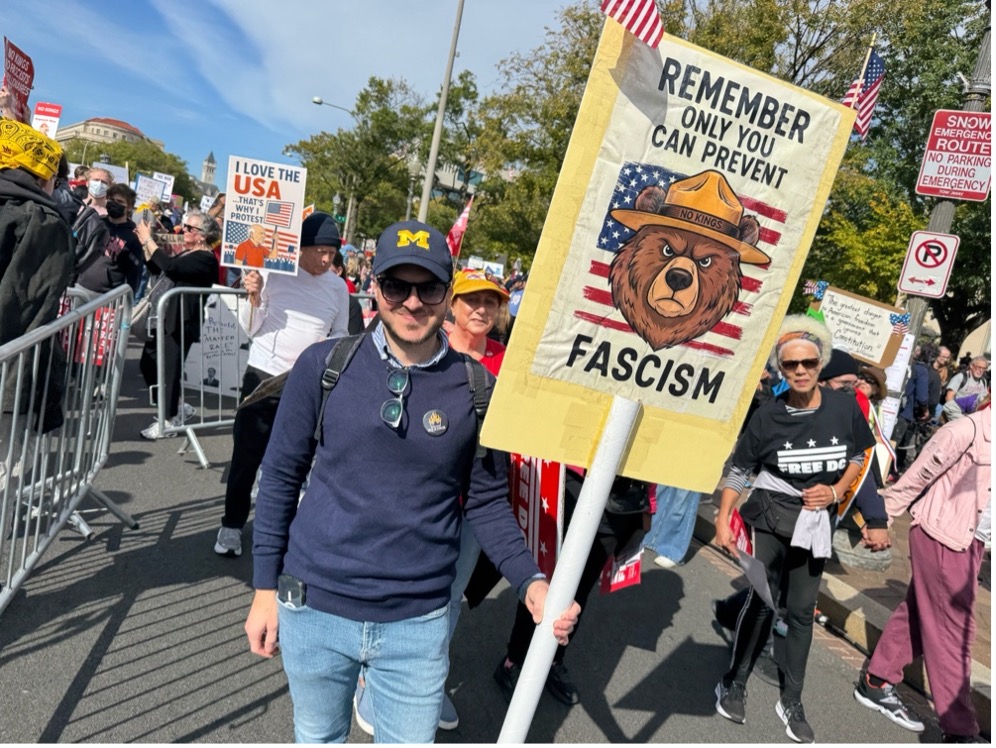
Standing within the massive crowd at the Washington, DC, No Kings rally on Saturday—which was full of people both angry (at Donald Trump’s deconstruction of America) and joyous (to be part of a community of shared concerns)—I had something of an epiphany. Okay, maybe more an observation.
Before I explain, let’s rewind the tape to the primary season of the 2016 presidential campaign. Do you remember how pundits referred to both Trump and Sen. Bernie Sanders (I-Vt.) as populists? There was much talk of those voters who supposedly could easily vote for one or the other, and Sanders’ supporters argued that was one reason he ought to be the Democratic nominee.
On the surface, this comparison held. Trump and Sanders each were pushing sharp critiques of elites and the people in power. Sanders railed against billionaires who were pouring money into the political system to protect their own interests, corrupt decision-making, and thwart actions that could benefit the many. Trump brayed that the folks in charge were idiots who had screwed middle America and that it was necessary to blow up the establishment to restore greatness to the nation. Both men championed forgotten and neglected Americans and blamed the people at the top for undermining the American Dream. Each spoke the language of populism, yet their respective versions of populism did not overlap as much as they stood in opposition to each other.
|
|
|
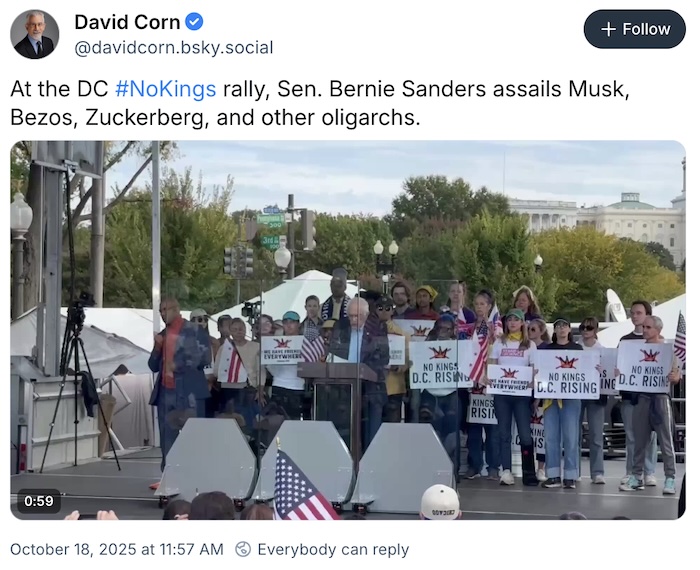
That’s what occurred to me at the DC rally. Sanders was the closing speaker, and he presented his now-familiar populist case against the oligarchy, slamming Big Tech overlords, including Elon Musk, Jeff Bezos, and Mark Zuckerberg. Here’s a taste:
|
Sanders asserted that it was necessary for Americans of various backgrounds, races, ethnicities, religions, and identities to band together to forge a country with a more just economic system in which health care, affordable housing, quality education, and retirement security are available to all. It was an inclusive message, with the dream of an expansive and diverse coalition making connections among different groups to serve common interests. The only foes in this picture are the 1 percent and their political puppets, whose greed and conniving prevent the building of a society that far better addresses the needs of the many.
Trump’s populism is divisive. While he assaults elite institutions, such as universities, the media, and (occasionally) certain industries, his main enemies are other Americans, such as those he calls “the radical left”—which, in his telling, includes progressives and all Democrats. He assails his fellow citizens who challenge certain traditions or precepts. The main threat to the nation, as he describes it, comes from socialists and commies who raise questions about the country’s past and who identify and criticize its flaws. They want to destroy the United States and are undermining the country. They are, as he has said, “the enemy within.” Demonizing a large chunk of Americans and generating fear and hatred are at the heart of this populism.
As we saw in the days before the 2,000-plus No Kings rallies, Trump’s toadies in the GOP tried mightily to brand these protests as “Hate America” shindigs, intending to “other” millions of Americans and depict them as enemies of the United States. That wasn’t surprising. Trump’s political strategy from the get-go has been to rile up his base—white voters with economic and cultural grievances that may or may not be legitimate—and create a gravitational pull that draws in always-vote-GOP voters and a decisive number of less-engaged voters. He’s not looking to widen his electoral base as much as to deepen it, by turning Americans against other Americans.
Looking at the DC crowd, it was easy to see the distinction between the all-of-us populism of the left and the us-against-them populism of the right. The former seeks to create a large bloc of voters who share a desire to advance economic and social policies aimed at achieving a more equitable order. Us-against-them populism feeds on the passions of our assorted culture wars that divide people by ideology, faith, political beliefs, and other notions. This populism of the right is its own form of identity politics, separating Americans into good Americans and the other Americans.
In the last issue of this newsletter, I showed how Sen. Eric Schmitt (R-Mo.) is a master practitioner of this right-wing populism. In a long speech last month, he asserted that real Americans are the descendants of the white Christian Europeans who immigrated to the United States in the 1700s and 1800s and who built an exceptional nation for their families and their descendants to come. Other Americans—whose ancestors were enslaved people, Mexican farmworkers, Chinese laborers who laid railroad tracks—could take a hike. Likewise for those who are the children or grandchildren of immigrants who arrived later—and for those who immigrated here in recent decades. Schmitt railed against powerful elites whose decisions have left Main Street in tatters, but, ultimately, he seemed to care only about Americans with the right DNA.
Traditional Republicans and centrist Democrats do not tend to adopt populist stances. Still, one of the main fault lines in US politics during this stretch is the gap between these two versions of populism. One is fueled by the idea of serving and strengthening a diverse and expanding community. The other is propelled by a circle-the-wagons tribalistic impulse: America is for us, not you. The No Kings marchers did not rant against other Americans. They targeted Trump and his henchmen. Some expressed tremendous antipathy toward the president and his MAGA allies. But they were not fundamentally engaged in the politics of hate. Yet the populism of the right that Trump wields relies on animosity. It runs on rancor and seeks to exacerbate and exploit divisions.
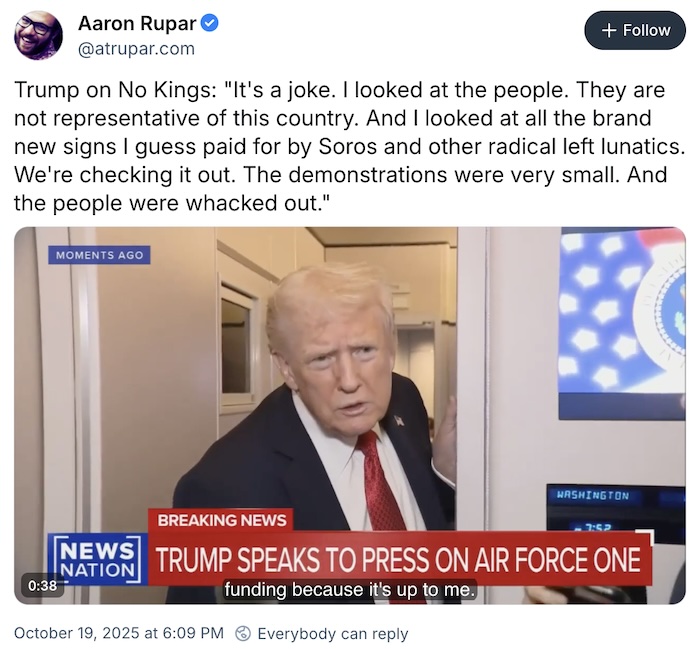
The crowds at the rallies—people of different colors, backgrounds, ages, identities, and views—bolstered the vision of pluralistic America, an idea that Trump and his supporters reject. It was a visceral reminder that there are two populisms, and the clash between them is a defining battle of the moment. On Sunday night, while speaking to reporters on Air Force One, Trump derided the protests:
It's a joke. I looked at the people. They are not representative of this country. And I looked at all the brand-new signs I guess paid for by Soros and other radical left lunatics…We're checking it out. The demonstrations were very small, very ineffective. And the people were whacked out. When you look at those people, those are not representative of the people of our country.”
|
Trump was at it again: dividing to conquer. But given his poll numbers, the attendees at the rallies do reflect popular sentiment. They represent the American people—at least, a large chunk of them—and their populism can prevail over Trump’s, if they and millions of like-minded citizens continue to put it into action. |
|
|
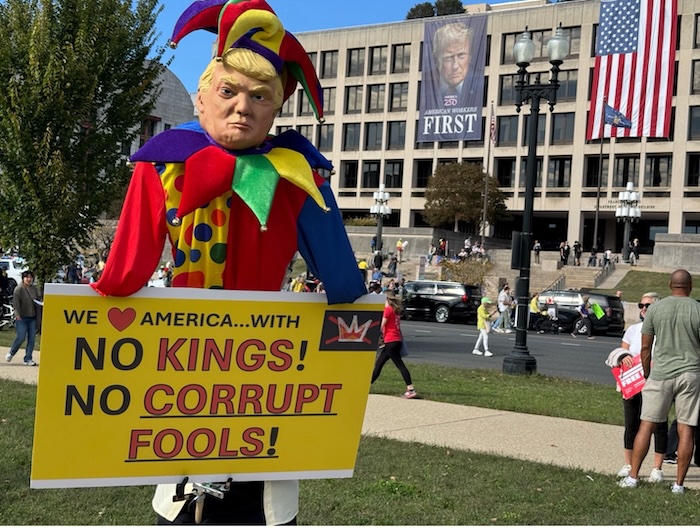
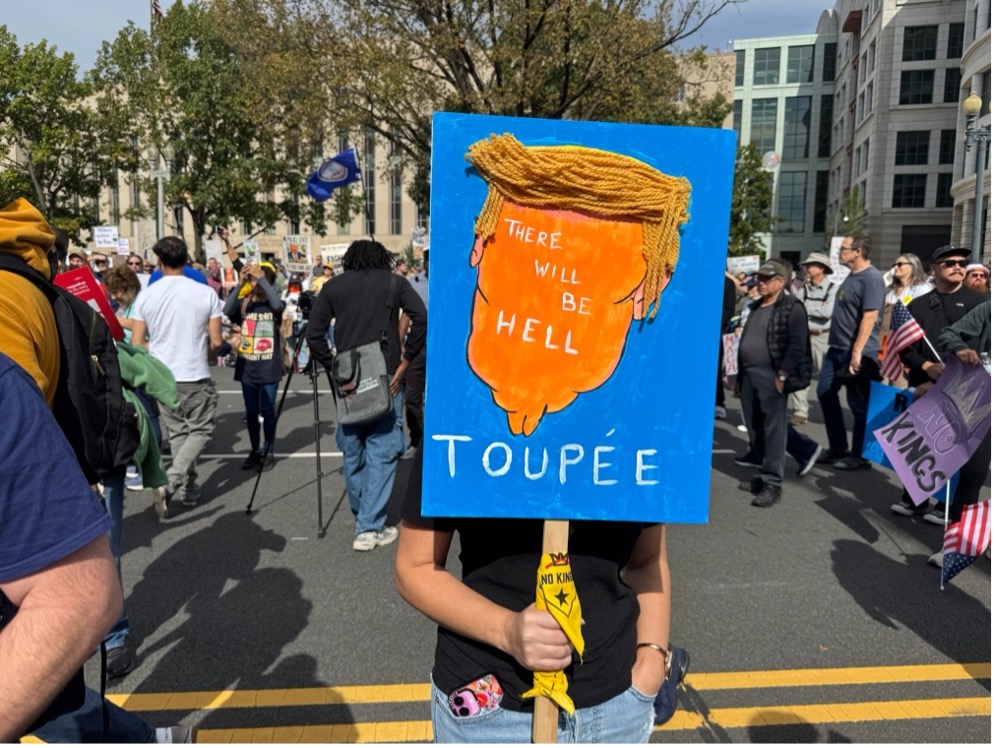
Below are photos I snapped at the No Kings rally. The first is of a person who preferred not to show their face because being seen at the protest would cause them much trouble at work. They wouldn’t tell me where they were employed. Not even off the record. |
|
|
The Watch, Read, and Listen List |
Liberals With Attitude: The Rodney King Beating and the Fight for the Soul of Los Angeles, Danny Goldberg. Imagine a narcissistic and dishonest authoritarian bully who defies norms and laws, who exploits racism and the fears of white voters, who claims he alone can preserve order, and who abuses his office to target his critics and maintain his power. How do you get rid of someone like that?
I’m not referring to Donald Trump but to Daryl Gates, who was chief of the Los Angeles Police Department from 1978 to 1992. His tenure was marked by racist police violence and brutality that culminated in the horrific beating of Rodney King by LAPD cops in March 1991. That event was videotaped by an LA resident watching from his balcony and subsequently broadcast to the world, becoming the first viral video. In this new era of home recording, here was shocking evidence that backed up what many within the marginalized communities of Los Angeles had long claimed: The Gates-led LAPD routinely abused and terrorized people of color with impunity. Gates called the assault an “aberration.” But that spin did not work, and an effort materialized to boot Gates as the first step toward reforming the police department.
Danny Goldberg has had a career to envy. As a player in the music business for decades—including as a record company exec and a manager of top acts—he worked with Nirvana, Led Zeppelin, the Allman Brothers, Bonnie Raitt, Sonic Youth, Stevie Nicks, and many others. He’s written several engrossing books about his rock ’n’ roll life. But he was also chair of the ACLU Foundation of Southern California from 1987 to 1994, when the ACLU was on the front lines of the fight to reform the LAPD and, after the King assault, a key participant in the move to defenestrate Gates. Benefiting from that perspective, he has, with his new book, Liberals With Attitude, produced a fascinating, fly-on-the-wall account of the battle against Gates, who fought bitterly to retain his position.
Goldberg’s tale is full of intriguing characters, most notably Stanley Sheinbaum, a onetime economics professor who married Warner Bros. heiress Betty Warner in 1964 and became a progressive philanthropist and activist. Sheinbaum was part of what was called the “Malibu Mafia,” an informal collection of wealthy Jewish men, including television producer Norman Lear and Warner Bros. chair Ted Ashley, who supported numerous liberal causes and shaped LA politics for decades. (I knew Sheinbaum; he once hosted a book party for me.) Sheinbaum, a feisty and savvy fellow, helped broker the Israel-Palestine peace talks that led to the Oslo Accords of 1993.
A few weeks after the King attack, Mayor Tom Bradley—another major figure in this book—appointed the 70-year-old Sheinbaum to be president of the police commission, with the task of removing Gates, who due to the city charter could not be fired by the mayor. What followed was months of intrigue, as Sheinbaum and others—including the ACLU; the Los Angeles Times; Warren Christopher, a powerful attorney soon to become the US secretary of state; Richard Riordan, a centrist businessman looking to run for mayor; and local politicians and activists—maneuvered to oust Gates, while Gates schemed to thwart them.
At play were the sentiments of white moderate voters. Where would they land on the question of Gates? Would they be moved by revulsion to the King beating or be susceptible to Gates’ I-alone-can-protect-you-from-crime demagoguery? The answer would say much about the City of Angels and its future. The only chance for success that the reformers and the usually cautious Bradley had, Golberg notes, was to pull together a center-left coalition in which each side fully respected the other. That’s a lesson for the current moment. This gripping inside story of bare-knuckles politics is three-decades old, but in Goldberg’s deft hands it resonates with relevance for today.
|
|
|
Task. Have you ever seen Mark Ruffalo in a performance that was not captivating? That includes his depiction of Bruce Banner/the Hulk in the Avengers flicks. He infuses a soulfulness—often a tortured soulfulness—into many of his roles. His characters are fortunate to be brought to life by this veteran actor. That includes Tom Brandis, a priest-turned-FBI-agent who’s in a bad place at the start of the new HBO limited crime drama, Task. A tragedy has struck Brandis’ family, and he’s been relegated to representing the FBI at college career fairs, where he attracts few recruits. But then he’s put in charge of a task force that includes local law enforcement agencies to investigate a series of robberies that have hit stash houses operated by a ruthless motorcycle gang. The big question is whether Brandis, who’s drinking too much and at odds with his teenage daughter, is up to this mission.
Meanwhile, on the other side of this Pennsylvania town, Robbie Prendergast (an excellent Tom Pelphrey) is in a jam. He and his pal have day jobs as waste haulers, but they’re the pair who have been jacking the drug houses. One night, it goes wrong, and they end up fleeing a scene full of dead bodies—with a bag of fentanyl in their hands and a grade-schooler named Sam in their custody. Brandis’ task force is now on their tracks, and there’s a massive search for the boy. The bikers are also looking for the guys who took their drugs and the son of one of their brethren. Robbie, an otherwise good-natured fellow whose wife abandoned him and their two kids, must figure a way out of this mess and protect his own family, while he’s sucking into trouble Maeve (Emilia Jones), his 21-year-old niece, who’s the caretaker for his children and who ends up stuck with Sam.
The series, written and produced by Brad Ingelsby, who created the superb Mare of Easttown, is much like his previous work: gritty, riveting, full of pathos and betrayal, and set in a slice of America where life is harder than it used to be. Brandis and Prendergast are each looking for some sort of redemption, while contending with their own demons. They both are trying, against the odds, to be good family men. But given the hands they’ve been dealt, it’s a tough task. |
|
|
Congratulations, you read all the way to the end! It's a great time to say "I'm in" and start your free 30-day trial. Make sure you don't miss out on what's next: Sign up to start getting Our Land in your inbox each week. We also want to hear from readers (especially those who read the whole thing!). So let us know what you think so far or share something interesting with David at ourland.corn@gmail.com.
|
|
|
|