In the pre-Trump days, this might have worked. President Bill Clinton trounced House Speaker Newt Gingrich and the GOP in their budget combat by wielding the weapon of “E2M2.” He bashed the Republicans over and over regarding their proposed cuts in education and environment spending and Medicare and Medicaid. The public sided with Clinton; the GOP eventually caved.
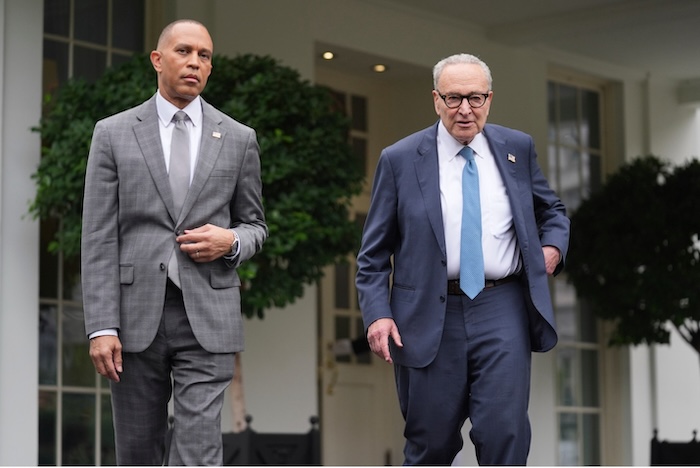
The world is different now. First, Clinton had the power of the bully pulpit. The Democrats today do not. Neither Senate Minority Leader Chuck Schumer not House Minority Leader Hakeem Jeffries have the charisma or standing in the hyper-niche-ified political-media ecosystem to reach tens of millions of Americans with a policy-driven message. Second, the Republicans in the 1990s were the ones obstinately refusing to vote for a spending bill without getting their policy wishes (which included the E2M2 cuts). Now Democrats are the party declining to vote for a measure that would maintain spending as it is and keep the government open unless their policy proposals are adopted.
And there’s this: Trump doesn’t mind a government shutdown.
Trump might even embrace it as part of his crusade to smash and downsize the executive branch. Russell Vought, his budget director and a Christian nationalist who was an architect of Project 2025, has openly signaled he wants to exploit the shutdown to fire tens of thousands of federal workers—beyond those he and Elon Musk already canned.
How can you negotiate with a terrorist who wants to detonate the bomb? In these ongoing negotiations—which don’t seem to be much of negotiations—all the Democrats have to offer Trump, Vought, and the GOP are votes for a spending bill that will reopen the government. If Trump and the Rs are not paying much of a political price and are delighted to have a shutdown, the Dems are left without much leverage, and Trump can sit tight.
Then again, you never know with him. After declaring there was no need to negotiate with the Democrats, on Monday afternoon he shifted and said, "We are speaking with the Democrats, and some very good things could happen with respect to healthcare....I’d like to see a deal made for great healthcare.” Did he mean that? Is he worried the Democrats are gaining ground? Or is he just playing games? Sometimes his erratic behavior is a tell; sometimes it's just erratic.
One of the latest polls—from CBS News-YouGov—shows that 39 percent of Americans blame Trump for the shutdown, and 30 percent point the finger at the Democrats. That’s not a huge difference, especially since 31 percent say both sides are at fault. Moreover, 52 percent disapprove of Trump’s handling of the shutdown, and the same amount disapprove of the Republicans’ approach to the matter. Yet 49 percent disapprove of how congressional Democrats have dealt with the shutdown. Again, no big diff.
Most of the public sees no heroes in this. Only 28 percent of Democrats say the shutdown is worth the policy proposals their own party is fighting for—though large majorities of Democrats, independents, and even Republicans support extending the enhanced tax credits for health care insurance that the Democrats are demanding as part of a spending deal.
This suggests to me that the Democrats have not succeeded in whipping up their own supporters for this fight or even persuading them that this is a necessary battle at this point. Can that still happen? Perhaps, but probably not. The Democrats, with their emphasis on policy, have not been able to define the overall conflict at hand. Consequently, to many Americans it looks as if Washington is one big mess and government doesn’t work—a view that Trump and his anti-government posse don’t seem to mind.
As you know, the Democrats have been engaging in the inevitable post-defeat debate over whether the party needs to embrace stances that move it toward the center to court white working-class voters (including Trump-leaners) or highlight policies that steer it to a more forceful progressive position to energize its base and younger voters and excite some non-voters (see Zohran Mamdani, who, granted, has so far only succeeded in a Democratic primary, not a general election). But in certain instances—such as the shutdown standoff—policy stances may not matter that much.
While writing this, I came across a Substack article by Anat Shenker-Osorio, a progressive political strategist. Its title caught my eye: “Bringing a Survey to a Gunfight.” Sound familiar? She noted, “There are two vastly different ideas [within the Democratic Party] about what it takes to achieve political victory, but only one gets real airtime in Democratic circles.” She writes:
The dominant Democratic model views voters as rational individuals who make electoral decisions, including whether to vote at all, based on their conscious preferences about issues. Advocates of this model believe that polling outcomes within controlled survey environments equate to real-world success — that “winning” in testing corresponds to winning in the real world. Although it’s known by other names, the most apt moniker is Pollingism, as it assumes voters’ issue preferences are static, discernible via polling, and hold ultimate, if not exclusive, sway over their voting behaviors and candidate selections. Pollingism does not come with a set agenda for governance; it relies on discerning voters’ registered preferences because it views the political task as winning elections and treats the work of governance as something to be hashed out later.
She’s hammering a point that’s a bit different than what I’ve been pondering, as she focuses on Democrats who would use polling to determine the best issues to deploy in a political fight. But for this discussion, her counter to pollingism is instructive:
An alternative worldview understands voters as inherently social beings, driven by unconscious cues, whose opinions, beliefs, and behaviors are formulated within the context of relationships and dominant discourse. The repeated refrains of friends, family, and trusted messengers, as well as voters’ identities, hold the greatest sway in their actions, electoral and otherwise. This model views political persuasion, even in the sprint of electoral campaigns, as occurring through diverse mechanisms — including offline interactions, persistent media narratives, and social movements. This approach, which I call Magnetism, prioritizes establishing the right conversation — rather than reacting to terms set by the opposition or the moment-in-time polled preferences of voters.
Magnetism is the notion that if you want people to come to your cause, you must be attractive. This, of course, requires having a cause to which to draw people. And, like any magnet, it also means having a polarity that distinguishes you from your opposition. For Magnetism to work, you meet people at the place of their broadly shared values, not their podcast-promoted prejudices, and bring them with you toward your desired policies and the candidates who will enact them.
In short, the first step to winning an election is making it about what you can win on. Strategic campaigns begin with the question: How do I force the issues and conversations that most benefit my side to the fore?
She goes on to explain all this at great length, and I encourage you to read the whole piece. But I’d ask us to consider this question: Have the Democrats in this budget fight demonstrated magnetism?
They haven’t because over the past few months they haven’t devoted enough time, resources, and, perhaps most important, creative energy to conveying the big picture of what Trump is attempting to do to the United States—not long ago I called it the deconstruction of America—and how Democrats are out there fighting for you to oppose this. I’ve harped on this before. But without establishing that dynamic—or attempting to—it’s tough to beat a nihilistic, power-grabbing demagogue hell-bent on blowing things up, especially when he has the complete loyalty of the majority in Congress.
Yes, when Schumer wimped out earlier in the year on the previous spending face-off, many in the Democratic base, especially those active on social media, howled in protest. Schumer promised he would hold the line in the fall when the next round occurred. And he and Jeffries stuck to that. Had they not, there would have been much outrage on Bluesky and Twitter. Yet I wonder if they were forced into a fight that they did not have a clear path to win.
This goes back to my Johnny-one-note point: The Democrats have not been able to tell a compelling story—certainly not one that would bring the majority to their side on the shutdown. Shenker-Osorio and I agree on this. She writes: “Good stories, and bad ones, have characters and conflict. But what Democrats claim as stories are often more like grocery lists. Affordable housing, quality jobs, accessible healthcare. We have to write down the groceries we need because they’re not memorable, even as the items on them are life-sustaining.”
Though I’m writing this as if I were a politics know-all, I admit I have no good advice for the Democrats at this moment. Have they backed themselves into a corner in which they will have to agree eventually to the GOP’s “clean” measure to continue federal spending at current levels with no gains on health care spending? Otherwise, the shutdown pain will continue, and federal jobs might be at stake. Will anything convince the GOP and Trump to retreat and either pass the spending measure on their own (which they could do by changing Senate filibuster rules) or grant concessions to the Ds? They don’t appear to be sweating yet, and the notion of acting responsibly is about as foreign to them as air travel is to a fish.
All this is happening, as Trump continues to ramp up his assault on constitutional democracy. He’s intensifying the pressure on universities, press freedoms, and Democratic-run states and cities. His mini-me, Stephen Miller, has been popping out hysterical social media posts that assert that judges, mayors, and governors who oppose Trump’s deployment of troops into American cities are part of an “organized terrorist” network that’s mounting an insurrection—as if he is salivating for a civil war. Multiple crises are underway, and Schumer and Jeffries cry out that Trump is not engaging in good-faith bipartisan negotiations. Well, duh.
As I noted in the last issue, Trump is posting memes that depict the Democrats as “the party of hate, evil, and Satan,” celebrate Vought’s slashing, and contain racist taunts of the Democrats.
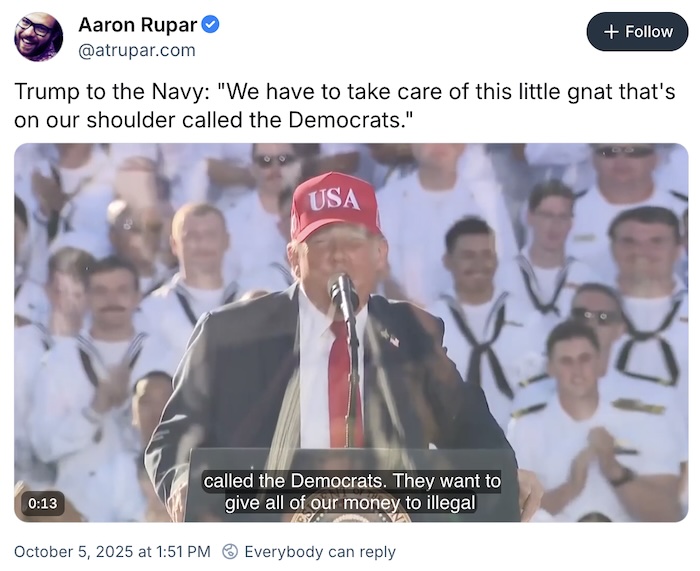
On Sunday, Trump spoke to a large crowd of sailors at the US Navy’s Norfolk, Virginia, facility—servicemembers who are not receiving their pay during the shutdown—and he denigrated the Democrats as “a little gnat.” (Once upon a time, if a president turned an appearance at a military event into such a blatant political exercise, members of both parties would have complained.)