FREE TRIAL VERSION. DON'T MISS OUT. |
FREE TRIAL VERSION. DON'T MISS OUT. |
|
|
The Springsteen Generation |
By David Corn August 16, 2025 |
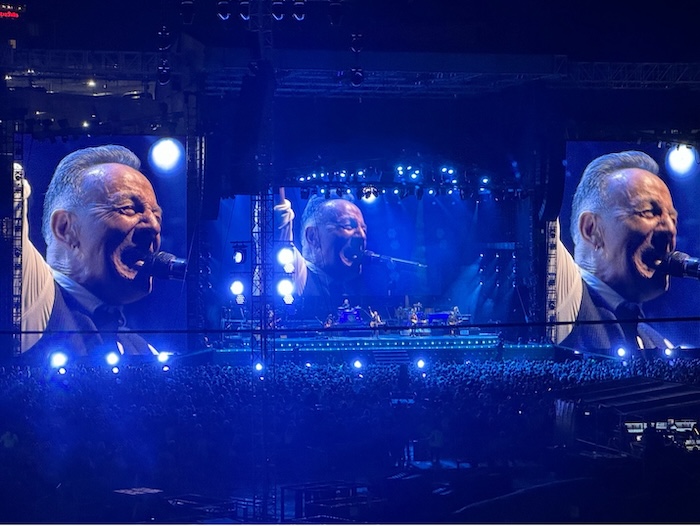
Bruce Springsteen and the E Street Band performing at Nationals Park in Washington, DC, on September 7, 2024. David Corn |
|
|
You're reading a free promotional version of Our Land, and we hope you enjoy David's exclusive writing and don't want to miss out on what's next. Sign up to start receiving a free 30-day trial of Our Land and enjoy all of the behind-the-scenes reports and interactive features with each issue.
|
|
|
I spent much of the summer of 1975 working on cars at my friend Jamie’s house. His older brother had a business renovating vintage sports coups—MGs, Triumphs, Jaguars—and Jamie and a group of his pals were the worker bees. The brother didn’t pay us—I was making money that summer pumping gas at an indie station—but every once in a while we earned a beer. Most of what we did was highly unskilled work: smoothing panels (by hand with sandpaper) and de-gunking disassembled motor parts. It was fun, and at night after quitting time there’d be the usual underage drinking in the garage behind the house or the basement rec room.
On the evening of August 15, as we were finishing up, I suggested we find a radio. A somewhat new-to-the-scene musician named Bruce Springsteen was playing with his E Street Band at the legendary Bottom Line club in New York City, as part of a 10-concert showcase, and WNEW-FM was broadcasting this performance live. Springsteen was about to release his third album, Born To Run. His first two—Greetings from Asbury Park, N.J. and The Wild, The Innocent & the E Street Shuffle—had garnered critical acclaim and airplay on the hippest FM stations but weren’t commercial successes. Columbia had signed Springsteen as the new next-Dylan, but so far, he had not delivered. This new disc could be his last shot. A pre-release of the “Born to Run” single—an operatic, full-throttle rock anthem that incorporated the sounds of Phil Spector and R&B—had quickly become a favorite at WNEW and other taste-making outlets, and expectations were high for the new album, for which Columbia Records was spending a ton to promote.
Yet when I said we should listen to this show, my gang—which included Deadheads and aficionados of middle-of-the-road arena rock—said, no dice. “He’s just greaser music,” one offered, which I found amusing, given that we spent our days reviving junkers—which seemed adjacent to the car-centric mythology at the center of Springsteen’s universe. I can’t recall how much of an argument I put forward, but I ended up alone in Jamie’s bedroom, sitting on the floor in the dark, with the stereo tuned to WNEW. I hung on every note, hook, and riff. Little did I realize that I—and many others listening at that moment—were forging what would be a lifelong relationship with this scruffy dude from Jersey.
|
|
|
His Bottom Line performances and the Born to Run album launched Springsteen into rock ‘n’ roll stardom. Two months later, he was featured on the covers of Newsweek (“Making Of A Rock Star”) and Time (“Rock’s New Sensation”). Springsteen was on his way to becoming not just a rock luminary but a guiding light for millions. He was composing what would be for 50 years the soundtrack for their lives.
His timing was propitious. After a decade or so of accompanying social upheaval, rock had become bloated. In the middle of the 1970s, it was no longer the music of peace-and-love-and-protest, as it had been in the 1960s. And much of the optimism that had accompanied the chaos of those years had evaporated. Watergate. The oil embargo and the end of cheap gas. The defeat of the United States in Vietnam. A mood of cynicism had started to take hold. Those of us who had been born at the end of the Baby Boom had missed out on the fun of the ’60s (Sex! Drugs! Revolution!). Though we had been too young for the party, we now were saddled with the morning-after hangover. After the cultural and political spasms of the previous decade, the nation was still at odds with itself and still with no direction home.
With mainstream rock having become flabby, there were stirrings of a new sound: punk music. Lou Reed (formerly of the Velvet Underground), the New York Dolls, the Stooges, MC5, and others were kicking a new jam. Just as Springsteen-mania was hitting, Patti Smith, a beat-style poet who hooked up with garage-rock musicians, was finishing her pioneering Horses album, full of dark and mystical lyrics. At the core of this rock rebirth was a sense of alienation and anarchy. The nihilistic message of much of this music: It’s all shit. In England, the Sex Pistols were being slammed as a sign of civilization’s end. Soon the Ramones would show up singing about sniffing glue and beating up brats. The arrival of The Clash would add a dose of politics to this countercultural sneer. It was all powerful stuff—especially for anyone disaffected and wondering where the hell the world was heading.
Springsteen offered something different: aspiration.
His songs captured what had been the traditional essence of rock: yearning for more. That more could be more fun, more love, more freedom, more community. What had Elvis symbolized? The ability to break free of convention. Springsteen’s songs focused on a fundamental American ideal: the pursuit of happiness. That was the main moral of the myths he created about teenage racers, street toughs, and guitar-wielding gangs. The protagonist of Born to Run was desperately seeking to escape the “death trap” of a “runaway American dream” to find “that place” where he and his love could “walk in the sun.” You didn’t have to be a motorhead who could rebuild a Chevy to identify with this compelling sentiment. In fact, as he has acknowledged, Springsteen wasn’t one either. That was just the realm where he located his poetry and storytelling. More fundamental, he was tapping into a universal desire of young people as America was experiencing an unsettling backlash to the 1960s.
He did this by embodying the spirit of early rock ‘n’ roll. During that Bottom Line performance, Springsteen played several covers, including “Then She Kissed Me” (a gender-flipped version of the Crystals’ “Then He Kissed Me”), “Having a Party” (Sam Cooke), and “Quarter to Three” (Gary “U.S.” Bonds). Each had been a hit for a Black musical act. And just as significant, his long-term relationship with saxophonist Clarence Clemons, a towering Black man, rendered the E Street Band a multiracial endeavor, a not-so-common lineup in mainstream rock.
With such covers and original compositions that sought to capture the fire of his progenitors, Springsteen was honoring and building upon the past, not rejecting it—incorporating it into a modern retelling of American life. His mission was to show that music could be a positive and reaffirming spark in the lives of those who listened. As an ungainly and out-of-sorts teen reared in a home in which family love and dysfunction competed, rock had been his salvation. He believed it could be the same for others. Music was a way to cope with the disappointments, mysteries, and longings of life, as well as a source of exhilaration and delight.
Most important, Springsteen grew up with us—or we with him. On the albums that followed Born to Run, he expanded his palette from songs that chronicled the exuberance of youth to tracks that confronted the responsibilities and obstacles of adulthood. It wasn't always pretty. His most recent album of original songs explored the sense of loss experienced by anyone who makes it into their mid-70s. Without mawkish sentimentality, he sung about the friends he had lost—including each member of his first band—and the inevitability of the final farewell.
Springsteen examined the hardships of life without ever giving up on hope. “And I believe in the promised land,” he would sing—for decades. Even though burdens and challenges only increase through the years, he constantly reminded his audience that it was crucial to seek, recognize, and celebrate moments of jubilation.
One of his basic rules remained untouched by time: Rock is supposed to be joyous. He demonstrated this whenever he hit the stage with his fellow E Streeters for one of his marathon concerts. He was always a hard-working showman dedicated to inspiring and uplifting those who cheered and applauded before him. He wanted to give them something to hang on to. On the dark and moody Nebraska, his unplugged solo album, he put it simply: “Still at the end of every hard day / People find some reason to believe.” The camaraderie he displayed with his bandmates extended to the audience. For decades and through various stages of life—his and ours—he reassured us: We’re all in this together.
As he and his audience matured, Springsteen became more attuned to the world outside the cosmos of his lyrics. He began addressing deindustrialization and the decline of blue-collar America (“Johnny 99,” “My Hometown, and “Youngstown”), the poor treatment of Vietnam veterans (“Born in the USA,” which was absurdly hailed by Ronald Reagan as a patriotic anthem), AIDS (“Streets of Philadelphia”), the cruelty of 1990s Republicans (“The Ghost of Tom Joad”), police violence (“41 Shots”), 9/11 (“The Rising”), and the Iraq War and the use of torture (“Long Walk Home”). On his 2006 album, We Shall Overcome: The Seeger Sessions, Springsteen offered his interpretation of 13 folk songs, including several protest songs, that Pete Seeger, the activist and folk musician, had popularized.
As a side gig, he became an articulate advocate for progressive American values. In May, during a show in Manchester, England, he introduced “Land of Hopes and Dream”—a quintessential Springsteen gospel-esque number that encourages optimism and faith—with a diatribe against Donald Trump: “In my home, the America I love, the America I’ve written about, that has been a beacon of hope and liberty for 250 years, is currently in the hands of a corrupt, incompetent, and treasonous administration. Tonight, we ask all who believe in democracy and the best of our American experiment to rise with us, raise your voices against authoritarianism and let freedom ring!”
The Springsteen generation came of age at a time when decline loomed. America seemed to be slipping on the world stage. The post–World War II economy that had birthed a powerful and secure middle class was no longer so mighty, and the wildness and thrills of the 1960s were heading toward the conventions and cultural conservatism of Reaganism. Fifty years ago this month, Springsteen unveiled Born to Run and offered a different path, presenting a revived rock ethos that would forge a bond with his fans for decades.
|
|
|
Springsteen maintained his relevance through all that time with deep respect for this relationship and with much discipline and mountains of hard work. He grabbed ahold of us long ago and took us on an exciting journey, as a ringleader and fellow seeker. It’s easy to poke fun at a certain demographic of white guys (and gals) for their devotion to Springsteen. But he mirrored our desires, transforming these notions into songs and stories that helped us better understand ourselves and our world, delivering both amusement and reflection. And he stayed with us, never letting go of that original dream, even though its contours inexorably changed as the years flew by. As an artist and an entertainer, he has been a faithful companion and a steady guide. He has held fast to that promise he presented half a century ago. He has given us a helluva ride.
|
|
|
Dumbass Comment of the Week |
Donald Trump’s hostile takeover of Washington, DC—predicated on the lie that violent crime in the nation’s capital is out of control and escalating—follows a long-running GOP disinformation campaign on crime. For months, Republicans and MAGA-ites have intensified their phony charge that Big City America is a dystopic, crime-ridden cesspool. Trumpers have declared that they fear riding the NYC subway and have depicted Los Angeles as a Road Warrior-like hellscape of miscreants and demons.
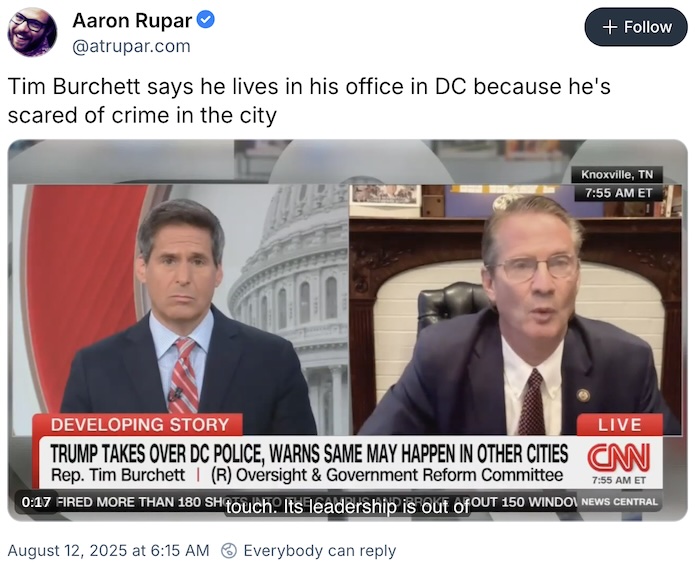
Now comes Rep. Tim Burchett (R-Tenn.). Praising Dear Leader’s performative seizure of DC’s police force, he declared he sleeps in his office because “it’s too dad-gum dangerous, brother. It is dangerous, and everybody knows it.” |
As a four-decade-long resident of the metropolitan DC area, I can say that I’ve never met a person who said it was too dangerous to go home from work—especially in the neighborhoods where Burchett would rent or buy. By the way, as a member of the Tennessee congressional delegation, he ought to know that Nashville and Memphis each have a higher violent crime rate than DC. I don’t believe he has called for Trump to send troops into those cities.
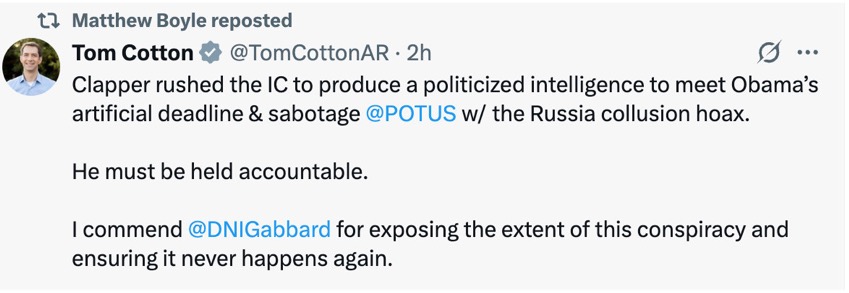
There’s been much nonsense from Trump and his fellow Russia deniers, who these days are manipulating intelligence documents to cook up a sham investigation claiming that Barack Obama and his national security aides (John Brennan, James Clapper, Jim Comey, and others) concocted a phony intelligence report stating Russia attacked the 2016 election. It’s all BS, but Trump’s lickspittles in the GOP are all jumping aboard this train. That includes Sen. Tom Cotton (R-Ark.), a longtime member of the Senate Intelligence Committee:
|
Cotton referring to the Trump-Russia scandal as the “Russia collusion hoax” is ridiculous. As a member of the intelligence committee, Cotton voted, with the other Republicans on the panel, including now Secretary of State Marco Rubio, to approve the report the committee released in 2020 that concluded Moscow assaulted the 2016 election to boost Trump and that the Trump campaign tried to block attribution of the attack to Moscow. That is, he affirmed the intelligence community’s finding and went so far as to okay the conclusion that Trump had aided and abetted the Russian attack by denying its existence. He seems to have forgotten that.
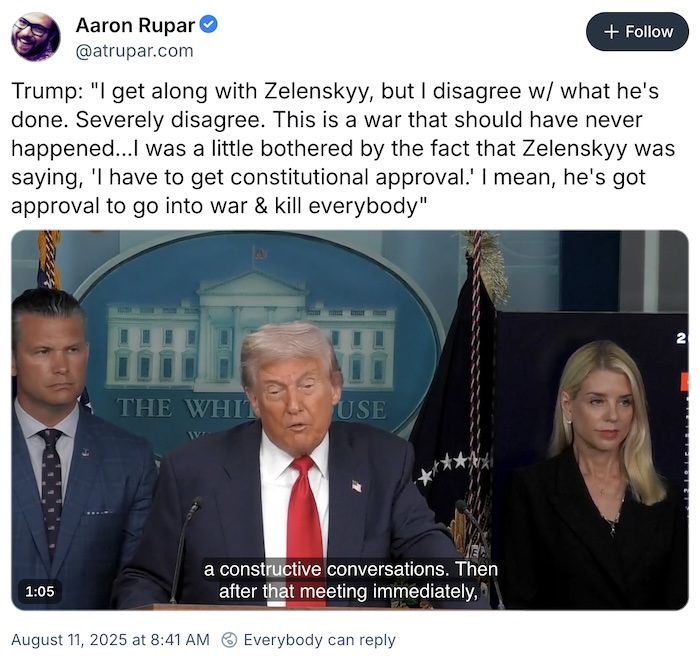
Speaking of Russian skullduggery, as Trump and the White House prepped for his scheduled meeting in Alaska with Russian war criminal Vladimir Putin, they sent out various and conflicting signs about what might happen at this misguided rendezvous. And though Trump had indicated in recent weeks that he might toughen his stance toward Putin, he reverted to form and took a sharp poke at Ukrainian President Volodymyr Zelenskyy:
I get along with Zelenskyy, but I disagree with what he's done. Very, very, severely disagree. This is a war that should have never happened... I was a little bothered by the fact that Zelenskyy was saying, 'Well, I have to get constitutional approval.' I mean, he's got approval to go into war and kill everybody." |
This is a false and troubling description of the war. Zelenskyy didn’t plan “to go into war and kill everybody.” His country was invaded by a barbarous tyrant. Yet Trump was suggesting—once again—that Zelenskyy bears responsibility for the war that has inconveniently thwarted Trump's craving to bond with Putin.
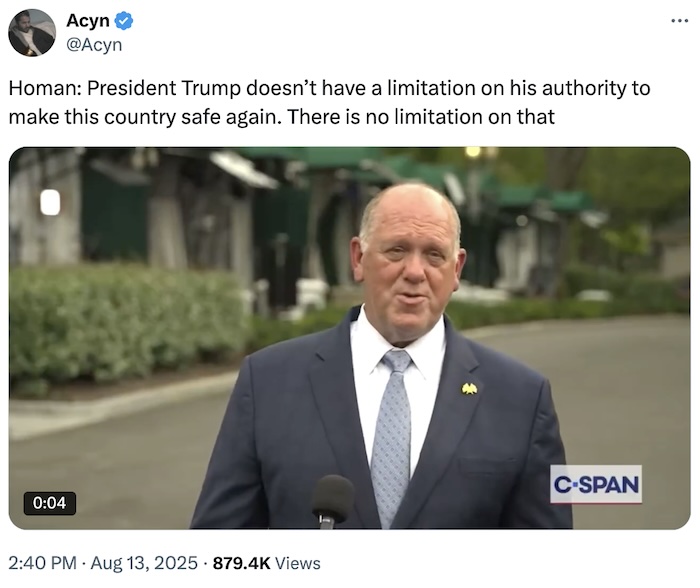
It’s evident that Trump and his crew have no shame about implementing authoritarian measures to consolidate power and pursue autocratic rule. And for expressing this so openly, Tom Homan, Trump’s so-called border czar, snagged first place. On C-SPAN, he remarked, “President Trump doesn’t have a limitation on his authority to make this country safe again. There is no limitation on that.” |
You know what other leaders have no limitations on their authority? Kings and dictators. The founders of the United States were quite clear on a basic point: The president should not possess absolute power and could not reign as a monarch. There are constitutional limits to what he can do, even if the Supreme Court has weakened some guardrails. To claim Trump can do whatever he wants in pursuit of the vague goal of safety is not only a breathtakingly ignorant misreading of the Constitution; it is a fascist sentiment. Homan’s comment is not just this week’s winner; it’s a warning for us all.
|
|
|
This week’s mail was full of correspondence expressing unease about the present moment. James Quigley wrote:
I fear that it's too late now, and some kind of national disintegration is likely within the next five to ten years, maybe sooner. I was in the USSR in the 1980s and 1990s as a student and US government employee, and I'm getting the same unsettling "vibe" that I felt back then: on society's surface, a barely functional normalcy; deeper down, a vast cratering of public faith in the system itself. No national system survives a collapse of faith among its citizenry. Patriotism ceases when a critical mass of citizens can't even afford the basics of life.
Lynda Dobens emailed a one-sentence observation: Without resistance or revolution, we are circling the drain.
A bunch of readers responded to the recent issue holding Sen. Bill Cassidy (R-La.), a medical doctor and vaccination proponent, accountable for his vote to confirm Robert F. Kennedy Jr. as secretary of Health and Human Services. Joan Janisch wrote:
And what on earth is it about Trump that inspires such loyalty in an otherwise obviously caring, compassionate man. This lying grifter is like a snake charmer seemingly having everyone hypnotized. The Trump era is showing us that greed, power, ambition, and fear are more important for many than compassion. Suzanne Nielsen shared this:
Dr. Bill Cassidy makes me ill, even more so than anti-science RFK Jr. I fantasize about setting them adrift in a leaky tub where they would be forced to admit to at least one fact of our world. George Gilfoil sent us this message:
What do we do to change this ill-thought action by RFK Jr. and Trump? Who has the megaphone and/or public presence to counter this stupid thinking being promoted by them and their MAGA followers? We need someone to lead the way.
The lack of leaders with a national platform is a problem. On the vaccine front, governors and top congressional Democrats might score some political points. After all, Trump and Kennedy are putting all of us at greater risk. But I don't see many of them trying. Bridget Whitley had this creative thought:
I think you have laid the foundation for a new verb: Cassidyed. As used in a sentence, "Lisa Murkowski learned that she had been Cassidyed, as the concessions she was promised in exchange for her vote on the budget bill have been revoked by Trump." For my part, I have decided to grow my hair, as I fully anticipate that we'll need to go back into quarantine for months, as there will be no vaccine available for avian flu or a re-emergent Covid, and I'll need to be able to go without a haircut.
Michael Wakefield responded to a recent issue in which I wrote about the need to create and advance the narrative that Trump is in the process of deconstructing America:
Are Democratic leaders conferring to create such a vision? From the endless stream of fundraising solicitations I receive, it appears they are siloed, each raising a handful of the various issues without explaining how their efforts fit into a larger picture. Why should I give more to a candidate who is just yelling foul if I don't know what they intend to do with the money and how that fits into an overarching campaign by the Democrats to regain control? Without this meta view, my donations feel so inefficient that I conclude it would be a waste to give. I can't just assume that all these individual Democratic PACs or candidates are joining forces to efficiently use the donations. I suspect many others feel the same way.
I keep saying this: Politics is telling stories. If the Dems don't have a big story to tell—especially in a time of crisis—potential supporters will not be grabbed. |
“Moxie, is that the doggy paddle?”
“Very funny.”
“It never gets old.”
“Enjoy your frog stroke.” |
|
|
Congratulations, you read all the way to the end! It's a great time to say "I'm in" and start your free 30-day trial. Make sure you don't miss out on what's next: Sign up to start getting Our Land in your inbox each week. We also want to hear from readers (especially those who read the whole thing!). So let us know what you think so far or share something interesting with David at ourland.corn@gmail.com.
|
|
|
|