FREE TRIAL VERSION. DON'T MISS OUT. |
FREE TRIAL VERSION. DON'T MISS OUT. |
|
|
|
Election Day and the Battle to Come |
By David Corn November 3, 2026 |
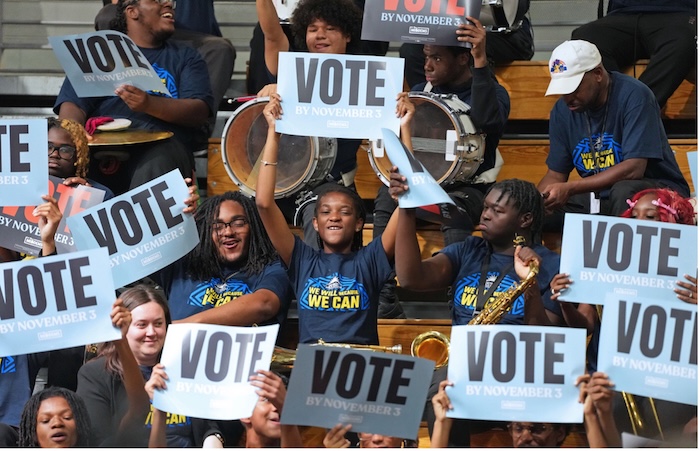
Supporters of the Democratic Party at a campaign rally in Detroit on October 24. Yomiuri Shimbun via AP |
|
|
|
You're reading a free promotional version of Our Land, and we hope you enjoy David's exclusive writing and don't want to miss out on what's next. Sign up to start receiving a free 30-day trial of Our Land and enjoy all of the behind-the-scenes reports and interactive features with each issue.
|
|
|
|
“Nauseously optimistic.”
That’s how one Democrat described her mood to me two days before Election Day. That seems to capture the general sentiment of progressives and Dems. All indicators—poll numbers, early voting figures, and the like—were generally pointing in the same direction, suggesting a Democratic win in the House and the distinct possibility of a similar triumph in the Senate. But in the final days of the campaign, media outfits conducting surveys took the unusual step of pointing out that while they endeavor to calculate the right sampling for their polls—obviously, a fundamental step for accuracy—there was a chance they could be off the mark.
So as I write this, hope accompanied by heartburn seems the appropriate stance for Democrats. (See the Haley Stevens soap opera in Michigan.) But if the D’s do prevail in one or both houses of Congress, it will be important for them to keep in mind—once the celebration concludes—that victory is not the end of the battle, but merely the beginning of the next one. |
|
|
|
A success on either side will be a signal that President Donald Trump’s push to impose a corrupt, kleptocratic, authoritarian regime on the United States is being thwarted by the American public. Like the recent elections in Serbia and Hungary, this would show that democratic backsliding can be slowed and perhaps reversed. It would remind us that Trump’s politics of fear, bigotry, hatred, deceit, cruelty, division, warmongering, and demagoguery is not always a winning strategy. That Trumpism is not inevitable. Reality—the brutality of his mass deportation crusade, the economic hardships caused by his erratic tariffs and plutocratic policies, and the dumb war in Iran and high gas prices—gets a vote.
Yet, whatever the outcome of these midterm elections, Trump’s assault on America will not cease.
Assuming the Democrats gain control of at least the House, they will have to wage and prepare the American public for the subsequent political war, which will be unlike any seen since the days of Abraham Lincoln. Trump is not going to fade quietly into lame-duckness. As far as he’s concerned, this will still be his show, and his agenda of autocracy, corruption, and brutality will remain. Democrats might be able to pass legislation in the House, but doing so in the Senate, even if they win a majority, will be tough. (Remember the filibuster.) And Trump retains veto power. Democratic efforts to constrain Trump through the appropriations process will be challenged or ignored by the White House. (SCOTUS, get ready.)
It’s unlikely the D’s will be able to immediately address (or improve) the basic components of the affordability crisis: higher prices and the costs of education, healthcare, and housing. But they will need to convince voters they are trying. And if they’re in charge of either half of the legislative branch, they will be able to launch investigations of the Trump administration and its cronies. Trump and his lieutenants will, no doubt, decline to cooperate and perhaps defy congressional subpoenas. Is Trump’s Justice Department going to prosecute Trump officials for contempt of Congress? Is Trump not going to pardon—perhaps preemptively—officials and associates investigated or hauled in by congressional committees?
A string of constitutional crises could ensue if Trump refuses to accept or bend to congressional actions and prerogatives. Through this chaos, the Democrats will need a story—an overarching narrative that provides compelling context for what will likely be a never-ending stream of conflicts with Trump. This is precisely what they failed to do at the start of Trump’s second stint as president. Longtime readers of this newsletter might recall that during those days, I frequently chastised Democrats for not clearly informing the public that Trump was mounting a war to destroy government in order to pave the way for a corrupt and authoritarian regime, in which he could rule as a tyrant and grab billions of dollars for himself and his chums.
The Democrats did complain about Trump’s individual assaults on the US Agency for International Development, the civil service, the public health system, environmental and financial safeguards, and so on. But as Trump presented such steps as part of his grand effort to scale back and remake government so a “golden age” would flourish, the Democrats repeatedly missed the chance to tell the citizenry that Trump, Elon Musk, the DOGE dudes, and their minions were on a mission to weaken the government to clear the path for their own plundering and pillaging.
It was pure class warfare. The revenge of the oligarchs. Yet the Democrats—who admittedly lacked a bully pulpit like the one Trump bellowed from—did not convey this. They fielded no counternarrative to Trump’s bogus tale and false promises of prosperity.
This time around, they will need to focus on one of the most essential elements of politics: storytelling. Trump will be shouting that he’s under attack by the nefarious Deep State, the evil media, and trans-loving communists who want to destroy America. The Democrats will have to offer a counterplotline that keeps voters engaged and goes beyond hailing their policies as the best remedies for what ails the economy. I’m sure I and others will have more to say about this, should the Democrats be so fortunate as to clash with Trump from a position of power. But in a fight over narrative control, it’s never too early to start.
The Trump era has been an exhausting stretch for much of America. It has threatened values and principles that have long guided, even if imperfectly, the nation. We’ve learned that democracy cannot be taken for granted—that our republic is far more vulnerable to lies, tribalism, deception, authoritarianism, and grift than many, including the cynics among us, once believed. And much of the damage cannot be undone. We’re losing a generation of young scientists who’ve immigrated to other nations after Trump’s attack on university-based scientific research. Our Foreign Service and international aid system have been decimated and will not be quickly rebuilt—ditto for our public health system. Attempts to address climate change have been subverted, with valuable time going to waste. Families have been torn apart, with law-abiding residents detained, deported, and forced into hiding.
Still, these midterms offer the nation a chance for a course correction. To stop digging. Whatever the results, this election will not be a reversal in itself. It will determine if one is possible. It can provide the opportunity for de-Trumpification before more is lost. The voters will tell us today whether that’s what they’re looking for. Then the fight for America will continue and become even more intense. * * *
I used to have a midterm Election Day tradition: I would clean my office. There usually isn’t much news through that day. It’s a time of waiting—a perfect moment for straightening (or throwing out) the assorted papers and files I had amassed. It was a visceral exercise that helped put a period on the election cycle. Afterward, my office—once a jungle of almost-toppling stacks of documents, notebooks, clippings, reports, books I never got to, and whatnot—would be clean and neat, a sign I was ready for what was to come.
Nowadays, though, most of the material I collect while pursuing stories is digital. The few paper documents I’ve gathered are already organized in file folders that sit on the side of my desk or on a bookshelf. I suppose I can go through the more than 300 tabs I have open in my browser and wrestle with the excessively cluttered desktop of my laptop. It’s a mess and ought to be better organized. But doing so won’t be the same. |
|
|
|
Meanwhile, here’s a tune I’ll be playing on Election Day. Bruce Springsteen calls it “a prayer for my country.” |
|
|
|
The Watch, Read, and Listen List |
You Can See Everything. Nathan Fielder and Lance Oppenheim’s documentary—if that’s what it is—on Elizabeth Holmes, the billionaire-to-felon founder of Theranos and object of much social commentary, is fascinating and frustrating. For reasons never made clear in the film, Holmes and her personal partner, Billy Evans, a hotel heir, picked Fielder, a Canadian filmmaker, actor, and comedian, to make a documentary on her. Not Errol Morris. Not Rory Kennedy. And certainly not Alex Gibney, who did a Holmes documentary in 2019. The filming began in April 2023, 34 days before she was set to report to a federal prison camp to start serving an 11-year sentence for fraud.
In an act of what they called “radical transparency,” Holmes and Evans offered Fielder and his film crew full access to them in the San Diego beach house they were renting at the time. Fielder even moved into a guest cottage on the property. The couple’s goal was obvious: to have Holmes depicted not as a crook, but as a pioneering humanitarian unfairly railroaded, who still believes she can save the world. (The pair were busy pursuing Theranos 2.0 as she prepped for prison.) So there’s plenty of supposedly candid footage of Holmes and Evans at home tending to their young children. (Their nanny is not in any of the shots.) And lots of conversations between Fielder and Holmes that, boiled down, focus on one big question: Was she a scammer?
For many, this is not subject to debate. But she and Evans are still fighting that battle. Fielder repeatedly presses her on whether she lied to investors—or has ever lied. With eyes watering but not blinking, Holmes insists she did not con anyone and contends she’s been misunderstood, misrepresented by the media, and misportrayed in popular culture (particularly in the television series The Dropout).
Much of the conversation centers on a single statement she made in her heyday about Theranos’ blood-testing device: that it “can” perform a host of medical tests from one drop of blood. She tells Fielder that the “can” referred to the machine’s potential. That is, if the right chemistry were developed, it could function this way. He points out that her use of “can” was heard by others as a description of the device’s actual capability—as in, it can do this now. A great deal of time is spent on this word game—which seems a little silly—with Fielder even playing for Holmes and Evans the “Who’s on First?” classic comedy routine by Abbott and Costello. Holmes, who says she has not seen the bit before, nervously laughs as she watches it. But afterward, she cannot explain the joke. She does not recognize the parallel.
This is but one of many awkward moments in the film, as Fielder throughout his stay with the happy couple prods and Holmes parries with what appears to be—or is concocted to be—an overabundance of earnestness and guilelessness. Fielder tends to capture these exchanges with extreme close-ups of his face and hers, creating a sense of intimacy that may or may not be real. Is she sincerely faking sincerity? Is he slyly trying to catch her out?
Much that’s unexpected occurs in this movie, and it would be unfair to spoil some of the almost-unbelievable surprises that transpire, as the second half of the film becomes exceedingly meta, essentially a documentary about itself.
At first, it appears Fielder’s aim is to suss out whether Holmes is a complete con artist. But that mission ends up being supplanted by subsequent developments after Holmes is incarcerated in a minimum-security and cushy federal facility in Texas. And the film—which includes a mind-bending set of reenactments—ends up being many things, including an account of the filmmakers (Fielder and Oppenheim) perhaps manipulating their subjects (Holmes and Evans), who themselves may be trying to manipulate the filmmakers; a meditation on how to process truth and fiction when the two overlap; and, yes, a contemplation of love.
You Can See Everything shows us a lot of Holmes, but, you might ask, does it reveal anything about her? (Much is revealed about Evans, including his schlong in a shower scene.) Voyeurism and weirdness provide the film plenty of lift. After 174 minutes, though, you likely won’t feel you’ve seen all there is to see. |
|
|
|
90 Years, Institute of Contemporary Art. The Institute of Contemporary Art is a beautifully designed and wonderful museum on Boston Harbor. It was founded in 1936 as an offspring of the Museum of Modern Art in New York City and has been at the forefront of advancing and celebrating the work of the cutting-edge artists of the 20th and 21st centuries, including Picasso, Munch, Kandinsky, Nevelson, Avery, Calder, Judd, Ono, you name them. When I dropped by the other day, I was pleased to see one of its current exhibitions chronicles its 90-year history.
One landmark event this exhibition recalls is a 1941 exhibition, Modern Mexican Painters, which promoted the dynamic painting scene of our neighbor to the south. Another highlight of this remembrance is a commemoration of the ICA’s 1966 survey of Andy Warhol’s art. His Campbell’s soup cans and portraits of Jackie Kennedy, Marilyn Monroe, and Elvis Presley were part of that influential show. And in conjunction with that exhibit, Warhol staged at the ICA Exploding Plastic Inevitable—an experimental jumble of dance, projected film, and music performed by the Velvet Underground.
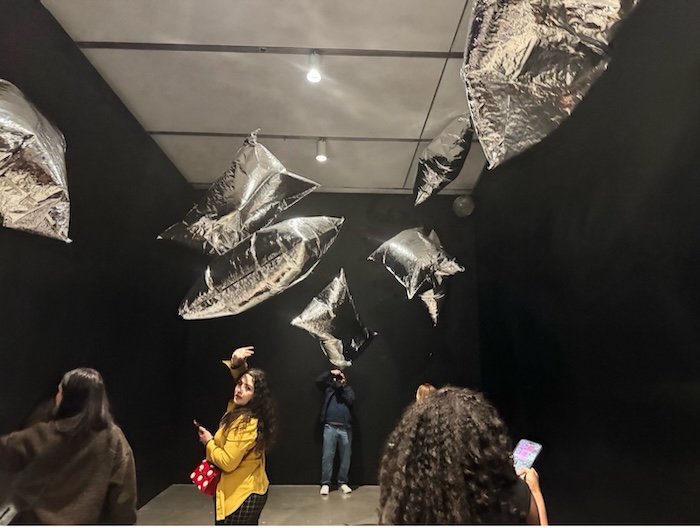
As part of the 1966 exhibition, Warhol included Silver Clouds, an installation of metallic, helium-filled balloons that floated through the galleries. Visitors were encouraged to touch and propel the balloons. He called these reflective objects “paintings that could float.”
The ICA’s callback of the Warhol show features a revival of Silver Clouds, with a black-walled room filled with the same sort of balloons. Visitors are invited to step inside and interact with these floating paintings. The placard explaining the exhibit states that the “reflective metallic surfaces” of the original balloons “echoed the seductive aesthetics of postwar consumer culture” and that Silver Clouds “remains relevant sixty years [later].” It notes: “In a world increasingly saturated by images—real and manipulated, taken by phone cameras and surveillance footage—Silver Clouds offers another model of spectatorship. Its mirrored surfaces redirect our attention to a shared field of reflection where seeing oneself is inseparable from seeing others.”
I’m not sure it was that “shared field of reflection” that drew museum attendees into the room to gently punch at the balloons to keep them aloft. But I got a kick out of becoming part of a Warhol piece six decades after he created it. |
|
|
|
Congratulations, you read all the way to the end! It's a great time to say "I'm in" and start your free 30-day trial. Make sure you don't miss out on what's next: Sign up to start getting Our Land in your inbox each week. We also want to hear from readers (especially those who read the whole thing!). So let us know what you think so far or share something interesting with David at ourland.corn@gmail.com.
|
|
|
|
|