This is no shocker.
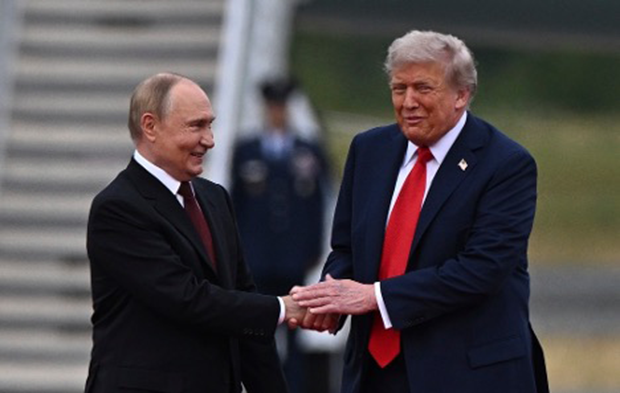
Since the late 1980s, Trump has sought to strike a deal in the Soviet Union or Russia, as Russian money flowed into assorted projects of the Trump Organization in the United States and elsewhere. Soviet and Russian officials dangled the possibility of joint ventures before Trump in the 1980s, 1990s, and 2000s, yet nothing materialized. Then in 2013, Trump held the Miss Universe contest in Moscow. He netted about $2 million from the venture, while his partner—an oligarch close to Putin who underwrote the pageant—lost about $10 million. Essentially, this was a transfer of wealth from one of Putin’s plutocrats to Trump. More important, when Trump announced the contest would be held in the Russian capital, he asked if Putin, a repressive thug, would become his “new best friend.” From that point on, Trump repeatedly signaled he yearned to be a Putin BFF.
Following the Miss Universe contest, Trump once again tried to score a big development project in Moscow—but Putin’s illegal annexation of Crimea got in the way of that endeavor. Yet that did not stop Trump. While campaigning for president in 2015 and 2016, as he spoke positively of Putin, he secretly pursued a massive Moscow Trump Tower project, negotiating with Russian businessmen with suspected ties to Russian intelligence. He never bothered to tell voters about this side gig that ultimately did not come to pass. He even claimed he had nothing to do with Russia. A lie.
As a presidential candidate and then as chief executive of the United States, Trump aided and abetted Putin’s covert assault on the 2016 election—which was mounted by Putin in part to help Trump win the White House—by ceaselessly and loudly echoing Putin’s denials. With his constant braying that the Trump-Russia scandal was a “hoax” and “witch hunt” orchestrated by the Deep State, the Democrats, and the media, Trump has provided cover for a foreign adversary that has attacked American democracy repeatedly.
During his first stint as president, Trump defied his advisers and strove to be supportive of Putin, such as when he urged the G-7 nations that had kicked Putin out of the G-8 following his seizure of Crimea to welcome the Russian back. Or when he tried to muscle Zelenskyy to open an investigation to whip up evidence proving the bonkers conspiracy theory that Ukraine had somehow orchestrated the Russia scandal. He told aides that he had learned of this plot from Putin. That move to absolve Putin—twinned with his effort to force Ukraine to manufacture evidence of corruption related to Joe Biden—led to Trump’s first impeachment.
In 2020, Trump even helped spread derogatory disinformation about Biden that, according to his own administration, had been cooked up by a Russian intelligence operation. The president of the United States assisted Putin’s assaults on American elections.
For at least 13 years, Trump has displayed a deep and bizarre affinity for Putin, as I chronicle in my latest book, How Russia Won: Donald Trump, Vladimir Putin, and the Fight for America. During his first term in the White House, this was a source of profound puzzlement for Trump’s top national security aides. Director of National Intelligence Dan Coats wondered whether the Russians had something on Trump. There has been widespread speculation on this possibility. My take (in brief): The Russians might indeed possess compromising material on Trump—though not a “pee tape”—but Moscow has not had to use any of it. Trump has not been coerced into his man-crush on Putin.
Fiona Hill, who handled the Russian portfolio at the National Security Council at that time, concluded that when Trump gazed at Putin he saw an incredibly wealthy autocrat who possessed total authority, and he longed to emulate all of that. Trump has repeatedly displayed his affection for dictatorial rulers. But amid his stanning for other tyrants—Kim Jong Un, Xi Jinping, Recep Tayyip Erdoğan, Abdel Fattah el-Sisi—his mooning over Putin stands out.
During his first administration, as has been widely noted, Trump was surrounded by advisers who constructed various guardrails. Consequently, he was not free to forge the bond with Putin that he wished for. The second time around, he’s not encumbered in this fashion. It was only a matter of time before he would—after all those years—make real his love for Putin.
From the start of Trump 2.0, it was obvious that the president viewed the Ukraine war mainly as a nuisance that blocked the path to a beautiful relationship between him and Putin. He doesn’t care about Ukrainian democracy. (He doesn’t care about American democracy.) He doesn’t care about the violation of international laws and norms—or the preservation of a rules-based international order. He wants to dominate what he perceives as an American sphere of influence, as Putin seeks to do in his neck of the woods. What animates him is the possibility of concocting deals and running the world with Putin (with Xi as a third wheel).
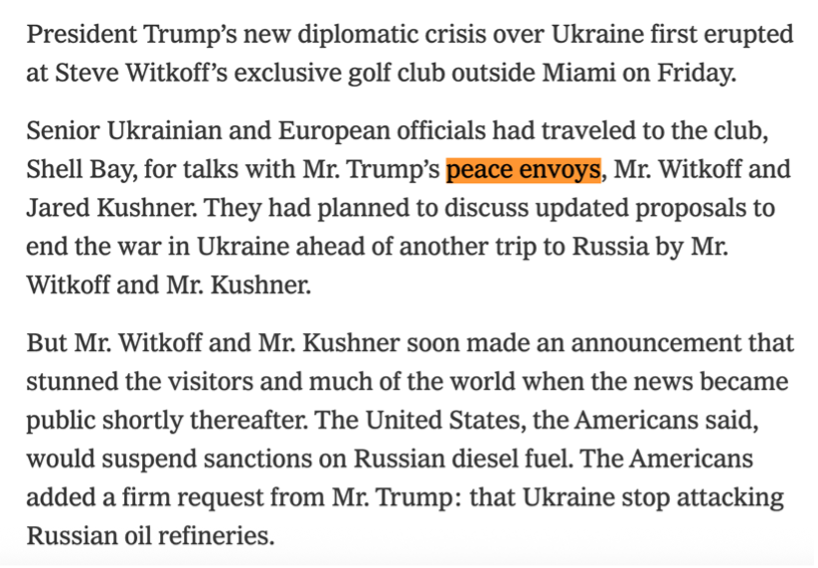
But poor Trump was stuck with a status quo in which the United States was expected to maintain its commitments to Ukraine, which included the provision of armaments and intelligence. Trump couldn’t quite toss Zelenskyy and Ukraine overboard. But he repeatedly conveyed the message that he was just not into them. He periodically dressed down Zelenskyy and blamed him for the war. He and his not-ready-for-prime-time negotiators—Steve Witkoff and Jared Kushner—kept leaning on Zelenskyy to cut a deal. That meant ceding territory to Putin, even land that Ukraine still controls. That is, reward the fascist aggressor.
Which brings us to recent days. In sync with the diesel deal, Trump has been squeezing Zelenskyy. He said the Ukrainian was responsible for the war. He called on Zelenskyy to leave office. He decried him as a “dictator.” He claimed that Zelenskyy had swindled $350 billion in military assistance out of the United States and falsely stated half of those funds were “missing.” He falsely maintained the United States has provided more funding to Ukraine than Europe has. He suggested Zelenskyy wants to continue the war to “keep the ‘gravy train’ going.”
There has been more than just gum-flapping. The Trump administration apparently paused the sharing of intelligence with Ukraine—which the Ukrainians desperately need to defend against Russia’s missile attacks. Ukraine charged that Elon Musk’s SpaceX imposed new limits on the military-grade Starlink terminals used by Ukrainian forces and, thus, impeded Kyiv’s ability to conduct drone attacks and intercept Russian drones. (Musk says the Pentagon and the White House controlled this; the service was eventually restored.) Trump angrily demanded that Ukraine cease its attacks on Russian oil facilities. (After refraining from such strikes for three days, Zelenskyy defied Trump and said Ukraine would resume these attacks.) Trump proclaimed an “energy ceasefire,” which Putin ignored, and Trump did not press Russia to end its assault on Ukraine’s power grid.
The Trump administration also requested that European countries unfreeze Russian assets impounded after Putin’s full-scale invasion of Ukraine and transfer them to an entity that would be overseen by the US government. So Trump could control those funds? What a nice gift it would be to return them to Putin. (The Europeans told Trump to get lost.)
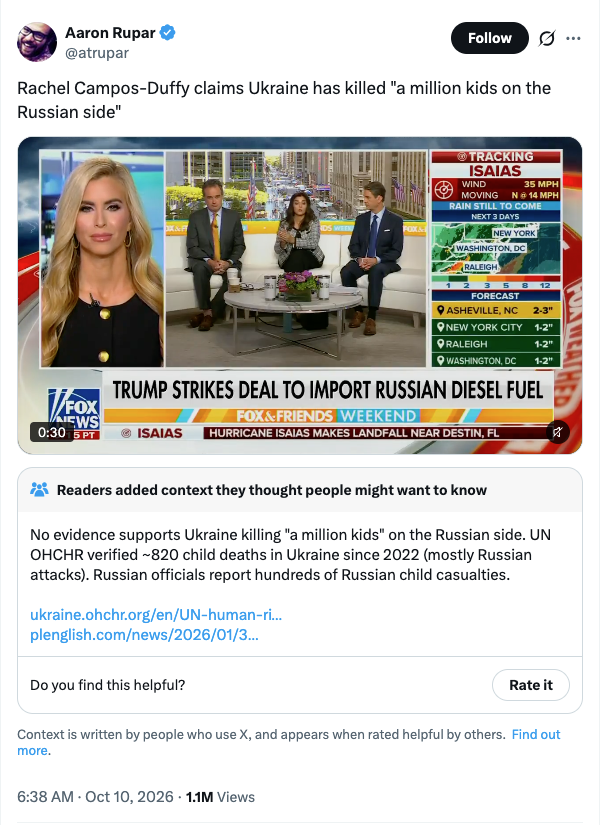
Trump’s argument for the diesel deal is absurd. He and his lieutenants once contended—as a bargaining chip for Russia—that if the war in Ukraine was resolved, an array of opportunities for US-Russian business deals would arise, which is what the Trumpers have cared about the most. Now they say that reaching a business agreement with Putin before any resolution of this horrific conflict will create a path to peace. Their ridiculous position is to hand Putin the carrot first and then see what happens.
Trump has never held Putin responsible for the war. He has repeatedly said that Putin wishes for the war to end, and he asserts the Russian is pursuing peace. This is more than appeasement. Trump has been running a disinformation campaign on Putin’s behalf—while haranguing Zelenskyy as the impediment to peace and now urging his defenestration. With these latest actions, Trump is making it easier for his pal Putin to triumph in Ukraine.
Commentators on Russian state-controlled media get it, and they are hailing Trump. “Well done, Trump,” one of Putin’s pundits proclaimed. “Today he’s on our side!” Though Trump is an erratic fellow capable of changing course, that appears to be an accurate characterization. He’s with Putin.
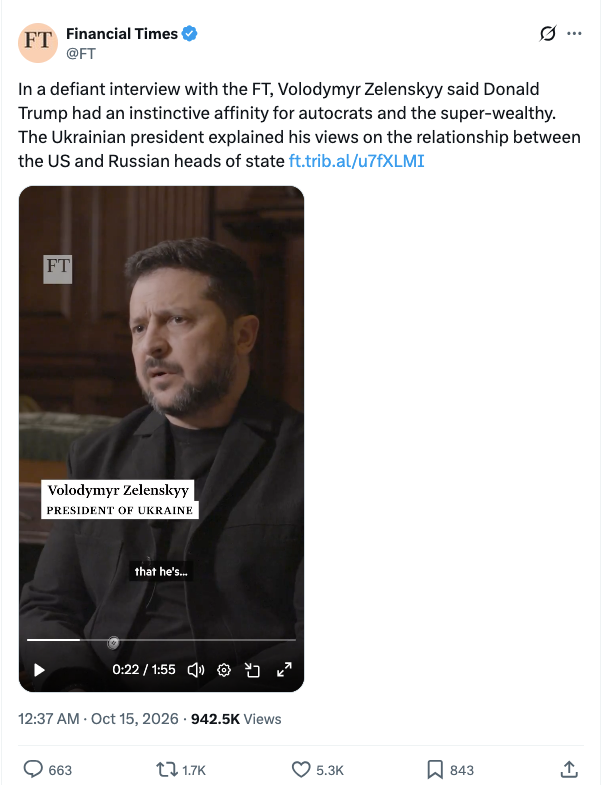
Asked about Trump taking his relationship with Putin to the next level, Zelenskyy did not hold back: “He speaks about it, openly and loudly, that he loves such people, and he respects such people.” Fact-check: True. Zelenskyy added, “How can Trump be friends with him? I think that it’s a mistake.”