FREE TRIAL VERSION. DON'T MISS OUT. |
FREE TRIAL VERSION. DON'T MISS OUT. |
|
|
|
It’s the Incompetence, Stupid |
By David Corn July 28, 2026 |
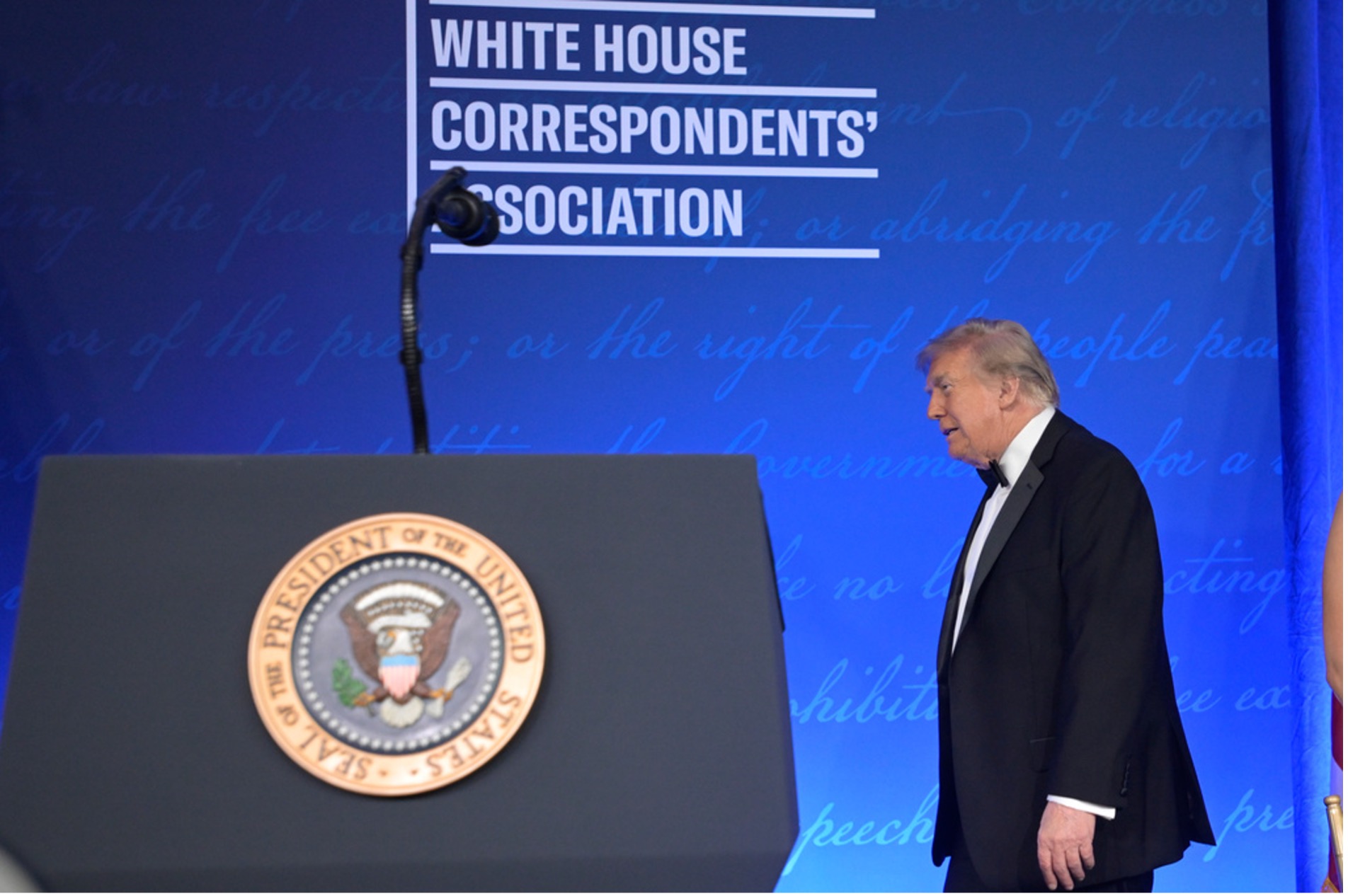
President Donald Trump at the White House Correspondents' Association Dinner on Friday. Rod Lamkey, Jr./AP |
|
|
|
You're reading a free promotional version of Our Land, and we hope you enjoy David's exclusive writing and don't want to miss out on what's next. Sign up to start receiving a free 30-day trial of Our Land and enjoy all of the behind-the-scenes reports and interactive features with each issue.
|
|
|
|
I was pondering the state of Trumpism as we reached the 100-days-from-the-midterms mark, and two data points caught my eye this weekend. First, a study published by Nature and conducted by Elizabeth Mitchell Elder, a fellow at the Hoover Institution at Stanford University, and Neil O’Brian, a political science professor at University of North Carolina at Chapel Hill, found that “conservative Americans experienced worsening health and higher mortality than liberals.” Two “mechanisms” contributed to this. “Demographic realignment within political coalitions,” they write, “brought less healthy individuals into the conservative camp.” That seems like a natural outcome, as more low-income rural voters moved from D to R. Think West Virginia.
The second “mechanism” was more intriguing: “Declining trust in medical professionals among right-leaning individuals, including lower willingness to seek care, follow clinical advice or believe in medication effectiveness, even for issues unrelated to COVID-19.” So the relentless assault from the right on vaccines, public health officials, and medical science—which intensified during the pandemic—has life-and-death consequences for Trump’s base.
This skepticism has been fueled by the attack on expertise and elites that’s been a crucial component of Trumpism. Donald Trump’s embrace of vaccine foe and conspiracy nutter Robert F. Kennedy Jr. and his dismissive regard for public health agencies, such as the Centers for Disease Control and Prevention and the National Institutes of Health, have sent a clear signal: Medical experts are not to be trusted. This study suggests that right-wing Americans are applying that message to doctors and health care practitioners at the ground level. “The conservative coalition,” Elder and O’Brian write, is “now more likely to eschew medical advice.”
|
|
|
|
Trump is killing his own people, and, of course, most of them don’t see that.
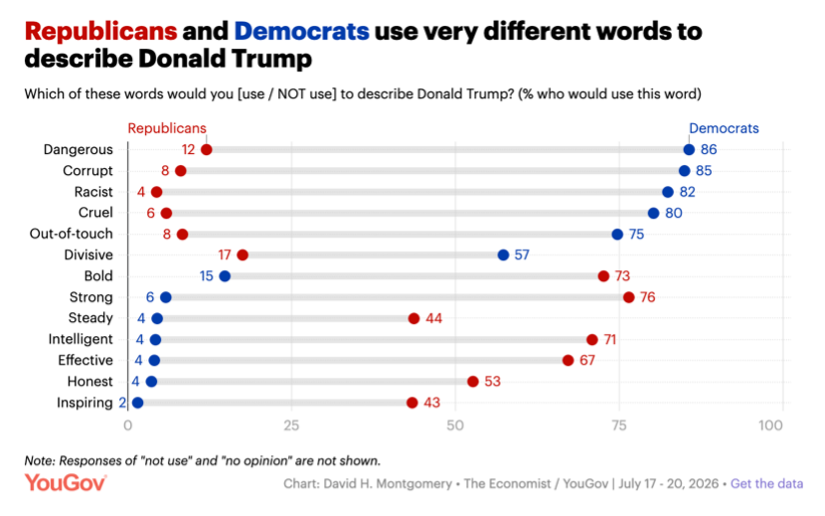
Which brings me to the second data point. YouGov recently published a poll showing what Democrats and Republicans think of Trump. Nearly nine out of ten Democrats believe Trump is “dangerous” and “corrupt.” Only one of eight Republicans sees him as dangerous, and fewer view him as corrupt. |
What was striking in this survey is that between 67 percent and 73 percent perceive him as “bold,” “strong,” and “intelligent,” but only half of Republicans consider Trump “honest.” The same poll shows that 80 percent of Republicans approve of Trump’s performance as president. This means that a fair number of Republicans don’t regard Trump as truthful but still give him a thumbs up. They don’t mind his lying. Perhaps they even view it as an asset. The worshiping of Trump within MAGA and the GOP is nothing new. This poll, however, indicates there is a slight deterioration in his cult-like hold over conservative Americans, with only two-thirds of Republicans judging him “effective,” meaning some don’t buy his claim that he’s the greatest president ever and has rescued America from total collapse and transformed it into a paradise of prosperity and security.
It certainly is ludicrous that any American rates Trump as “effective.” Just look at the Iran War. Trump has spent scores of billions of dollars—probably more—only to create a quagmire with horrible consequences throughout the world. Gas prices are high in the United States, but the impacts are worse elsewhere. Due to fuel shortages caused by the war, millions of farmers around the globe cannot operate their irrigation systems, and the closure of the Strait of Hormuz has blocked the shipment of much of the world’s fertilizer supply. Food production is in crisis in Asia, Africa, and elsewhere.
The shutdown of the Strait was entirely foreseeable—but Trump didn’t bother to plan for this easy-to-predict scenario. Less obvious is an ecological disaster that could be triggered by his war. The 1,500 or so ships stuck in the Persian Gulf are being besieged by a variety of marine life, including barnacles, algae, plants, and microorganisms. When tankers move, they collect far less of these passengers on their hulls. But now as they idle, they are attracting loads of such stowaways. Once they can pass through the Strait, they will carry these invasive species into ecosystems around the world. This could cause a “bioinvasion super-spreader event,” according to a paper published last week in the Biological Invasions journal.
Talk about unintended consequences. Here’s another one: the Pentagon’s munitions are being depleted by the war, limiting military options for the Trump administration. And one more: Iran is now being led by a supreme leader who’s reportedly far more eager to develop nuclear weapons than the supreme leader (his dad) who was killed by a US strike in the first days of the conflict. This war might be pushing Iran (and other nations) toward obtaining nuclear weapons.
What the war is demonstrating is that not only is Trump not effective; he’s incompetent. He has mismanaged this endeavor from the start—no surprise. During his second stint in the White House, there’s been a constant flow of commentary about his corruption, deception, indecency, megalomania, and authoritarianism—I’ve proudly been part of that—but perhaps Trump’s greatest political vulnerability is that he’s really bad at his job.
For years, he has promised a health care proposal and an infrastructure plan. Yet, there’s nada on both fronts. He boasted he would wipe out inflation. No progress there. Instead, he has called the affordability crisis a hoax, as he has grifted about $2 billion. He referred to bipartisan legislation to address the national housing shortage as a “big yawn.” He vowed to usher in a “golden age” with his tariffs and boost US manufacturing. He has only created economic chaos, and manufacturing jobs have declined by 75,000 since he returned to the White House. Measles, though, is up. So, too, salmonella and explosive diarrhea—all partly because of Trump’s weakening of the public health system.
His mass deportation campaign is not ridding the nation of the “worst of the worst”—but targeting tens of thousands of law-abiding residents. And now Trump has ended Temporary Protected Status for 350,000 Haitian migrants, placing them at risk of immediate deportation. About 35,000 of these immigrants work in the health care industry in Florida, as nurses, home health aides, or employees in medical assistance facilities. Deporting them will lead to a crisis within the health care sector, placing elderly and ill Americans at risk.
I have no large point to trumpet today, just the mundane observation that Trump is an incompetent president. He devotes more time to thinking of how much gaudy gold-leafing he can apply to the Oval Office or how many monuments to his ego he can erect than he does to any policy matter. He cares more about the Reflecting Pool—and this supposedly master developer (“I know pools like nobody else”) has botched its renovation. He couldn’t even competently deliver his vitriolic and low-class speech at the disgraceful White House Correspondents’ Association dinner. He, of course, blamed his speechwriters.
|
|
|
|
Though he’s not good at being president, Trump and his more competent minions—think Russell Vought and Stephen Miller—have done so much damage. (See this commentary on Trump’s war on science.) And there’s much other harm they can wreak, particularly if the Republicans hold off the Democrats in the midterms.
But of late, Republican officials and strategists, even though their party has a big money advantage over the Democrats, have become nervous about their voters. Polling, focus groups, and door-knocking have produced data showing a tremendous lack of enthusiasm among Republican voters, including the party’s most loyal core. Trump, as I recently noted, has been trying to gin up a Red Scare, hysterically claiming America faces an existential threat from communism (that is, Democrats), to motivate GOP voters. This contemptible and deceitful tactic doesn’t appear to be succeeding. For much of the last decade, being a demagogue is what Trump has been best at. It now looks as if he’s no longer even competent at that.
Got anything to say about this item—or anything else? Email me at ourland.corn@gmail.com. | More Shameless Promotion of How Russia Won |
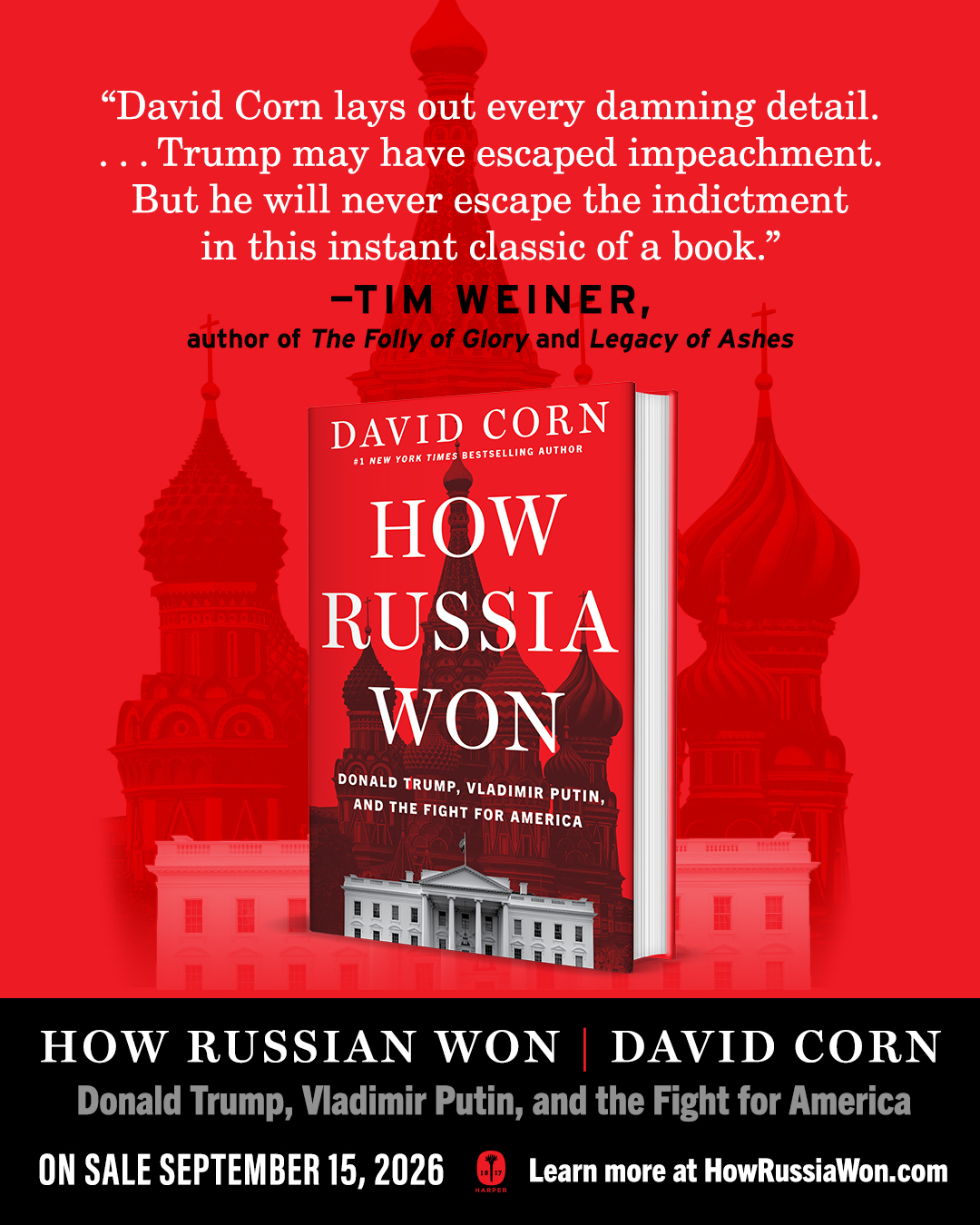
I warned you. All authors are desperate. I’ll be flogging my new book, How Russia Won: Donald Trump, Vladimir Putin, and the Fight for America, until its release on September 15—especially to generate preorders. Advance sales are so important these days. If booksellers and publishers see there’s an audience for a book before it comes out, they will do more to promote the book—and, thus, more copies will sell. I explained this recently. If you’re predisposed to purchase this book, please do so early. It’s sort of like early voting. Click here to buy a signed edition. If you want more information on the book, go to HowRussiaWon.com.
So far I’ve highlighted blurbs from Heather Cox Richardson and Anne Applebaum. Here’s one from Tim Weiner, the Pulitzer Prize-winning author of two great books on the CIA, The Mission and Legacy of Ashes. |
Time for Another Our Land Zoom Get-Together |
Save the date: August 5, 8:00 p.m. ET. Once again, we will have a gathering of the Our Land faithful on Zoom. As many of you know, these shindigs happen almost monthly and provide an opportunity for Our Landers to vent, kvetch, share their observations (and obsessions), and ask me questions. It’s like a cable news panel—but you get to participate. And, yes, we can talk about How Russia Won. If you insist.
These Zoom sessions are only open to premium subscribers—that much-appreciated band of Our Land readers who pay a few bucks each month to get the full version of this newsletter, which contains additional behind-the-scenes reports and analysis and a boatload of extra features, such as Dumbass Comment of the Week, Inspiration of the Week, the interactive Mailbag, and reviews of movies, TV shows, podcasts, books, music, and other cultural fare. And there’s MoxieCam™.
Here comes the pitch: This newsletter is made possible by the premium subscribers. Without their support, it would be kaput. If you’d like to receive those extra features, join our Zoom get-together, or just help us keep the lights on, please sign up for the full version here. I am so grateful for those readers who do so, for they allow me to continue this modest venture—and they make it possible for others to receive the limited version.
As for the Zoom confab, if you’re a premium subscriber, on the day of the event, you will receive an email with a link. Click on it at the right time, and our highly trained bouncers—who used to be ushers at the Kennedy Center—will let you in. As always, BYOB. See you then. |
|
|
|
The Watch, Read, and Listen List |
Bob Dylan, Wolf Trap National Park for the Performing Arts. Going to a Bob Dylan show is always a calculated risk. For decades, he’s been notorious for—let’s say—his unpredictability, sometimes delivering stupendous performances, other times offering not-so-stupendous performances. I’ve seen both. On Friday night at the Wolf Trap amphitheater outside Washington, DC, the Nobel laureate offered thousands of fans a mixed bag. The show drew heavily from his well-received 2020 album, Rough and Rowdy Ways, and included only a few of his many classics, which he reworked in a jazzy blues fashion. His rendition of “It Ain’t Me, Babe” had a Steely Dan styling, and “When I Paint My Masterpiece” was centered on a riff reminiscent of Irving Berlin’s “Puttin’ on the Ritz.”
Dylan’s band, closer to a jazz combo than a rock outfit, played in a tight and propulsive manner, moving lickety-split from one song to the next, with Dylan speak-singing his lyrics. It recalled the days of Beat poets reciting prose over music provided by beboppers. A standout in the band was guitarist Joel Paterson, a fixture on the Chicago music scene for 25 years. Three weeks ago, Dylan invited him to join the ensemble after two guitarists departed the group in what seems to have been acrimonious circumstances. Paterson’s lead work was a strong melodic counterpoint to Dylan’s vocals.
I don’t mind Dylan revising his well-known numbers. But a few devotees at the show disagreed and left. And it’s fine by me—not that he’s asking—if Dylan wants to lean into songs that are unfamiliar to most of the crowd. But his trademark mumbling, more indecipherable than usual, made it difficult to thoroughly absorb the non-hits. He won the Nobel Prize for Literature for his lyrics. So the words matter. Yet his warbling was too often incomprehensible, as he stood backlit behind a keyboard and shrouded by a hoodie, virtually unseeable. There was no patter—or any talking—between songs. He came, he played what he wanted, as he wanted, and left. (He exited in a hurry, departing the stage—no encore—and immediately stepping into his tour bus, which sped off, with a police escort, before many in the audience had cleared the venue.)
The show was more fascinating than enjoyable. Which is what you sometimes get with the Bard of the Sixties. Dylan’s whole career has been one long piece of performance art. He’s always been a sphinx, a chameleon, an enigma—while producing hundreds of dazzling songs. He performed “False Prophet”—from Rough and Rowdy Ways—a composition in which he seems to take aim at the label attached to him in his heyday. (“I ain’t no false prophet / I just said what I said.”) And with several songs laden with references to death, his set had an ominous tone. He sang of a man in a long black coat and of a black rider. Was there a message here? Was he sharing insights or provocative notions? Reflecting back on his six decades in the pantheon of American culture? I wanted to know what the guy in the hoodie was telling us.
The ushers at the show were enforcing a strict no photos/no video policy. But someone I know snapped this pic: |
And here’s audio of his recent performance in Philadelphia, in which you can actually hear the lyrics. |
MobLand. The Sopranos set the bar high for mob family dramas, and no television show has hit that mark since we last saw Tony, Carmela, AJ, and Meadow at a Jersey diner. Clearly, the creators of MobLand, the Paramount+ series, are striving to come close. The show, which premiered last year, gives us an Irish crime family in England that’s led by Conrad Harrigan (Pierce Brosnan) and his wife, Maeve Harrigan (Helen Mirren). They’re both cutthroat schemers, who, when necessary, plot against the other. Imagine a union between Richard III and Lady Macbeth. But they do love each other, and they’re both determined to guarantee the Harrigans prevail in their battle with the Stevensons, a rival crime clan.
Brosnan and Mirren deliver deliciously over-the-top performances, as Conrad and Maeve pursue their venal plans. But the emotional core of the show is Tom Hardy’s Harry Da Souza, the family’s fixer. He’s soft-spoken, steady, always calm when mayhem and hell break loose—quite the counterpoint to the maelstrom of Conrad and Maeve. He can subtly blackmail a Stevenson goon or toss one off the roof of a carpark—whatever is needed at the moment. Hardy is an always hypnotic actor, hard to look away from. (He shined in Peaky Blinders as Alfie Solomons, the head of an East End Jewish gang.) Throughout MobLand, Da Souza projects a quiet but potent menace. He seems to have a conscience but not too much of one. Hardy makes this series shine.
As with The Sopranos, the family dynamics and internal conflicts drive the action. When Eddie Harrigan (Anson Boon), Conrad’s grandson, kills the son of criminal kingpin Richie Stevenson (Geoff Bell), an all-out war is about to break out between the two gangs. At the same time, tensions within the Harrigan family—including those between Conrad and Maeve, Conrad and his son Kevin, Maeve and Conrad’s out-of-wedlock daughter Seraphina, among others—are exacerbated. And it’s up to ever-loyal, always-dependable Harry to keep it all together. Yet he’s at odds with his own wife and teenage daughter, who never fully understood what Harry did for a living and who now do not appreciate becoming targets in a war between two bands of violent thugs.
Harry is as sympathetic as a fixer for a sadistic mob boss can be, and much of the narrative centers on how he deftly deals with one dilemma after another—which includes the coppers trying to infiltrate the Harrigan outfit—while endeavoring to keep his own family intact. The show lacks the nuances of The Sopranos, and at points it veers into preposterousness—such as when Harry becomes an action hero who wipes out a whole warehouse full of heavily armed bad guys.
Missing from the series is a depiction of the Harrigans’ crime-ing. There’s an ongoing conversation about moving into the fentanyl trade, but there’s not much explanation of their daily illicit and highly lucrative doings. (Conrad and Maeve live in a beautiful estate in the Cotswolds.) More attention is paid to the family dysfunction than the family enterprise. The cast—especially Hardy—compensates for these shortcomings and succeeds in the tough task of causing you to root for the survival of a family that deserves to be put out of business.
|
|
|
|
Congratulations, you read all the way to the end! It's a great time to say "I'm in" and start your free 30-day trial. Make sure you don't miss out on what's next: Sign up to start getting Our Land in your inbox each week. We also want to hear from readers (especially those who read the whole thing!). So let us know what you think so far or share something interesting with David at ourland.corn@gmail.com.
|
|
|
|
|