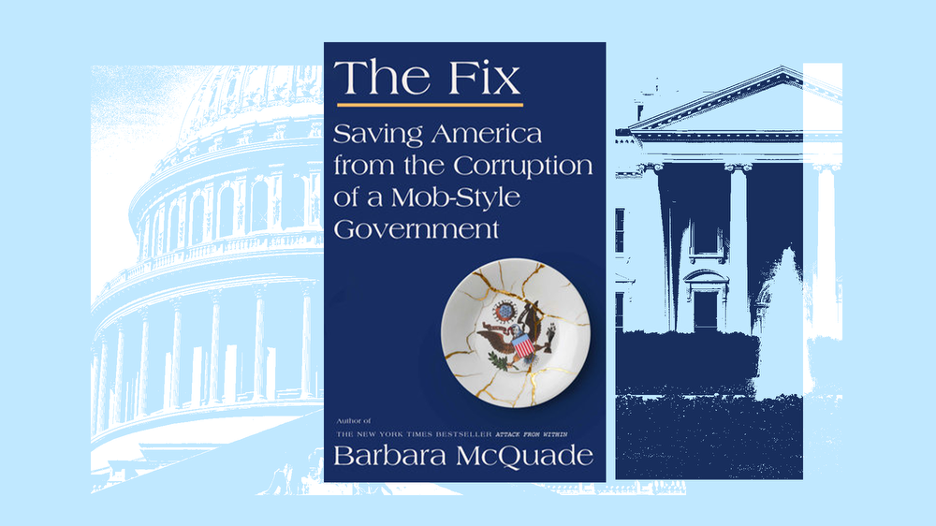
It’s the way he uses power to acquire more power and money. That’s what a mob boss does. The idea is that I’m going to inflict pain on you and coerce you to come to the table to negotiate your own punishment. That's the classic mob technique. Nice business you have here, be a shame if something happened to it. Maybe I could do a little protection for you. If you pay me $1,000 a week, I'll make sure nothing bad happens. What we've seen with Trump is similar.
Think about the executive orders he issued against law firms, making absurd findings that they had engaged in illegal weaponization or lawfare simply by associating themselves with particular lawyers like Robert Mueller and others who brought cases against Trump. You’re going to lose your security clearances, you're going to lose your ability to enter a federal building, including a courthouse, which means you can't practice you craft. But if you pay me off in the form of millions of dollars’ worth of pro bono hours, then we let things go.
One of the things that I've written about ad nauseum for 11 years is that the three major psychological motivations for Trump are revenge, revenge, and revenge. There’s something very moblike about that. He has said repeatedly that if someone screws you, you have to screw them back 10 or 15 times more than they screwed you.
This is a mob tactic: It isn't enough to exact revenge; you have to do it so harshly that no one else will ever think to do that to you again. You have to do it very publicly because the goal is retribution and deterrence. I want everybody out there to see that if you cross me, you're going to get it 10 times or 15 times worse. That’s why we see the president using the Justice Department to go after his enemies with criminal prosecutions and working to get Republicans who challenge him on anything to lose their elections. It’s an effort to silence critics and to chill dissent.
Much of your book is an account of all the Trump wrongdoing of the past year. But the last third of the book contains proposals for de-Trumpifying the US government—that is, restoring democracy and the rule of law. Let’s start with something in the news: acting appointments. Trump recently named Bill Pulte, the housing official known for trying to orchestrate spurious criminal investigations of Trump's political foes, to be acting director of national intelligence. He has absolutely no intelligence experience, and now he's in charge of overseeing the 18 intelligence agencies in the US intelligence community. What could possibly stop something like this in the future?
This acting appointment is particularly dangerous. The director of national intelligence was a position created after the 9/11 attacks to make sure all 18 of our intelligence agencies were on the same page, that they were connecting the dots. If we don't have someone capable in this position, we’re at greater risk. The statute that created the DNI position says the person in it must have extensive expertise in national security. Pulte has none.
The Federal Vacancies Reform Act of 1998 allows a president to appoint to any position for 210 days anyone who has been Senate confirmed for any position in the US government. We need acting appointees for short periods of time to make sure someone's on the job during the time it takes to replace somebody if there's a death, a resignation or a firing. But not seven months and not just anyone who's been confirmed for any position elsewhere in the government. They might be qualified for one thing but not qualified for something else. A way to alleviate this would be to pass legislation saying an acting appointee has to be a Senate-confirmed person from the same agency or an agency that deals with the same subject matter and cut back the time they can be in the position.
We’ve seen the Justice Department in this second Trump administration become a personal revenge hit squad for Trump. What can be done about to prevent this from happening again?
Well, in the book, I float the broad, bold, wild idea of creating a fourth branch of government that's not controlled by the president: Amend the Constitution to have this branch that would include agencies that shouldn't be political—Justice, Treasury, the IRS, and intelligence collection. Sen. Sam Ervin, who led the Senate Watergate investigation, floated this idea after Watergate to preserve the independence of the Justice Department.
But let’s look at things that maybe are more likely to occur. Since Watergate, there have been norms in place to protect the independence of the Justice Department. But they’re only norms. And now that we have a president who doesn't care about norms, we’ve seen how easy it is to drive a truck through them. We could have either legislation to enshrine those norms—which may get some constitutional challenges—or, at the least, we could codify in the code of federal regulations some of the norms that protect the rule of law at the Justice Department and its independence.
For example, there’s a document known as the Principles of Federal Prosecution that guides how federal prosecutors are supposed to exercise their discretion. One principle is that partisan politics may never play a role in a charging decision. I worked in the administrations of different presidents, and we always abided by that. This norm has been destroyed. Codifying it in federal regulations would be useful. It would provide a basis for court challenges, make it easier to spot violations, and give career officials stronger grounds to resist pressure to pursue partisan prosecutions.
Could this be legislated?
There's been debate about this, with the Supreme Court sympathetic toward the unitary executive theory, which says the president has complete control of the executive branch. Under that, Congress can't tell the Justice Department how to govern itself. But I disagree. The Justice Department was created by Congress through the Judiciary Act of 1789. If Congress can create the Justice Department, it seems to me it could also put some rules around the Justice Department about how it conducts itself, including saying that it has to operate under the rule of law and be independent from partisan politics.
What else can be changed at DOJ?
Other principles and norms could be codified. One is that a prosecution should not be initiated simply on the basis of probable cause, even though that's the standard for a grand jury issuing an indictment. The standard should be that a prosecutor believes the evidence is sufficient to obtain and sustain a conviction. That means guilt beyond a reasonable doubt. So there would be none of this name-and-shame strategy we’ve seen Ed Martin advocate. He was a failed nominee for US attorney who then moved over to the Justice Department’s Weaponization Working Group and then was moved out of that. He said that even if we don't have sufficient evidence to convict people, we are going to name and shame people with indictments and investigations. We should not have a prosecutor squeak out an indictment to punish and humiliate people and put them through the expense of defending themselves if we don't have evidence sufficient to obtain a conviction at trial.
Another norm to codify—if you cannot legislate it—is the ban on communications between the White House and the Justice Department on individual cases. Certainly, a president can say, “I was elected on a platform of immigration enforcement, and I would like you to increase the level of immigration enforcement.” That's fine. But when a president gets involved in specific cases—as we saw Trump do in his direct message to then-Attorney General Pam Bondi ordering her to go after Jim Comey, Letitia James, and Adam Schiff—that should be forbidden. It has been forbidden by policy in the past, and I think we should codify it to make it clear that that's an inappropriate use of presidential power.
Let's talk about fighting corruption. What ethics laws or rules could be changed to do something about that? In the book, you mention applying existing ethics rules to the president and vice president.
We have the Ethics in Government Act, but it exempts the president and the vice president. That could change. These ethics in government rules have been here since after Watergate, and they make great sense. One of the most important things they do is try to prevent actual and perceived conflicts of interest.
When I worked in the Justice Department, I couldn't accept free stuff. Even coffee service. The idea was it would either make you beholden or create the appearance that you are beholden to the person giving the gift. Now we have Trump accepting millions of dollars in private donations for his ballroom. And we see reports just the other day that companies that made donations to the ballroom have been rewarded with government contracts totaling $50 billion Maybe they would have gotten those contracts anyway, but maybe not. It creates an appearance of a conflict of interest, and so if you could apply these rules to the president and the vice president—that they couldn't accept free stuff from businesses doing business with the US government—that would be a good start.
The president is supposed to avoid taking any emoluments or gifts from any foreign officials and governments. And yet we have this president doing that. Acceptance of gifts and other payments is contrary to the idea that the president serves only one master, and that is the US Constitution and the people of the United States.
What about Trump’s businesses, though? He has a crypto business that's taken almost half a billion dollars in investment from a United Arab Emirates official. How could ethics rule apply to that?
It’s challenging. You could prevent a president from doing business. You could require him to put assets in a blind trust. The hard part, though, is a business with the president's adult children. Right now, Eric Trump., Donald Trump Jr., and Ivanka Trump are getting all kinds of lucrative business deals. Hunter Biden capitalized on his father's name, as well. I don't know that there's any way to stop that. People want to curry favor with the family. Don Jr. has got an exclusive social club in Washington. He's got cryptocurrency. He’s got AI investments. I don't know that you can prevent that activity from happening. But you can say the president himself is not permitted to engage in any sort of business whatsoever. He must put his assets in a blind trust. He shouldn't be able to trade stocks.
This president is trading stocks. He’ll even pump up a stock. He says that everybody should go out and buy a Dell computer the same day he buys Dell stock. That strikes me as the ultimate insider trading, right? He’s got the ability to move markets by just making a comment. If we could put a president's assets in a blind trust, at least during the time he's president, that could be helpful.
Jared Kushner received at least $2 billion in investment from a Saudi government-controlled fund for his private equity firm—and additional funds from other foreign sources—and he has served as a negotiator for his father-in-law in Iran and Russia. That seems—how can I put it?—wrong.
The whole idea of private advisers to the president is something we should eliminate. We have people in the State Department who are there to do these jobs. They're professional career employees, diplomats. They know how this is done. The idea that “Hey, I'm going to throw my son-in-law in there, or my buddy”—this is not how it should be done. A ban on having private individuals serve in these capacities as diplomats or as advisers to a president would be easy enough for Congress to do.
You suggest in the book that both the election interference case and the stolen documents case against Trump—which were shut down after he was elected in 2024—could be revived once he leaves office. How so? Is there no statute of limitations on these cases?
Here’s my argument: Both cases were dismissed without prejudice, which means they can be brought again. The statute of limitations is five years from the time of the conduct itself. The conduct in this case, the election interference case, occurred mostly in 2020 and early 2021. The documents case in 2021. The position of the Justice Department is that a sitting president cannot be prosecuted. Thus, it seems to me a fair argument that for the four years the president is in office, the statute of limitations should be on hold. You stop the clock, and as soon as he leaves, January 20, 2029, the clock starts up, and the case could proceed.
In both cases, the indictments looked strong. A lot of the evidence in these cases is documentary. You could pick up right where you left off. And it’s important to do so. There will be a temptation at the end of Trump's term to move on, turn the page, let's look forward, let's not look back. But the failure to hold people accountable is what causes misconduct to reoccur.
Here in Michigan, we are very fond of Gerald Ford, our only president. I am, too. He was an honorable man, but he made a mistake when he pardoned Richard Nixon. He said, “Our long national nightmare is over, let's turn the page, let's look forward.” But because of that, the lesson learned was that you can get away with murder if you're the president. I'm a former prosecutor. I believe strongly in accountability—not so much for revenge, to punish someone for their past deeds, but for deterrence to prevent other people from doing it in the future. For deterrence purposes, Trump needs to be held accountable for his crimes.
In the book, you write, “To save America as we know it, we must first acknowledge the corruption, cruelty, and chaos that now exists around us.” Do you think Democrats across the board are doing that? And will the 2028 presidential candidates do that? Or will they be told by advisers or decide on their own to stick to economic issues, and focus on looking ahead, not backward?
A great lesson comes from the recent elections in Hungary, where Peter Magyar did both. He pointed the finger at Viktor Orban and called him corrupt. He did not mince words. He said, "We have lived under this regime of corruption, fear, and hate for too long. It's time to get back to running the country in the way that best serves all of us.” And he also reached out across party lines and courted people who had voted for Orban in the past, rural voters, people who felt left behind. You have to have a vision for what comes next. People yearn for affordability, for better housing, for a better life for their children, to stop seeing the expansion of wealth disparities, for lifting up the middle class. There is a way to point to this corruption as something that we want to get past and also present a vision for the future that does address the economic needs of the middle-class Americans who feel left behind.