FREE TRIAL VERSION. DON'T MISS OUT. |
FREE TRIAL VERSION. DON'T MISS OUT. |
|
|
|
Trump’s Gift to Drug Cartels, Money Launderers, Terrorists, and Sanctions Evaders |
By David Corn June 2, 2026 |
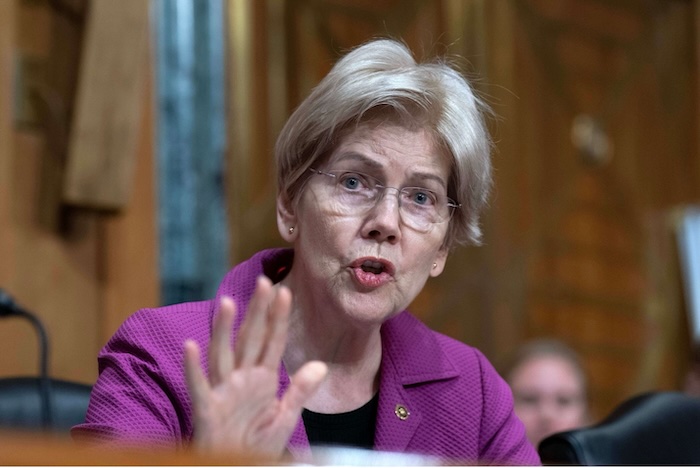
Sen. Elizabeth Warren, seen here at a Senate hearing in April, has called out Donald Trump for weakening reporting requirements for shell companies. Jose Luis Magana/AP |
|
|
|
You're reading a free promotional version of Our Land, and we hope you enjoy David's exclusive writing and don't want to miss out on what's next. Sign up to start receiving a free 30-day trial of Our Land and enjoy all of the behind-the-scenes reports and interactive features with each issue.
|
|
|
|
There has justifiably been much attention paid to Donald Trump’s personal corruption: cutting sleazy crypto deals, trading stocks in companies affected by his administration’s decisions, doling out pardons to fraudsters who make hefty donations to his political organizations, and so much more. But what’s even more significant is how Trump is perverting the federal government to allow wealthy individuals and corporations engaged in crooked conduct to escape scrutiny, prosecution, and punishment. Corporate scumbags and felonious plutocrats have never had it so good.
At the Securities and Exchange Commission, enforcement actions have fallen precipitously, and the commission ended several high-profile cryptocurrency inquires that involved Binance, Coinbase, and other firms. The workforce for the SEC’s enforcement division was cut by a fifth last year, with many experienced attorneys and accountants given the boot. The IRS, too, has been hammered by layoffs, and the number of audits of people with $10 million or more in income dropped by two-thirds from 6,786 in 2025 to 2,264 in 2026. With new priorities established at the Justice Department—such as essentially shutting down the pursuit of cases under the Foreign Corrupt Practices Act—the number of white-collar prosecutions has fallen to its lowest level in at least 40 years, according to the Financial Times.
But beyond this, the Trump administration has taken steps to make sure that the United States is a safe space for money launderers, drug cartels, and international financial rogues. Who says so? The US Government Accountability Office. Last week, it released a report assessing Trump’s decision to loosen reporting requirements for shell companies. These are corporations that can have legitimate uses but are also set up so people or entitites can evade taxes, launder money, hide assets, and obscure the true beneficiaries of financial transactions. For instance, a sanctioned Russian oligarch might be able to use a shell company—or a string of them—to buy real estate in the United States and keep secret his ownership of the property.
|
|
|
|
The Corporate Transparency Act, a bipartisan bill passed in 2021, required most US firms to disclose to the Treasury Department’s Financial Crimes Enforcement Network (FinCEN) their “beneficial owners”—that is, the real people who control or own them. (In many instances, shell companies do not have to reveal their true owners and are registered in the name of others.) The aim of the legislation was to create a registry of owners and impede illegal financial activities, such as money laundering. An estimated 32 million businesses would have to register and note their real owners. (Several categories of business were exempted because disclosure requirements already applied to them—such as banks, credit unions, and securities dealers.)
But one month into Trump’s second term, his administration essentially eviscerated this reporting requirement, when FinCEN issued rules exempting domestic companies and Americans from this disclosure. As the GAO put it, this new exemption applied “to over 99 percent of entities that were previously targeted.”
The GAO report—in exceedingly dry language—notes this exemption is a boon for assorted malfeasants:
U.S.-based shell companies, often structured as LLCs or corporations, can pose significant risks of illicit finance activity. Treasury’s 2026 National Money Laundering Risk Assessment identified several cases in which shell companies were used to facilitate financial crimes, including laundering the proceeds of drug trafficking, cybercrime, and fraud, among others, indicating the continued risk posed by shell companies. The 2025 domestic reporting company exemption may perpetuate these risks.
Sen. Elizabeth Warren of Massachusetts, the senior Democrat on the Senate Banking, Housing, and Urban Affairs Committee, quickly jumped on the GAO report and cited it as evidence Trump is on the side of the bad guys:
The Trump Administration continues to put cartels and criminals ahead of law enforcement, opening the door for them to move millions of dollars through our financial system. Today’s GAO report confirms that Treasury gutted a bipartisan law designed to crack down on the abuse of shell companies, exempted 99 percent of the entities previously required to report, and has failed to address the “significant risks” this rollback created. Law enforcement groups have warned that it will be harder to go after drug traffickers, sanctions evaders, and major criminal enterprises.
Warren noted that one of the main forces behind passage of the Corporate Transparency Act was a former senator named Marco Rubio. In 2020, he tweeted, “My ‘Corporate Transparency Act’ [is] the most significant anti-corruption and money-laundering legislation in decades [and] forces anonymous shell companies to disclose their true owners.”
Republican and Democratic senators have opposed the Trump administration’s wipeout of the Corporate Transparency Act, as have law enforcement organizations, business groups, and national security–minded think tanks of the right and left. The hawkish and neocon-ish Foundation for Defense of Democracies issued a statement last year that said, “Anonymous U.S. shell companies are not a theoretical vulnerability—they are a proven vehicle for illicit finance, sanctions evasion, corruption, terrorism, and transnational crime…FinCEN’s decision to exempt domestic entities would allow these practices to continue unchecked.”
Last year, Warren, Sen. Chris Van Hollen (D-Md.), and other Democratic senators wrote the Treasury to complain about the weakening of this requirement, noting, “There is growing evidence that [Chinese money laundering networks] are taking advantage of shell companies to help cartels move billions through the U.S. financial system.”
The Trump administration claims this disclosure obligation was too onerous for businesses, but it entailed minimal effort for the corporations compelled to register. So why kill this requirement? Warren and other legislators suspect Elon Musk had something to do with this. In a separate letter sent to Treasury Secretary Scott Bessent in April 2025, she and 18 other congressional Democrats asserted the Trump administration’s decision to neuter the Corporate Transparency Act was “seemingly triggered by a single Elon Musk social media comment.”
They pointed out that Musk, who at that time was a key adviser to Trump and engaged in a reckless dismantling of various government agencies, might have been “benefiting from foreign investments made through legal entities designed to hide the identities of the foreign investors.” They cited the Financial Times: “Wealthy Chinese investors are quietly funneling tens of millions of dollars into private companies controlled by Elon Musk” through “opaque structures” and “an arrangement that shields their identities from public view.”
Responding to the recent GAO report, Warren asserted that this disclosure requirement would be beneficial for efforts to combat transnational crime, drug trafficking (including fentanyl smuggling), sex trafficking, the evasion of sanctions imposed on Iran, the theft of US technology by China and others, and fraud that targets US government programs. (The criminals that stole federal funds in Minnesota relied on shell companies.) |
|
|
|
This may well be a personal issue for Trump. His Trump Organization is a collection of hundreds of shell companies. (Such entities are commonly used for real estate transactions.) And during the 2020 presidential race, Trump’s campaign, according to the Campaign Legal Center, deployed an LLC to launder “$170 million in spending to conceal payments to people close to the Trump family and campaign.”
Corporate reporting rules may seem like a wonkish topic. It certainly is not as visceral as Trump selling pardons or pocketing billions in crypto grift. But it may be more important, for Trump’s decision to protect the secrecy of shell companies—perhaps at the urging of Musk—has more far-ranging consequences than his own sticky-fingers corruption. It’s another way Trump is making America great for plutocrats, oligarchs, fraudsters, and scoundrels. Got anything to say about this item—or anything else? Email me at ourland.corn@gmail.com. | Steve Earle in a City of Immigrants |
In 2007, singer-songwriter-rocker-folkie-bluegrasser-actor-writer Steve Earle released the album Washington Square Serenade, a collection of songs the Texas-reared troubadour recorded after moving to New York City. Earle was delighted to be in the Big Apple, and on this record it showed, especially with the song “City of Immigrants,” which featured the Brazilian group Forró in the Dark. This tune is a love letter to NYC and its immigrant communities. “Livin' in a city of immigrants,” Earle sings. “I don't need to go travelin' / Open my door and the world walks in.” And he makes the fundamental point: “All of us are immigrants.” The record won the Grammy for Best Contemporary Folk/Americana Album, and the song went on to become a staple of his live shows.
After Bruce Springsteen recorded “Streets of Minneapolis” following the killings of Renée Good and Alex Pretti and joined Tom Morello (of Rage Against the Machine) in a protest concert in the Twin Cities, Earle, who has a long career of political activism, said to himself, “Get off your ass.” And he decided to revive “City of Immigrants” for the current moment. He did that by teaming up with actor Steve Buscemi (Fargo, Reservoir Dogs, Boardwalk Empire), who directed a new video for the song. It’s a heartfelt appreciation of New York City’s melting pot and a celebration of the town’s diversity. “I think anybody can appreciate that song,” Buscemi told Variety. “It doesn’t even need to be political. It’s just human.”
|
Kash Patel’s Mystery Money From a Kremlin-Linked Filmmaker |
Sam Van Pykeren, a video producer at Mother Jones, and I recently nabbed a Telly. Founded in 1989, the Telly Awards honor “excellence in video and television across all screens.” That includes small screens. Last year, we videofied an investigative scoop that Dan Friedman and I uncovered about Kash Patel: Before he became FBI director, Patel pocketed a $25,000 payment to appear in a documentary produced by a Ukrainian Russian American filmmaker and propagandist with ties to the Kremlin. In that film, Patel claimed that Russia did not intervene in the 2016 election, even though he had worked on a congressional committee that concluded Vladimir Putin’s cyber operatives had done so. By the way, there’s never been an accounting of where that money came from. Here’s the article, and here’s the award-winning video:
|
|
|
|
The Watch, Read, and Listen List |
Big Mistakes. In recent years, there has been a justifiable backlash to nepo babies in the entertainment world. Yet occasionally there’s an opportunity to cheer an NB for truly creative accomplishment. One such son-of is Dan Levy, the offspring of actor Eugene Levy of SCTV, Splash, Best in Show, A Mighty Wind, and Waiting for Guffman, among other great works of comedy. Dan inherited both his father’s eyebrows and arched sense of humor. Together they developed Schitt’s Creek, the critically acclaimed Netflix series. And to follow up on that—and to show he can soar without his pop—Dan subsequently created with comedian Rachel Sennott Big Mistakes, a dark comedy that has a bit of the spirit of HBO’s Barry.
Levy plays Nicky, an openly gay pastor at a church in suburban New Jersey (though he’s somewhat hiding his current relationship). His sister Morgan (Taylor Ortega) is a failed actor who’s now a public school teacher. Their relationship is essentially a nonstop current of sibling bickering. When grandmother is on her deathbed, the two are tasked by their mom, Linda, to find a gift for her. At a knick-knack store, Morgan spots a costume jewelry necklace. When told it’s not for sale, she pinches it. Well, it turns out, that necklace was the real McCoy and worth $75,000, and Russian mobsters want it back. But there’s a problem, after it was hooked around grandma’s neck, she died and was buried with the piece.
Yes, hijinks ensue. Nicky and Morgan must return the necklace to the Russians. But things get complicated, for the Russians are working with the Brazilian mob who are up against the Italian mob, and Nicky and Morgan are drawn deeper and deeper into an underworld mess, incessantly sniping at each other all along the way. Meanwhile, their mom, admirably played by a madcap Laurie Metcalf, is running for mayor of their town.
It’s a creative setup, and Levy shows he has a sharp eye for human foibles in the most banal circumstances. His father delivered absurdist humor in conventional formats along with his fellow SCTVers. Dan Levy has taken up that mantle and, with Big Mistakes, he wears it well. |
|
|
|
“Machines,” Happy Landing. One of my great joys is listening to the radio to discover new music. As a kid, I used to keep a pad and pen next to my budget stereo player, so when I heard a song that grabbed me on WNEW or WPLJ, I could write down the name of the artist and the title of the track. I still do that, in a way, but now I use Shazam or dictate the info into my phone.
I tend to hear new music mostly when I’m on road trips and catch an independent or college station. Recently on the way to New York state, I had on WTMD out of Baltimore and heard “Machines” by Happy Landing. The track has an Oasis-ish feel to it. I later looked up Happy Landing. It was formed a few years ago by a group of students at the University of Mississippi, and the group has been described as an indie folk band or a folk-rock band or alt-folk band (their term). Interesting trivia: Lead singer and songwriter Matthew Hendley was an intern at 60 Minutes.
Earlier this year, they put out their second album, Big Sun, which includes the track “Machines.” I don’t think the song—a blend of alt-rock and power pop—was written about AI. But that’s what comes to my mind when Hendley sings, “Little do we know they’re watching from the window while we’re asleep / Little do we know we all scream, ‘We’re all, we’re all machines.’” |
|
|
|
Congratulations, you read all the way to the end! It's a great time to say "I'm in" and start your free 30-day trial. Make sure you don't miss out on what's next: Sign up to start getting Our Land in your inbox each week. We also want to hear from readers (especially those who read the whole thing!). So let us know what you think so far or share something interesting with David at ourland.corn@gmail.com.
|
|
|
|
|