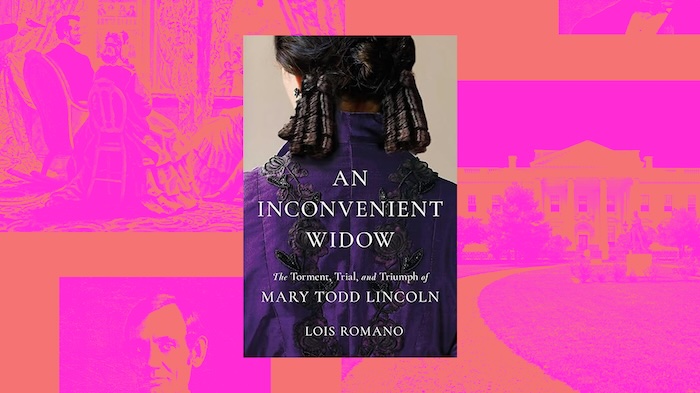
Mary Todd Lincoln is hot. That is, the Mary Todd Lincoln in Oh, Mary!, the Tony-winning play that serves up an ultra-campy version of the first lady as a high-strung, alcoholic, and frustrated cabaret singer stuck in a loveless marriage with a deeply closeted Abraham Lincoln. But long before this fictitious Mary Todd Lincoln became a smash Broadway hit, veteran reporter Lois Romano, who has worked for the Washington Post and Politico, was deep into research on the 16th first lady. This week, she’s publishing her new biography of MTL: An Inconvenient Widow: The Torment, Trial, and Triumph of Mary Todd Lincoln.
 
FREE TRIAL VERSION. DON'T MISS OUT.

FREE TRIAL VERSION. DON'T MISS OUT.

FREE TRIAL VERSION. DON'T MISS OUT.

FREE TRIAL VERSION. DON'T MISS OUT.


Saving Mary Todd Lincoln

By David Corn  May 23, 2026

Mother Jones illustration; Wikimedia (3)

Mother Jones illustration; Wikimedia (3)


You're reading a free promotional version of Our Land, and we hope you enjoy David's exclusive writing and don't want to miss out on what's next. Sign up to start receiving a free 30-day trial of Our Land and enjoy all of the behind-the-scenes reports and interactive features with each issue.

Start My Free Trial
 

Mary Todd Lincoln is hot. That is, the Mary Todd Lincoln in Oh, Mary!, the Tony-winning play that serves up an ultra-campy version of the first lady as a high-strung, alcoholic, and frustrated cabaret singer stuck in a loveless marriage with a deeply closeted Abraham Lincoln. But long before this fictitious Mary Todd Lincoln became a smash Broadway hit, veteran reporter Lois Romano, who has worked for the Washington Post and Politico, was deep into research on the 16th first lady. This week, she’s publishing her new biography of MTL: An Inconvenient Widow: The Torment, Trial, and Triumph of Mary Todd Lincoln.

Romano’s work is a compelling tale of a tragic figure. Mary Lincoln was maligned in life and maligned afterward, often depicted as a troubled and troublesome woman who made things tough for Honest Abe. Yet Romano has a much different take and ably presents a persuasive the case that Mrs. Lincoln has been unfairly short-shrifted by history and that the United States owes her much for helping to deliver Mr. Lincoln to the White House. Romano was kind enough to chat with me last week about the real Mary Lincoln. 

Advertisement

Support Mother Jones' fearless journalism.

What led you to believe that what the world needs now is a biography of Mary Todd Lincoln?

I didn't decide that recently, even though it seems I did because we're all talking about the play Oh, Mary! I became interested in her a number of years ago after covering first ladies. In doing research on different first ladies, it struck me that here was a man—Abraham Lincoln—who was one of the most consequential presidents in history, and I believe we got his wife wrong. She was portrayed as a burden, and I believe she was a partner, and I thought that she deserved a fair shake.

The one-line description of her is that she was a difficult person, hypochondriac, hyperbolic, and, as you said, a burden. As I read the book, I felt sympathy for her but also did not find her likable. She did seem to have a few bad qualities. It’s confusing.

Here's what I like to say: Her picture wasn't complete. She was vilified, but there was a whole other side of her, and I believe with all my heart he would have not been president without her. He was a depressive personality. He would go into long funks. Now, the scholars like to use the word melancholy. But melancholy is a very deep form of depression. She also had some mental illness, but hers was more manic. So she was able to lift him up. She was an engine, and he would not have made it to the White House were it not for her engine. He might not have pushed himself far enough, even though he was brilliant and ambitious.

What did Abe see in her, and what did she see in him? She came from a rather cultured and refined family in Lexington, Kentucky, a very metropolitan city at the time, and he was a bit of a country hick.

I can see what he saw in her. He was a Whig, and she was a Whig, and she was very political. Her father was close to Henry Clay. He was a regular guest at the dinner table. He was secretary of state, speaker of the House. He ran for president several times. He was a big deal, and he was part of their family. So you could see how Lincoln would be intrigued by her.

What was more curious was that she found something in him. She had a rough childhood. Her mother died when she was 6 years old, and her father remarried someone who she did not get along with, and who then had nine more children. She's in the middle of 14, 15 children. She described her childhood as desolate. Lincoln had a lot of empathy. He was kind, he was intuitive, and I think she saw in him somebody who might take care of her. I tend to think that Lincoln liked the idea of taking care of somebody. There was something in him that was attracted to her neediness. Regardless of what some people have written—some men—they had a real partnership and shared a singular goal: getting him to the White House.

Your book shows us they each had their own set of troubles. He was exceedingly patient with her. He loved her for all these difficulties. When he was president, people around him were always badmouthing her, and he stood by her. What does that tell us about him?

What does it tell us about him because she was flawed? Let’s look at it a different way. He was no prize to live with. The second she marries him, he goes on the road, as a traveling lawyer, for months at a time. She’s in Springfield—which was no Lexington with its paved roads—and she's raising their kids by herself. She's had enormous anxiety. Then he comes home, and he's not really there. He goes into these trances. It was not Ozzie and Harriet. He was not this great, incredible catch at first. She endured quite a lot in those first 20 years, and he wasn't making a lot of money.

After Lincoln was shot, the political world seems to have wanted Mary to disappear. She was treated in a shockingly horrendous manner. She wasn’t provided financial support. There was an outright smear campaign mounted against her. She was harshly and cruelly criticized. Why was that?

As we started this conversation, you said she wasn't likable. That’s part of it. She liked who she liked. There were some people who thought she was wonderful, generous, and kind. But she antagonized a lot of people, and she was needy and demanding, and they just wanted her to go away. It would never happen now because today's politicians understand that the legacy of a president is tied to the first lady. But they thought she would just go away. It was reprehensible. Lincoln’s friends and allies—such as Supreme Court Justice David Davis and Leonard Swett—had the resources to help her buy a house, but they didn't. Davis, the executor of Lincoln’s estate, decided that she needed to move back to Springfield into the house the Lincolns owned. She didn't want to. But if she wasn't going to do that, he wasn't going to free up the money. It was cruel.

After Lincoln’s death, his former law partner, William Herndon, was giving lectures saying Lincoln never loved her.

Mary did not like Herndon for a number of reasons. He was smart but a loudmouth, indiscreet, and a drunk. Mary thought he was beneath Lincoln. He was also a very loud abolitionist. Even though Lincoln is credited with ending slavery, we all know that he was slow on emancipation, and Mary, as a political matter, knew that he could not be an abolitionist in the 1850s. He had to be a little bit more delicate as he was moving up the political ladder. One time, Lincoln had to bail Herndon out of jail because he went on a bender and broke a store window. So she held him in great disdain and didn't hide it. She would never invite him to her house for dinner. If you read Herndon's letters, I swear it's all about the dinner.

He claims Lincoln was never comfortable with Mary and would leave the house to get away from Mary yelling at him. In his lectures, he said that Lincoln never loved her, that he loved some other woman. He was making up stuff. He had a real ax to grind. Davis was more the problem. He couldn’t stand the fact Mary was trying to raise money for herself because he wouldn't settle Lincoln’s estate and provide her funds.

She could be her own worst enemy, right? She engaged in several schemes to sell her clothing—

Why was that bad?

But there was some shiftiness, right?

She believed there was nothing wrong with selling her clothes to raise money, but the way she went about doing it did cause a problem. She believed the Republican Party should have bailed her out of her debts because her husband gave his life for the country. But the sympathy for him didn’t transfer to her. She didn't have quite enough money to buy and sustain a house, and she thought these people should take care of her. So she goes to New York to sell the clothes, and she falls in with a hustler. He has her write letters to him, dating them from Chicago when she was in New York, saying, “I'm so poor, and I have no money, and I need to sell my clothes, and all of these Republicans won't help me.” And he tries to peddle these clothes to these people she references in the letter. It doesn’t work. He gives the letters to the New York World, and she’s humiliated nationally because it looked like she was trying to shake down these politicians.

Her life is full of tragedies, not just the assassination of her husband. She loses three sons to disease. And one of the saddest parts of the book comes later in her life when her son Robert Lincoln in 1875, 10 years after Lincoln’s assassination, gets her declared insane and committed. There was a trial in which she was railroaded in the most unfair way.

It was unbelievable. At this point, she and Robert are both in Chicago, and for some reason, she drives Robert crazy, even though they're not living together. She’s shopping all the time. But she’s never going to run out of money, because she’s just spending the interest from the bonds she has. But he gets it in his head that she’s buying stuff she doesn't need. I think he was worried that she would spend all her money and then he’d have to take care of her. And she was creating controversy by fighting for a pension from Congress. That was embarrassing and played out in the newspapers. He felt all this was a poor reflection on him.

So how did Robert Lincoln gin up a trial to label her insane?

Five years prior, any husband in Illinois could commit his wife for any reason. If you disagree with him at the dinner table, if you wouldn't conform to his religious beliefs, the woman could be confined. A woman named Elizabeth Packard mounted a campaign and got legislation passed saying there had to be a jury trial to commit a woman. That brings us to Mary. She was supposed to be given notice of the trial, and she wasn't. She was supposed to have been assigned an attorney, and all they did was bring an attorney to the courtroom the day of the trial.

One day, a friend of her husband shows up and says, “You should come with me or they’ll arrest you.” He takes her to this courtroom for a trial, and it's packed. The jurors are there, the witnesses. All the shopkeepers are there to testify. People from the hotel where she lived were there to say she was a little wacky. And the media was there. It was completely rigged by Robert and his father's friends. She gets convicted in 10 minutes. Later a juror was quoted saying that he really didn't think she was crazy. He said that he thought she had some episodic issues but the jurors were given instructions that boxed them in and had to find her insane.

Her reputation was also shaped by her interest in the spirit world, seances, and mediums, right?

The money issue drove Robert crazy. The second thing that drove him crazy was her interest in spiritualists, trying to get in touch with her deceased husband and sons. He was embarrassed by it. But having that interest was common during the Civil War. Seven hundred thousand soldiers had died. Many people were into spiritualism. If she could have been on antidepressants, she would have been, but they didn't have them. Instead, she was finding anything she could for solace.

She over-grieved. She had lost three sons by the time Robert committed her, and her husband was killed in front of her. She was looking for lifelines, and the two she found was shopping and spiritualists. She would find these people, and she was so gullible. Robert was worried they were going to fleece her. Another thing: She was carrying around the equivalent of close to a million dollars in bearer bonds sewed into her dress. When Robert realized that he was apoplectic. He, too, was depressive, and he’s a wreck about all this and goes to his father's friends and says we have to get her off the street.

It’s such a sad story. She gave the country one of its best presidents, suffered a tremendous loss, and was treated so shabbily. But she won her release from the mental institution four months later. She went on to live in Europe for four years before returning to Springfield and dying of a stroke in 1882 at the age of 63. An estimated 15,000 to 18,000 books on Abraham Lincoln have been publish—.

Only Jesus has more books.

I know our subject here is Mary, but what does your book tell us about Abe? Anything we didn’t already know?

You're not going to get me to say anything bad about Abraham Lincoln.

I'm not asking you to say anything bad about Abraham Lincoln.

My takeaway is that he was an incredibly good man, and he really loved her. But he was a difficult husband. Not that he mistreated her. He was absent—physically and mentally. That was hard. She was alone a lot. He was a moral authority, but I never saw him before from the perspective that he was an absentee husband. She gave up everything for him, and she had a troubled personality. I think getting through life every day was hard for her. He knew how to manage her and her anxiety, and part of the problem was that when he died, there was nobody there to give her solace. That was something very big she lost when he died.

Advertisement

Support Mother Jones' fearless journalism.

So ultimately what makes Mary different from other first ladies?

She was the first modern first lady. She decided right from the get-go that she was not going to be a quiet wife that stayed upstairs. She was going to be seen. Here’s the best example: A month after the Civil War starts, the major who was in charge at Fort Sumter in South Carolina, where the war began, Robert Anderson, is a hero and everyone in the North wants to celebrate him. He's invited to Philadelphia and New York, and she decides she's going to go with him. That was an unbelievable decision at the time: the first lady accompanying the biggest war hero on a train trip in the middle of the war. She became a positive symbol promoting the war. In Philadelphia, she visits a clothing factory that had been turned into a uniform company. She goes to troop encampments and observes regiments in New York City. She goes to Brooklyn to visit Henry Ward Beecher's church. This is huge. He's one of the biggest abolitionists in the country. Lincoln hasn't yet decided what he's doing about slavery, and she walks into that church. That is a political statement, and everybody knew it.

After her 11-year-old son Tad died, when they were in the White House, she goes to hospitals for wounded soldiers every day. She was a billboard for the Union. And the media covered her 24/7. No first lady before was ever covered like that. They covered when she visited the encampments, but they also covered all her shopping. She doesn’t get credit for being as tough as she was. She had good instincts, but she had a lot of emotional flaws. If she had been on antidepressants, she could have been president.

Play 

Got anything to say about this item—or anything else? Email me at ourland.corn@gmail.com.

Gone Grillin’

It’s been an intense few weeks, with practically an impeachable action every day. And I’m in the final throes of finishing a book. (More on that later.) Consequently, we’re giving the crew at Our Land Worldwide Headquarters a break. Enjoy the three-day weekend and brace yourself for a hot—in more ways than one—summer.

A brief reminder that you're reading a free promotional version of Our Land. If you appreciate David's smart takes on the news and all the extra features, sign up to start receiving a free 30-day trial of Our Land directly in your inbox.

Start My Free Trial

Dumbass Comment of the Week

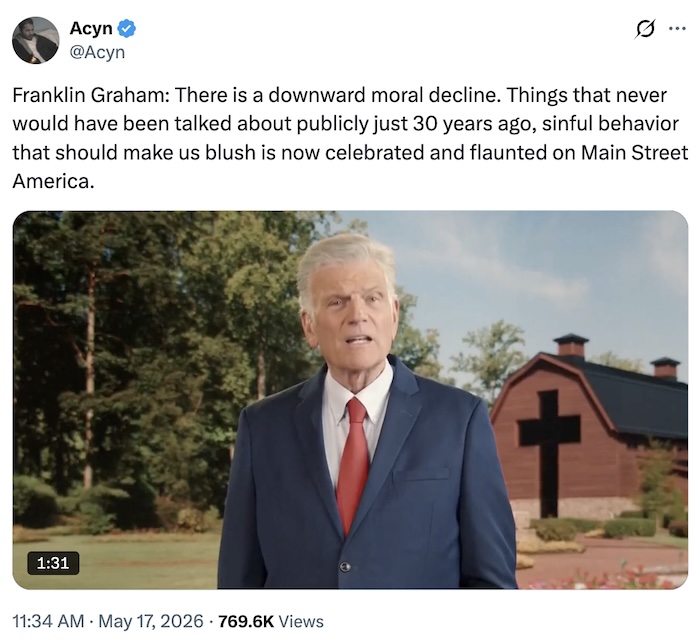
In connection with the Rededicate 250 event held on the National Mall last week—a federally funded prayer service that featured a gaggle of evangelical Christian leaders who proclaimed the United States is a Christian nation—Franklin Graham, a prominent evangelist, issued a big complaint about America:

There is a downward moral decline…Things that never would have been talked about publicly just 30 years ago, sinful behavior that should make us blush is now celebrated and flaunted on Main Street America. America has become morally rotten, completely sick with sin.

Acyn on X.com; Franklin Graham: There is a downward moral decline. Things that never would have been talked about publicly just 30 years ago, sinful behavior that should make us blush is now celebrated and flaunted on Main Street America.

Now remind me: Who boasted he grabbed women “by the pussy,” was a serial cheater, has publicly lied a gazillion times, said he has never had to ask for God’s forgiveness, erected a golden statute of himself to be worshipped, and has posted blasphemous social media messages?

And who has steadfastly supported that man? Yes, Graham has been a loyal Trumper, despite Trump’s embodiment of the moral rot he decries. Graham even once said Trump's supposed affair with porn star Stormy Daniels was "nobody's business.” He can spare us his grousing about declining morality. Pastor, heal thyself—and your pal.

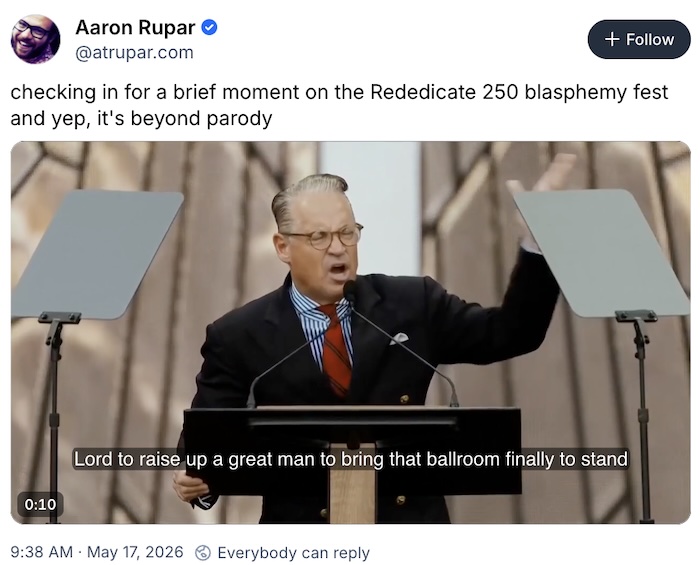
At the Rededicate 250 rally—which was attended by House Speaker Mike Johnson, Secretary of State Marco Rubio, and Defense Secretary Pete Hegseth—Eric Metaxas, a Christian nationalist (who rejects this term), used his time at the podium to tell us that God is all in on Trump’s billion-dollar ballroom:

It’s hard to believe that it would take two centuries for the Lord to raise up a great man to bring that ballroom finally to stand where it needs to stand. It’s extraordinary. We only had to wait 200 years.

Aaron Rupar on Bluesky; checking in for a brief moment on the Rededicate 250 blasphemy fest and yep, it's beyond parody

I am certain that were Jesus with us these days, he would demand that money be spent on the ballroom rather than, say, food or health care for the poor.  

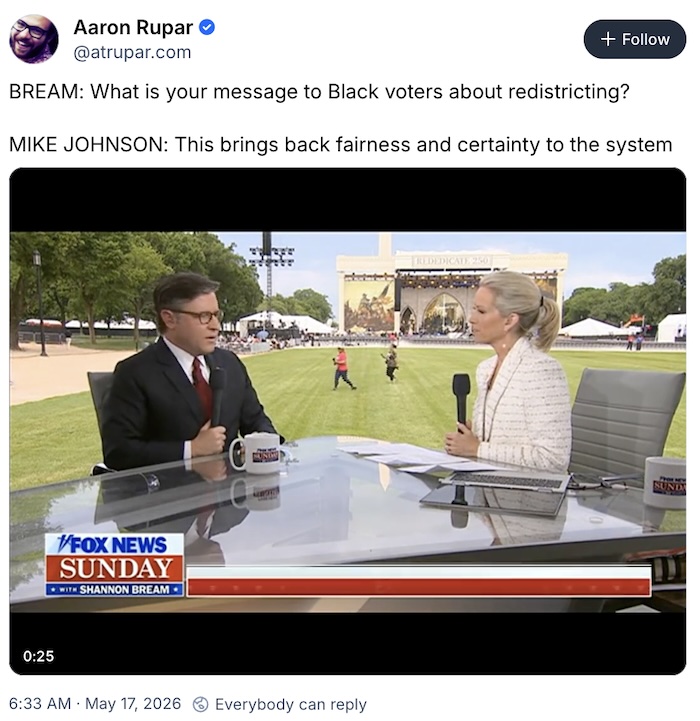
On Fox News, House Speaker Mike Johnson was asked by host Shannon Bream to explain to Black voters the Republican crusade to demolish majority-Black congressional districts. He suggested they would understand this had to be done:

Bream: What is your message to Black voters about redistricting?

Johnson: This brings back fairness and certainty to the system.

Aaron Rupar on Bluesky; BREAM: What is your message to Black voters about redistricting?  MIKE JOHNSON: This brings back fairness and certainty to the system

Disempowering Black Americans is a question of fairness, according to Johnson. This guy really knows how to talk to Black voters.

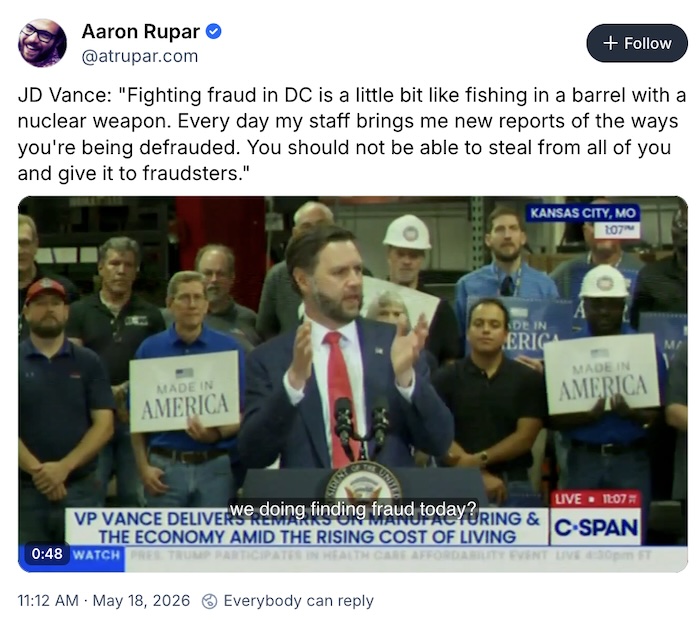
At an event in Kansas City, Vice President JD Vance talked about corruption in the nation’s capital:

Fighting fraud in DC is a little bit like fishing in a barrel with a nuclear weapon. It is the easiest thing to find. Every single day my staff will bring me new reports of the ways you're being defrauded…You should not be able to steal from all of you and give it to fraudsters.

Aaron Rupar on Bluesky; JD Vance:

I was happy to see that Vance was opposing the Justice Department move that set up a $1.8 billion slush fund for Trump’s political allies and ended any tax audits of Trump and his family. But then a colleague informed me that was not what Vance was talking about. Oh.

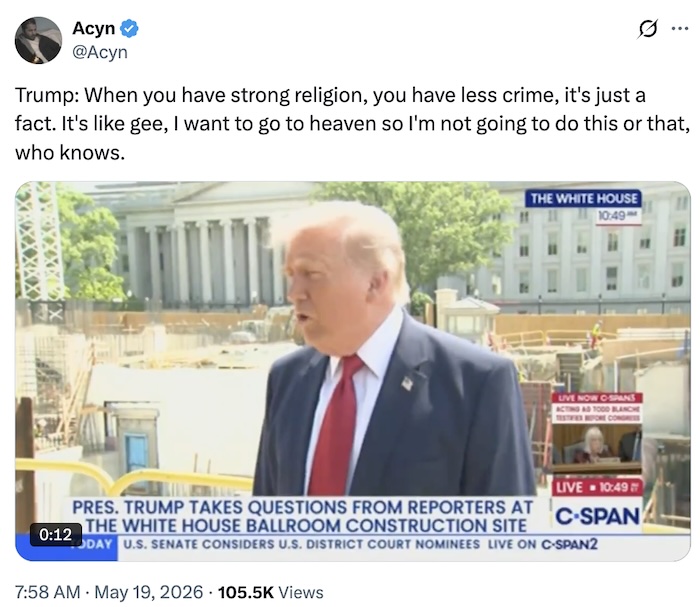
On occasion, I must overrule the judges. This week they tried to cite the mercy rule to strike nominations for Donald Trump. But his stupid remarks were just too compelling. Speaking to reporters at the White House on Tuesday, he said, “When you have strong religion, you have less crime, it's just a fact. It's like, gee, I want to go to heaven so I'm not going to do this or that. Who knows?”

Acyn on X.com; Trump: When you have strong religion, you have less crime, it's just a fact. It's like gee, I want to go to heaven so I'm not going to do this or that, who knows.

You might find this shocking. But Trump had it exactly backwards. Let’s look at Europe. Americans, according to polls, are generally more religious than Europeans. Yet there’s far more crime in the United States. In 2024, the US homicide rate was 5 to 10 times higher than that in most Western European countries. Seems piety does not prevent crime.

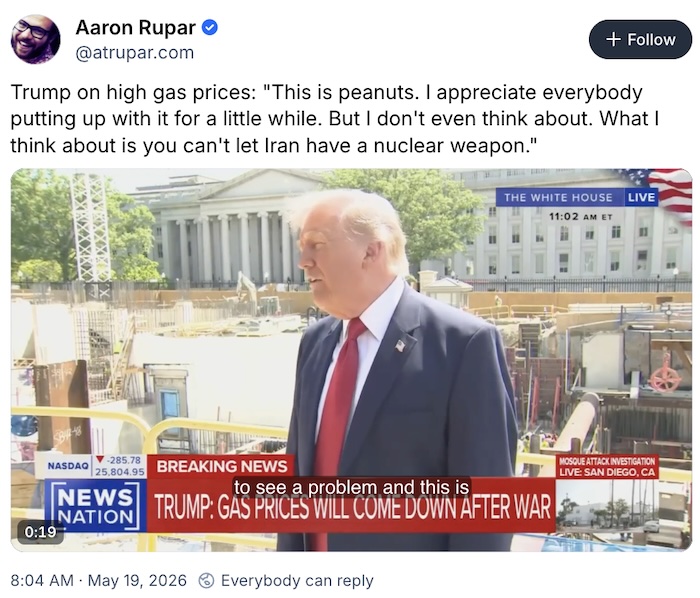
In that same presser—which Trump held near the spot he’s building his Jesus-wants-it ballroom—he was asked about the higher gas prices caused by his impulsive war of choice in Iran. Days earlier, he had sparked an uproar when he said, “I don’t think about Americans’ financial situation. I don’t think about anybody.” Now he answered:

This is peanuts. I appreciate everybody putting up with it for a little while…But I don't even think about that. What I think about is you can't let Iran have a nuclear weapon.

Aaron Rupar on Bluesky; Trump on high gas prices:

I don’t even think about it? That was his response after being ripped for saying he didn’t ponder the “financial situation” of voters? Trump was literally on a construction site and digging a deeper hole.

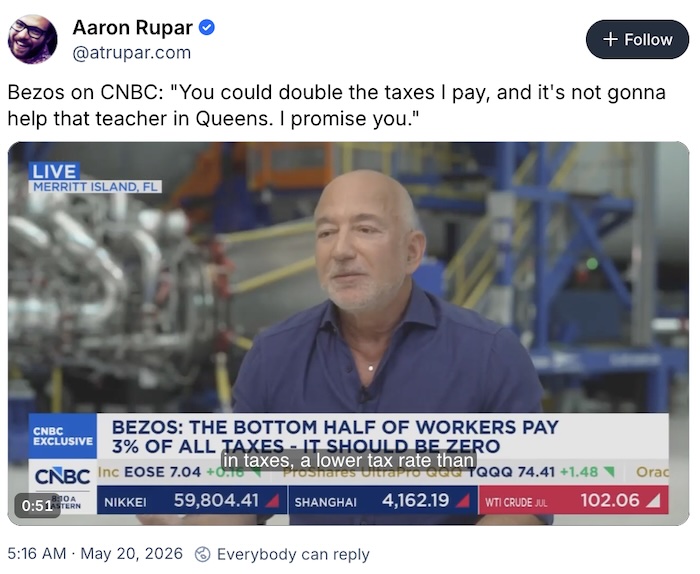
That remark—delivered in that setting—would have won Trump this week, but I didn’t want to piss off the judges. Thus, he was edged out by Amazon kingpin Jeff Bezos. In a CNBC interview on Wednesday, the tech oligarch asserted, “You could double the taxes I pay, and it's not gonna help that teacher in Queens. I promise you.”

Aaron Rupar on Bluesky; Bezos on CNBC:

If you doubled the taxes on all billionaires (and half-billionaires and one-tenth-billionaires and one-hundredth-billionaires) and expanded Medicare, a lot of Americans would be helped. That’s math.

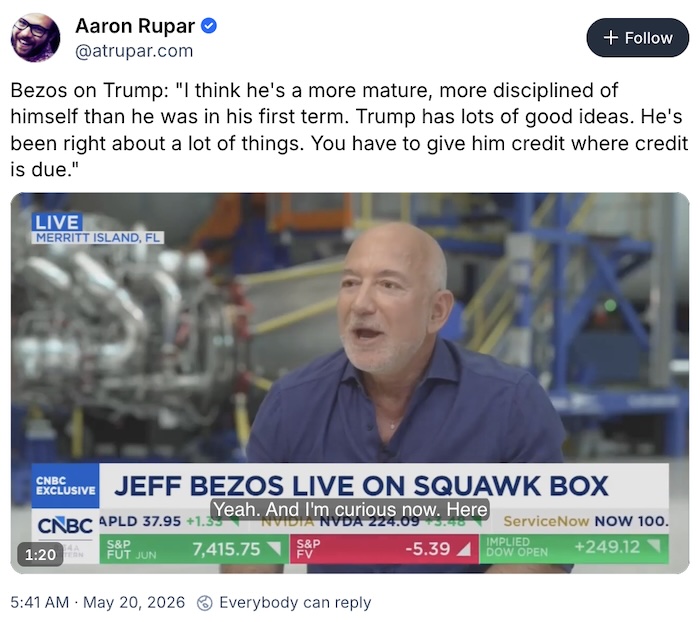
Yet that remark did not land Bezos in the winner’s circle. It was this comment he made about Trump:

I think he's a more mature, more disciplined version of himself than he was in his first term…Trump has lots of good ideas. He's been right about a lot of things. You have to give him credit where credit is due.

Aaron Rupar on Bluesky; Bezos on Trump:

Launching an impulsive and stupid war in Iran, employing police state tactics to round up non-criminals, imposing illegal tariffs willy-nilly, perverting the Justice Department to prosecute his political foes, undermining the nation’s public health system and its scientific research infrastructure, undoing action to address climate change, setting new records for Oval Office corruption and grift, pardoning violent insurrectionists—this is the “more mature” version of Trump?

Amazon has billions of dollars in contracts with the Pentagon, the CIA, the NSA, and other federal agencies, and Bezos' Blue Origin space company has billions in contracts with NASA. Both firms are seeking more government largesse. One cost of doing business with this administration is brown-nosing the Mad King. For an outstanding example of that, the billionaire bootlicker gets the trophy. With free shipping.

Advertisement

Facts beat lies.

The Mailbag

This seemed to be the week for random thoughts from readers. Linda Jack felt compelled to share a quote from Mitch Albom:

...a lie told once is easy to expose, but a lie told a thousand times can look like the truth. And destroy the world.

I looked it up. The line comes from Albom’s 2023 novel The Little Liar, which is about an 11-year-old boy during the Holocaust who is tricked into deceiving fellow Jews into boarding trains to Auschwitz. It seems the quote references Nazi propaganda, but, alas, it also applies to the Trump’s never-ending crusade of disinformation.

Lynda Dobens had a Nazi-related thought about a possible Trump plot:

So the brownshirted, extreme-right soldiers create havoc. Trump winks and this gives him the reason to clamp down. He will blame the left for the havoc. Wash rinse and repeat. Martial law. anyone?

With Trump, anything is possible. I have no doubt he has imagined all sorts of scenarios for holding on to power and becoming an emperor. But consider this: He seems to be becoming increasingly incompetent. That may undermine any scheme he has to replace American democracy with an authoritarian regime.

Richard Gilbert wrote:

I have read that Russia is providing Iran with strategic military intel to use against the US. If that is the case, then I would think that the president would support Ukraine to keep the Russians busier.

You might think that. But Trump’s years-long affinity for Vladimir Putin has not waned, no matter what the Russian thug does. And after all this time, we still don’t have a clear explanation of his affection for Putin.

Teresa Harper responded to the recent issue featuring an interview with Ben McKenzie about his excellent documentary scorching cryptocurrency:

Jeez, my 45-year-old son needs to see that documentary! He's just like his dad (my ex), thinking he can get rich quick. As for my husband and I, we told our financial advisor to never invest in crypto. He said they never do. 

Serena Fossia emailed:

I know it is fun to make fun of Trumpublican nonsense and endless conspiracy theories. But do you think there is any genuine link between the worry about “chemtrails” and the very real geoengineering that may be happening in some forms already (cloud seeding to induce rain) and almost certainly will be tried on the large scale of the atmosphere by unaccountable billionaires if they want to.

This type of conspiracy is just one way to grapple with the massive decisions being made for all of us without any consequences. And it is probably one of the only ways in which I have sympathy for these folks. They really have been hoodwinked in so many ways, denied education, especially about science. They feel forgotten overall (true about many rural people) and preyed upon by politicians when they need them (so many lies). It can be hard to see clearly under those circumstances.

Serena, I appreciate the respectful attitude expressed in the question. The chemtrail conspiracy theory has been soundly debunked by atmospheric scientists. As for your larger point, the belief in chemtrails certainly reflects concerns about government secrecy and the power of unseen forces to make consequential decisions for the rest of us—which often does lead to conspiracy theories. Too often, though, conspiracy theories distract from the real issues and actual abuses of power that do serious harm. There may come a time to fret about plutocratic geoengineering. But now the more legitimate target of these sorts of worries is AI, as a small number of tech oligarchs are currently deciding the future of human society. That's not a conspiracy theory, and our politics should address this—soon. 

MoxieCam™

“Why do you keep taking pictures of me with flowers? People might get the wrong impression.”
“What impression is that, Moxie?”
“That I spend so much time outside. Most of the day, I’m indoors. Often by myself. Just waiting and waiting and—”
“Okay, that’s enough.”
“And waiting and waiting.”
“I get it.”
“And waiting.”

Moxie!
 

Congratulations, you read all the way to the end! It's a great time to say "I'm in" and start your free 30-day trial. Make sure you don't miss out on what's next: Sign up to start getting Our Land in your inbox each week. We also want to hear from readers (especially those who read the whole thing!). So let us know what you think so far or share something interesting with David at ourland.corn@gmail.com.

Start Receiving Our Land
 

Our Land

This message was sent to example@example.com. To change the messages you receive from us, you can edit your email preferences or unsubscribe from all mailings.

www.MotherJones.com
PO Box 8539, Big Sandy, TX 75755