FREE TRIAL VERSION. DON'T MISS OUT. |
FREE TRIAL VERSION. DON'T MISS OUT. |
|
|
|
The AI War in a GOP Primary |
By David Corn May 19, 2026 |
A screenshot from an AI-generated ad attacking Rep. Thomas Massie (R-Ky.). AdImpact. |
|
|
|
You're reading a free promotional version of Our Land, and we hope you enjoy David's exclusive writing and don't want to miss out on what's next. Sign up to start receiving a free 30-day trial of Our Land and enjoy all of the behind-the-scenes reports and interactive features with each issue.
|
|
|
|
Politicos and pundits are intensely focused on a Republican congressional primary contest in Kentucky today. Rep. Thomas Massie, a far-right seven-term libertarian, is battling Ed Gallrein, a Trump-backed former Navy SEAL, farmer, and management consultant. This contest has plenty of currents running through it, most notably the question of whether Trump’s ability to wreak revenge within the GOP is absolute. But what’s also been notable in this bitter fight is the use of artificial intelligence.
Trump has declared Massie “disloyal” to the Republican Party and the United States. What he really means is that Massie has been disloyal to him—mostly for leading the effort to force the Justice Department to release the Jeffrey Epstein files. Additionally, Massie, a deficit hawk, was the lone House Republican vote against Trump’s big ugly bill that included budget-busting tax cuts for the wealthy, and he’s opposed the US-Israeli attacks on Iran. So Trump and his allies—including donors who support the policies of the Israeli government—are pouring millions of dollars into this primary contest to squash Massie and demonstrate that it’s perilous for any Republican to oppose Trump on anything. The message: In the GOP, there’s no tent but the Trump tent. |
|
|
|
Recently, six Republican state legislators in Indiana each lost their GOP primary race because they had defied Trump’s call to redraw the state’s congressional map to produce more Republican-leaning districts. Trump blasted this group as RINOs—Republicans in name only—and backed their challengers. The election was hailed by the White House as proof Trump still has a powerful chokehold on GOP voters.
As was the Louisiana GOP Senate primary on Saturday. Incumbent Sen. Bill Cassidy, one of seven Republicans who voted to convict Trump after he was impeached for inciting the January 6 riot, placed third in that contest, far behind Trump’s hand-picked candidate, Rep. Julia Letlow. Cassidy, a medical doctor and longtime vaccine proponent, had tried to make nice with Trump by supporting the nomination of Robert F. Kennedy Jr., the bonkers vaccine opponent, to be secretary of health and human services. Cassidy knew Kennedy, a conspiracy theory-monger and an inveterate liar, was a disastrous choice for this job, and, as chair of the Senate Health, Education, Labor, and Pensions Committee, Cassidy was in a position to block his appointment. But…no. He acceded to the Mad King, and his payback is a Trump-endorsed pink slip from the Republican voters of Louisiana.
Now comes Massie. Trump has slammed him as the “worst person,” and his political machine has gone all-out to annihilate him. This race has become the most expensive primary election in history, with at least $32 million spent so far. Almost a third of that has come from the American Israel Public Affairs Committee and other pro-Israel groups looking to bounce Massie. (Two years ago, pro-Israel groups started running ads against the isolationist Massie, calling him an “anti-Israel radical.”)
There’s no reason to shed tears for Massie. After supporting Florida Gov. Ron DeSantis in the 2024 GOP primary, he endorsed Trump a month before the general election. Massie, an MIT-trained engineer and contrarian, has taken several stances that overlap with progressive positions, but he has also been a promoter of assorted conspiracy theories. As Stephanie Mencimer recently wrote:
Long before the Epstein files—a real scandal wrapped in an array of implausible conspiracy theories—he called the investigation into Russian influence in the 2016 election a “hoax.” Last year, Massie co-sponsored then-Rep. Marjorie Taylor Greene’s bill to ban supposed weather modifications like “chemtrails.” More recently, he has promoted the debunked theory that a US Capitol Police turned CIA officer planted two pipe bombs in DC the night before the January 6 attack on the US Capitol. (In December, the FBI arrested Brian J. Cole Jr., who confessed to planting the bombs, but Massie thinks they got the wrong guy.)
And there’s more. After Vladimir Putin launched a full-scale invasion of Ukraine in 2022, Massie embraced and pushed the Russian disinformation that the United States had set up bioweapons in Ukraine—a false charge that Moscow used to justify its brutal attack on Ukraine. He also compared Covid vaccine mandates to the Holocaust.
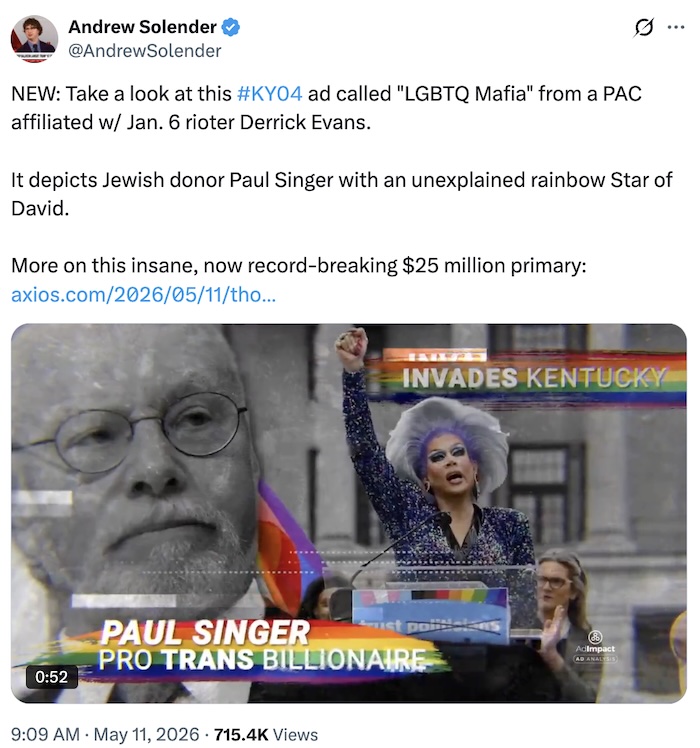
The race has been a dirty one. One pro-Massie ad absurdly claims that the Trump-backed Gallrein is “bought and paid for by the LGBTQ Mafia.” It notes that “far left trans activist billionaire” Paul Singer “is bringing his trans madness to Kentucky” and “spending millions to remove Massie.” Singer, a hedge fund manager and major Republican funder who supports gay rights and Israel, has donated at least $1 million to the main super-PAC supporting Gallrein. The basis for this hateful accusation is that Gallrein chaired a company that trained business executives, and its trainings covered DEI. The ad declares that Gallrein’s values are “freak values” and that “he’s with the weirdos.”
For good measure, there’s a dash of antisemitism in the ad. It shows an image of Singer with a rainbow-colored Star of David behind him—as if to shout, “Jew!” Massie, as of this writing, has not denounced or distanced himself from the spot. |
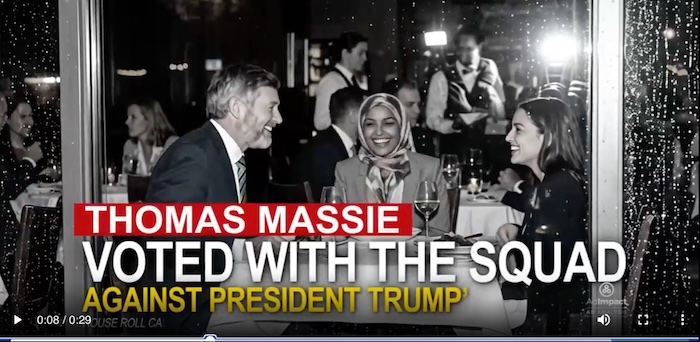
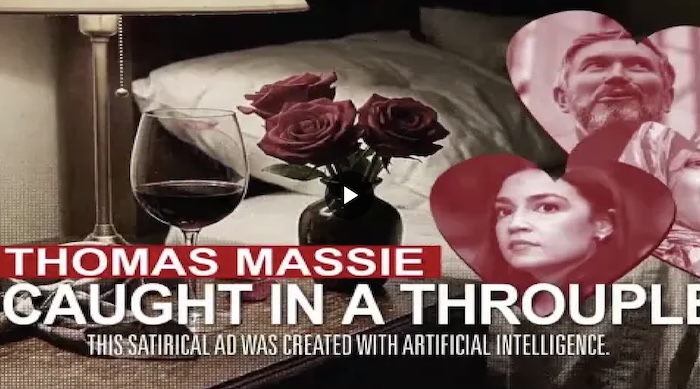
Beyond a test of Trump’s mob-boss-like muscle, this race has become a case study for the use of artificial intelligence in creating political ads. A spot put out by the super-PAC supporting Gallrein accused Massie of being in a “throuple” with Democratic Reps. Alexandria Ocasio-Cortez and Ilhan Omar and “cheating” on the America First movement. It showed AI-generated video of Massie dining at a restaurant with the pair, holding their hands, and leading them into a hotel. There’s a briefly displayed notice at the start of the ad saying the video was produced using AI.
|
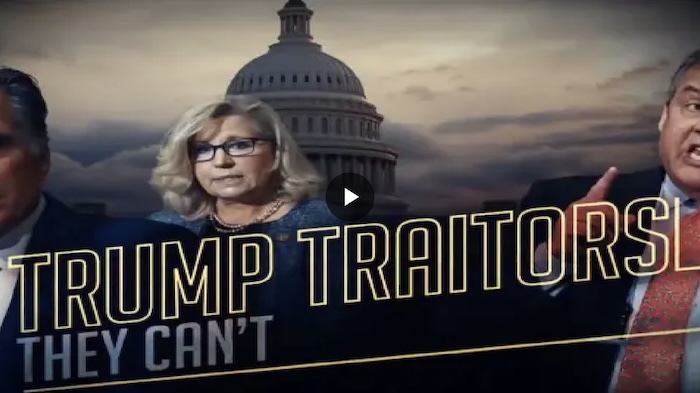
An ad from a pro-Massie super-PAC blasted “Woke Eddie” Gallrein for being one of the “Trump traitors”—a group including Mitt Romney, Liz Cheney, and Chris Christie—because he changed his party identification from Republican to independent after Trump won the party’s presidential nomination in 2016. (He re-registered as a Republican following Joe Biden’s inauguration.) Yes, the pro-Massie forces are claiming the Trump-supported candidate—whom Defense Secretary Pete Hegseth was scheduled to campaign with on Monday in arguably a violation of the Hatch Act—is not as pro-Trump as Massie.
This ad shows Trump as a soldier in a foxhole firing a rifle at an unseen enemy, and Gallrein sprinting away from the position. “Trump was in the foxhole,” the narrator intones, “and Woke Eddie tucked his tail and ran.” This is obviously not real footage, but there’s no AI warning. The ad also shows Gallrein in more realistic settings—leaving a Trump rally and signing a voter registration form—that are also AI-generated without any such notification. |
Neither of these ads are deceptive. It’s clear that Massie did not have a ménage à trois with two members of the Squad and that Gallrein was never in a foxhole with Trump. (After all, everyone knows Trump couldn’t serve in the military because of his bone spurs.) But each ad presented powerful realistic images that can create lasting impressions.
The big fear about AI and deepfakes has been that people will be bombarded with fabricated images, audio, and video that they will mistake for real. Imagine an ad showing what purports to be video of a candidate saying the N-word or taking a bribe or boasting about grabbing women by their genitalia. Or, better yet, imagine a flood of hundreds of such ads hurled at a candidate. How does an incumbent or challenger contend with that? Political campaigns and the media will need to find ways to counter that sort of assault.
|
|
|
|
Yet in addition to outright false ads, there will be a tsunami of made-with-AI spots that are not disingenuously presented as actual video or audio but that contain high-quality, real-looking footage and sound that registers deeply with voters. What if a pro-Massie PAC produced an ad that showed Gallrein making out with RuPaul? Or Paul Singer putting on a dress and showering Gallrein with money? A label—“this was generated by AI”—wouldn’t affect the impact of the ad.
AI will allow the purveyors of mud-throwing politics to get muddier than they ever thought possible. They can now easily concoct the most demonizing and demeaning imagery for attack ads. They will only be restrained by the limits of their imagination. The outcome of the Massie-Gallrein race will be a measure of Trump’s standing as the not-to-be-defied cult leader of the GOP. (He has vowed vengeance against Rep. Lauren Boebert, the Colorado Republican, who has campaigned for Massie.) But as the crucial midterm elections approach, this contest has provided us a glimpse of what lies ahead for political attack ads. It’s not pretty.
Got anything to say about this item—or anything else? Email me at ourland.corn@gmail.com. | |
|
|
An Update on My Ghislaine Maxwell FOIA Lawsuit |
Last year, I filed a Freedom of Information Act request with the US Bureau of Prisons for information related to the suspicious transfer of Ghislaine Maxwell, who’s serving 20 years for procuring girls for sex offender Jeffrey Epstein, from a medium-security, coed facility in Florida to a cushy women-only prison camp in Texas. (Yoga! Puppies!) When the BOP didn’t respond promptly, Mother Jones and I, with the help of the Reporters Committee for Freedom of the Press, filed a lawsuit.
A few weeks ago, a submission in the case from the BOP revealed some interesting information. It reported that its “initial search” had “identified 15.8 GB of potentially responsive records, which has crashed BOP’s system during the download process several times due to the large number of records.” The agency reported there may be “approximately 120,000 pages of material to review.”
Possibly 120,000 pages related to this one transfer? So many documents the system crashed? That seems a rather large pile. Far beyond what might be expected. The final number of responsive documents could be much smaller. But why might there be a mountain of material?
The BOP says it will finish its collection of possibly relevant documents by June 19 but that there’s no telling how long it will take after that to review this information. I’m not holding my breath. For more on this, check out my recent article. |
|
|
|
The Watch, Read, and Listen List |
Beef. The first season of Beef, the Netflix series created by Lee Sung Jin, was a taut and psychologically intricate tale of a feud that ensues after a road rage incident involving two strangers. A struggling contractor and a small business owner on the verge of selling her company to a major chain—each of Asian heritage and struggling to attain their own idea of the American dream—nearly get into a fender bender in the parking lot of a home improvement store. Could be no biggie. But one gives the other the finger, and a dangerous car chase occurs. That’s not the end of it. An escalating face-off continues for weeks, as each one obsessively funnels their personal and professional disappointments into diabolical attempts to ruin the other. The show, tightly focused on these two otherwise reasonable people, was a marvelous study of how life can easily fly off the rails. Audiences and critics loved it. So…season 2.
This second outing has nothing to do with the first. It’s not another two-person duel. This chapter is wider in scope and a tad more Hollywood. One tip-off: It stars Oscar Isaac and Carey Mulligan. They play Josh Martin and Lindsay Crane-Martin, a married couple who are each coming to the realization their life together has failed to meet their expectations. He’s the general manager of a ritzy country club, where the ultra-rich members treat him as a pal but don’t see him as a peer, and she’s a frustrated interior decorator whose career hasn’t fully clicked. A young couple—Ashley (Cailee Spaeny) and Austin (Charles Melton)—are the counterpoint. They seem deeply in love, do regular check-ins with each other about their feelings, and talk about safe spaces and anchoring each other.
Ashley staffs a beverage cart at the country club, and one night she and Austin drive to Josh and Lindsay’s home to drop off a wallet Josh left at the club. They witness—and, of course, video—a hellish fight between the two, in which Josh and Lindsay say (that is, scream) all the ugly and nasty things a spouse might at one time think of a partner. The young lovebirds use the video to blackmail Josh into giving Ashley a promotion. And it seems that we’re off on a new feud—now between two couples—that will inevitably spin out of control in directions that cannot be foreseen.
Yet this time, Lee doesn’t stick just with the duelists. The club is being bought by a Korean billionaire who uses its finances to cover up wrongdoing back in South Korea. This corporate intrigue intersects with the intensifying conflict between the two couples.
In this season, Lee cooks up a dizzying plot—with a few far-fetched stretches—that extends beyond a personal beef of accidental origin. This not-so-random setup allows him to dig into issues of class and identity. His use of a country club setting to poke at the foibles (and societally injurious attitudes) of the wealthy is far more sophisticated than what’s been attempted in Your Friends & Neighbors. And Beef skews the top 0.1 percent more effectively than White Lotus. At the same time, Lee presents a complicated if somewhat jaundiced contemplation of love. It’s a much more elaborate meal than the first season, with plenty—and perhaps even too much—to chew on.
|
Bait. Hollywood is abuzz. After years of delay, Amazon MGM Studios has finally started its search for the next James Bond. As Variety breathlessly reported last week, auditions have begun for the role. It’s been five years since the last Bond film, the mediocre No Time to Die, but the franchise is back on track, and, no doubt, this casting contest will draw much attention, as word leaks out of who is and who is not under consideration. My choice would be Idris Elba—though at 53 he may have aged out. The producers are looking for an actor who can play Bond for several films. (Do we want a Bond who’s in his 60s and kvetching about achy joints?) And Elba in 2023 said he was put off when the prospect of him being cast as Bond “became about race.”
A satirical look at Bond and race was recently delivered by Amazon itself. In Bait, a limited six-episode series, Riz Ahmed plays a struggling British Pakistani actor in London named Shah Latif who secures an audition to be the next James Bond. Humorous hijinks follow, with both family drama and an internet hullabaloo over a non-white Bond. The possibility of becoming Bond forces Latif to confront his own sense of identity and his relationship to the Pakistani community. Will he be able to change the dominant culture, or might he be subsumed by it? The pressure of being in the running for Bond causes a near-breakdown for Latif, and the series becomes overly madcap. But overall, it’s clever satire, and Ahmed, a talented actor who created the show, well plays the conflicted Latif. To be Bond or not to be Bond. That is the question.
|
|
|
|
Congratulations, you read all the way to the end! It's a great time to say "I'm in" and start your free 30-day trial. Make sure you don't miss out on what's next: Sign up to start getting Our Land in your inbox each week. We also want to hear from readers (especially those who read the whole thing!). So let us know what you think so far or share something interesting with David at ourland.corn@gmail.com.
|
|
|
|
|