FREE TRIAL VERSION. DON'T MISS OUT. |
FREE TRIAL VERSION. DON'T MISS OUT. |
|
|
|
Trump Lets Violent Right-Wing Extremists and White Supremacists Off the Hook—Again |
By David Corn May 12, 2026 |
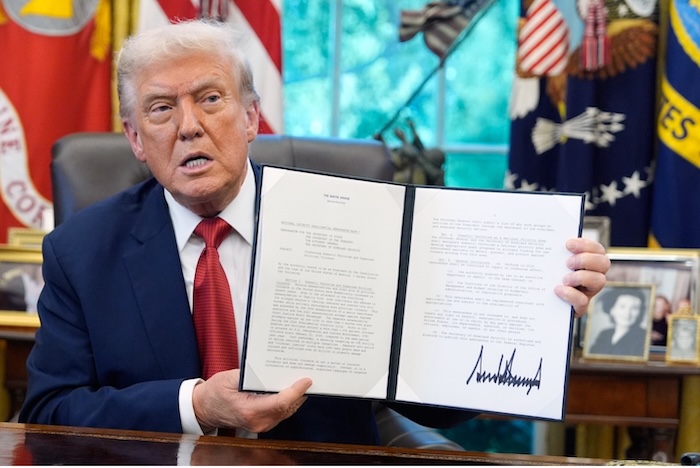
Donald Trump holds a presidential memorandum on countering domestic terrorism and organized political violence in the Oval Office on September 25. Alex Brandon/AP |
|
|
|
You're reading a free promotional version of Our Land, and we hope you enjoy David's exclusive writing and don't want to miss out on what's next. Sign up to start receiving a free 30-day trial of Our Land and enjoy all of the behind-the-scenes reports and interactive features with each issue.
|
|
|
|
Last week, the Trump White House released its counterterrorism strategy, embodied in a 16-page document that, naturally, praised Trump and presented an absurd, MAGA-fied view of the world and the threats the United States faces. In the introduction, the administration asserts that it will pursue its counterterrorism policy “apolitically.” But in its next breath—paragraph, that is—the document slams the Biden administration for trying to rig an election (presumably, a reference to the criminal investigations of Trump’s misdeeds).
Then the paper gets down to business, declaring there are three “major types of terror groups” that threaten the United States: “Narcoterrorists and Transnational Gangs, Legacy Islamist Terrorists, Violent Left-Wing Extremists, including Anarchists and Anti-Fascists.”
This is bonkers. The strategy doesn’t mention possible terrorism that might be spurred by the war in Iran that Trump launched. The paper blames the jihadist terrorism it cites as a danger on the policies of prior Republican and Democratic administrations—not on anything Trump is doing these days. Nor does it mention how his revenge-a-thon at the FBI led to the evisceration of a unit that tracked terrorism threats from Iran and elsewhere in the Middle East.
|
|
|
|
As for left-wing extremists, the administration vows to neutralize “violent secular political groups whose ideology is anti-American, radically pro-transgender, and anarchist” by focusing on “international organizations like Antifa.” Antifa is not an organization, but a term that describes a loosely connected collection of far-left groups. And associating transgender rights with violence is quite the nasty move.
This is not a serious policy document. Plus, there’s one huge missing element: the threat of domestic violence from right-wing extremists, including white supremacists and anti-government militias. There are no mentions of this danger anywhere in this thin paper. But in recent decades, far-right extremist violence has been widely recognized as a major threat. Some deets: |
-
A 2017 Government Accountability Office study found, “Of the 85 violent extremist incidents that resulted in death since September 12, 2001, far right-wing violent extremist groups were responsible for 62 (73 percent) while radical Islamist violent extremists were responsible for 23 (27 percent). The total number of fatalities is about the same for far right-wing violent extremists and radical Islamist violent extremists over the approximately 15-year period (106 and 119, respectively). However, 41 percent of the deaths attributable to radical Islamist violent extremists occurred in a single event—an attack at an Orlando, Florida, night club in 2016.”
- A 2020 report prepared by the Department of Homeland Security—when Trump was president—cited white nationalists as a prominent threat: “Among [domestic violent extremists], racially and ethnically motivated violent extremists—specifically white supremacist extremists (WSEs)—will remain the most persistent and lethal threat in the Homeland.”
-
In 2021, the Washington Post reported, “Domestic terrorism incidents have soared to new highs in the United States, driven chiefly by white-supremacist, anti-Muslim and anti-government extremists on the far right, according to a Washington Post analysis of data compiled by the Center for Strategic and International Studies…Since 2015, right-wing extremists have been involved in 267 plots or attacks and 91 fatalities, the data shows. At the same time, attacks and plots ascribed to far-left views accounted for 66 incidents leading to 19 deaths.”
- A 2023 New American Foundation report categorized the deaths caused by terrorist acts in the post-9/11 period: far-right (130); jihadist (107); incel/misogyny ideology (17); Black nationalism or separatism (12); far-left (1).
-
A 2023 study from the Anti-Defamation League Center on Extremism noted, “Right-wing extremist terror incidents in the US have been increasing since the mid-2000s, but the past six years have seen their sharpest rise yet. There were just seven right-wing terror incidents in the period 2005-2007, but by 2017-2019 there were 27, which increased to 40 in 2020-2022…White supremacists were responsible for more attacks than any other type of right-wing extremist in the past six years (30 of 67, or 45%), but anti-government extremists, anti-abortion extremists and other types of right-wing extremists have also plotted and carried out attacks.”
-
Last year, following the assassination of conservative activist Charlie Kirk, PBS posted a review of academic studies that concluded, “Based on government and independent analyses, right-wing extremist violence has been responsible for the overwhelming majority of fatalities, amounting to approximately 75% to 80% of US domestic terrorism deaths since 2001.”
|
All of this has been erased by Trump and his henchmen. That’s not surprising, given that Trump pardoned the 1,500 or so January 6 rioters, a group that included white nationalists, Christian nationalists, and militia members. Trump has been winking at far-right extremists since he first ran for president. He noted that some participants in the 2017 Unite the Right rally in Charlottesville, Virginia, which was organized by white supremacists and neo-Nazis, were “very fine people.” And remember when he told the Proud Boys to “stand back and stand by” during the 2020 campaign? Now he refuses to acknowledge that right-wing extremists are a source of violence, let alone a leading source.
But Trump’s game extends beyond disappearing the threat of right-wing violence. Trump, Stephen Miller, and others in the administration have been hell-bent to sell the phony narrative that the left poses a dangerous and existential threat to the nation, and they seek to do this by linking progressives to Antifa and the few instances of left-wing violence.
After the Kirk assassination, Trump and his crew tried to exploit his murder to tar their political opposition. Trump released a presidential memo on “countering domestic terrorism and organized political violence” that focused solely on acts tied to left-wing actors. The document broadly characterized what fuels these malefactors: “Common threads animating this violent conduct include anti-Americanism, anti-capitalism, and anti-Christianity; support for the overthrow of the United States Government; extremism on migration, race, and gender; and hostility towards those who hold traditional American views on family, religion, and morality.”
|
|
|
|
Parts of that description could be applied to many non-violent liberals or critics of Trump’s regime. And that’s the point. As I’ve noted previously in this newsletter, Trump’s scary ghost story for MAGA is that Democrats, progressives, the media—maybe you!—are all part of a “radical left” that is “the enemy within.” And this force is violent and evil and wants to destroy the United States. This is a standard play for authoritarians and fascists: Demonize domestic foes as a dire threat to the homeland. Another basic move is to empower allied extremists.
Trump’s counterterrorism strategy is not a plan to protect Americans from the most perilous threats. It is propaganda to buttress his autocratic effort to delegitimize his political opposition. It is true that recent acts and attempted acts of violence—including the shooting of Kirk and assassination attempts aimed at Trump—were allegedly committed by people who seem to have harbored left-of-center views or criticisms of Trump and MAGA. Yet the trend of the past few decades is clear: Right-wing extremists are a major domestic terrorist threat. Trump and his aides, though, have made a deliberate decision to ignore this political violence. That’s a signal they are willing to accept it, as they have done with the insurrectionist 1/6 riot. And here’s the real danger: Acceptance can often be regarded as encouragement.
Got anything to say about this item—or anything else? Email me at ourland.corn@gmail.com. | |
|
|
In 2006, an event was held to mark the reauthorization and extension of the Voting Right Act, during which a prominent American made heartfelt remarks:
By reauthorizing this act, Congress has reaffirmed its belief that all men are created equal; its belief that the new founding started by the signing of the bill by President Johnson is worthy of our great nation to continue. I'm honored to be here with civil rights leaders like Dr. Dorothy Height; Julian Bond; the Chairman of the NAACP, Bruce Gordon, thank you, Bruce; Reverend Lowery, it's good to see you again, sir…Jesse Jackson, good to see you, Jesse. Al Sharpton. Dr. Benjamin Hooks and Frances are with us…The Voting Rights Act broke the segregationist lock on the ballot box rose from the courage shown on a Selma bridge one Sunday afternoon in March of 1965…Today, we renew a bill that helped bring a community of the margins into the life of American democracy.
That was President George W. Bush speaking at a White House signing ceremony for the measure. The bill had been passed on an overwhelmingly bipartisan vote. In the House, 192 Republicans joined 197 Democrats to approve it. In the Senate, the vote was 98-0.
Yes, the Republican Party, not too long ago, was a champion of the Voting Rights Act. Even after the Reagan years and the rise of GOP and right-wing attacks on what we today call DEI. Now, though, Republicans openly connive to disempower Black voters, as we saw last week with Republicans in the Tennessee state legislature gleefully rushing, in the aftermath of a Supreme Court decision emasculating the Voting Rights Act, to redraw the state’s congressional districts to get rid of the one district where Black voters hold the power to elect a member of Congress. This is happening elsewhere, where Republicans have gerrymandered—or will be gerrymandering—to wipe out districts with Black majorities.
What is striking is the utter shamelessness of the GOP. The party of Abraham Lincoln is brazenly embracing racist politics without any pretense. As I note above, Trump just gave a pass to violent white supremacists. And here’s his party waging war on Black voters. They’re not bothering to hide the racism. It is now the central strategy for the GOP’s effort to hold on to power and defy the popular will. There’s a phrase for that: minority rule. |
|
|
|
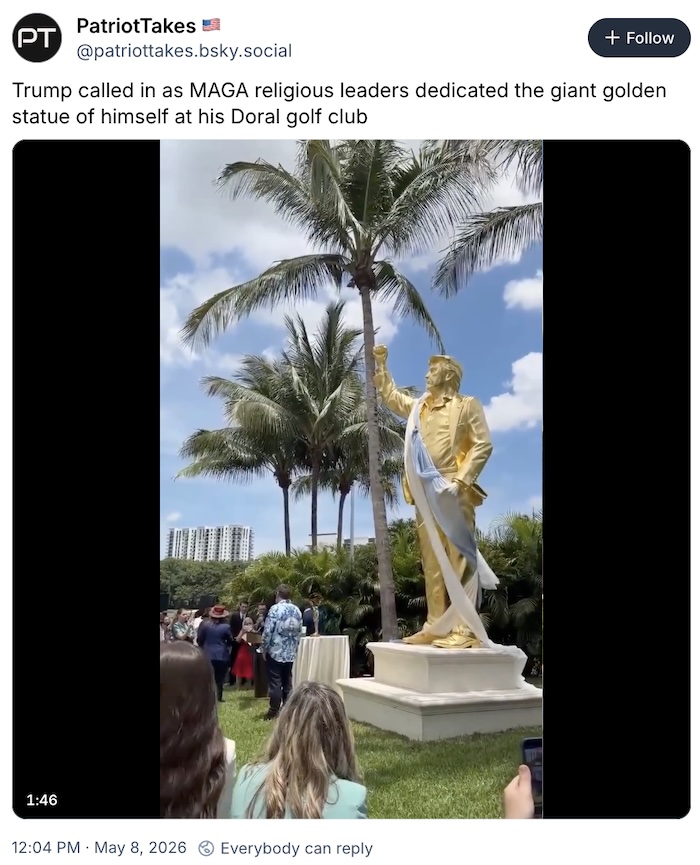
It’s hard to believe that Trump and his followers—especially his evangelical supporters—could be so oblivious. |
Is the Second Commandment an optional commandment? Just a suggestion? |
The Watch, Read, and Listen List |
Dog Day Afternoon. Sidney Lumet’s 1975 critically acclaimed film Dog Day Afternoon was a cultural breakthrough. Based on a real-life bank heist in Brooklyn that turned into a hostage situation, the film, an irreverent take on the caper, captured the rise of live-TV drama (film crews quickly arrived at the bank and turned the in-progress crime into a media spectacle) and centered a gay-related theme, with the lead bank robber, Sonny (Al Pacino), revealing he planned this hit to obtain the money his transgender boyfriend needed for what was then called a sex-change operation. With DDA, Lumet, who had recently directed Serpico and was soon to helm Network, enhanced his standing as the Hollywood director best able to capture the grit of NYC. The film showcased Pacino’s daring as an actor, and John Cazale’s performance as Sal, Sonny’s troubled partner-in-crime, was heartbreaking.
For the producers and stars of the new Broadway production of Dog Day Afternoon, this is quite a legacy to live up to. This theatrical version is a rewrite of the story by Pulitzer Prize-winning Stephen Adky Guirgis, and the play’s not-so-secret weapon are its two stars: Jon Bernthal and Ebon Moss-Bachrach, powerful actors who are cast members of The Bear, the magnificent restaurant drama. When they each hit the stage at a performance I attended last week, the audience let out a tremendous cheer—an expression of Bear fandom and a sign that people were quite happy to see these two guys in the flesh.
DDA the play closely follows the plot of DDA the movie, which was a reasonably accurate depiction of what happened at that Brooklyn bank on August 22, 1972. It is delightfully overloaded with New York-in-the-1970s references—Crazy Eddie, the Wilfred Academy of Hair and Beauty, Bella Abzug, the Knapp Commission, Attica—that will inspire nostalgia for anyone who was around then and loved the grimy and chaotic Big Apple of that decade. (Count me in that group.) What seems to have bothered some critics is that this new theatrical take is more jokey than the classic film. If you’re looking for a venerating version of the original, black-humored movie, this may not be for you.
But the night I was there, the audience did not seem bothered by this funnier reimagining. The jokes landed well. The set, designed by David Korins (who did the same for Hamilton), was a marvel, with the bank swiveling and moving to the front and back of the stage, as the action shifted from inside the bank to the street in front of it. Bernthal, a bit early Brando-ish, and Moss-Bachrach, who deftly conveyed a lost soul, put in engaging performances. (Kudos to Spencer Garrett, a friend, who plays the hard-ass, tough-talking FBI agent who has no patience for negotiating with Sonny.) The show is a solid production—perhaps more in tune with the entertainment needs of the 2020s than those of the cynical 1970s. But I hope it sends audience members back to the film so they can see why its story still resonates half-a-century later.
|
The Big Fake. If you’re looking for a real-life example of a Deep State, consider P2, the secretive society in Italy that in the 1970s and 1980s included right-wing politicians, industrialists, senior military officials, top intelligence officials, neofascists, and criminals that was bent on beating back trade unions and the Italian left. It was implicated in political corruption, financial skullduggery (including the collapse of a Vatican-associated bank), and assorted murders. Though the P2 is not explicitly name-checked in the wonderful Italian thriller The Big Fake, which was released last year and is streaming on Netflix, its presence hovers throughout the film, creating the shadowy backdrop for the tale of an artist-turned-forger.
Toni (Petro Castellitto) is an ambitious and talented painter. But when an art gallery owner sees he’s able to masterfully reproduce famous artists, she signs him up to produce fakes she can sell. Monets, Modiglianis, Manets—he can do it all. And without any moral qualms. He soon falls in with Italian mobsters who require his skills of fabrication for other uses. And somehow these crooks are tied to (and afraid of) a clandestine, government-connected force—that would be P2. Toni’s forgery career puts him at odds with his two best pals, a priest and a radical activist who joins the Red Brigades. When former prime minister Aldo Moro is kidnapped by the leftists, including his chum, (which indeed did happen), Toni is caught between his old friend and the P2ers, who with the Vatican may—or may not—be trying to work out a deal for Moro’s release before he is murdered. In the middle of all this, he seeks help from his buddy the priest.
There’s a lot of intrigue whirling about Toni, who has tried hard to remain oblivious about his involvement in assorted crimes and misdeeds up to this point. Finally, he cannot skate past the consequences of his crooked actions. The Big Fake, loosely based on the real-life story of forger Tony Chichiarelli, captures the paranoid and violent atmosphere of Italian politics in the 1970s—and the wild days of Roman life—while presenting a good yarn about a criminal who gets in over his head. At the end, the big question is whether Toni can fake his way out of this mess.
|
|
|
|
Congratulations, you read all the way to the end! It's a great time to say "I'm in" and start your free 30-day trial. Make sure you don't miss out on what's next: Sign up to start getting Our Land in your inbox each week. We also want to hear from readers (especially those who read the whole thing!). So let us know what you think so far or share something interesting with David at ourland.corn@gmail.com.
|
|
|
|
|