FREE TRIAL VERSION. DON'T MISS OUT. |
FREE TRIAL VERSION. DON'T MISS OUT. |
|
|
Let the Iran Investigation Begin |
By David Corn March 17, 2026 |
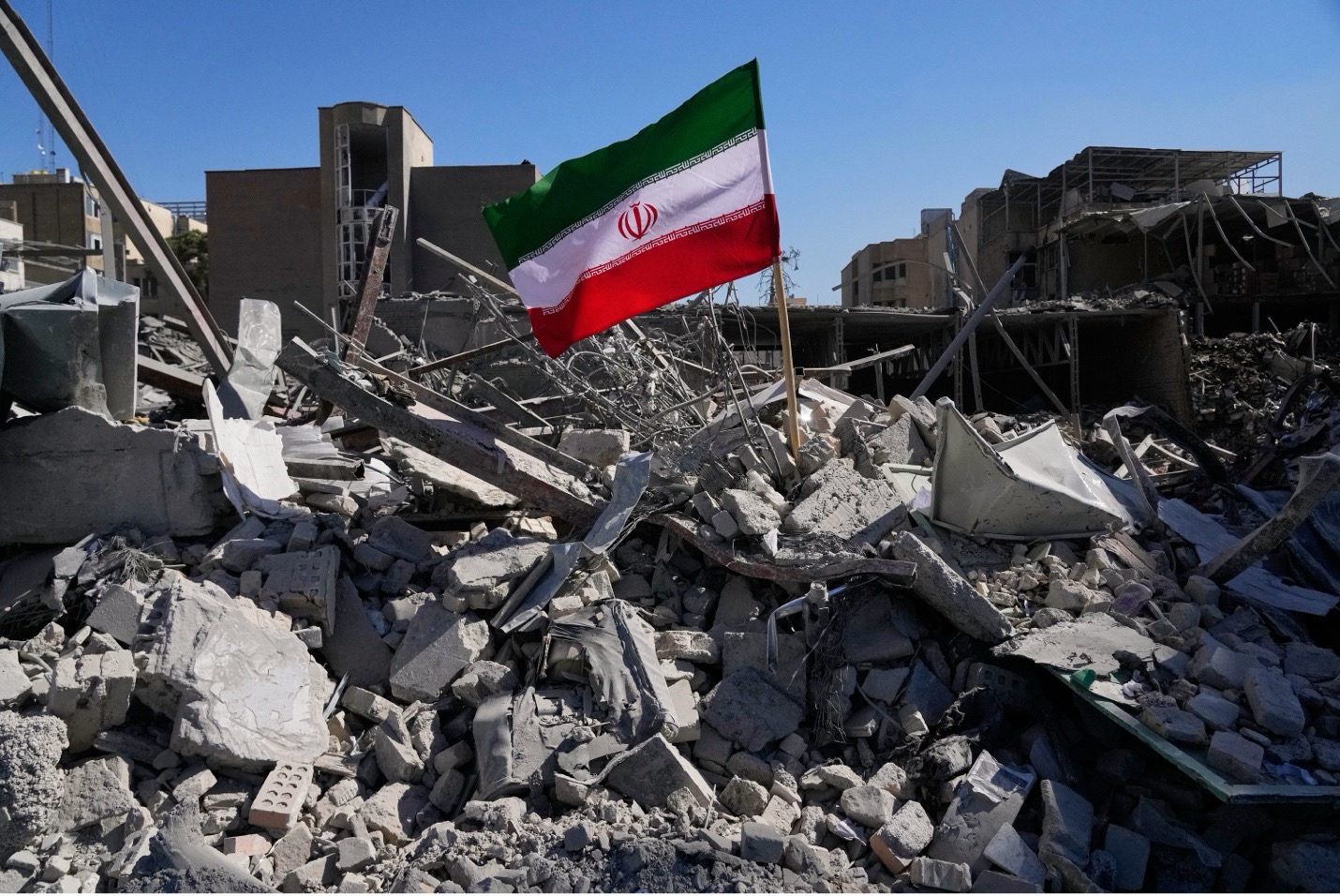
An Iranian flag among the ruins of a police station struck during the US-Israeli military campaign in Tehran on March 3. Vahid Salemi/AP |
|
|
You're reading a free promotional version of Our Land, and we hope you enjoy David's exclusive writing and don't want to miss out on what's next. Sign up to start receiving a free 30-day trial of Our Land and enjoy all of the behind-the-scenes reports and interactive features with each issue.
|
|
|
I hope someone is keeping a list of everything that ought to be investigated should the Democrats win back either house of Congress in November. It’s one helluva spreadsheet—from Donald Trump’s crypto business to the deadly abuses of ICE to the tragic decimation of USAID to Robert F. Kennedy Jr.’s lies-fueled war on science. But Trump’s current project in Iran deserves its own column. This war of choice—launched without consultation with (or the assent of) Congress or Washington’s allies—appears to have been poorly conceived and haphazardly planned, especially regarding what to do after the bombing. Strait of Hormuz? Who could have imagined that might be a problem?
Following George W. Bush’s Iraq War, the Senate intelligence committee did two comprehensive reports, one on the pre-war intelligence screw-up, the other examining the misrepresentation of the intelligence by the Bush-Cheney crew. That’s a good precedent. Though the war and the global chaos Trump has wrought is not over, there already are obvious subjects that warrant digging into.
Perhaps the most salient topic worth probing is why Trump launched this war. He and his aides have offered multiple reasons. The nuclear talks had failed. Israel was going to attack, and the United States needed to hit Iran before it could retaliate at American targets. There was an opportunity for regime change. At one point, Trump said Iran was two weeks away from a nuclear bomb. Well, what was the reason? |
|
|
And what did the intelligence say? It certainly did not indicate that Tehran was a fortnight from possessing a nuclear bomb. At that point, it would likely have taken months, perhaps a year, for Iran to make one. What was Trump told? What did he make up? What advice did he get? What counsel did he ignore? All of this—besides what the hell Trump was thinking—is knowable and discernable. What steps, if any, did Trump take to make an informed decision? Or did he really just decide to launch a war impulsively because his gut said so?
Prior to the attack, Trump had Steve Witkoff, his chief diplomatic envoy, and Jared Kushner, his wheeling-and-dealing son-in-law, negotiating with Tehran over Iran’s nuclear and ballistic missiles programs. In the past week, there have been reports that Witkoff and Kushner were in over their heads during these talks and didn’t understand all the technical details. The Arms Control Association examined recent remarks from Witkoff and concluded his comments make “clear that Witkoff did not have sufficient technical expertise or diplomatic experience to engage in effective diplomacy. His lack of knowledge and mischaracterization of Iran’s positions and nuclear program throughout the process likely informed Trump’s assessment that talks were not progressing and Iran was not negotiating seriously.”
So was the attack on Iran one big goof because Trump placed inexperienced cronies in charge of crucial negotiations? What was the state of the talks when Trump decided to bomb Iran? He has said they were at a dead end. Was that so? These are questions that deserve answers. The American public should know whether Trump blundered into this war because he assigned a critical diplomatic mission to lightweights loaded with more hubris than know-how.
An investigation also ought to zero in on how much planning Trump and his advisers engaged in prior to the attack for what to do after the attack. Was any consideration given to what might have to be done to evacuate Americans in the region, particularly those serving at US embassies? Or to how the conflict could be resolved once the bombing concluded? Who would Washington talk to in Tehran? Or what might happen should Iranians try to overthrow the mullahs? What might be the endgame?
There clearly weren’t preparations for the obvious possibility that Iran would block the shipping lanes through the Strait of Hormuz and cause a worldwide economic crisis. Only after the fact did Trump bother to ask allies for assistance in dealing with this. Why not beforehand? And what were Trump’s interactions with Israel regarding the attack? Secretary of State Marco Rubio suggested the Israelis drew the United States into the war. He subsequently backtracked and Trump denied this. But what transpired on that front?
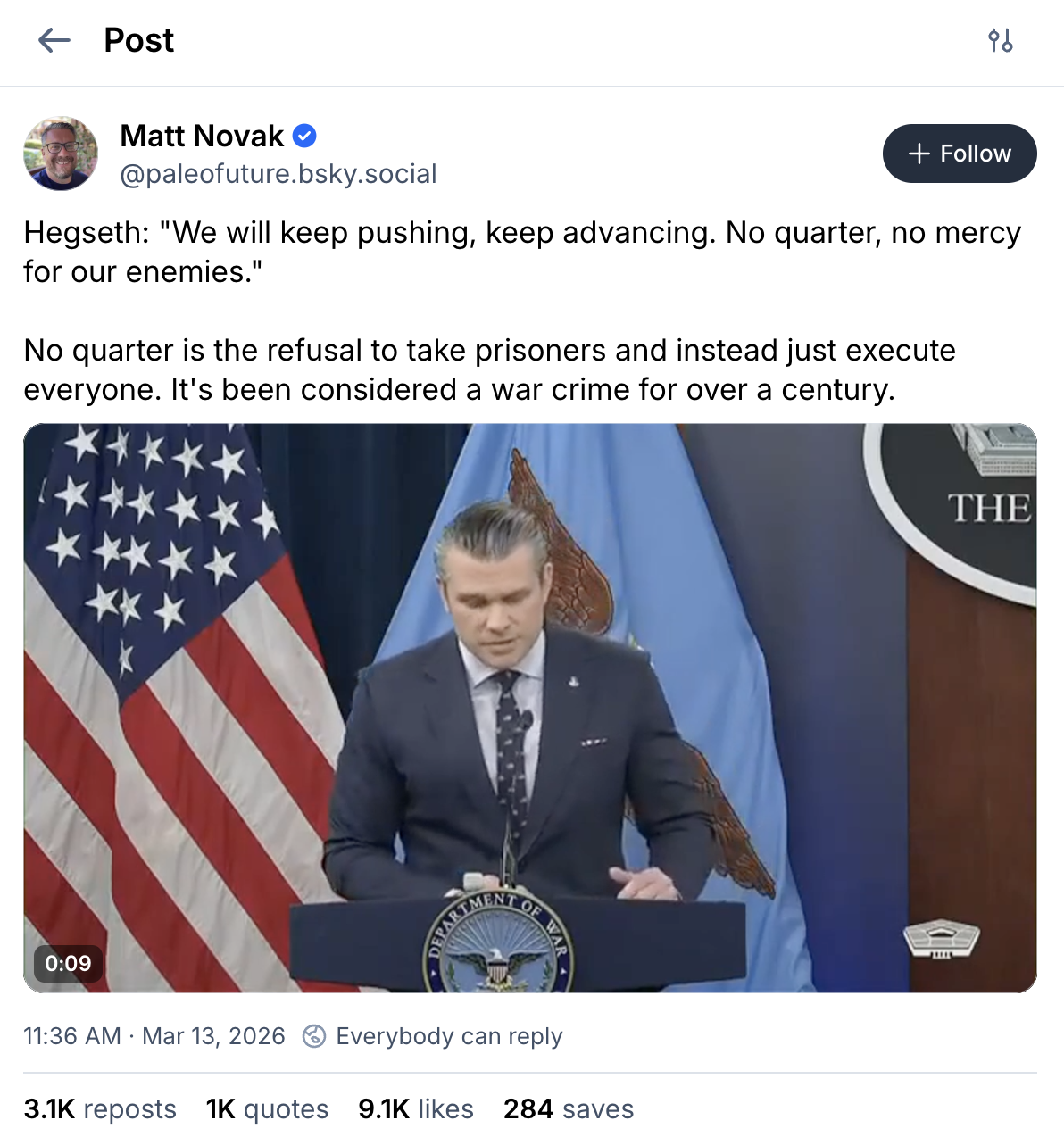
There are questions about the conduct of the war. A preliminary Pentagon inquiry found that the United States was responsible for the horrific bombing of a girl’s school that killed at least 175 people, most of them children. Congress ought to examine the final review, as well as the rules of engagement set by Secretary of Defense Pete Hegseth. Last week, Hegseth said, “We will keep pushing, keep advancing. No quarter, no mercy for our enemies."
|
|
|
In military jargon, “no quarter” has a specific meaning: An army will not accept the surrender of the enemy; all opposing soldiers will be killed rather than taken prisoner. A declaration of “no quarter” is illegal under the Geneva Conventions and considered a war crime. Has Hegseth been instructing US troops to commit a war crime?
While the Democrats are in the minority, they cannot stop or defund this war. They cannot hold hearings, demand testimony, or send out subpoenas. But they can start collecting string for investigations to be mounted next year if they succeed in the midterms. They can identify potential witnesses and collect open-source evidence. They can begin creating a to-do list. Trump and his gang need to be held accountable for this war (and much else), and it will never be too late for that. Got anything to say about this item—or anything else? Email me at ourland.corn@gmail.com. |
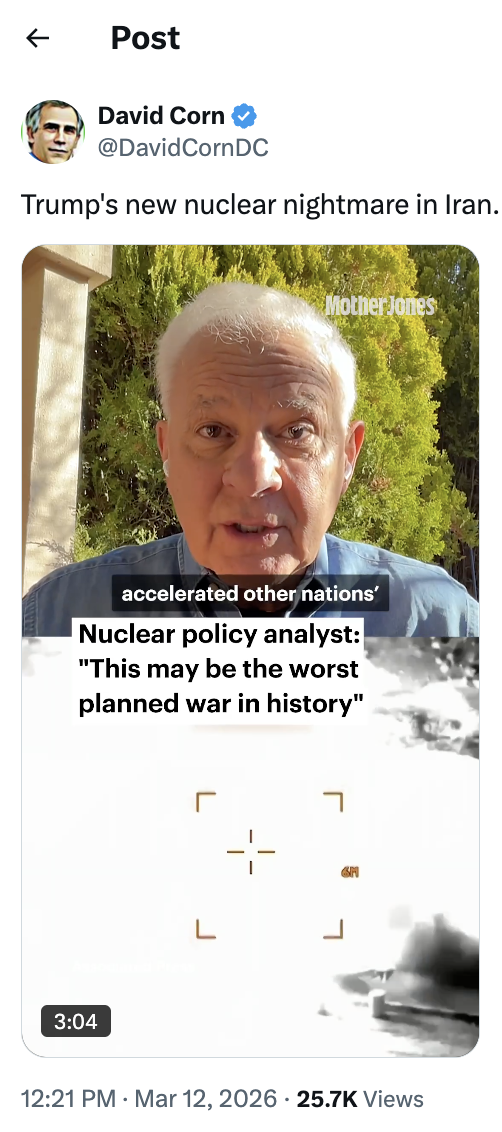
Trump’s New Nuclear Nightmare in Iran |
Speaking of the lack of plans, it seems Trump and his advisers didn’t think much about what to do regarding the half a ton of enriched uranium Iran had stockpiled. This material is close to the level of enrichment needed for bomb-grade uranium. That means the Tehran regime could now try to enrich it further and sprint toward a bomb. Or perhaps in the chaos of war some other party could gain control of this uranium. It’s unclear where all this stuff is being stored within Iran. Wondering how much to worry about this, I contacted Joe Cirincione, a veteran nuclear policy analyst, and he explained it all: |
|
|
Dumb Advice for House Republicans |
This was somewhat amusing. When House Republicans gathered for a retreat to discuss strategy for the midterm elections—naturally, at a Trump-owned resort in Doral, Florida—there was much handwringing about their prospects. But the White House offered advice. James Blair, the president’s deputy chief of staff, counseled the Republicans to not mention “mass deportations” and instead talk up the administration’s claim that ICE is targeting and removing violent criminals.
Uh, no shit. But this is the same phony talking point that Trump and his lackeys have been pushing for a year. As the CATO institute noted, about three in four people who have been deported had no criminal conviction. And most Americans have not fallen for Trump’s disinformation, mainly because they have seen what ICE is doing—rounding up law-abiding residents and deporting people without due process. The polling repeatedly shows voters recognize and reject the police-state tactics of this administration.
So, yes, let the Republicans double-down on a message that has flopped. If this is the best they can do, maybe the Democrats can start measuring the drapes. |
Trump’s UN Guy Doesn’t Know Recent History |
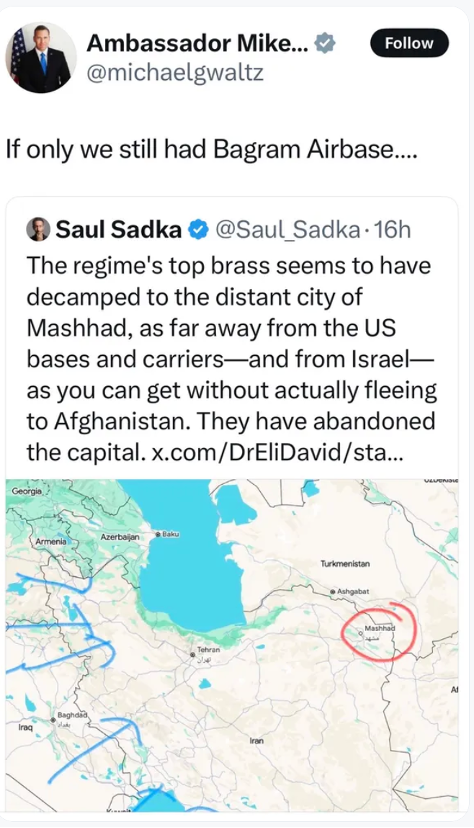
You would think that the US ambassador to the United Nations, who recently served as national security adviser, would know a little bit about geopolitical history. But, sadly, no. As Trump’s war was grinding on, Michael Waltz—famous for inadvertently inviting Atlantic editor Jeffrey Goldberg into a Signal chat in which top Trump officials discussed a pending military operation against the Houthis in Yemen—tweeted this snarky comment. |
This was obvious intended as a dig at the Biden administration for its withdrawal of troops from Afghanistan. One problem: It was Trump who during his first term negotiated with the Taliban the US withdrawal from Afghanistan, and that agreement obligated the United States to leave every base, including Bagram. Looking to score a cheap political point, Waltz ended up taking a shot at his boss. |
|
|
The Watch, Read, and Listen List. |
The Pitt. The Pitt, the stunning hospital drama that recently dropped its second season, shows us that life is a miracle. Oh, I’m not thinking miracle in the sense that on this rock floating within a gargantuan universe non-animated matter somehow became living matter and over millions of years evolved into Colin Jost. I mean, it’s a damn miracle any of us survive.
Watching The Pitt, you see that every day we each face an almost infinite number of possible maladies and injuries. Brain tumors, necrotizing fasciitis, polycystic ovary syndrome, tuberculosis, pulmonary hemorrhages, phytophotodermatitis, hypokalemic periodic paralysis, car accidents, motorcycle accidents, motorboat accidents, accidents with fireworks, accidents with superglue, gun violence, and, of course, priapism—the doctors and nurses working the ER of the Pittsburgh Trauma Medical Center must contend with all of these on a single shift. And the show sends a heartening message: We are surrounded by potential peril, but, thankfully, there are those among us who are committed to doing all they can to save us from such dangers, be they caused by our genes, events beyond our control, or our own stupidity.
The Pitt is perhaps the most immersive an experience television can produce. A season covers one long shift in the ER, with each episode depicting an hour. In the first season, the docs and nurses had to contend with a mass shooting, as well as the usual flood of emergencies and not-so-emergencies that end up in the ER due to our health system’s flaws. The latest season occurs on July 4, with all the misery a holiday can yield.
The series has a documentary feel, especially when it displays the blood and guts these providers must contend with. Still, it weaves in not-too-soapy drama—chief doctor Michael “Robby” Robinavitch (Noah Wyle) appears to be in a midlife crisis that he believes calls for a three-month-long motorcycle trip far away from the ER—as well as the real-life issues that are illuminated by the individual cases. A patient who is too poor to pay his bills but who does not qualify for Medicaid flees the ER without getting the care he needs to live. A young man who blew off several fingers with an M-80 has no parent to help him because mom and dad were deported. Rape kits with test results sit in a fridge because the cops are not pursuing these sexual violence cases.
The stories of the caregivers and the patients are compelling. The details of the medical challenges are absorbing. I’ve noted before that The Pitt is mesmerizing. In season 2, the mesmerization continues. |
Meanwhile, The Pitt inspired Saturday Night Live to produce one of its best skits: |
“Happy Together,” Susanna Hoffs and Rufus Wainwright. One of the most infections songs in the history of modern music is “Happy Together,” which the Turtles recorded in 1967. It was a No. 1 hit for the band. The song was written by Garry Bonner and Alan Gordon when they were members of the Magicians, a garage rock band you’ve probably never heard of. (Fun fact: The lead guitarist for that band was Mike Apel, who went on to become a manager and producer for Bruce Springsteen early in the Boss’ career.) Several artists took a pass on the song before the Turtles, who were in a dry spell after turning out several hits, gave it a shot.
I’ve always thought that the bridge with its bah-bah-bahs and counterpoint melody tapped into some universal current of pop music (or something Jungian, if you dig such analysis). No wonder it’s a much-covered tune. And a recent entry in this category is a version by Susanna Hoffs (of the Bangles) and Rufus Wainwright. The song plays at the end of The Roses, a quasi-remake of the 1989 The War of the Roses that was released last year. In that context—given the film’s ending (which I won’t spoil)—the tune had an ironic edge. But on its own, it’s a reminder of the delight the best pop music can generate.
|
|
|
Congratulations, you read all the way to the end! It's a great time to say "I'm in" and start your free 30-day trial. Make sure you don't miss out on what's next: Sign up to start getting Our Land in your inbox each week. We also want to hear from readers (especially those who read the whole thing!). So let us know what you think so far or share something interesting with David at ourland.corn@gmail.com.
|
|
|
|