FREE TRIAL VERSION. DON'T MISS OUT. |
FREE TRIAL VERSION. DON'T MISS OUT. |
|
|
Democrats Need to Escape the Left-vs.-Center Trap |
By David Corn February 21, 2026 |
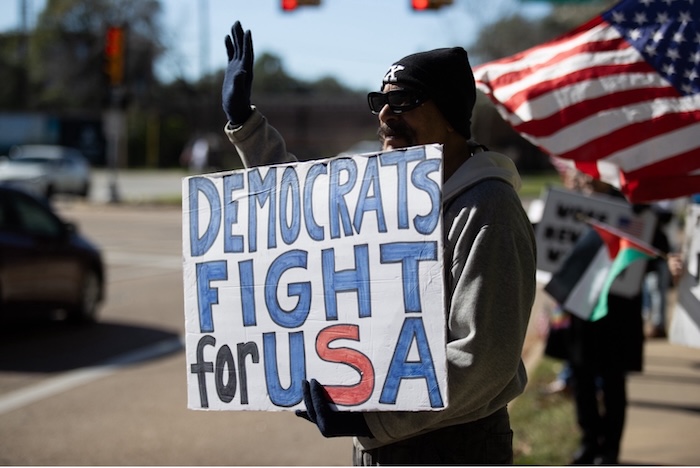
A protester holds a sign at a demonstration outside Texas Senator John Cornyn's office in Houston on December 30, 2025. Reginald Mathalone/NurPhoto/AP |
|
|
You're reading a free promotional version of Our Land, and we hope you enjoy David's exclusive writing and don't want to miss out on what's next. Sign up to start receiving a free 30-day trial of Our Land and enjoy all of the behind-the-scenes reports and interactive features with each issue.
|
|
|
It’s certainly beginning to feel increasingly like an election season. There are more polls about the coming midterms. Donald Trump, as his approval rating sinks, has started holding campaign-style rallies, supposedly to support GOP congressional candidates. Political reporters are drooling over all the money Trump has amassed in his political action committees ($400 million), which he can use to aid endangered Republicans. There’s talk about Elon Musk returning to the Republican fold and the mega-cash this immigration-law-flouting racist weirdo could put behind GOP contenders.
Republicans are pushing for more restrictive voting rules. Redistricting fights are still at hand. Trump’s FBI raided an election center in Atlanta—a sign that he’s scheming skullduggery to rig or tilt elections in a few key spots. And Democrats are back to the same-old tussle over whether the party should beef up its centrist cred or adopt a sharper progressive message. As regular readers of this newsletter know, I have become bored with that stale go-left/go-right battle. I have a personal preference for progressive policies. But in recent years, I’ve become convinced that the critical divide in American politics is not left versus right, but fight versus no fight. |
|
|
Many American voters are not ideologically minded. When evaluating candidates, they don’t run through a policy checklist. Instead, they seek champions who will go to the mat for them to make things better, however they envision that. And given that a huge number of voters have lost faith in institutions and the establishment, they’re often looking for aspirants willing to punch away at the powers that be. That’s what Trump pretends he does. I hate to say that style counts more than policy. But it frequently does, though policies can be deployed by politicians to show their mettle and express their priorities. Zohran Mamdani demonstrated that in his successful campaign last year in New York City.
Harboring these seat-of-my-pants sentiments about the current play of US politics, I was delighted a few months back to come across an essay that buttressed my presumptions with data. Real data. And as the midterms approach, I find myself thinking of it.
The essay, “The hidden axis: the left-right spectrum has a non-ideology problem,” was written by G. Elliott Morris, a 29-year-old data journalist and pollster who used to oversee FiveThirtyEight, the polling, politics, and sports website that was created by data analyst Nate Silver, acquired by Disney and ABC News, and then shut down in 2025. The article appeared on his Strength In Numbers Substack, which I highly recommend.
The piece opened with an unsurprising observation. Most voters say both political parties suck:
Dissatisfaction with American politics and the two major parties is at a modern high. In our new Strength In Numbers/Verasight poll, 54% of voters said the Democratic Party doesn’t get people like them — and 55% said the same about the Republicans. Nearly a quarter said both parties are out of touch, and only a third of voters told us they are happy with their current choice of political parties.
Trying to figure out what American voters want in a party, Morris took the unorthodox step of asking American voters what they want in a party. He conducted a poll that asked voters to describe in their own words the “ideal” political party. One problem with political polling has been that surveyors tend to present voters a list of policies and ask whether they support each one or not. So if 55 percent of voters tell a pollster they want the government to do more to address global warming, the impression is created that a party that strikes this stance could do well.
But this sort of question doesn’t capture an important data point: How often do these voters think about global warming and the need for the government to do more? When asked about the matter, they will proffer an opinion. But if this is not a major concern for them, it’s not likely to affect their attitudes about a party or a candidate.
In this poll, Morris put a question to voters: “In a few words, what would your ideal political party argue for or believe in?” Evaluating the responses, he identified “five broad visions of Americans’ ideal political parties.”
Those who described generally ideologically driven parties—either of the right (more small government!) or the left (more equality!)—each comprised a bloc of 26 percent. Those who expressed a hatred of government were placed in a “populist” bucket (6 percent), and those who yearned for a party that was distinctly “centrist” or “moderate” and adopted positions on both sides of the divide were labeled “explicitly moderate” (4 percent). And those who called for a party that addresses affordability issues, focuses on the general well-being of the people, and protects the American dream—without employing ideological terms—formed the largest group (38 percent).
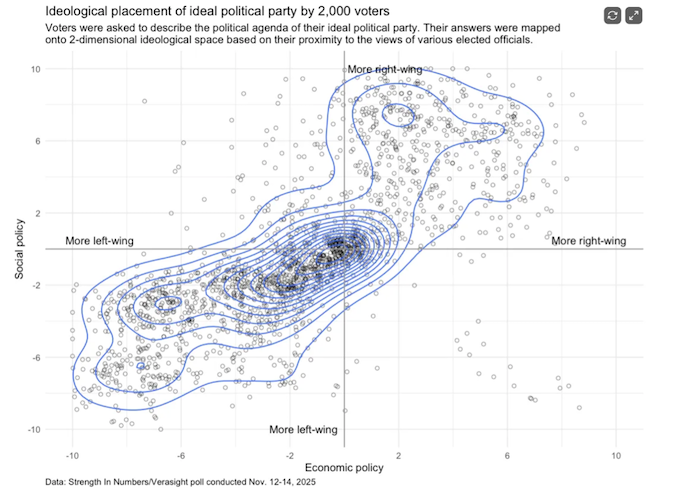
Looking at the data, Morris concluded that voters “want a generally left-leaning party on both economic and social policy.” Look at this nifty chart he made: |
But wait. This doesn’t mean that a lefty party prevails. He notes, “Most Americans don’t think about politics ideologically & just care about material wellbeing.” As noted above, about half don’t mention ideological terms when describing their ideal party. This is especially true, he points out, for the explicit moderates: “They have little to no ideological preferences.” That suggests that a politician is unlikely to win them over just by moving to what he or she thinks is the center. These voters don't reside in a political center; they live in a political no-man's-land.
Morris writes: Elite Democrats are currently stuck in a debate about whether to address their loss in 2024 by running to the left to increase turnout, or publicly shifting major issue positions to the center to win more “moderates” (an imprecise strategy that is unlikely to move the needle).
He suspects there is “an escape hatch from this tiresome debate”—which is what I’ve called it: That escape is a third strategy—not left, not right—that exists on another axis of ideological conflict in America today. That axis is non-ideology and general wellbeing: There is a great mass of voters today who don’t care about left vs right (or left vs center), and just want politicians to care about them and improve their lives. My bet is this: The party that wins the non-ideological, affordability-minded voters will win the next election.
I’m delighted to see research back up my kvetching about the endless left-center tug-of-war within the Democratic Party. The strategy for success Morris suggests seems to lean left and be more in sync these days with the Democrats than the Republicans, who are hidebound to blending MAGA extremism and traditional trickle-down economics (while supporting a corrupt kleptocracy).
In more recent pieces, Morris has expanded on this idea of breaking out of the left-right prison. He scorches what he calls “the Median Voter Theorem,” the notion that “an individual votes for the candidate that most shares their values, beliefs, and issue positions—formally, the one that is ‘closest’ to them on some set of important ideological and political variables” and that to win “a candidate has to earn the vote of the median American” by juggling issues. And he has explored how “low-knowledge voters”—those Americans who don’t consume much political news—after propelling Trump to victory in 2024 have dramatically turned against him.
|
|
|
All this reinforces the notion that success for Democrats does not rest on an ideological shift—for it likely won’t register with “explicitly moderate” or “low-information” voters—but on other factors, say candidate impression and performance. Voters want muscle not moderation.
I hope Democratic strategists and candidates are paying attention to Morris. The November elections demonstrated that fierce Democrats who vowed to address affordability and well-being issues triumphed, be they of the left (Mamdani) or of a more centrist bent (Abigail Spanberger in Virginia and Mikie Sherrill in New Jersey). So Democrats of the world, break free of the left-center construct. You have nothing to lose but an endless stream of op-ed columns. It’s time to blow this pop stand. Got anything to say about this item—or anything else? Email me at ourland.corn@gmail.com. |
Jesse Jackson was a force, a complicated fellow but with a powerful and simple message: We should respect and help one another. That was his fundamental request. Urging us to keep hope alive. Telling kids of all colors and backgrounds that they each are somebody worthy of love and dignity. And making sure everyone had a seat at the table. He tried hard to inject all this into American politics, with his history-making presidential runs in 1984 and 1988, which, as many have noted, paved the way for Barack Obama and other politicians of color.
Covering him in 1988, the late Andrew Kopkind, my old pal, zeroed in on a key portion of Jackson’s standard campaign stump speech.
“We work every day,” he reminded the crowds, who invariably responded with knowing assent. “And we are still poor. We pick up your garbage; we work every day. We drive your cars, we take care of your children, we empty your bedpans, we pick up your garbage, we sweep your apartments; we work every day. We cook your food, and we don’t have time to cook our own. We change your hospital beds and wipe your fevered brow and we can’t afford to lie in that bed when we get sick. We work every day.” By the end of the speech the nods of approval were mixed with tears.
National politicians didn’t talk like that then. By and large, they don’t now. Unlike most set pieces from presidential candidates, this one never got old. I heard it over and over, but it was always electrifying, because it was so true.
The death of Jesse Jackson caused me to recall the night Obama was elected president in 2008. I was in the press tent at Grant Park in Chicago, with a slew of reporters, fielding calls from family members and friends asking if the nation really was about to elect its first Black president. I told each one I only knew as much as was being reported on the news stations they were watching.
Jackson was flitting in and about, being his usual ebullient and commanding self, talking with journalists. When the race was called, he was standing near me, staring at the television. He became quiet and tears trickled down his face. For a few moments, he said nothing. Then a large smile emerged—an expression of infinite joy—and he started dashing off quotes to the assembled newshounds. It was a moment he had waited so long for—and that he had done much to bring about. Now we know, as he surely must have realized before his departure from our world, that such an achievement was not permanent but merely a victory in a struggle that remains unfinished and must be diligently prosecuted, perhaps forever.
Jackson indeed was always good for quotes and quips. I once interviewed him during the Clinton years, when he was toying with the idea of challenging President Clinton in 1996. (He decided not to.) Explaining Clinton’s penchant for avoiding hard political choices, he exclaimed, “When Bill Clinton comes to a fork in the road...he likes the fork.” Another time, he blurted out to me, “Text without context is pretext.” I can't recall what he was discussing, but I have never forgotten that line. His mind moved fast; his heart pumped hard. He made his mistakes. But he sure as hell was somebody.
|
|
|
Dumbass Comment of the Week |
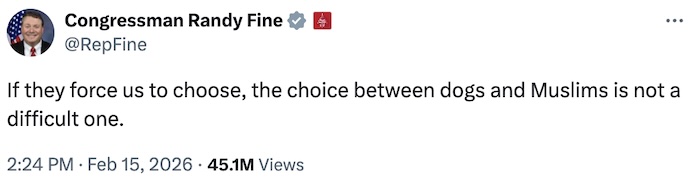
Rep. Randy Fine (R-Fla.) is quickly becoming a regular contestant. He’s back for this beaut: “If they force us to choose, the choice between dogs and Muslims is not a difficult one.” |
Fine is one of the most vocal anti-Muslim jerks in the GOP—and that’s quite a competition to win. His remark did spark an uproar, with some Democratic members of Congress advocating a measure censuring him. But he didn’t back down. He whined, “Not only are we supposed to let all these people in, we're supposed to smile and submit while they redefine what it means to be in America." Not sure what that even means. There are a bunch of Muslims in my town and none of them are redefining what it means to be in America—or trying to force me to give up my dog.
Rep. Andy Barr (R-Ky.), running to fill McConnell’s seat, was seemingly trying to out-racist Fine. He released an ad in which he says with a smile: You know what DEI really stands for? Dumb evil indoctrination…It’s not a sin to be white. It’s not against the law to be male. And it shouldn’t be disqualifying to be a Christian. |
Let’s call this snowflake racism. Where is being a Christian disqualifying? Seems every president has been a Christian. Oh—and a male. What’s especially odious is that “It’s not a sin to be white” echoes the rhetoric of Nazis. As Judd Legum writes, “The language used by Barr is a variation of the phrase ‘It’s OK to be white,’ which has been adopted by white supremacists.”
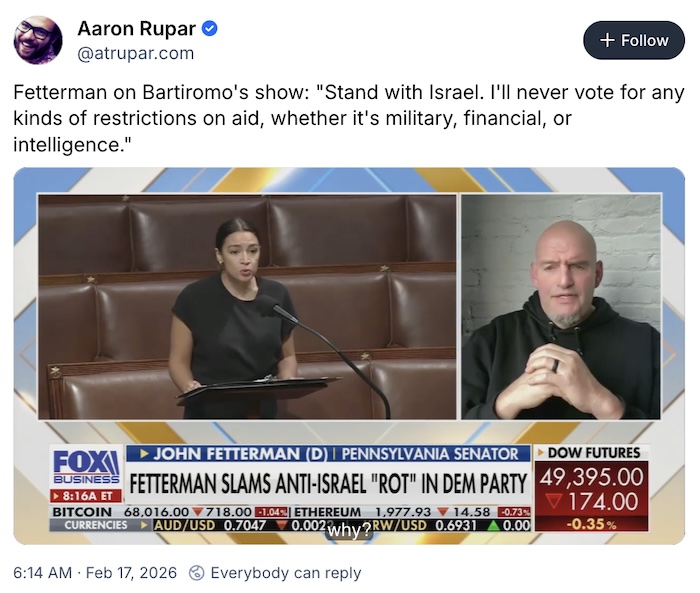
We all know that Sen. John Fetterman (D-Pa.) has been both disappointing and highly erratic. On Fox Business this week, he assailed “rot” in the Democratic Party—really helping your party, there, Senator—and fumed, “For me, [it’s] stand with Israel. I'll never vote for any kinds of restrictions on aid, whether it's military, financial, or intelligence." |
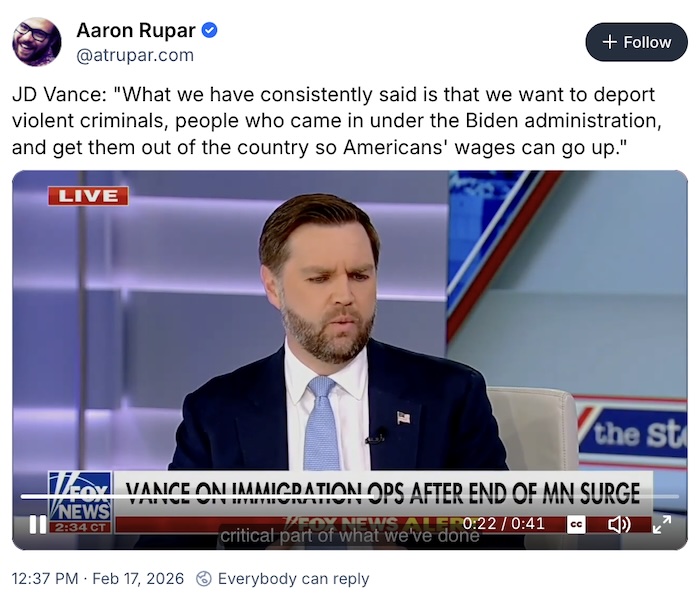
A total blank check? No matter what Israel ever does? Is there any other country he’d say this about? Vice President JD Vance was back in contention. On Fox News, when he was asked if ICE enforcement would look different after the supposed end of the Minneapolis surge, he replied:
“What we’ve consistently said is that we want to deport violent criminals, people who came in under the Biden administration illegally, and get them out of the country so that Americans' wages can go up.” |
Is Vance suggesting that violent thugs who have illegally entered the United States are also toiling away as farmworkers or laborers and taking jobs from good ol’ white Americans? They’re committing violent crimes and then heading to fields, slaughterhouses, and construction sites to put in an honest day’s work? And if we get rid of them, Americans will flock to these jobs and see the wage levels for them skyrocket? Vance gets this guff from: Stephen Miller. How do I know Miller is the source for this cockamamie idea? Because Miller told me himself, and I wrote about that here.
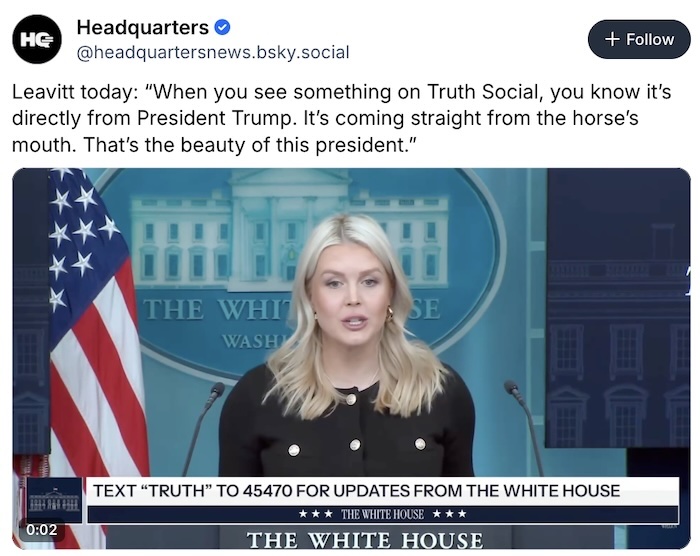
White House Press Secretary Karoline Leavitt doesn’t seem to be paying attention to what the boss says. In the White House briefing room this week, she explained that a post from Trump “should be taken as the policy of the Trump administration. It’s coming straight from the horse’s mouth. When you see something on Truth Social, you know it’s directly from President Trump. That’s the beauty of this president and his transparency.” |
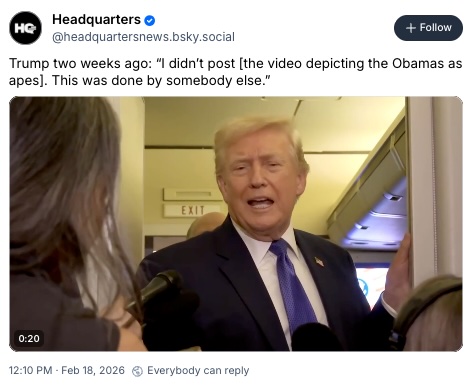
Apparently, the horse’s mouth is not always controlled by the horse. When a racist video depicting Barack and Michelle Obama as apes recently appeared on Trump’s Truth Social media platform, the troll-in-chief ducked responsibility and said, “I didn’t do it, by the way. This was done by somebody else.” |
For this White House backflip confidently executed without a blink or hesitation, Leavitt takes gold this week. |
|
|
Jurists keep providing us doses of encouragement. A few days ago, US District Court Judge Cynthia Rufe ordered the Trump administration to restore the slavery exhibit at the President’s House in Philadelphia, which depicted the lives of people enslaved by George Washington when he lived in Philadelphia during his presidency. Removing this display was part of the Trump gang’s Make America White Again crusade that is seeking to erase accounts of racism from the official tale of the nation’s past.
In her decision, which imposed a temporary injunction compelling a return of these panels, Rufe went to one of the best sources on historical manipulation: George Orwell. She began with a quote from 1984: “All history was a palimpsest, scraped clean and reinscribed exactly as often as was necessary. In no case would it have been possible, once the deed was done, to prove that any falsification had taken place.” Then she wrote,
“As if the Ministry of Truth in George Orwell’s 1984 now existed, with its motto ‘Ignorance is Strength,’ this Court is now asked to determine whether the federal government has the power it claims—to dissemble and disassemble historical truths when it has some domain over historical facts. It does not.”
Three cheers for this defense of history. As Washington said, “Truth will ultimately prevail where pains to taken to bring it to light.” |
Before we get to the mail, let me note that my email software now offers to write responses for me. It shows me the replies that I can dash off with a single click. If an Our Land reader sends in a note like “Hey, David. Enjoyed the last issue. Here’s a 5,000-word piece I wrote comparing the Trump administration to a pack of rabid dogs in the Alaskan wild,” it will generate a message that says, “Thanks for writing. I will check it out.” That’s marginally useful. But I promise you, dear reader, that the replies you receive from me are free of AI. At least for now.
Many complimentary notes came in about the recent issue that reported how Rupert Murdoch is defending Trump’s $10 billion lawsuit against the Wall Street Journal for its story on the Jeffrey Epstein birthday greeting by arguing that Trump is too lewd a fellow to suffer reputational damage from being associated with Epstein. But it’s boring to publish those. Linda Jack wrote: The Trump case is another attempt to extort a multimillion-dollar settlement by the empty threat of a lawsuit. It would never proceed to court, because Trump can't allow discovery to possibly publicize even more salacious facts about his relationship with Epstein.
Discovery would be delicious in any case about Trump and Epstein. Imagine the deposition. But since Trump is pocketing gazillions in ill-gotten crypto, he can afford to pay for a pointless lawsuit until it hits such a crunch point. Richard Gilbert seems to believe that the Epstein case has been something of a distraction:
The MSM has a forever audience hungry for Epstein details that never stop coming, thanks to Attorney General Pam Bondi. Despite outrageous and politically stupid adventurism—think Venezuela and Greenland—the public wants more Epstein. I think that Greenland has done more damage to the reputation and leadership of the United States than Epstein has or will; it will in the final analysis sink Trump and his sycophants.
Perhaps. But if Trump dumps his Greenland crusade—as he seems to have done, at least for the moment—this may all be forgotten by voting time in November. Especially if he bombs Iran or forces a collapse and humanitarian crisis in Cuba. Michael Bradley thought he found an error in that Epstein piece:
This was well-written with a seasoning of cynicism that fits the subject matter perfectly. If I remember correctly, the Trump comment about “grabbing them by” was caught on a hot mic, so it should be considered audio, rather than video as you report here.
It was technically a video. Trump, on a bus and mic’d, was talking to Billy Bush, the co-host of Access Hollywood, while a film crew was outside the bus shooting his exit from the vehicle. His remarks were caught on that hot mic but synced to the video being shot. If you have any desire to relive this: |
Ken Kagan did find an error in that same issue: Mark Kelly is a retired naval officer (not Air Force).
I apologize for mis-servicing Sen. Kelly. Kudos to him and the five other Democratic legislators whom Trump tried to prosecute for (very legally) reminding members of the military they have an obligation to not follow illegal orders. A grand jury in Washington, DC, told Trump to shove it.
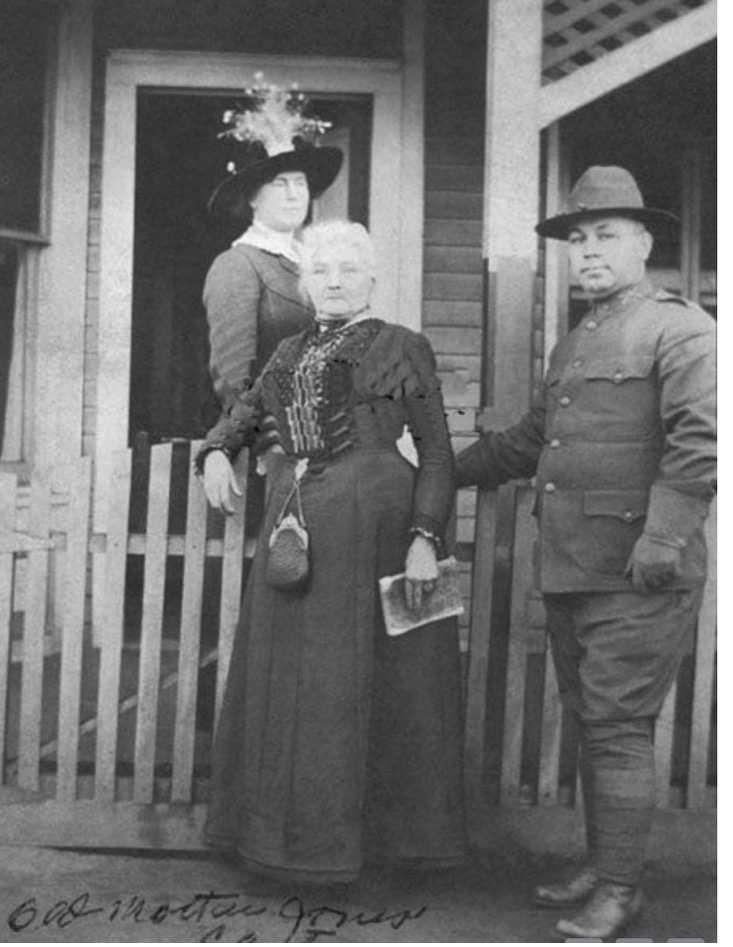
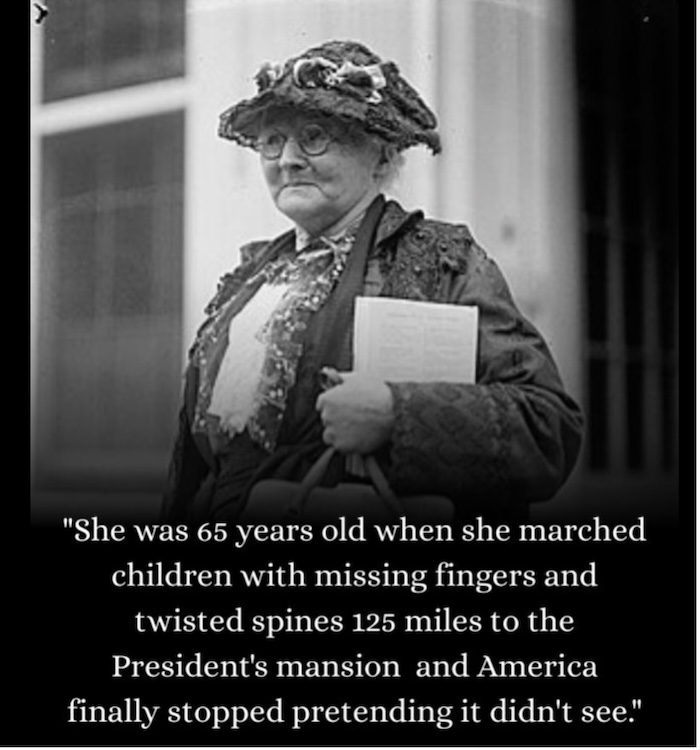
Martha Ture found a much-appreciated historical reference in a calendar: 13 Feb 1913 82-year-old labour activist Mother Jones was arrested in West Virginia for supporting a coal miners' strike. Convicted in a military court and sentenced to 20 years in prison, she was pardoned after serving 85 days. |
Our Land old-timers might remember that I wrote about this. Not at the time, but two years ago. On the same day, a friend sent me this: |
That’s a reference to the March of the Mill Children that Mother Jones led from Philadelphia to Theodore Roosevelt’s summer home in Oyster Bay, New York, in 1903 to protest child labor and the horrendous conditions pre-teens were forced to work in. They carried banners that read, “We want time to play.” You can read more about that here. These days, it’s good to have reminders of past acts of resistance.
Speaking of which, Ken Arbogast shared this: I recently found on eBay a recording of A Night at Santa Rita about the National Guard rounding up protesters in Berkeley during the Vietnam War. The descriptions of violence and cruelty during the detentions are eerily similar to what many are enduring in Trump's America.
I’d never heard of this album, but I looked it up. It was a jazz recording with bassist Ron Carter and flutist James Spaulding riffing, as Rosko, a famous deejay at WNEW-FM in New York City, read an article by Ramparts editor Robert Scheer chronicling a clash between National Guard troops and demonstrators (and onlookers) in 1969. Wild, man. |
“Moxie, what’s that cut under your eye? You’re bleeding.”
“Just a dispute over a certain patch of territory.”
“We’ve talked about this. Other dogs are welcome to walk past our house.”
“You should see the other guy.” |
|
|
Congratulations, you read all the way to the end! It's a great time to say "I'm in" and start your free 30-day trial. Make sure you don't miss out on what's next: Sign up to start getting Our Land in your inbox each week. We also want to hear from readers (especially those who read the whole thing!). So let us know what you think so far or share something interesting with David at ourland.corn@gmail.com.
|
|
|
|