FREE TRIAL VERSION. DON'T MISS OUT. |
FREE TRIAL VERSION. DON'T MISS OUT. |
|
|
The Most Despicable Lie From the Guns-Over-All Gang |
By David Corn December 16, 2025 |
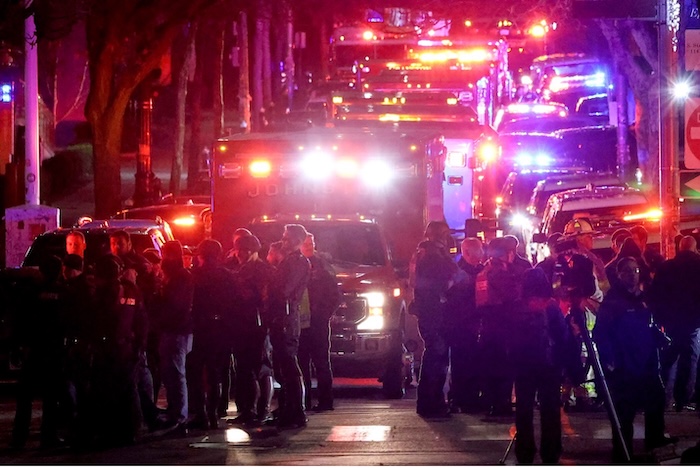
Emergency personnel gather at Brown University on Saturday after a shooting in a lecture hall that killed at least two students. Mark Stockwell/AP |
|
|
You're reading a free promotional version of Our Land, and we hope you enjoy David's exclusive writing and don't want to miss out on what's next. Sign up to start receiving a free 30-day trial of Our Land and enjoy all of the behind-the-scenes reports and interactive features with each issue.
|
|
|
Every school shooting is horrific—a reminder of the worst form of American exceptionalism and one more infuriating occasion to question why so many of our neighbors and citizens accept this perverse violence and choose not to cry out for measures that might counter or diminish the mass murders that plague our land. When Donald Trump responds with the usual tut-tutting—“It’s a shame; just pray”—it’s a sign that doing nothing is just fine. Which is especially aggravating when gun violence devastates your own community.
I am a graduate of Brown University. As an alum, I have organized and held panels there. I know professors, administrators, and recent students. And many times, I have walked past or near the site of the Barus and Holley building where a gunman on Saturday burst into a lecture hall and shot 11 students, killing two of them. I mourn the lives lost, ache for the families of the dead, hope the best for the survivors, and grieve for the community, concerned for how this will impact the university’s students, teachers, and workers, and the people of Providence. We have all become too accustomed to such tragedies. They can seem faraway occurrences; that’s obviously a survival mechanism. It’s different when it’s close.
As my blood boiled in the aftermath of this horror, the usual context kicked in: In this level of gun violence, the United States stands alone among Western democracies. And the math is simple: We have more guns than other nations—500 million total firearms or so, by some estimates—and few restrictions on guns. Thus, more gun deaths. There’s nothing incomprehensible here. |
|
|
Nor are the politics difficult to understand. In the 1970s, as Republicans searched for cultural wedge issues with which they could coax white working class and ethnic voters from the Democrats, they landed on abortion, race, religion, and guns. Democrats might be fighting for workers’ rights and protections, better pay, the expansion of civil rights and personal liberties, and fewer handouts to the wealthy—but, hey, the Ds favor gun control. So they must be defeated. And for the Republicans—backed by the NRA—this strategy worked.
Shootings like this one are political inconveniences for them. They prompt the usual denunciations of Republicans’ do-nothingism and scorn for their hollow thoughts-and-prayers offerings. Republicans, though, only need to wait out the storm, and then they can get back to blocking and thwarting gun safety measures, deploying their silly arguments against any and all gun control. And one of the most aggravating elements of the so-called debate over gun violence is the despicable falsehood pushed by Republicans and conservatives: They are coming to confiscate your guns.
For years, this has been the mantra for the GOP: It’s not that Democrats merely champion restrictions on guns and assorted safeguards; they also want the government to forcibly take your weapons away. Certainly, gun safety advocates have proposed numerous ideas that would impose limitations and regulations, such as licensing guns, banning specific weapons and ammo, implementing waiting periods for buying a gun, tracking gun sales, passing red flag laws, restricting certain types of purchases, and so on. Yet right-wing and Republican foes of gun safety measures routinely claim that all of this is a prelude to total confiscation—that the ultimate objective is prying all guns from your cold live hands.
This has been the Big Lie of the NRA and the Republican Party for decades. In a 1975 commentary in Guns & Ammo, Ronald Reagan warned against handing government “the power to confiscate our arms.” Half a century later, during last year’s election, Trump repeatedly assailed Vice President Kamala Harris with this charge. “She supports mandatory gun confiscation," he declared at a campaign rally in Atlanta on August 3. He added sarcastically, "Would anybody mind if they came into your house and took away your gun?...She's for taking away all of your guns." Five days later, at a press conference at Mar-a-Lago, Trump exclaimed, “She wants to take away your guns.” Later in the campaign, during a speech, Trump bellowed, “They’re going to take away your guns, you saw that, they’re going to take away your guns. She’s going to take away your guns.” Fact-checkers noted these were false assertions.
This was not new rhetoric for Trump. During a 2019 speech to a NRA gathering, he said, “Far-left radicals in Congress want to take away your voice, your jobs, your rights, and they especially want to take away your guns. You know that. They want to take away your guns.”
Confiscation has become the standard line for the Republican Party and the right. Some examples: Marco Rubio, then a senator running for president, in 2016: “I am convinced that if [President Obama] could confiscate every gun in America, he would.”
Ben Shapiro, right-wing commentator, in 2016: “Of course Hillary Clinton is coming after our guns. There's a reason she has consistently over and over again cited gun confiscation in England and Australia as her.”
Sen. Josh Hawley in 2021: “[Gun control] is really about confiscating weapons…ultimately to take away firearms from law-abiding citizens.”
Marjorie Taylor Greene, then a congressional candidate, in 2020: “All this talk about gun confiscation has me thinking...no one is taking my guns away!”
Then–NRA Executive Vice President Wayne LaPierre in a 2023 fundraising email: “NOTICE OF GUN CONFISCATION...You'll soon face the threat of having your guns confiscated with your right to self-defense.”
I’m sure there are some Democrats who, if they could snap their fingers and make all guns disappear, would do so. But confiscation is not on the agenda. This notion that gun restrictions are a steep slippery slope to confiscation is paranoid bunk. Cars are registered. Can they be confiscated by the government?
The goal of the pro-gunners is to discredit all discussion of gun safety proposals. And with this rhetoric, they sidestep any serious policy debates (does limiting the sale of assault weapons make us safer?) and delegitimize their political foes. As Trump presents it, his opponents are not only radical, communist lunatics; they are also gun grabbers who want to round up all guns so they can impose tyranny on the American people.
As I write this, there are no details publicly known about the Brown University shooter. There’s no telling what, if any, possible gun laws might have prevented this terrible crime. But the passage of gun safety laws—and reforms in mental health care—would likely decrease the number of such horrors. And the fewer school shootings there are, the less encouragement there’ll be for the next one. |
|
|
During the nightmare at Brown, a student texted her mother: “Mom, there’s a live shooting on campus. I’m going to run. I love you.” It’s stunning—or maybe the better word is “disgusting”— that an entire political party is willing to live with this and, worse, exploits sincere efforts to prevent gun violence in order to demonize political rivals and hang on to power. They fuel their political campaigns with the blood of innocents and disregard the fear created by our guns-over-all culture, including, most troubling, that experienced by our children.
The reasonable among us know the thoughts-and-prayer routine is bullshit. But the Big Lie—gun safety means confiscation—ought to also be deflated. The cynical deployment of this canard protects a status quo of violence and death. And that’s the goal of Republicans and MAGA. They will tolerate the killing of our fellow citizens and our children. For them, it’s good politics. And power is more important than blood.
Got anything to say about this item—or anything else? Email me at ourland.corn@gmail.com. |
Rob Reiner (Mensch) versus Donald Trump (Schmuck) |
Rob Reiner was a friend. The murder of Rob and his wife, Michele, this past weekend was tragic and shocking. He enlightened and entertained us with his writing, acting, and directing, and he was a fierce progressive advocate who led campaigns that overturned a ban on same-sex marriage in California and that implemented a program to provide early child development services to the state’s residents. He was also an articulate and fervent critic of Donald Trump. I’ll forever treasure our long and leisurely lunches at his favorite Italian restaurant where the conversation easily shifted from great comic bits to US history to California politics to tales of his father and his father’s pals (Mel Brooks, Norman Lear, Sid Caesar) to music and, inevitably in the past 10 years, to Trump.
His death was slightly overshadowed by Trump’s callous response that derided Rob and that somehow seemed to blame Rob’s death on his opposition to Trump. But Trump’s attack on Rob sparked a backlash on the right, where some MAGA-ites were put off by his crassness. And then a clip circulated online of gracious comments Rob made when Charlie Kirk was gunned down. So in death, Rob made Trump look like a schmuck—even to Trump supporters. In a way, he got the last laugh. I wrote about Rob and all that here.
There is so much for which to remember Rob. In my family, we have long treasured this one bit he did with Carroll O’Connor on All in the Family. It has always made me laugh, no matter how many times I’ve watched it. And we all could use a good laugh these days: |
|
|
This is certainly a stretch when we can use some inspiration. You have probably seen this by now. But on the off chance you haven’t: |
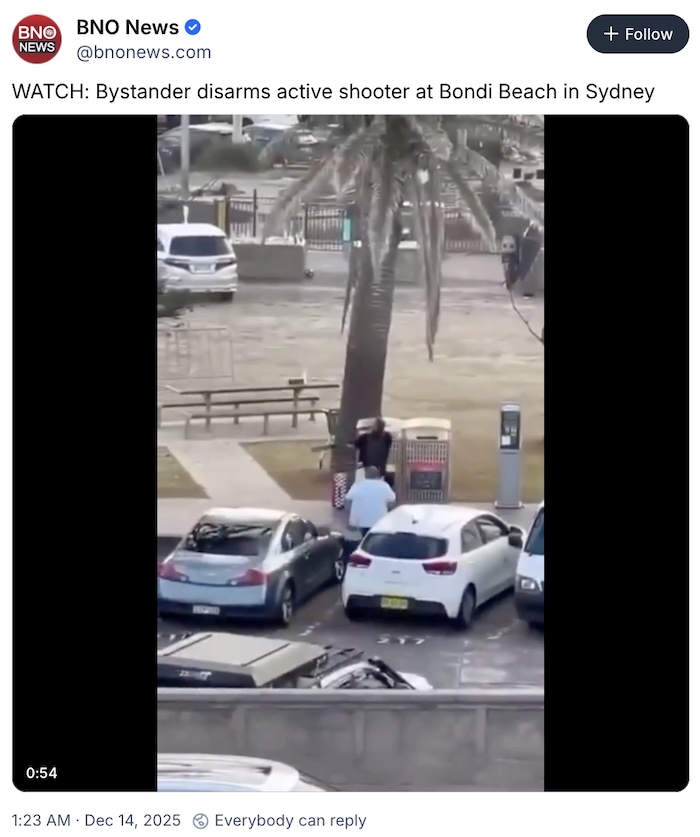
His name is Ahmed al Ahmed. He is the father of two, a fruit shop owner, and a Muslim. He came to the rescue of Australian Jews. |
|
|
The Watch, Read, and Listen List |
“A Year of Hell for Immigrants,” Isabela Dias, Mother Jones. Since Donald Trump returned to the White House, it’s been a year of cruelty. With the help of Elon Musk, he gleefully decimated USAID and eviscerated US foreign assistance that had helped millions of people overseas avoid death and disease. And Trump’s mass deportation crusade, implemented with police-state tactics, has upturned the lives of hundreds of thousands of law-abiding residents and their relatives, often with the most devastating consequences. My fear is that over time it is easy for a person and a population to become inured to all this malice. The parade of barbarity doesn’t cease. It can be overwhelming and, eventually, numbing. Multiple outrages can cause our outrage detectors to shut down.
A college student grabbed off the street. A laborer illegally deported. A mother pulled out of a car and separated from her child. A detainee in a holding facility maltreated to death. People disappeared. Migrants sent to gulags overseas to be tortured. How does one keep up with all the horrific stories? Recognizing this dilemma, Isabela Dias, a reporter who has covered much of this for the past year, writes in a recent essay for Mother Jones:
Displays of inhumanity were a normalized phenomenon in 2025. A peril of having punitive theater as a central tenet of governance is that, eventually, the shock factor and public outrage risk wearing out. The horror may never fully register. When there’s a barrage of previously-unbelievably-unconscionably-legally dubious acts and brutal policies, how does one begin to wrap their head around each uniquely reprehensible episode, let alone a year’s worth of anti-immigration cruelty?
In her piece, she offers “an imperfect attempt to take stock” of all the awfulness, noting these awful actions have been perpetrated for one reason:
The message is clear: No immigrant living in the United States is to feel safe or welcome. No one will be spared. Not a college freshman visiting family on Thanksgiving. Not even the mother of the White House press secretary’s nephew. “The distinction between legal and illegal immigration becomes meaningless when both can destroy a country at its foundation,” a spokesperson for USCIS said in a press release email that landed in my inbox in November.
Much of the current immigration policymaking—if this rampant clampdown and unleashing of brutalizing force can be called that—seems to be now distilled to a simple modus operandi: we do it because we can. Little does it matter if families are separated again or if US children with cancer end up being removed from the country. Any means fit for this end: to get as many people out as possible and stop others from coming.
Every disturbing news report about a wrongful deportation or military-style raid of an apartment building should come as a reminder that the US government is using its prosecutorial discretion—it is choosing—to normalize casual cruelty and overt racism. And it’s doing so ostensibly in the name of “protecting” the American people.
You can read the full piece here.
Train Dreams. Train Dreams is an exquisitely beautiful and contemplative work that is achingly sad yet not depressing. Directed by Clint Bentley and based on the 2011 novella by Denis Johnson, this film is a meandering account of the life of Robert Grainier, a railroad construction worker and logger in the Northwest. Born in the 1880s and orphaned as a child, Grainer knew nothing of his origins, and he spends much of his time as an adult puzzled by his own existence and experiences. The film is not propelled by plot. There is one dramatic episode that haunts Grainier. He witnesses a group of white workers throw a Chinese laborer off a railroad bridge to his death for reasons never stated, and he does not intervene. Years later, he experiences a tragic loss. He wonders if the two events are connected.
Mostly Granier flows with the current of his life across decades. As the United States and the globe undergo immense changes, much of Grainier’s world—he lives in rural Idaho—stays largely the same. He is flummoxed when gasoline-powered chainsaws are introduced into logging. He has few relationships with others, but he possesses a capacity to love deeply. He carries on—and does so simply.
This might sound boring. But Bentley delivers a microscopic rendering of a single life that highlights a universal predicament. Grainier’s effort to understand his place in a world that offers both joy and despondency is understandable to anyone who has engaged in similar pondering and who has ever thought about the fleetingness of it all. Which, I would hope, encompasses just about everyone. Joel Edgerton’s performance as Grainier is mesmerizing. His eyes can convey wonder and melancholy simultaneously. And William H. Macy does fine work as Arn Peeples, an explosives expert who almost counts as a friend for Grainier.
Train Dreams indeed feels like a nocturnal imagining. Tracking the life of a single and unexceptional person—but someone you want to hug and embrace—Bentley illuminates the perplexing and unique ride we each take to a destination we all share. |
|
|
Congratulations, you read all the way to the end! It's a great time to say "I'm in" and start your free 30-day trial. Make sure you don't miss out on what's next: Sign up to start getting Our Land in your inbox each week. We also want to hear from readers (especially those who read the whole thing!). So let us know what you think so far or share something interesting with David at ourland.corn@gmail.com.
|
|
|
|