FREE TRIAL VERSION. DON'T MISS OUT. |
FREE TRIAL VERSION. DON'T MISS OUT. |
|
|
Isn’t a Death Threat From Trump a Front-Page Story? |
By David Corn November 25, 2025 |
|
|
You're reading a free promotional version of Our Land, and we hope you enjoy David's exclusive writing and don't want to miss out on what's next. Sign up to start receiving a free 30-day trial of Our Land and enjoy all of the behind-the-scenes reports and interactive features with each issue.
|
|
|
For years, a serious threat to American democracy has been the normalization of Donald Trump. Mainstream news organizations have too often given him the treatment they afford routine politicians, without emphasizing his profound dishonesty or highlighting the peril he presents. The main story regarding Trump is that he’s an extremist, an incompetent, and a liar who poses a danger to the constitutional order. That’s no secret. After all, he refused to accept the 2020 vote tally, schemed to overturn election results, and incited a riot to retain power. Yet this overall context has frequently gotten lost in the day-to-day coverage, with Trump’s excesses and idiocies sane-washed through the application of neutral language and bland characterizations, as major media outlets strive to provide what they consider to be straight-news and objective reporting on the Mad King.
One of the best examples of this occurred last week at the New York Times. I don’t want to pick on the The Gray Lady. The Times has done fantastic and essential reporting on many aspects of the Trump nightmare, such as the Trump clan’s rampant corruption (for recent examples, see here, here, and here), the devastating consequences of Trump’s cruel mass deportation crusade, and his despicable annihilation of USAID and its foreign assistance programs that saved the lives of millions. Thanks to the newspaper of record, we know so much about the horrors of the Trump administration.
But...the New York Times has failed to consistently convey the Trump crisis, especially in how it reports on him directly. (I’m referring only to the news coverage, not the opinion journalism it produces, which supplies a steady stream of trenchant warnings about Trump and his MAGA movement.) Which brings me to Friday’s edition. |
|
|
The day before, Trump, in response to a video released by six Democratic members of Congress who reminded members of the US military and the intelligence community that they must disobey illegal orders, went ballistic. He promoted a social media post that declared, “HANG THEM.” And he wrote his own post declaring, “SEDITIOUS BEHAVIOR, punishable by DEATH.” The president was essentially calling for killing six lawmakers. This was unprecedented in modern times. A big deal. How did the Times handle this? It placed its story on p. A16.
Why wasn’t a death threat from the president front-page news? Worse, the headline on the hard-copy version was, “Trump Says Democrats’ Message to Military Was ‘Seditious.’” This created the impression that the primary news here was Trump leveling a serious charge against some Democrats, with the focus on Trump’s mischaracterization of the Democrats’ video—not his amplification of a call for them to be killed by hanging.
The opening sentence reflected that, as well: President Trump accused a group of Democratic lawmakers of sedition in an outburst on social media Thursday morning and said their behavior was “punishable by death.”
Making Trump’s charge of sedition the central point was ass-backward and beneficial to Trump, intentionally or not. And it was baseless. In US law, sedition requires the use of force. The Times did not explain that.
The lawmakers had not urged any violence; they had merely told service members and intelligence professionals that their duty is to not follow illegal orders. There was nothing seditious about it. Yet the headline and the start of the article gave credence—or, at least, attention—to a false accusation, ahead of Trump’s deplorable boosting of a death threat. Why center Trump’s misrepresentation?
But time and again, the Times has downplayed or even ignored Trump’s most worrisome conduct. It’s my recollection that when Trump in 2023 suggested that Gen. Mark Milley, the outgoing chair of the Joint Chiefs of Staff, ought to be executed, the paper did not cover it at first. (A Google search turned up nothing for me.) That, too, warranted front-page notice. And the Times and other media have often worked hard to present Trump’s gibberish as coherent communication, summing up rambling and disjointed statements in a way that makes him seem far more lucid than he is.
I know that there are liberals on social media who obsess over Trump-normalizing headlines in the New York Times, and on occasion their gripes can seem petty or small change. But the Times does set the national agenda, perhaps not as much as it once did, given the fracturing of the national information ecosystem. Nevertheless, how it contextualizes Trump matters greatly. Other reporters take their lead from its coverage. And its practice of portraying Trump’s radical and treacherous conduct in an evenhanded manner—which in this case is not so evenhanded—does not capture reality.
Why does the newspaper take such a stance? I asked an astute reporter for another major news organization that often engages in the same practices, and he told me he believed that there’s a desire within the Times and elsewhere to not appear hysterical, to not take the bait and jump at every Trump inanity. Sophisticated journalists stay calm and carry on. They don’t get drawn into the whirlpool of craziness Trump creates. They preserve the tone and the objectivity they have long relished and celebrated.
My own guess is that folks at the Times are overly susceptible to the gravitational pull of conventionality and neutrality. Their instinct is to reach for impartial language and stick to what they consider to be fair-minded and not-heated descriptions. According to longstanding rules of the game, that means you give the president his say and then, perhaps, provide information that might counter his assertion. My hunch is that they recoil at the idea of appearing adversarial or of being accused of advancing an agenda. Call the president a dangerous and power-mad con man who encourages violence and who often jumbles words and thoughts, and someone somewhere will say, “There goes the liberal media.”
|
|
|
To be fair, the Times and other outlets have gotten better at calling out Trump’s lies and labeling them as such. They’ve been forced to by Trump’s unending and unavoidable firehose of falsehoods. According to the Washington Post, he made more than 30,000 false statements during his first stint as president. (Jeff Bezos’ Washington Post, this time around, is no longer chronicling and counting Trump’s misrepresentations and prevarications.) And the Times has done impressive work reporting on Trump’s revenge-a-thon and his attempts to consolidate power. But it has not consistently depicted him as an authoritarian menace to American democracy.
Earlier this year, the paper noted Trump’s intent to follow a “muscular vision of presidential power”— a far-too polite way of describing Trump’s autocratic power grab. From the outside, it looks as if the Times crew is most comfortable when it can apply the traditional rules to Trump. But he’s not a traditional president. He threatens laws and norms. He seeks to turn the government into a kleptocracy and his presidency into a despotic rule that serves his greed and his desire for retribution and self-glorification. His extremes ought not be dismissed or downsized. They deserve to be front and center. Seems obvious to me: If a president promotes a death threat against members of the legislature, it’s a big story. Maybe the biggest—until his next outrageous act.
Got anything to say about this item—or anything else? Email me at ourland.corn@gmail.com. |
Tonight’s the Night: An Our Land Zoom Get-Together at 8 p.m. ET |
We’re having an Our Land Zoom shindig tonight, November 25, at 8 p.m. ET. Come join us to talk about all the craziness of late and prepare for Thanksgiving dinner with that relative you don’t want to talk politics with.
As you probably know by now, these sessions are only open to premium subscribers, our favorite readers who pay a few bucks a month to get the full version of this newsletter, which includes an assortment of extra features: additional behind-the-scenes reports, Dumbass Comment of the Week, Inspiration of the Week, the interactive Mailbag (you send in questions, I reply), MoxieCam™, and reviews of movies, books, music, television shows, podcasts, and other cultural fare. Without premium subscriptions, Our Land would not exist. We are grateful for these supporters. So even if you don’t want all that additional content—there’s so much to read these days!—consider subscribing so we can continue to deliver kick-ass reporting and analysis. You can sign up here to join this noble band. As for the Zoom get-together, here’s the deal: Today premium subscribers will receive an email with a Zoom invitation. Just click on that link at the right time, and our bouncers—who are studying to become Buddhist monks—will let you in. See you tonight. |
|
|
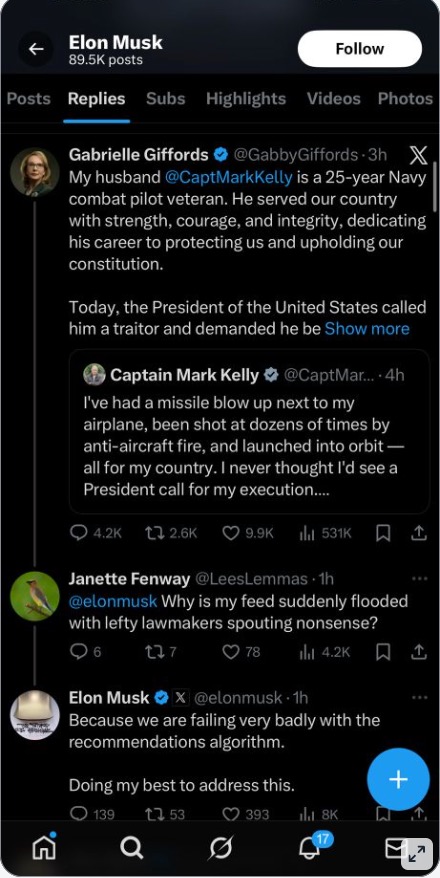
Remember those days when Elon Musk referred to X (née Twitter) as the public square and declared it should be a realm of free speech and unfettered debate? That was always bullshit. He wants to rig the site so it aligns with his alt-right, bigoted, conspiratorial, and self-serving views. And he just admitted that. Look at this exchange. |
That’s an acknowledgment Musk skews the algorithm that controls what users see in order to throttle or suppress left-of-center content. He’s no free speech advocate. He’s a propagandist. |
|
|
The Watch, Read, and Listen List |
Pluribus. Imagine if Alfred Hitchcock directed a Twilight Zone episode. That might get you close to Pluribus, the new Apple TV series created by Vince Gilligan, who delivered us Breaking Bad and its transcendent spin-off Better Call Saul (one of the best-written series of the past decade). Or you can think of this mindbender of a show as a bit of a cross between Invasion of the Body Snatchers (take your pick—the 1950s or 1970s version) and The Man Who Knew Too Much. But in this case, it’s a woman. Carol Sturka is a bestselling author of romance fantasy novels and, despite her success (or because of it), an utter misanthrope. One night, while she’s returning home to Albuquerque from a book tour, during which she had to suffer yet again through the adulation of her fans, the entire human species changes.
It's hard to explain this event without spoiling the neat premise concocted by Gilligan. But the result is that everybody in the world—after this “joining”—becomes part of a hive mind. And all conflict, hatred, greed, and violence disappear. People are happy, with everyone connected and all human knowledge pooled and accessible to each person. (A slacker skateboarder can now perform brain surgery!) But can you still call people “people”? No longer do humans exist as individuals. Everyone is everyone, as well as a cog. But they are each a peaceful and contented cog devoted to the good of the whole. They can’t lie. They don’t kill. Everyone is a vegetarian!
Except for Carol. For some unexplained reason, she’s left out of the joining, and now this hard-ass (and frightened) cynic must find her way. But what’s to be scared of? Every snatched body in this calm new world wants to help her. They do inform her they are trying to figure out why she was left behind so they can devise a remedy—a prospect that horrifies her. She wants to remain Carol and not become everyone. But in the meantime, she can have whatever she wants. She needs food? The good citizens of Albuquerque come out and restock an entire supermarket just for her. And when she wants to meet the handful of other humans who have not made the transition, they fly her to Spain, where she discovers these others do not share her wish to reverse the joining and “save” humanity. Some want to be part of the shiny happy people brigade.
Years ago, I had a meeting with an HBO executive, who told me that when the network developed shows it aimed to create “new worlds.” That’s what Gilligan has done, and he has positioned his protagonist in literally a me-against-everyone-else situation. There are obvious themes at play: What are the interests of the individual versus those of the community; what imperatives should society serve? But a simpler dilemma drives the drama: What do you do when you are truly on your own?
Only four episodes of the show have aired so far. It’s been brilliant, but it’s fair to wonder how Gilligan will sustain the suspense. Better Call Saul was masterful in its slow-but-steady storytelling. And Gilligan has plenty of help from Rhea Seehorn, who plays Carol. She excelled in Better Call Saul, as Kim Wexler, the conflicted lawyer who carefully walked the line between conventionality and the chaos of her law partner/boyfriend/husband Jimmy McGill (a.k.a. Saul Goodman). Gilligan wrote Pluribus for Seehorn, and she ably carries it.
At this stage in the series, it’s tough to suss out where the story is heading. But Gilligan’s tale is so damn intriguing you do want to stick around and find out. And you don’t know whether you’re rooting for Carol to burst the bubble or for the billions of pod people to continue living in peace and hive-mind happiness. |
Shadow Ticket, Thomas Pynchon. The Pynchonian world has always been close to ours—just loaded with more conspiracy, paranoia, and weirdness. His first novel, V. (1963), was a postmodern tale in which one of the main characters searches for a mysterious and elusive entity—perhaps a woman—called V., who intersected with numerous historical episodes. In The Crying of Lot 49 (1966), protagonist Oedipa Maas pursues an underground postal system that appears to be part of a secret society that began in the early 1800s. Gravity’s Rainbow (1973) is almost too hard to describe. Put simply, after British intelligence during World War II discovers that the impact sites of German V-2 missile strikes in London correspond to locations of the sexual trysts of a US Army lieutenant, this lieutenant is launched on a quest to find a secret rocket, dodging an international cabal of military-industrial superpowers.
Pynchon’s subsequent work did not become more straightforward, though his last three books have loosely taken the guise of detective novels—but still set in non-Euclidean realities in which coincidences (or conspiracies) reign. You don’t come to Pynchon for linearity. You turn the pages to plunge into his amalgam of wordplay, bizarre characters and circumstances, and dare-devilish and outlandish storytelling performed without a net.
It was a big deal when he published his ninth novel, Shadow Ticket, last month, his first new work in a dozen years and the third in his series of noir-ish volumes. This time out, Pynchon gives us Hicks McTaggart, a private dick working for Unamalgamated Ops in Milwaukee in the 1930s. He glides easily between the worlds of eccentric mobsters, American Nazis, federal agents working for a syndicate of financial tycoons, free-spirited Lindy-hoppers, and assorted lowlifes. His big case—or “ticket,” as the ops call it—is to locate Daphne Airmont, the gone-missing daughter of a magnate known as the “Al Capone of Cheese.” The assignment takes him on a weird—of course—journey to prewar Central Europe, where he encounters a Czech golem, a terrorist training camp, an antisemitic biker gang, and a to-be-expected collection of oddly-named oddball characters. Meanwhile, back in the United States, political turmoil is heading toward a climax.
One wonders whether the reclusive Pynchon is trying to tell us something about the current moment. But, unfortunately for him, the strangeness of life during the Trump Era has matched or surpassed the strangeness that has fueled his work. Kathryn Schulz summed this up neatly in The New Yorker:
Things, most of which have been weird for a while, are getting distinctly weirder. The President of the United States is busy redecorating the White House and bent on buying Greenland. A new wonder drug is making people skinny. Domestic affairs are increasingly controlled by an upstart political entity whose official status is murky but whose powers are all but limitless: DOGE, or the Department of Government Efficiency, which was started by a multibillionaire with a sideline in unusual forms of transportation—rocket ships, Cybertrucks, Hyperloops—and named for an internet meme featuring the Comic Sans typeface and a Shiba Inu. Tens of millions of people, followers of a mysterious figure known only by the letter “Q,” believe that many of the nation’s leaders are involved in a global child-sex-trafficking ring that will one day be crushed in an all-encompassing, all-cleansing event called The Event.
Sounds like Pynchon, yes? But the weirdness of Shadow Ticket, which is occurring nearly a century ago, does lag our current reality. And critics have tended to award mixed reviews to this Pynchon production. But Pynchon fans can put aside expectations and enjoy the only new Pynchon they have had in a long while. It’s not a masterpiece, but it is still Pynchon. The novel is full of hardboiled dialogue and chockful of delicious delights. (“Glow Tripforth del Vasto is here on assignment for Hep Debutante magazine, sending in a series of articles on how to be a Jazz Age adventuress on a Depression budget.”) At the age of 88, Pynchon is not offering us a grand work that will help us fathom our cracked world, but a ticket to his wild and wooly imagination, and that remains worth a ride.
|
|
|
Congratulations, you read all the way to the end! It's a great time to say "I'm in" and start your free 30-day trial. Make sure you don't miss out on what's next: Sign up to start getting Our Land in your inbox each week. We also want to hear from readers (especially those who read the whole thing!). So let us know what you think so far or share something interesting with David at ourland.corn@gmail.com.
|
|
|
|