FREE TRIAL VERSION. DON'T MISS OUT. |
FREE TRIAL VERSION. DON'T MISS OUT. |
|
|
The Great Jeffrey Epstein Mystery: What Was Trump Thinking? |
By David Corn November 18, 2025 |
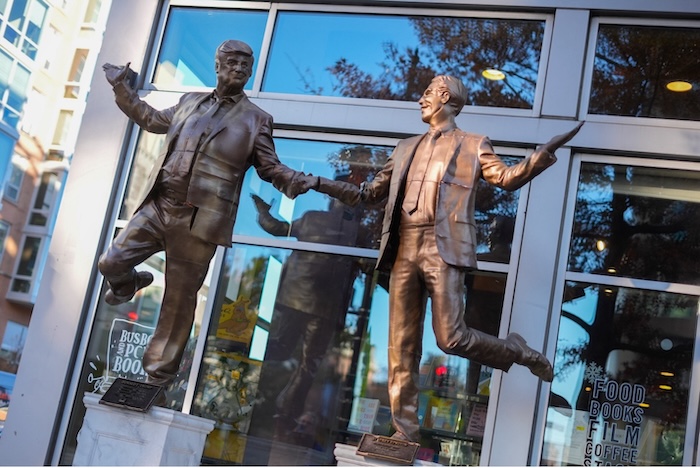
Protest art representing Donald Trump and Jeffrey Epstein outside a restaurant in Washington, DC, on Thursday. Pablo Martinez Monsivais/AP |
|
|
You're reading a free promotional version of Our Land, and we hope you enjoy David's exclusive writing and don't want to miss out on what's next. Sign up to start receiving a free 30-day trial of Our Land and enjoy all of the behind-the-scenes reports and interactive features with each issue.
|
|
|
Donald Trump is usually not that hard to figure out. What does he want? An insecure and pathological narcissist, he craves money, revenge, and worship. As he sees it, he is both the world’s greatest human and its greatest victim. But he is a liar and a cheat. When he gets caught for misdeeds, he issues indignant false denials and hurls false accusations. Any criticism of him is a hoax. Any investigation of him is a witch hunt. He will say whatever he needs to say at any given time to achieve the desired ends of the moment. For him, truth doesn’t exist. All that matters is how to gain an advantage and serve his own interests.
Russia intervenes in an election to help him win. He says the investigation is a Deep State plot. He’s accused of assorted grift. He says his opponents are “crooked” criminals who ought to be locked up. He loses the 2020 election. He says it was rigged. He’s indicted for falsifying business records, stealing sensitive government documents, and attempting to sabotage American democracy. He says it’s all a sham. And January 6 was a lovely day, and the violent marauders were patriots persecuted by overzealous prosecutors.
His narratives, though, make sense. They are outlandish, false, and untethered to reality. But they adhere to a Trumpian logic. We can see the reasons for his prevarications and utter bullshit. But when it comes to the Jeffrey Epstein case, Trump goes flying off the rails. His handling of this imbroglio is hard to follow and difficult to fathom. It is flummoxing. |
|
|
The Epstein scandal—as a paramount concern of the conspiratorial far right—traces back, as I recently explained, to the bonkers Pizzagate controversy, which erupted (thanks to a Russian hacking operation that targeted the Democrats) at the end of the 2016 campaign, and to the subsequent QAnon conspiracy movement that arose from the ashes of debunked Pizzagate nuttery. The central element of each of those lies was that a foul cabal of satanic globalists and pedophiles who engaged in sex trafficking were secretly controlling the world—and, as the QAnoners saw it—Trump was covertly battling this nefarious force and saving the universe.
It was nonsense. But for MAGA, the Epstein case became a concrete manifestation of this dark fantasy. He was a sex-trafficking pedo who associated with financiers and establishment institutions (Harvard! MIT! JPMorganChase!) and hobnobbed with the rich and powerful (Bill Clinton, Prince Andrew). He was the proof. MAGA cheerleaders and grifters—Kash Patel, Dan Bongino, Don Trump Jr., JD Vance—pointed to Epstein as Exhibit A of the profound corruption of the system. They claimed there was a cover-up, and demanded the release of information, asserting this would reveal and annihilate the vile power structure ruining America. (In late 2021, Vance tweeted, “What possible interest would the US government have in keeping Epstein’s clients secret? Oh…”)
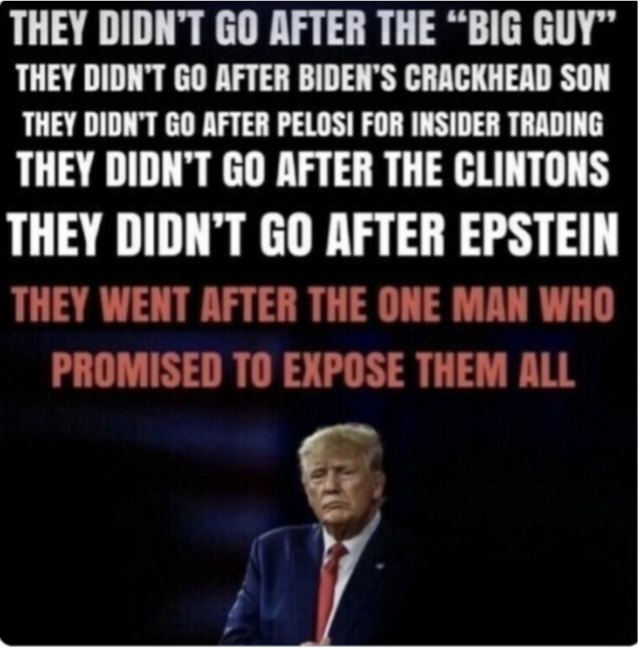
Trump saw the political value of aligning himself with the QAnon craziness. During the 2020 campaign, he retweeted posts with QAnon messaging. In subsequent years, he was more explicit. At rallies, he played music associated the QAnon movement, and he posted an image of himself wearing a Q lapel pin overlaid with the words “The Storm is Coming”—a QAnon slogan. And he repeatedly pushed conspiracy theories about Epstein. After Epstein died in prison in 2019—reportedly by suicide—Trump, then in the White House, shared a tweet suggesting Bill and Hillary Clinton were involved in his death. He demanded an investigation. During the 2024 campaign, he said he would “declassify” the government’s files on the Epstein case and would be inclined to release them. He wasn’t emphatic about this, but he signaled he was on the side of MAGAites who demanded such transparency. He also posted a meme suggesting Epstein warranted further investigation:
|
Trump knew Epstein. They had a years-long relationship. They socialized together. Trump flew on Epstein’s plane. He sent Epstein a lewd birthday greeting. Epstein recruited at least one of his victims from Mar-a-Lago. Presumably, Trump remembers what he did with Epstein and what he might have known of Epstein’s criminal conduct—and whether he witnessed or engaged in any untoward or illegal activity with or related to Epstein.
So why would Trump push for an investigation or the release of files that might implicate himself?
If Trump had anything to hide—even if only the fact that he had been aware of Epstein’s heinous misdeeds—that would be quite reckless. Politicians do act recklessly. Remember Gary Hart, when asked about rumors of his womanizing, told a reporter, “Follow me around…If anybody wants to put a tail on me, go ahead. They'll be very bored." (Well, they weren’t.) Perhaps when Trump echoed the calls for unleashing the Epstein files, his reptilian brain only focused on the gain of the moment—siding with MAGA masses who believed the Epstein case was something of a Rosetta Stone for exposing vast evildoing on the part of Democrats and liberal elites—and he did not expect any investigation or release of files to materialize.
But the question lingers: Why bang on the Epstein drum if he were guilty of something? I doubt this was a five-dimensional chess move designed to make it appear he had nothing to fear in the Epstein files or a preemptive deflection (it’s the Clintons!). Could it mean there wasn’t anything in the files for him to worry about, as hard as that might be for his critics to believe?
The case gets more puzzling once Trump is in the White House.
He installed at the FBI Patel as director and Bongino as deputy director—MAGA favorites who each had made releasing the Epstein files a priority. And his new attorney general, Pam Bondi, a Trump loyalist through and through, repeatedly said the Epstein material would be shared with the public. On Fox News, she even remarked that Epstein’s client list—a document that probably doesn’t exist— was “sitting on my desk right now to review. That's been a directive by President Trump.” A week later, she told Fox, “Nothing can be withheld” regarding the Epstein files. MAGA expectations were justifiably high. Trump apparently sent no signals to Bondi or others that they ought to tamp down talk of disclosing these 200,000-plus pages of records.
After releasing a dossier of 200 or so pages of Epstein material that was already public—and being lambasted by MAGA influencers for this—Bondi on March 14 said she had received a new "truckload of documents" and stated "we will get out as much as we can, as fast as we can, to the American people, because they deserve to know.” Nine days later, she said, “we are releasing all of these documents as soon as we can get them redacted to protect the victims.” It looked like the mother lode was coming. Trump obviously did not tell Bondi to cool it, and on April 22, he reinforced her message. Asked when the Epstein files would come out, he said “100% of all of these documents are being delivered.” With these remarks, Trump and his aides further excited the MAGA horde.
Again, why would Trump do that, if there was a chance these documents could pose a problem for him? Had he forgotten about interactions with Epstein that could be damaging? What was he thinking? In May, there were two major turns in the case.
First, Bondi informed Trump that his name appeared in the Epstein files and was associated with several unsubstantiated claims that the Justice Department supposedly found not to be credible. How surprising could this have been? Trump and Epstein had swum in the same waters, flown in the same skies. He had to know his name would be in some of these documents.
Second, Patel and Bongino started downplaying the Epstein matter. They maintained that Epstein had died by suicide—that is, his death was not the outcome of a sinister conspiracy (as they each had suggested prior to joining the second Trump administration). Then Bongino said there was nothing new in the Epstein files—which was heresy for MAGA. Still, the White House said the files would be released, with press secretary Karoline Leavitt stating the administration was “committed to releasing those files.” It was a time of mixed signals. Patel told podcaster Joe Rogan, “We’re gonna give you everything we can.” But he added, “We’re not gonna re-victimize women. We’re not going to put that shit back out there. It’s not happening, because then he wins. Not doing it. You want to hate me for it, fine.”
What was going on? The messaging on this critical matter for Trump and MAGA was erratic. Why the shifting? Trump’s lackeys couldn’t get their story straight.
Next came the bombshell—or lack thereof. The Justice Department in July issued an unsigned memo saying the suicide ruling was legit and no further Epstein files would be released. “We found no basis to revisit the disclosure of those materials,” the statement said.
A shitstorm ensued. MAGA influencers were outraged. Patel and Bongino feuded with Bondi. Trump deployed his old standby and started referring to the “Jeffrey Epstein hoax.” He lashed out at Republicans who continued to call for releasing the files. He claimed that the media reports of that birthday greeting he sent to Epstein was a “hoax.” Despite Trump’s protests, a handful of MAGAish House Republicans signed on to a discharge petition to force a vote on releasing the Justice Department files on Epstein. It was a MAGA circular firing squad. The Mad King had gone from supporting the release of the Epstein files to comparing this latest scandal to “Russia, Russia, Russia”—his favorite libel.
Trump has played this atrociously. By supporting the call for disclosing the files when he was a candidate, and then allowing top officials in his administration to state the material would soon be unveiled, he put himself into a corner: The files would have to be released. One logical assumption to draw from this vow of transparency was that he believed he would not be hurt by the disclosure.
But then he flipped, and everything he has done since has suggested he’s guilty. Of what? Who knows? But he acted as if suppressing this material was an imperative for him. And we know that the only imperatives for Trump are those connected to his own personal interests, such as self-preservation. Did he learn about material in the files that made it necessary for him to stop the disclosure and trigger a MAGA-on-MAGA conflict?
Last week’s release of 23,000 pages of Epstein material by the House Committee on Oversight and Government Reform, which had received these documents from his estate, did not help us solve the mystery.
There were emails in this batch that did not look good for Trump. But there was no smoking gun that proved he had engaged in illicit conduct. In a 2019 message to journalist Michael Wolff, Epstein wrote that Trump “knew about the girls,” yet it wasn’t clear what that phrase meant. And in a 2011 email from Epstein to Gislaine Maxwell, his associate and procurer, the financer observed, "i want you to realize that that dog that hasn't barked is trump… [Epstein victim Virginia Giuffre] spent hours at my house with him ,, he has never once been mentioned.” This note might be evidence that Trump knew what was going on with Epstein and underage girls and hadn’t yet said anything.
But to be fair, it should be noted that in her recent memoir, Giuffre, who had worked at Mar-a-Lago before becoming an Epstein victim, said of Trump that he “couldn't have been friendlier" and alleged no wrongdoing on his part. So what was Epstein suggesting here?
This cache of documents did not contain anything fatal for Trump. Though he’s mentioned quite often, his loyalists can reasonably point to this trove and say there’s no concrete evidence of any Trump improbity. Which makes me wonder why Trump in the past few months has acted so much like a guilty man.
His hysterical response to this release—which came from House Republicans!—suggests he’s frightened. He has resorted to his usual tactics when in trouble. He blasted his critics, this time including Rep. Marjorie Taylor Greene (R-Ga.), the MAGA firebrand who signed that discharge petition and who has slammed Trump for not releasing the Epstein files (and for not addressing pressing domestic issues, such as rising costs and a hike in insurance premiums). And he instructed Bondi to launch Epstein-related investigations of Democrats, including Bill Clinton, former Harvard president Larry Summers, billionaire philanthropist Reid Hoffman, and others. Bondi saluted and assigned a US attorney to the task.
It’s a classic instance of Trump deflection. There’s been the obvious speculation that he wants the DOJ to generate an inquiry that will allow it to say that it cannot release any files because there’s now an open investigation. (There are no indications any of these men engaged in any criminal behavior with Epstein. Trump is conjuring up a phony investigation.) Meanwhile, the House today is likely to pass the measure to release the Justice Department files on Epstein, and then the action (or non-action) will shift to the Senate.
This weekend, Trump changed course again. Once it was clear the Epstein bill would be approved in the House, he called on Republicans to vote for it. “[W]e have nothing to hide,” he declared on social media, “and it’s time to move on from this Democratic Hoax perpetuated by Radical Left Lunatics.” About Epstein, he exclaimed, “I DON’T CARE.” Yet he reiterated the Justice Department was “looking at” Bill Clinton’s, Summers’, and Hoffman’s contacts with Epstein.
Trump still seems desperate and running scared. Why did he do so much to elevate the Epstein issue and make the release of the files a priority for his administration only to backtrack—before backtracking again? Was it merely a boneheaded miscalculation? Or did he not understand that his contacts with Epstein—even if they did not include anything illegal—could be a political minefield? Was he oblivious to what he had done or had known when he and Epstein were buds? Did he assume that he could push his way through any Epstein mess, as he did with the grab-’em-by-the-pussy scandal?
|
|
|
We don’t know whether the government’s Epstein files hold dynamite that could blow up Trump’s presidency. So far, no credible accusations against Trump have emerged in the civil lawsuits targeting Epstein’s horrific actions. Government prosecutors in both the first Trump administration and the Biden administration did not file charges against anyone else, besides Maxwell, in the Epstein investigation. It’s quite possible that Patel and Bongino are right: There’s no evidence in these files on which to charge anyone else with a crime. Maybe there’s nothing that credibly implicates Trump.
But that brings us back to this: Trump has behaved exactly as he has behaved previously when faced with well-founded charges of wrongdoing. He’s done almost everything possible to convince us he’s hiding something. There’s that old saying: The cover-up is worse than the crime. That’s not always true. His actions raise this question: Is it possible to have a cover-up without a crime (or some transgression)? After all, why throw up a smokescreen if there’s no fire?
Got anything to say about this item—or anything else? Email me at ourland.corn@gmail.com. |
Coming Soon: An Our Land Zoom Get-Together on November 25 |
Here’s just what you need before the official start of the holiday season: an Our Land Zoom shindig on November 25 at 8 p.m. ET. Come join us to talk about all the craziness of late and prepare for Thanksgiving dinner with that relative you don’t want to talk politics with.
These sessions, as most of you know, are only open to premium subscribers, those wonderful people who pay a few bucks a month to get the full version of this newsletter, which includes an assortment of extra features: additional behind-the-scenes reports, Dumbass Comment of the Week, Inspiration of the Week, the interactive Mailbag (you send in questions, I reply); MoxieCam™, and reviews of movies, books, music, television shows, podcasts, and other cultural fare.
Premium subscriptions keep this enterprise afloat. Without the financial support of these Our Land readers, we couldn’t keep the printing press going. So even if you don’t want all that additional content, please consider subscribing so we can continue to deliver kick-ass reporting and analysis. (Remind me to tell you later how the suits at Our Land International Headquarters are pushing to put more of this newsletter behind a paywall to encourage more people to subscribe.) You can sign up here. Please consider doing so.
Regarding the Zoom get-together, here are the deets: The day of the event, premium subscribers will receive a Zoom invitation email. Just click on that at the right time, and our bouncers—who used to be on the US Olympics shotput team—will let you in. See you soon. |
|
|
The Watch, Read, and Listen List |
The Lowdown. This FX drama contains hints of some of the best mystery and crime writers, such as Tony Hillerman, James Lee Burke, and Walter Mosley. Actually, it has much more than a hint of Mosely. He was a consultant on this project and scripted one of its eight episodes. Created by Sterlin Harjo, the force behind FX’s much-acclaimed dramedy Reservation Dogs, The Lowdown is also something of a tribute to Jim Thompson, the master of hardboiled crime novels (The Killer Inside Me, The Grifters, The Getaway, and so many more). Thompson once provided one of the most useful tips for a writer: “There are 32 ways to write a story, and I’ve used every one, but there is only one plot—things are not as they seem.” A character in the show quotes this line, as he buys a biography of Thompson. Harjo clearly tried to take Thompson’s adage to heart in developing The Lowdown, and he largely succeeded.
The Lowdown’s hero is Lee Raybon, the owner of a used bookstore in Tulsa and an itinerant investigative journalist of a bohemian bent, who calls himself a “truthstorian.” He struggles to make a buck, to be a dad to his adolescent daughter, and to take on the elite of Tulsa and Oklahoma. He’s a well-known character in town and a pain-in-the-ass to just about everyone. Raybon is very loosely based on Lee Roy Chapman, who was a citizen journalist in Tulsa who helped uncover and publicize the hidden history of racism in the city, including the role of the city’s founder in the Tulsa Race Massacre.
The fictitious Raybon, played admirably by Ethan Hawke, is a fanatic who has zeroed in on the Washberg clan, a powerful Oklahoma family whose head, Donald Washberg (Kyle MacLachlan) is running for governor. No surprise, the Washbergs have a dark history tracing back to swindling Native Americans, and when Donald’s brother, Dale, is found dead in his home (an apparent suicide, but perhaps not), Raybon sets out on a hunt for the answers. His pursuit will take him to the fancy quarters of Tulsa’s high-and-mighty to the community of Tulsa’s indigenous people to a church of AK-47-toting Christian nationalists and white supremacists and to, naturally, a few dive bars. Nothing is as it seems—except for the passion of our eccentric protagonist, whose undying commitment to rooting out the rot puts him on a path of murders, femme fatales, and the nefarious machinations of politicians and plutocrats. It’s a heaping portion of Western noir of which Thompson, were he still with us, would appreciate.
|
|
|
Bucky, Oswald Slain. It can be tough to find new music to enjoy, especially as you age. After decades of absorbing artists and songs, I barely have time to listen to all the tunes I already like. So it’s rather easy to comfortably drift in a familiar sea. Occasionally, a pal will suggest a song or a band I don’t know. Once in a while, I’ll catch something exciting on an independent college-ish radio station. But there’s another avenue these days: an algorithm. If you listen to a track on Spotify, after it’s done the streamer will serve up another number. Usually, it’s not a surprise. A Talking Heads song might yield an Elvis Costello track. That’s fine by me, but it doesn’t expand my musical universe.
Yet the other day, after Spotify played a song I had requested, the algorithm delivered a track that I couldn’t identify and that stopped me dead. The sound was a luscious rock mix of guitars and organ that held traces of Badfinger, Oasis, the Verve, and Thunderclap Newman (“Something in the Air”). I glanced at my iPad. The song was “Terrible Neighbour” by a band called Oswald Slain.
Never heard of them. I darted to Google and discovered this was a group based in Bristol, England, formerly known as Little Thief. Last month, after ditching their old name and their old sound, they released an album called Bucky that includes this track. I checked out the rest of the disc and found a bunch of hot numbers, including “Happiness Is Overrated.” Alas, Oswald Slain so far has had a limited reach, clocking only a few thousand listens for these tunes on Spotify and far less on YouTube. It was as if I had walked into a half-empty bar and found a fantastic band rocking out with not enough people paying attention.
So props to the Spotify algorithm for injecting into my feed a local band from Bristol that grabbed me by the ears. I wish these guys and gals well. I have no idea what’s with the name. |
|
|
Congratulations, you read all the way to the end! It's a great time to say "I'm in" and start your free 30-day trial. Make sure you don't miss out on what's next: Sign up to start getting Our Land in your inbox each week. We also want to hear from readers (especially those who read the whole thing!). So let us know what you think so far or share something interesting with David at ourland.corn@gmail.com.
|
|
|
|