FREE TRIAL VERSION. DON'T MISS OUT. |
FREE TRIAL VERSION. DON'T MISS OUT. |
|
|
Donald Trump and A House of Dynamite |
By David Corn November 4, 2025 |
|
|
You're reading a free promotional version of Our Land, and we hope you enjoy David's exclusive writing and don't want to miss out on what's next. Sign up to start receiving a free 30-day trial of Our Land and enjoy all of the behind-the-scenes reports and interactive features with each issue.
|
|
|
On Thursday, President Donald Trump posted on social media, “Because of other countries testing programs, I have instructed the Department of War to start testing our Nuclear Weapons on an equal basis. That process will begin immediately.” It was as if he had watched A House of Dynamite, the new Netflix movie about nuclear warfare, and had absorbed the exact opposite lesson of the film. Trump also came across as, yet again, dangerously uninformed on the all-important subject of nuclear policy, given that the Department of Energy (not the Department of Defense) tests nuclear weapons and that the other major nuclear powers have not resumed testing, which the United States, Russia, and China each suspended in the 1990s.
On Sunday, Energy Secretary Chris Wright clarified Trump’s statement and said that the nuclear weapons testing Trump had ordered will not involve nuclear explosions “at this time.” Instead, Wright noted, these will be “system tests” with “non-critical explosions.” Tests that presumably already occur.
It was indeed unnerving that Trump may have launched a nuclear testing arms race unintentionally with a single, error-ridden social media post. This episode only makes A House of Dynamite more chilling than it already is. The film, directed by the Oscar-winning Kathryn Bigelow (Hurt Locker and Zero Dark Thirty), opens with the US military picking up signals that a single nuclear missile has been launched by an unidentified party somewhere in the Pacific and it’s heading toward the United States. If anti-missile interceptors based in Alaska fail to blow it out of the sky, the president and his national security team will have 18 or so minutes before it strikes an American city to figure out how to respond.
|
|
|
Is this an accidental launch or the prelude to a full-scale nuclear onslaught? Who’s behind this? North Korea, Russia, China? Can the situation be assessed with confidence within a few minutes? To prevent other possible attacks on the United States, should the president immediately order a nuclear assault on America’s presumed adversaries—a move that could trigger an all-out nuclear conflagration that destroys much of the world? Or should he take the hit—and accept millions of deaths—and see what comes afterward? Tick, tick, tick.
Bigelow’s hyper-realistic film, which proceeds in real time from different perspectives, does an excellent job of depicting the most important snap judgment a human might ever have to make. The movie has admirably sparked conversation and debate. The Pentagon has challenged the notion that its missile defense system would fail to intercept an incoming nuclear missile. In the movie, the president is informed that ground-based interceptors have only a 61 percent success rate—and the defense secretary exclaims, “So, it’s a fucking coin toss?! That’s what $50 billion buys us?” Our Defense Department claims a 100 percent rate, but this has only been achieved with a small number of tests in controlled environments—that is, not the real world. And that stat merely covers a couple of recent tests. As nonproliferation expert Joe Cirincione writes, “At best, in highly scripted tests, the interceptors have only hit their targets in half the tests (11 out of 20 attempts).”
There have been other criticisms of the film. The drama is propelled by the apparent need for the president to make a decision before this single missile hits the United States. But given that the perp is not known, it’s likely the commander in chief would be advised to wait on a counterstrike to determine whom and what to blast. And some experts have questioned the reality of a bolt-from-the-blue surprise attack of one missile. More likely, a nuclear attack would arise from an escalation of an ongoing conflict. And a surprise attack would probably be far more extensive, in the hope of blunting the US military’s ability to hit back. “No one in their right mind is going to fire one missile at a major US city out of a clear blue sky,” Matthew Bunn, a nuclear strategy expert at the Harvard Kennedy School, told NPR.
Perhaps. The point of the film is that we don’t know. We don’t know what might happen. We don’t know how the people in charge would handle such a crisis. We only know that we have collectively as a species created a system in which a small group of people have the power to destroy literally everything, that we live 24/7 under this threat of immediate and total annihilation, and that we trust them to make decisions that could determine the fate of human civilization and the entire planet. If that doesn’t scare the bejesus out of you, what will? And why do we accept this?
The mastery of Bigelow’s film, which was written by former journalist Noah Oppenhiem, is that it makes this abstract concept—folks we largely don’t know being responsible for the most consequential decision possible—all too real.
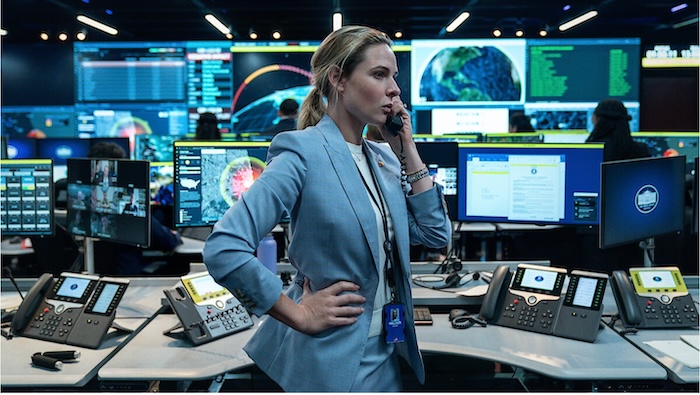
In A House of Dynamite, we meet the grunts, the military commanders, the sit room managers, the Presidential Emergency Operations Center staffers, the nuclear football guy, presidential advisers, and the president, who each must somehow contend with this crisis in less than half an hour. The national security adviser is in surgery, so his young deputy, whom the president barely knows, sits in for him, and at one point the green-behind-his-ears deputy, hoping to keep the world from blowing up, must confer with the Russian deputy foreign minister. The defense secretary, still bereft over the death of his wife, is rightfully concerned that his daughter is in the target city. This may be too much for him to handle. The worker bees in the Situation Room and the PEOC, as they perform their jobs and obtain information and provide it to the president and his advisers, are trying to contact their loved ones—and they’re not all that delighted to see some of their colleagues being evacuated, while they’re not. The president is shooting hoops with a girls basketball team when he gets the news. His Zoom connection to central command is hinky and only allows for audio.
Shit is happening while shit is happening. The film makes you wonder about the people we have in these positions and whether they possess the fortitude, intelligence, and judgment to handle the ultimate workplace stress and arrive at the best decision and not fry the whole planet.
Which brings us back to Trump. This is a man guided by ego, grievance, and an unslackable thirst for revenge and self-glory. He’s impulsive. He believes (wrongly) his big brain is better than any other brain. And in his second stint as president, he has made appointments to the most senior government posts based on loyalty (to him), not experience or smarts. You do not want the continued existence of humanity dependent on him. Or Defense Secretary Pete Hegseth. Or Director of National Intelligence Tulsi Gabbard. Or…
Like you, I hope that should Trump face such a crisis, he would realize his own limitations and seek and consider the advice of smarter people, presuming there are some in his vicinity. But there’s another reason to worry about Trump in command in such a moment: his fatalism.
In the years before he first became president, Trump, in assorted interviews, suggested he believed nuclear war was inevitable. During a 1990 interview with Playboy, Trump remarked, “I often think of nuclear war.” He added, “It’s like thinking the Titanic can’t sink. Too many countries have nuclear weapons; nobody knows where they’re all pointed, what button it takes to launch them.” Five years later, he expressed a similar sentiment; “You have people that are sick and they are now having nuclear arsenals, and I think it’s one of the greatest problems of the world…So it’s always tough to say—I mean I like to project for the future but really live very much for the present.”
In a 2004 interview—again with Playboy—Trump once more expressed a degree of fatalism. Interviewer David Hochman asked him, “Do you think Trump Tower and your other buildings will bear your name a hundred years from now?” Trump’s reply was chilling:
No, I don’t think so…I don’t think any building will be here—and unless we have some very smart people ruling it, the world will not be the same place in a hundred years. The weapons are too powerful, too strong. Access to the weapons is getting too easy, so I think the landscape we’re looking at will not be the same unless we get smart people in office quickly.
Hochman responded, “That’s frightening.” And Trump said, “You don’t agree?” Hochman remarked, “It’s just surprising coming from you. Your whole world is bricks and mortar.” Trump went on:
I had an uncle who was a great professor and a brilliant man—Dr. John Trump, a professor at the Massachusetts Institute of Technology. His whole life was devoted to the study and eradication of cancer, and sadly, he died of cancer. But he was a brilliant scientist, and he would tell me weapons are getting so powerful today that humanity is in tremendous trouble. This was 25 years ago, but he was right. The world is rocky, and some terrible things are going to happen. That’s why I lead the life I do. I enjoy it. I know life is fragile, and if the world looks like this a hundred years from now, we’ll either be very lucky or have found unbelievably good leaders somewhere down the line.
Trump did note there was hope—but only if smart leaders emerged. As the world knows, Trump does think of himself as a highly intelligent person. But he has repeatedly demonstrated he can be an ignoramus on this subject. During the 2016 campaign, MSNBC’s Joe Scarborough reported that Trump had thrice asked a national security adviser why a president couldn’t use nuclear weapons.
|
|
|
In a 2017 private meeting with his top national security officials, Trump said he wanted a nearly tenfold increase in the US nuclear arsenal. He made this remark after being shown a chart that illustrated a steady decrease in the number of US nuclear weapons over the previous 50 years. Trump responded by telling his most senior advisers, which included Secretary of State Rex Tillerson and the Joint Chiefs of Staff, that he wanted the bigger number shown at the start of the downward slope, not the smaller amount at the end. Officials had to explain to Trump that the current level was lower due to years of successful arms treaties and that the nation’s overall military posture was now much stronger than in the days of a larger and bloated nuclear arsenal. At the end of this meeting, Tillerson was overheard referring to Trump as a “moron.”
Can a man who has said he views nuclear war as almost unavoidable but who couldn’t be bothered to learn the fundamentals of nuclear policy be the “good leader” who can steer humanity past the greatest of all threats? Trump’s proposed renewal of nuclear testing—without knowing the recent history of nuclear testing—and his past string of comments about the possibility of using nuclear weapons are not reassuring. His previous remarks suggesting he believes nuclear war is all but inescapable are the stuff of nightmares. A House of Dynamite is damn frightening—and it’s even more so when you add Trump to the cast.
|
|
|
The Watch, Read, and Listen List |
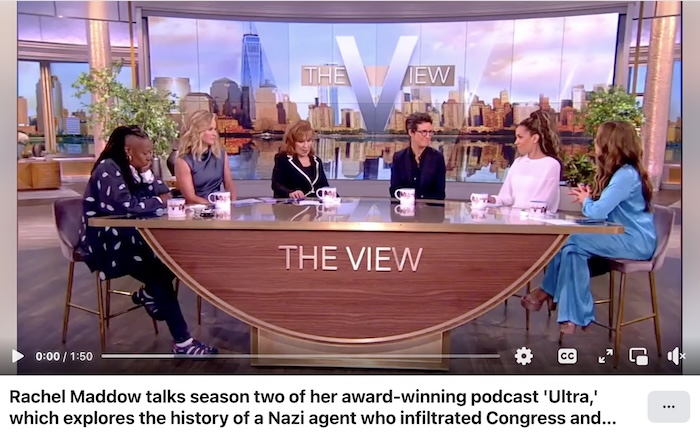
Rachel Madow Presents: Ultra, Season 2. In 2022, Rachel Maddow released her Ultra podcast, which told the harrowing story of how Nazi agents infiltrated US politics in the 1930s and 1940s and how they spread Nazi propaganda through their allies on the right, including members of Congress. She showed that elected US officials readily made common cause with extremists, antisemites, would-be insurrectionists, and Nazis to pursue political power in the years before World War II—and that conservatives later connived to undermine efforts to bring Nazi collaborators to justice. Last year, she put out season 2—which I only listened to recently—and this follow-up tale is even more shocking and relevant for today.
The story largely focuses on Sen. Joseph McCarthy, the infamous and scurrilous redbaiter. You may think you’re familiar with his misdeeds. I thought I was. But this season starts with a foul act of which I was unaware. As a Republican senator from Wisconsin, McCarthy was the chief proponent of a brazenly false conspiracy theory that claimed US military investigators—many of whom were Jewish—tortured Nazi soldiers, who were accused of murdering US prisoners of war in 1944 in what was called the Malmedy massacre, in order to extract confessions. This untrue narrative was being pushed by unrepentant Nazis in post-war Germany hoping to revive Hitler’s movement and by their fascist comrades in the United States. They concocted phony evidence, including fictitious testimony from the German soldiers, forwarded the material to McCarthy, and he spewed it forth in the US Senate. Why would he do this? To garner the support of far-right radicals, which included neo-Nazis and antisemites.
Season 2 tracks other tight connections between Nazis and the American far-right in the years after World War II, and it follows McCarthy’s rise as an anti-communist crusader. His mendacity and maliciousness have been well chronicled previously. But Maddow focuses on an episode largely lost to history: McCarthy and other Republican senators blackmailed a Democratic senator opposed to McCarthy and caused that senator’s suicide. It’s a grim and gruesome story.
Throughout season 2, Maddow examines how McCarthy’s demagogic ways—his hurling of false charges, his accusations that a cabal within the US government was trying to destroy the nation, his exploitation and encouragement of paranoia, his assaults on established institutions, and his claims that he was a target of nefarious forces aiming to crush him—fueled his political power, frightened and intimidated his foes and critics, and won him the adoration of millions of supporters and fanatic followers. Maddow is fond of citing the aphorism “history does not repeat itself, but it rhymes” (as I am). And she does not have to spell out the corollaries between McCarthy and the demagogue who currently imperils American democracy. (The two men have something of a personal bond in that Roy Cohn, the malevolent and vicious attorney, years apart advised each one.)
Highlighting such rhymes is a valuable task. Recently, Laura Loomer, the MAGA activist, conspiracist, and self-proclaimed Islamophobe who advises Trump on what government officials are not fully loyal to him and, thus, ought to be dismissed, quipped, “Joseph McCarthy was right. We need to make McCarthy great again.” Ultra not only reminds us of the well-known transgressions of McCarthy; it shows how far he went in villainy and in scheming with extremists and literal Nazis. Most important, Maddow covers how McCarthy succeeded in forging a cultlike coalition that included neo-Nazis, out-in-the-open antisemites, religious right leaders, traditional Republicans, assorted extremists, and conservative intellectuals, including a young William F. Buckley Jr.—some of whom advocated violence to gain power. He merged the fringe with slices of the GOP mainstream, creating a potent political movement that might have carried him to the White House, had he not drunk himself to death. Ultra is a warning of how far a right-wing despot can go, if he’s a liar, scoundrel, and a skilled practitioner of the politics of hate and paranoia.
|
|
|
“Black Dog,” Beth Hart. I’ve never been a Led Zeppelin fan. I’m not embarrassed to say the band’s hard-rock bombast did not entice me. (Yes, I know how to play “Stairway to Heaven” on the guitar. Who doesn’t?) But my socks were blown off when I saw Beth Hart’s version of the group’s “Black Dog.” She’s a powerful rock/blues singer with tremendous pipes who fittingly once starred in an off-Broadway musical about Janis Joplin. Hart, who’s collected numerous Blues Music Awards nominations and wins over the past 13 years, put out a collection of Led Zeppelin covers in 2022 that was highly respectful of the originals. Zeppelin lovers will get a kick out of it, but anything she sings is worth a listen.
|
|
|
Congratulations, you read all the way to the end! It's a great time to say "I'm in" and start your free 30-day trial. Make sure you don't miss out on what's next: Sign up to start getting Our Land in your inbox each week. We also want to hear from readers (especially those who read the whole thing!). So let us know what you think so far or share something interesting with David at ourland.corn@gmail.com.
|
|
|
|