FREE TRIAL VERSION. DON'T MISS OUT. |
FREE TRIAL VERSION. DON'T MISS OUT. |
|
|
What’s Next for Israel and Palestine? |
By David Corn November 1, 2025 |
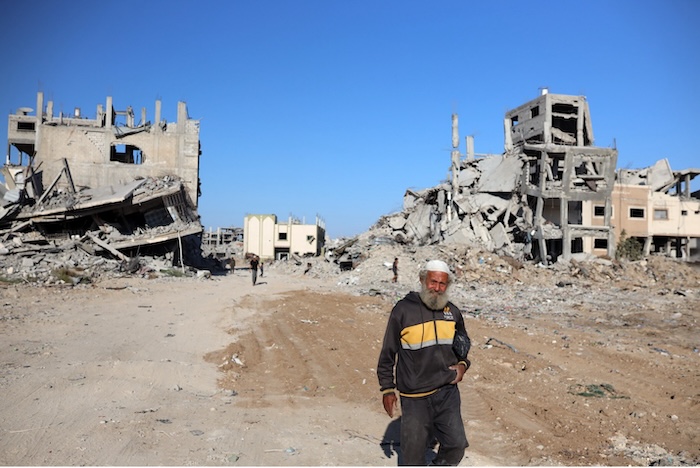
A Palestinian man walks past the rubble of destroyed buildings in the Al-Tuffah neighborhood near Gaza City on Tuesday. Photo by Majdi Fathi/NurPhoto via AP |
|
|
You're reading a free promotional version of Our Land, and we hope you enjoy David's exclusive writing and don't want to miss out on what's next. Sign up to start receiving a free 30-day trial of Our Land and enjoy all of the behind-the-scenes reports and interactive features with each issue.
|
|
|
Micah Sifry has been pondering the Palestinian-Israeli conflict for more than four decades. As a college student he spent time in kibbutzim in Israel and subsequently wrote his senior thesis at Princeton on Israel’s Peace Now movement. Afterward, in the 1980s and 1990s, as an editor at the Nation, he wrote extensively about the never-ending crisis. As a journalist, he eventually drifted toward other subjects, most notably democracy, technology, and independent politics. But he has returned to the tough topic of the Middle East with a new book, When Doves Try: Israel’s Peace Now Movement 1978-1983, which chronicles the rise and the successes of the movement that influenced Israeli politics and helped pave the way for progress in that seemingly intractable conflict. Sifry was kind enough to speak with me this week about what that history might mean for the current moment.
As we're talking, the ceasefire between Hamas and Israel is not solid. Israel has launched attacks in Gaza, killing scores of people, claiming Hamas is not abiding by the agreement. But let’s start with the larger matter, after the Hamas attack of October 7 and the Gaza war, is it now even possible to think about a resolution of the basic conflict that ends up with two states or another alternative to war and occupation?
It's definitely unlikely that we will see such a resolution soon. But if we give up all hope, the alternative is worse. There's a glimmer of possibility in the fact that the hot war appears to be over at the moment. For several reasons, President Donald Trump is restraining Prime Minister Benjamin Netanyahu, who would like nothing more than to just keep the war going for his own political survival. But look at the response of the vast majority of Israelis and of the vast majority of Palestinians to the emergence of this deal: They were all celebrating. They're absolutely not in the same place. Palestinians have suffered disproportionately more. But there's fatigue on all sides and a desire to somehow get out of this quagmire through creative diplomacy or corrupt diplomacy, whatever you want to describe what's going on now. Can that maybe lower the temperature enough that we can begin to see an alternative future emerge? We desperately need that. Without it, it's a war of annihilation.
|
|
|
Israelis and Palestinians have each come to see the other side as dedicated to their complete erasure, and as long as both sides see each other that way, the prospects for peace are nil. But you could have said that about Northern Ireland for hundreds of years, right? What we have to recognize is that we now have an opening, and it's what we do in this moment that can maybe strengthen that opening. But for the most part, I'm not holding my breath.
The amount of bitterness and hatred fueled by the Gaza war and the October 7 attack seems so deep and profound. At the same time, as you point out, there is a fatigue with war, with people on both sides happy this round of violence seems to have been paused. But there’s a tension between exhaustion and intensified hatred, right? I know from talking to people who have been to Israel recently that many Israelis, including left-of-center folks, while exhausted and fiercely opposed to Netanyahu, no longer have any sense of hope that this conflict can be resolved.
One of the reasons I decided to write this book was to try was to go back in history to a time when people thought there was no hope of ever ending the state of war between Israel and its Arab neighbors. In 1967, Israel won a lightning-fast victory over Egypt, Jordan, and Syria in the Six Days War. Suddenly it was occupying much more land than before. This set off euphoria in Israel, including much religious Messianism. But just six years later, Egypt and Syria attacked Israel by surprise on Yom Kippur, the holiest day of the Jewish calendar, and for several days, the Israelis thought they were going to be wiped out.
Yet out of that moment, just a few years later, the Egyptian president, who had commanded that attack, Anwar Sadat, says, “I'm ready to make peace with Israel. I'll even come to Jerusalem.” The Israelis say, “Sure, come.” He gives a speech at the Knesset and basically says to the Israelis, “I’ll trade land for peace, and you also have to treat the Palestinians fairly.” And public opinion in Israel suddenly dramatically changes.
This is when this peace movement, Peace Now, is birthed because Israel's right-wing Prime Minister Menachem Begin, who is a precursor to Netanyahu, hems and haws. He doesn't want to give up land Israel seized, including in the Sinai Peninsula. People forget that Israel had settlements in the Sinai, not just on the West Bank and in Gaza. It was the Peace Now movement—which was started by reserve officers who had done their military service, many of whom had been awarded medals and couldn’t be impeached as lefty and disloyal—that galvanized the public. It was the first time Israel had seen a mass movement like this.
That put a lot of pressure on Begin, and ultimately the movement is given credit for him deciding to compromise and ultimately sign a peace treaty with Egypt in 1979, which has lasted almost 50 years. The point is that brave leaders can change the course of history if they take risks. The other point is that public opinion is fluid. We're trapped in a bad cycle right now. I agree with you, but that does not mean that the future has already been written.
Your book is on the Peace Now movement. It rose, as you note, during the pre-Camp David days. This was a force that pushed Begin toward signing a peace deal and remained potent in Israeli politics afterward. But then the movement withered. Why did that happen?
The high point of its influence, after helping midwife the Egypt-Israel peace treaty, came a few years later in 1982, when Begin with Ariel Sharon, the defense minister, invaded Lebanon. They were trying to wipe out the Palestinian Liberation Organization. They failed, and there was a huge, horrible massacre of Palestinian civilians that the Israeli army oversaw and was carried out by Christian militias in Beirut. Peace Now organized a demonstration, which was attended by 400,000 Israelis, which was roughly 10 percent of the country's population—an amazing turnout. That ultimately led to Sharon being forced out of office in disgrace, and Begin ultimately decided to quietly leave public life.
What happened after that is the challenge that any peace movement has: How do you sustain yourself? David, I first got to know you when you were covering the anti-nuclear movement—the nuclear freeze—in the early 1980s, when it hit a high point and probably changed President Ronald Reagan’s approach from thinking a nuclear war could be won to seeking arms control treaties with the Soviets. But peace movements come and go. This is normal.
Peace Now had a difficult time after the Oslo Accords of the mid-1990s, under which Israel agreed to recognize the PLO as the legitimate representative of the Palestinian people, and the PLO agreed to recognize Israel and its right to exist. They also agreed that the Palestinians would gain control over some of the largest population centers in the West Bank as a first step and that there would be a five-year process of working out the details of how Israel would disengage from occupied territories and transfer power to a Palestinian entity. They kept it unclear whether it would be a state or not.
During those years, not enough trust developed between PLO head Yasir Arafat and Israeli Prime Minister Yitzhak Rabin, though their security forces did cooperate in trying to tamp down the extremists on both sides. A big flaw was that Israel never stopped building settlements in the occupied territories. The Palestinians saw that as bad faith. Radical fringe groups, such as Hamas, decided that it was in their interest to blow up Oslo. So they started blowing up Israeli civilians with suicide bombings. And then a right-wing Jewish fanatic assassinated Rabin. That’s probably the most successful political assassination in modern times, because it really did end whatever possibility there was for that process to continue to bear fruit.
Connect that, then, to the decline of Peace Now.
The role of Peace Now has always been to try to galvanize the side in Israel that hates the Israeli occupation of Palestinian territory and wants to find a way to peaceful coexistence with Palestinians. For that to work, this portion of the Israeli population needs a Palestinian partner who enough Israelis view as a reasonable partner they can trust. When the suicide bombings started, the peace movement in Israel began to disappear. This culminated in the early 2000s with the Second Intifada, which was two years of intense violence from both sides. Israel went back on its commitments to let the Palestinian Authority govern the parts of the West Bank it was already in charge of. It even surrounded Arafat in his own headquarters in Ramallah.
How does that relate to today?
What I would say to the current generation of Israel critics, and I know there are many, is you ought not treat Israel as a complete monolith, as if it’s only the Netanyahu government and its right-wing allies. You need to understand that it's still a place where politics takes place internally and where, even though this group has been drastically diminished, 10 to 15 of the Israeli Jewish population, not to mention the Arab population, support coexistence and want either a two-state solution, a federated sharing of the territory, or some other resolution. You need to be asking yourself, what are you doing to make those people stronger, not weaker?
In the epilogue of the book, you present a critique of the pro-Palestinian movement here in the United States and discuss what's the best way for them to achieve the goal of a stable, secure Palestinian state in a land where there will still be 7 million Israelis. We’re familiar with the campus protests. What should this movement be doing?
There’s no question that the pro-Palestinian movement is driven by good intentions, which have to do with rectifying the historic injustice that the Palestinian people have suffered and continue to suffer. And the United States, as Israel's longtime sponsor and ally—and at this point, probably its only significant ally on the world stage—has not been an honest broker in attempting to bring both sides to a resolution where they could each have peace and security in the land between the river and the sea.
My criticism of some of the solidarity work on behalf of Palestinians is the lack of recognition that there are actually 14 million people who live between the Jordan River and the Mediterranean Sea, 7 million Palestinians and 7 million Israelis, and none of them are going anywhere. There needs to be a pragmatism here about what will get you from the horrible situation that we're in now to one in which you're not reinforcing the hardliners on the Israeli side. We’ve been caught in a bad dynamic for decades. Netanyahu and Yahya Sinwar, the Hamas leader who was killed in a clash with Israeli forces last year, reinforced each other. Why should any Israeli think about allowing a Palestinian state next door, if it could be the launching pad for another October 7 attack on civilians? We've heard little about that in the pro-Palestinian discourse.
What's next?
I jokingly say I'm a silver-lining guy. I'm always looking for some reason to be hopeful, because, God knows, we have enough reasons to be gloomy. If you think the future can only be worse, for many people that's demobilizing. The wild card here is that there’s going to be elections in Israel, and, hopefully, elections in Palestine. Netanyahu’s five-year term will end next year, if the government coalition doesn't collapse before that. So there will be elections soon. And the head of the Palestinian Authority has said that long-delayed Palestinian elections—they haven't had elections in a dozen or so years—will be held for the presidency and their legislature. There will be a shake-up of the existing deck in terms of who's holding what cards. Things could get interesting.
Last week, I wrote about how the Israelis have unfortunately refused to release a prominent, long-term Palestinian prisoner named Marwan Barghouti. Even the Americans—Jared Kushner, Steve Witkoff—have told the Israelis they should include him on the list of the prisoners to be released per Hamas’ request. The reason is that he has the potential to be the Palestinian Nelson Mandela. He's broadly popular across all factions inside Palestinian society. He has blood on his hands, yes, which makes him problematic for Israelis. But since he's been in prison, he's made clear that he supports a two-state solution and that he no longer endorses an armed-struggle approach to resolving this conflict. Getting him out so he can then do politics, instead of what we've had, could be big and lead to change.
|
|
|
A change in the dynamics? What are the odds of that happening?
Not particularly high. But again, who would have told you that there could be a resolution in Northern Ireland? Who would have told you there could be a resolution in South Africa that would end apartheid? Things can change. My silver lining for the next year is to think about whether there are ways to strengthen those factions in both societies that see each other as ready for change. There's a movement of Israeli and Palestinian families, people who have lost their own children or other members of their families to terrorism, who have come together to say, “We don't want anyone else to experience the pain we've experienced.” So there has to be reconciliation. There has to be an embrace of the other. That's what we must work towards. We have no choice but to try.
Got anything to say about this item—or anything else? Email me at ourland.corn@gmail.com. |
|
|
Dumbass Comment of the Week |
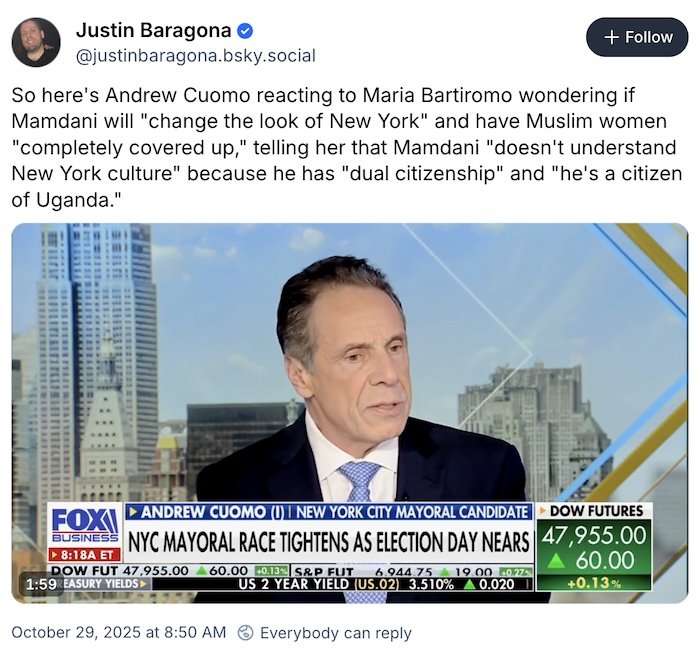
Last week, New York City Mayor Eric Adams and independent mayoral candidate Andrew Cuomo shared first place for each spewing Islamophobic swill about Assemblyman Zohran Mamdani, the leader in the mayoral race. Cuomo was back in contention again this week with more of the same. He appeared on Maria Bartiromo’s show on Fox Business, as the host said she feared Mamdani would make NYC “look more like London,” which she claimed is now “largely Muslim.” Cuomo played along, saying Mamdani “is out of sync with how New Yorkers feel…I just think that he doesn’t get it…He’s dual citizenship…His parents own a mansion in Uganda…He just doesn’t understand the New York culture, the New York values, what 9/11 meant, what entrepreneurial growth means, opportunity means, why people came here.”
|
Mamdani is the son of immigrants who emigrated to the United States when he was seven, and Cuomo is suggesting he doesn’t understand why people come to New York? By the way, a 2023 report put out by the NYC government noted that 3.1 million immigrants live there, and that was 38 percent of the city’s population. At the end of this campaign, the disgraced former governor seems committed to tarnishing his reputation even further.
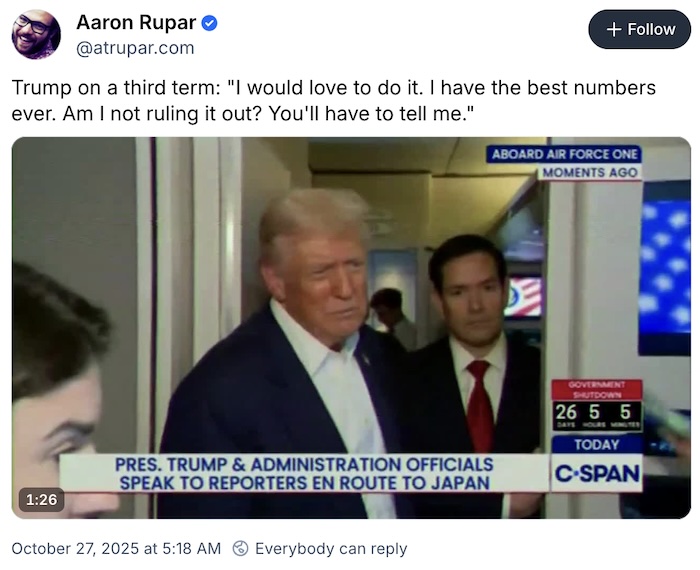
Is the nightmare of a possible third Trump term over? After toying with the idea of somehow trying to defy the 22nd Amendment and seeking a third stint in the White House, Trump this week seemed to concede that he is “not allowed to run” again, though he added, “We’ll see what happens.”
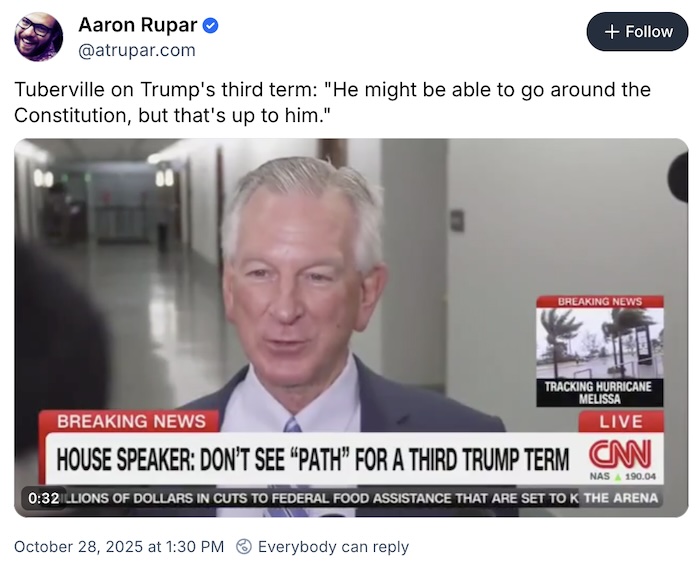
Before Trump quasi-ruled this out, Sen. Tommy Tuberville (R-Ala.) showed how much of a Trump toady he could be. Asked about this possibility of third term, he said,
You read the Constitution it says there’s not. [Trump] says he has some different circumstances that might be able to go around the Constitution. That’s up to him…I think there’s going to have to be an evaluation from President Trump’s viewpoint to the Constitution. There will be a lot of legal aspects to it. |
Tuberville couldn’t just side with the Constitution. He had to deferentially note Trump “might be able to go around the Constitution.” He didn’t seem to think that would be a problem. While Trump was telling reporters on Air Force One he probably couldn’t run again, he took a shot at the Democrats, claiming they had no strong contenders for 2028:
They have Jasmine Crockett. A low-IQ person. They have AOC, she’s low IQ. You give her an IQ test—have her pass the exams that I decided to take when I was at Walter Reed. I took—those are very hard—they’re really aptitude tests, I guess, in a certain way. They’re cognitive tests. Let AOC go against Trump. Let Jasmine go against Trump…The first couple of questions are easy, a tiger, an elephant, a giraffe, when you get up to about five or six, and then when you get up to 10 and 20 and 25, they couldn’t come close to answering any of those questions.”
|
In this one remark, Trump managed to both issue a racist and sexist insult and look like a buffoon for equating a cognitive test (given to determine whether any mental decline has occurred) and an IQ test. That’s hardly a sign of intelligence.
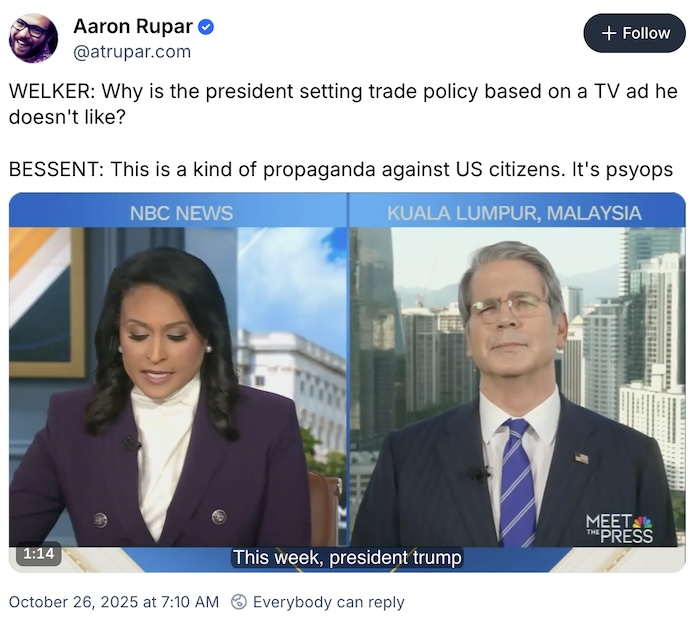
But the fella who reached the winner’s circle was Treasury Secretary Scott Bessent. When he appeared on Meet the Press, host Kristen Welker asked him about Trump’s 10 percent increase of tariffs on Canada in retaliation for a television ad paid for by the province of Ontario that featured anti-tariff statements from President Ronald Reagan. Bessent said of the ad, “This is a kind of propaganda against US citizens. It's psyops…What was the purpose other than that to sway public opinion. It’s some kind of propaganda.”
|
It’s actually a psyop to claim this ad—which accurately conveyed the anti-tariff stance of Reagan, a devoted free-trader—was a psyop. For such chutzpah, Bessent gets the trophy. But a special honorable mention goes to the Ronald Reagan Presidential Foundation and Institute, which put out a statement claiming the ad “misrepresents” Reagan’s remarks. The ad did not. It’s a sad day for American conservatism when the keepers of Reagan’s legacy feel compelled to bend the knee to Trump.
|
|
|
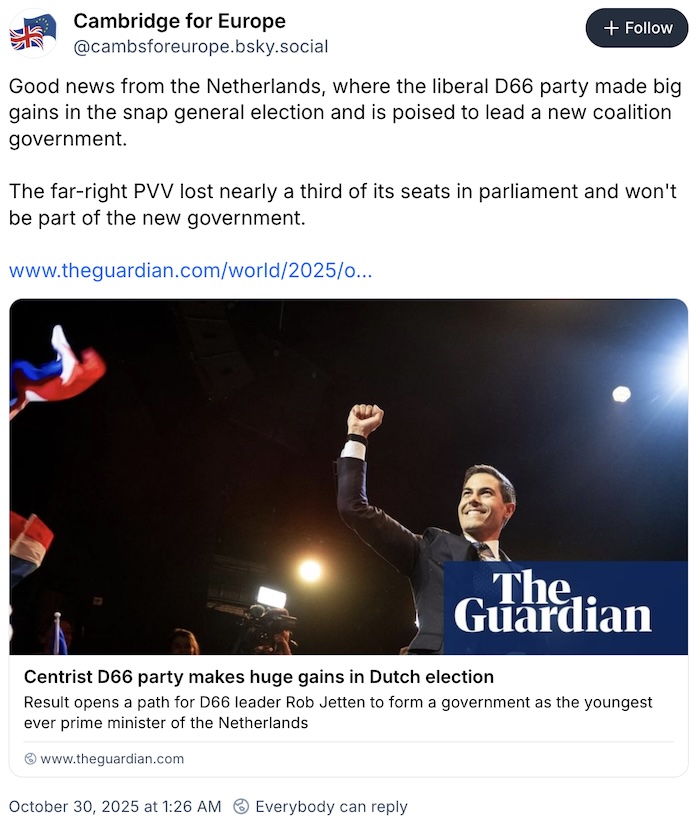
In recent years, regressive conservatism and authoritarianism have spread across the globe, and we routinely receive news of far-right, nativist, and sometimes racist political parties winning elections in Europe and elsewhere. This week there was a slap-back in the Netherlands. A center-left party triumphed in national elections and delivered a rebuke to the far-right party led by Geert Wilders. Wilders is an Islamophobe, a fierce anti-immigration advocate, an Eurosceptic, and an ally of Elon Musk. His Party for Freedom scored a surprising victory two years ago and threw Dutch politics into a tizzy. It took more than seven months to form a government.
In this election, other far-right parties gained, and left-wing parties lost seat. It’s now up to Democrats 66, the center-left party, to assemble a governing coalition. |
My tribute to Bruce Springsteen drew many Boss reminiscences from readers. This one from William Hennel made me chuckle:
I grew up with Bruce. I got his first album for Christmas in 1973. I had just turned 19. Hard to believe it's 50 years since Born to Run was released. I moved into Asbury Park in 1976, right after Born to Run came out. He used to play in the Stone Pony every Sunday night. But not after Born to Run so I just missed seeing him every Sunday night. Southside Johnny took over when we were there. Bruce has made tons of unannounced visits to the Pony, but I never got to see him there.
In 1978 my friend and I were making breakfast listening to WNEW-FM, as per usual, and an announcement was made that at 10:00 (in 15 minutes) tickets were going to be for sale in a music store in Long Branch for a Bruce show at the Capitol Theater in Passaic. We turned off the stove and blasted off. When we got there, there were about 20 people in front of us. We got to the window and asked for the best seats available. They said how about the front row. Woo hoo! What a great show. It was right after Darkness on the Edge of Town was released, so lots of songs from that album plus many from the first three albums. I found the set list: 24 songs, 185 minutes. Typical three-hour show he’s famous for. Probably cost less than 10 bucks for the tickets. I have tons of pictures, but it was a Kodak Instamatic, and they came out like crap. He doesn't stand still and most are out of focus. But the 25-year-old Bruce is in focus in our memory.
Julie Preston, a reader in New Jersey who’s been door-knocking for Rep. Mikie Sherrill, the Democratic candidate in a tight race for governor, sent in a field report, noting that she’s finding that many issues that progressives are focused on—such as Trump’s move toward authoritarianism and right-wing attacks on democracy—are not much on the mind of the voters she encounters:
At the moment, there is no crisis of democracy in New Jersey. The elections commission has created what so far has been an orderly election. Mail-in ballots went out weeks ago, and the state created many drop boxes where people can deposit them. We have early voting for the first time. Republicans have not made any concerted statewide effort to gerrymander or undermine the vote, at least so far. Trump's attack on democratic institutions and his neo-fascist politics are not top-of-mind issues for voters in this contest.
In many ways, it's the same as the race we had in 2024. I have knocked on many hundreds of doors and talked directly to hundreds of voters recently in Jersey City, Bayonne, and Hoboken. Democrats are the incumbents, and the cost of living and utilities and taxes is expensive. So voters want to know who is going to help them lower costs. Mikie has an extra burden to prove that she will be different.
In other ways, conditions have changed. I've knocked a lot of Latino doors, and they get it. They feel the threat to their communities from mass deportation, and they're ready to vote against MAGA. But often they are confused about the logistics of voting. Trump did Mikie a favor by cancelling funding for the tunnel under the Hudson River that will finally bring some relief to suffering commuters who wonder every day if they will ever make it to work on the PATH train.
Progressives are marching for No Kings, but at the rally in Jersey City, I had to remind a lot of people that marching wouldn't amount to anything if they don't vote for Mikie and MAGA takes over in Trenton. The most vocal and active anti-Trump forces are once again organizing around issues that are not the immediate concern of harried working-class voters in New Jersey, including many voters of color, who are trying to put food on the table, pay the rent, and keep their families safe and healthy.
Stephen Wend had this take:
Another week, another pardoned felon. And there was the demented video of fighter pilot Trump dumping feces on demonstrators. When people see the increases in their health insurance premiums, the shit will hit the fan. Trump is becoming more emboldened and unhinged. If he doesn't realize it, his enablers do: It's a race against time. His support fractures and things go south, or he goes big. I think the next couple of months will be crucial in indicating which direction the country is going in. Any thoughts on that?
Every week is crucial. And as I’ve noted, it is a foot race between Trump’s power-grab and popular revulsion with his actions and policies. He and his crew want to solidify their power before there’s sufficient opposition to thwart them. Will a wave of resistance come in time? That’s what will decide the nation’s fate. |
“Moxie, many readers wrote in to express concern about your heart condition.”
“You’re exploiting me to sell newsletters subscriptions?”
“No, it’s just you’re, uh, an important feature.”
“And what’s my cut?”
“Name your price.”
“More scrambled eggs for breakfast.”
“You got it.” |
|
|
Congratulations, you read all the way to the end! It's a great time to say "I'm in" and start your free 30-day trial. Make sure you don't miss out on what's next: Sign up to start getting Our Land in your inbox each week. We also want to hear from readers (especially those who read the whole thing!). So let us know what you think so far or share something interesting with David at ourland.corn@gmail.com.
|
|
|
|