FREE TRIAL VERSION. DON'T MISS OUT. |
FREE TRIAL VERSION. DON'T MISS OUT. |
|
|
How Many Impeachable Acts Can Trump Commit in a Week? |
By David Corn September 23, 2025 |
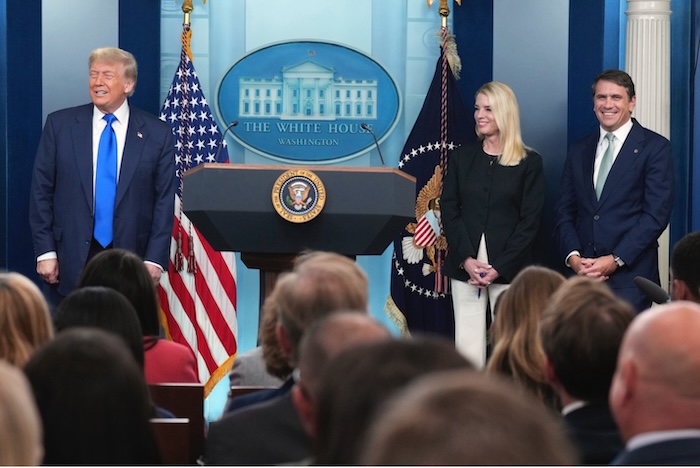
President Donald Trump with Attorney General Pam Bondi and Deputy Attorney General Todd Blanche at the White House on June 27. Jacquelyn Martin/AP |
|
|
You're reading a free promotional version of Our Land, and we hope you enjoy David's exclusive writing and don't want to miss out on what's next. Sign up to start receiving a free 30-day trial of Our Land and enjoy all of the behind-the-scenes reports and interactive features with each issue.
|
|
|
It’s not every day the news is full of impeachable offenses. Or perhaps these days it is. Let’s take a gander at the front page of Saturday’s New York Times. It featured three stories that each covered a matter that in the pre-Trump era would have spurred conversations about impeachment.
The first was on ABC’s suspension of Jimmy Kimmel’s show that occurred after the Trump-appointed chair of the Federal Communications Commission, Brendan Carr, threatened the network. Using a government agency to target a critic and impede the free speech rights of a citizen and a media corporation is an abuse of power. And an accompanying piece reported Trump’s threat to pull the licenses of broadcast networks that air material about him that he considers negative. As the paper pointed out, “The comments were a remarkable escalation in a coordinated attack by Mr. Trump and his top aides, who are using the threat of the power of the American government to silence criticism or dissent following the assassination of the right-wing activist Charlie Kirk.”
The second article covered Trump’s recent attacks on what he claimed were narcotraffickers in the Caribbean sea. Trump insists he has the power to kill suspected smugglers. He doesn’t. These lethal assaults are extrajudicial executions or, perhaps, unauthorized acts of war. In either case, he does not possess the authority to murder these people. If they are suspected of crimes, they deserve due process. And if Trump wants to contend this is the equivalent of a war, he needs to receive authorization from Congress. This is another abuse of power. (Referring to the criticism that these attacks are war crimes, Vice President JD Vance cavalierly bleated, “I don’t give a shit what you call it.”)
|
|
|
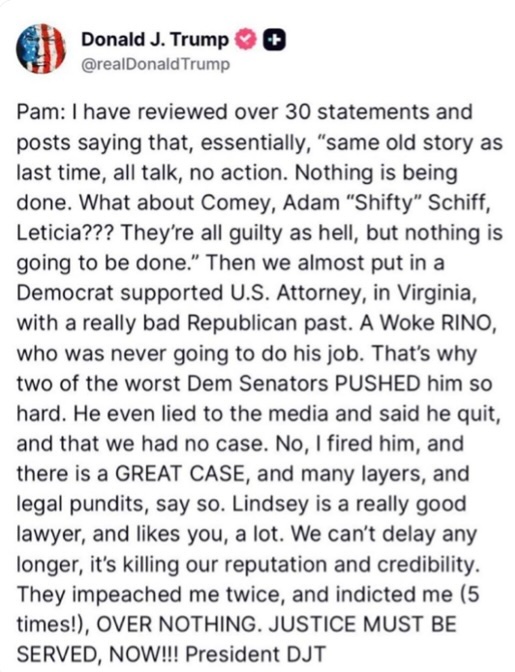
Third, the Times reported that Trump had pushed for the ouster of US Attorney Erik Siebert, who had declined to bring indictments against New York Attorney General Letitia James and former FBI Director James Comey—two Trump foes whom Trump had tagged for retribution. Siebert’s transgression? He had found insufficient evidence of wrongdoing. Siebert resigned following Trump’s call for his dismissal—though Trump in a late-night social media post declared, “He didn’t quit, I fired him!”
The Seibert scandal—and that’s what it is—might provide the most solid grounds for impeachment. Trump has demonstrated that he is attempting to use the Justice Department to smite his political enemies, no matter what the law is. On Saturday night, he posted online a message to Attorney General Pam Bondi, instructing her to prosecute James, Comey, and Sen. Adam Schiff (D-Calif.), who, as a House member, led the first impeachment against Trump. |
Trump’s missive indicated he was pressuring the Justice Department to seek revenge against his foes. This was Nixonian stuff, though Trump makes Richard Nixon look like a piker. Nixon drafted an enemies list, but he didn’t order his AG to indict his antagonists. Nixon did push the IRS to audit his detractors—but the IRS commissioner and other career IRS officials generally resisted. The FBI, at his urging, did harass and surveil a few folks, including John Lennon and journalist Daniel Schorr. But the Watergate tapes did not reveal the sort of command that Trump issued in his note to Bondi. Nixon’s big sin in Watergate was getting caught corrupting justice by trying to stop the criminal prosecutions of the Watergate burglars out of fear that investigation would lead to the White House. (He failed to do so.) Trump is trying to put his enemies in prison.
Exploiting the regulatory powers of the federal government to suppress the speech of critics, ordering illegal executions, and turning the DOJ into a politically motivated hit squad—each is a vast abuse of power.
During Trump’s first impeachment in 2019 and 2020, Democrats claimed his attempt to pressure Ukrainian President Volodymyr Zelenskyy to gin up faux investigations to produce dirt on Joe Biden and bolster the baseless conspiracy theory that Ukraine, not Russia, intervened in the 2016 election was an impeachable abuse of power. That triggered debate over whether an abuse of power could constitute a “high crime or misdemeanor.” But as Philip Bobbitt then wrote for Just Security, an “abuse of power may indeed be the basis for the impeachment and removal from office of a president if he corruptly acts to further his political interest.” Conscripting the Justice Department and the FCC for a war on his political enemies would certainly meet that standard. Killing people on the high seas without due process or congressional authorization might not be corrupt but it does seem brazenly unconstitutional and is arguably illegal.
To note that Trump is committing impeachable offenses is not to say that the House Democrats should race ahead with articles of impeachment in the GOP-controlled Congress. Impeachment is a political act that seeks to undo the will of the electorate (even if only, in Trump’s case, 49.8 percent). The past two impeachment efforts—which occurred when Ds ruled the House—were important and justified but failed. Trump, who, let’s face it, is better at politics than the frequently hapless Democratic Party, exploited these episodes to his advantage. My hunch is that many voters do not like chaos and view impeachment generally unfavorably. At this point, initiating a sure-to-flop impeachment effort against Trump might not boost Democratic prospects and might even distract from the damage Trump does daily—though I did recently examine how an impeachment targeted against Robert F. Kennedy Jr. or other administration figures could make sense for the Dems.
Yet with Trump trampling the Constitution, the rule of law, and decency on an hourly basis, the Democrats still must fight back with a sharp counternarrative and big punches (metaphorically speaking). And, as I’ve been whining about for months, that is not happening often enough. Sen. Chuck Schumer and Rep. Hakeem Jeffries seem more focused on the looming government shutdown and forcing Trump to cut a deal that wins them concessions on federal health care spending and other issues. But given the complexity of budget fights and the difficulty of engaging the public on this front, even if they prevail—a big if—they are unlikely to gain much ground in the overall battle.
|
|
|
Democratic governors, particularly California’s Gavin Newsom and Illinois’ JB Pritzker, have robustly challenged Trump’s autocratic moves. And on Sunday, Schumer did declare that Trump’s muscling the Justice Department to pursue his political enemies was “a real threat to democracy” and a step on “the path to a dictatorship.” Yet the Ds still could more consistently call out Trump’s authoritarian—or fascist—actions, as they becoming increasingly tough to keep track of. (Will Democrats noisily demand congressional investigations of the Trump Justice Department’s decision to drop the probe of border czar Tom Homan, who last year allegedly accepted $50,000 in cash from undercover FBI agents for promising to help them obtain government contracts?)
The political war at hand is not about policy; it is about power. Trump and his goons are waging a blitzkrieg to amass power and undermine democratic governance. His cult—the Republican Party—is onboard (though a few conservatives did gripe about Carr’s assault on free speech.) That leaves it to the Democrats to block this descent into authoritarianism. It’s a tough assignment, and it’s not easy for a party without a clear voice to concoct an effective strategy. But one thing is painfully evident: You cannot win a war, if you don’t recognize you’re in a war.
Got anything to say about this item—or anything else? Email me at ourland.corn@gmail.com. |
Thank you, Robert Redford |
Twenty years ago this month, I was at Sundance in Utah for a dear friend’s wedding. It was beautiful, calm, and quiet—prior to ski season and the film festival. The wedding party had the run of the place in the lovely autumnal weather. There were a variety of gatherings over the weekend. While I was heading to one, I passed a man, not so tall, and a younger woman walking in the opposite direction. He was wearing a cowboy hat, aviator sunglasses, and a shiny blue shirt. She was taking notes, as he talked. I wondered who he was and passed by. A moment later, I heard from behind me, “Is that David Corn?”
I turned around and the fellow had stopped. “David?” he asked. He put out his hand. “Bob Redford,” he said, taking off his sunglasses. Oh my God, I thought. I had not recognized him. “What are you doing here?” he inquired. I told him about the wedding. He told me he was a fan of my work. (I was now in the stratosphere.) And he said he was currently hosting a conference for the Natural Resources Defense Council at Sundance; he was a trustee of the organization. “I’m screening All the President’s Men tonight,” he said. “Come by if you can.” He pointed to the building where the event would occur. “Otherwise,” he added, “see you around.” Was that a twinkle in his eye? He was almost 70 but still oozed charisma and a magnetic boyish charm. “Yeah,” I said, a bit tongue-tied.
There was a reception for the wedding group that night. But my friend generously offered me dispensation, and I slipped out for the screening. The auditorium was full of NRDC environmental activists, when I tried to quietly enter at the rear. Bob—I could call him Bob, now, right?—was on the stage talking about the movie, and he spotted me in the back. He interrupted his remarks to say, “And now one of my favorite journalists is here,” and he introduced me. I nodded and sat down, feeling rather special. Bob had that true-movie-star glow, and now I was within it.
Bob told the audience the story of how during the early days of Watergate—long before it was clear this was a story that would end a presidency—he thought that there could be a film about how Bob Woodward and Carl Bernstein were uncovering the scandal bit by bit for the Washington Post. He called the newspaper and got Woodward on the phone to pitch the idea. Bob told the reporter the movie would focus not on Nixon’s misdeeds but on the reporting and on Woodward and Bernstein’s partnership. Woodward wasn’t interested.
As Woodward and Bernstein have told the story over the years, after Woodward hung up, he immediately informed Bernstein about the call, and Bernstein said, “Do not ever talk to him again.” They both figured that if word got out that Redford was calling and Hollywood was knocking on their door it would undermine their credibility. They were already getting plenty of crap for their reporting. Bernstein gave Woodward a direct command: “Do not pick up the goddamn phone if Bob Redford calls."
Bob didn’t give up. He kept track of the story and the reporters and every few months tried Woodward again. The pair remained skeptical. But Bob eventually won them over, and months before their book was published in 1974, he optioned the work for the then-exorbitant sum of $450,000. His persistence led to a cinematic masterpiece, a gripping buddy movie about journalism and political intrigue. Watergate sparked my interest in journalism, and All the President’s Men, the book and the film, were a big part of that.
I saw Bob once in a great while over the years. He was always open, engaging, curious, evincing intelligence, humility, and impishness. I had the sense he liked to hatch plots. In 2007, he invited me to the premiere of Lions for Lambs, a film he directed and starred in with Tom Cruise and Meryl Streep. It was about the Afghanistan War and had an antiwar perspective. At the reception following the screening, I saw him rushing toward me. His first words were, “Can you believe I got this made?”
As many have noted following his death at the age of 89 last week, Bob sought to act in and direct films that made the audience think about the world around them. He was a skilled and precise actor, a commanding director, and a passionate activist who entertained and enlightened. His work on All the President’s Men shaped my life. I don’t recall if I ever thanked him. I should have.
After his death, many people, no doubt, rushed to watch Bob’s classic works, such as Butch Cassidy and the Sundance Kid, Three Days of the Condor, The Sting, and All the President’s Men. I don’t need to encourage anyone to stream those movies. Instead, I recommend All Is Lost, one of his last films. It’s the story of a man on a sailboat during a solo crossing of the Indian Ocean. His boat collides with a shipping container that rips open a hole in the hull. On his own, far out at sea, the man is now in a fight for survival. There is precious little dialogue, and Bob provides a masterclass in acting without words. The film is a gripping metaphor. I know he was quite proud of his work on this picture, which did not draw the accolades it deserved. To fully appreciate Bob, give it a watch.
|
|
|
Charlie Kirk Was Antisemitic...According to Key Conservatives |
As I watched the Charlie Kirk memorial service on Sunday—during which this fellow who often made racist and bigoted remarks and who promoted Trump’s Big Lie about the 2020 election was being canonized by MAGA as a Christian martyr—I remembered the time, not so long ago, when prominent figures on the right accused him of being antisemitic. From a New York Times story published in July 2024:
“Jewish communities have been pushing the exact kind of hatred against whites that they claim to want people to stop using against them,” [Kirk] said, among a lot of other things [during a podcast in November 2023].
Around that time, conservatives had seemed ready to jettison Mr. Kirk and his organization. Erick Erickson, a commentator who has been in the mainstream of American conservatism, wrote in a post that Turning Point USA was “looking like not just a grifting operation, but an anti-Semitic grifting operation.” Ben Domenech, a co-founder of The Federalist, wrote, “If Charlie Kirk remains the head of TPUSA, the right has an anti-Semite problem that will follow them into the coming elections.” Guess that doesn’t matter now. |
|
|
The Most Hate-filled Politician? |
There’s been much talk of late about the politics of hate. For years, the right and MAGA have demonized Democrats as sex-trafficking, pedophilic global cabalists. Yet in the past few months, the MAGA-ists have been peeved that some on the left have been accusing Trump of being an authoritarian or fascist—even as Trump has repeatedly decried his own political foes as fascists, communists, or the “radical left.” This rhetorical battle will continue. But I’d like to point out one politician who truly is setting a high bar for fear and loathing: Rep. Nancy Mace (R-S.C.).
Mace was once a quasi-moderate Republican, in favor of LGBTQ rights. But as her congressional district was redrawn and became more conservative, she pivoted toward MAGA and last year positioned herself as the loudest and most ferocious opponent of trans rights, pushing a measure to prevent House members and their employees from using single-sex facilities in the Capitol that don’t correspond to their “biological sex.”
Now she’s running for governor of South Carolina, and one of her big issues in this race is calling for...the deportation of Rep. Ilhan Omar (D-Minn.). Yes, I am sure that many South Carolinians, as they face economic challenges, including concerns about jobs, inflation, health care, and employment security, are intensely worried about Omar. That must be why almost every day I receive a fundraising text or email from Mace’s campaign that urges the recipient to use their voice “to DEPORT ILHAN OMAR FOR GOOD” and, of course, to donate to Mace’s campaign.
|
In these emails, Mace calls Omar a “sick, twisted RADICAL” who “stands with 9/11 terrorists” and “supports Hamas’ war on Israel” and who “committed immigration fraud so she could lobby for her sh**hole country in Congress.” None of this is true. And Omar cannot be deported. An immigrant from Somalia, she became a US citizen in 2000 when she was 17. Mace is trying to con people. And I assume it’s working. The fact that I keep receiving these emails and texts suggests they are effective and bring in the bucks for this candidate of hate.
|
|
|
Congratulations, you read all the way to the end! It's a great time to say "I'm in" and start your free 30-day trial. Make sure you don't miss out on what's next: Sign up to start getting Our Land in your inbox each week. We also want to hear from readers (especially those who read the whole thing!). So let us know what you think so far or share something interesting with David at ourland.corn@gmail.com.
|
|
|
|