FREE TRIAL VERSION. DON'T MISS OUT. |
FREE TRIAL VERSION. DON'T MISS OUT. |
|
|
Trump’s One Big Win at the Putin Summit |
By David Corn August 19, 2025 |
Russian leader Vladimir Putin and President Donald Trump on the tarmac at Joint Base Elmendorf-Richardson in Anchorage, Alaska, on Friday. Sergey Bobylev/Sputnik via AP |
|
|
You're reading a free promotional version of Our Land, and we hope you enjoy David's exclusive writing and don't want to miss out on what's next. Sign up to start receiving a free 30-day trial of Our Land and enjoy all of the behind-the-scenes reports and interactive features with each issue.
|
|
|
When Russian leader Vladimir Putin descended from his airplane at Joint Base Elmendorf-Richardson in Anchorage, Alaska, on Friday, and walked across a red carpet that had been laid for the tyrant by US soldiers, President Donald Trump, waiting to greet him, applauded Putin. It was a disgusting sight—an American president warmly welcoming and practically cheering a murderous war criminal who has crushed democracy in Russia and launched a war against Ukraine in which almost 50,000 civilians have been killed or injured. It was also disgusting for another reason: Putin mounted an attack on the United States, deploying extensive information warfare during the 2016 election, and here was Trump essentially embracing him on American soil.
The mini-summit—which was cut short before Trump could serve Putin a scrumptious lunch of filet mignon and halibut Olympia—was widely panned as a flop for Trump. Putin offered no concessions regarding the war in Ukraine, let alone a ceasefire, which Trump had identified as a desired outcome. Yet the Russian was afforded grand treatment, including a photo-op press briefing (no questions!) in which he stood with Trump before a banner proclaiming, “Pursuing Peace.” That PR stunt was obscene, given Putin’s record of bombing civilian targets in Ukraine and kidnapping thousands of children. If Putin cared about peace, he could...end the war.
This quick jaunt across the Bering Sea won a man who has been indicted for war crimes by the International Criminal Court validation on the world stage, as Trump received him as a statesman and not the savage and barbarous authoritarian he is. And in the wake of this brief get-together, Trump reverted to the stance of pressing Ukraine to grant concessions—such as giving up both land that Putin seized with his illegal invasion and territory he has been unable to conquer—so the war can conclude with a finish favorable for Putin. Only Trump cultists cheered this Trump performance. Even Fox News reporters acknowledged the hastily and poorly arranged shindig was a dud that delivered nothing for Trump.
|
|
|
Yet Donald “No Deal” Trump did rack up one success during those hours: He memory-holed Putin’s act of war against the United States and his own complicity in that assault.
Without going into all the details once again, these are the basics, as the intelligence community (in 2017), special counsel Robert Mueller (in 2019), and the GOP-led Senate Intelligence Committee (in 2020) concluded: In 2016, Moscow unleashed a covert social media campaign and a secret hack-and-leak operation that each were crafted to help Trump, and Trump and his crew aided and abetted this attack by echoing Putin’s phony denials. And in that tight-as-a-tick election, with this social media scheme (which reached millions of voters) and the cyber break-in caper (which caused a slew of negative media stories for the Hillary Clinton campaign in the final weeks of the race), the Kremlin’s skullduggery was one of several factors that influenced the outcome and landed Trump in the White House.
Since then, as you know, Trump has incessantly screamed that the Trump-Russia scandal was a “hoax” and a “witch hunt” and has refused to admit that Russia engaged in warfare against the United States. His cult has slavishly followed suit. In recent weeks, his administration has gone so far as to baselessly claim that the abovementioned intelligence community assessment of 2017 was a con job feloniously concocted by President Barack Obama and his top national security aides and that they should be investigated and prosecuted for this “treasonous” plot.
In a Soviet-like manner, Trump has endeavored to erase the Russian attack—and his own involvement—from public discussion and history. The silly summit demonstrated that has largely succeeded.
The massive media coverage of this event barely included mention that Trump was affectionately hosting a foreign adversary who had assaulted the United States nine years ago. Neither the Washington Post nor the New York Times, in their main stories on the fizzled summit, referred to Putin’s war on the US or Trump’s participation in Putin’s cover-up. This important storyline was largely absent throughout the press reports. As if it never happened.
It was left to Trump to raise the subject. At the presser he held with Putin he brayed:
We really made some great progress today. I've always had a fantastic relationship with President Putin, with Vladimir. We had many, many tough meetings, good meetings. We were interfered with by the Russia, Russia, Russia hoax. It made it a little bit tougher to deal with, but he understood it. I think he's probably seen things like that during the course of his career. He's seen—he's seen it all. But we had to put up with the Russia, Russia, Russia hoax. He knew it was a hoax, and I knew it was a hoax, but what was done was very criminal, but it made it harder for us to deal as a country, in terms of the business, and all of the things that [we] would like to have dealt with, but we'll have a good chance when this is over.
Of course, Trump was yet again lying about this matter. The Russian interference was no hoax. And Trump went so far as to assert that Putin, who had ordered the attack, “knew it was a hoax.” This was absurd. He was absolving a foreign leader who had subverted American politics.
Yet this brazen lie was not deemed newsworthy. In the face of Trump’s unrelenting disinformation campaign, much of the media long ago moved on from the Trump-Russia scandal. Which is exactly what Trump wished for. The Trump-Putin summit at an American military base was even more dramatic because Trump first reached the White House with clandestine assistance from Putin. But that narrative was airbrushed out of this picture. The summit was a reminder that Putin got away with his covert war on the United States, and that Trump got away with his betrayal of America.
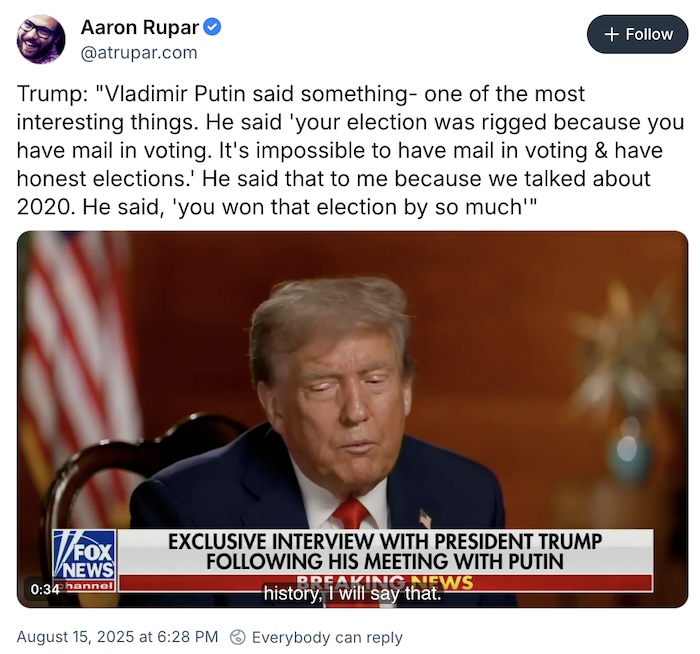
Hours after Putin skedaddled back to Russia, Trump sat for an interview with Sean Hannity, his No. 1 Fox BFF, and, as crazy as it had been for him to cite Putin as a credible witness regarding the 2016 election, he went further. He presented Putin as a source who also affirmed Trump’s bonkers conspiracy theory that the 2020 election was stolen from him:
Vladimir Putin said something—one of the most interesting things. He said. 'Your election was rigged because you have mail-in voting.’ He said mail-in voting, every election. He said no country has mail-in voting. It's impossible to have mail-in voting and have honest elections. And he said that to me and it was very interesting because we talked about 2020. He said, 'You won that election by so much’… He said, ‘You lost it because of mail-in voting. It was a rigged election.’”
|
Ponder the inanity of Trump relying on a dictator who imprisons (and kills) democracy advocates in Russia (see Alexei Navalny) and who holds sham elections to confirm Trump’s baseless claim that the 2020 election was rigged. This shows how mad the king is—and how enthralled he remains with this Stalinist despot. He takes whatever Putin says as the truth, without any recognition that the former KGB man is playing him when he supports Trump’s falsehoods about the 2020 campaign. |
|
|
Three days after his chat with Putin, Trump put up a social media post in which he vowed to “get rid of” mail-in ballots and noted he would sign an executive order “to help bring HONESTY to the 2026 Midterm Elections.” That is, he was taking the advice of a dictator and proceeding on a course that could cause havoc in US elections. By the way, if Putin did tell Trump that no countries have mail-in voting, he was dead wrong. At least 34 countries, including Canada, Germany, and South Korea, use mail-in voting. Trump would rather take Putin’s word than do a Google search.
The half-baked Alaska spectacle was a depressing affair. Trump, who has long sought a bromance with Putin, engaged in a gross PDA with a totalitarian, elevating the status of a war criminal and wrapping the American flag around an enemy of democracy. It did not augur well for Ukraine. But all this was made worse by the imagery of Trump glad-handing with a foe who successfully staged a secret war against the United States. This was quite the act of Trump perfidy. Yet it went mostly unreported—a sign that Trump has managed to achieve a paramount priority for him: disappearing the Trump-Russia scandal and his own treasonous actions that helped him become the president of the United States.
Got anything to say about this item—or anything else? Email me at ourland.corn@gmail.com. |
|
|
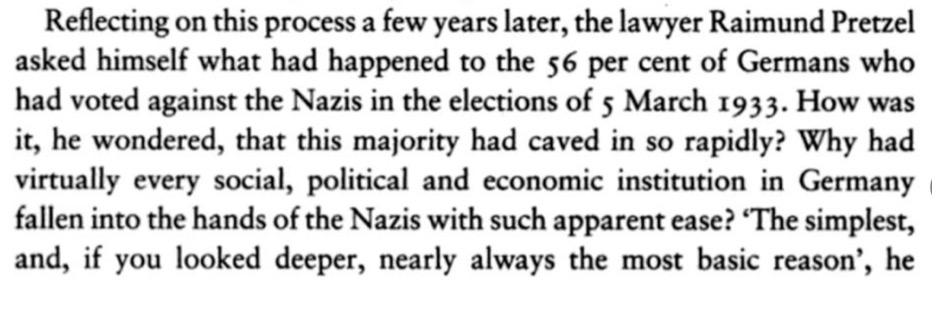
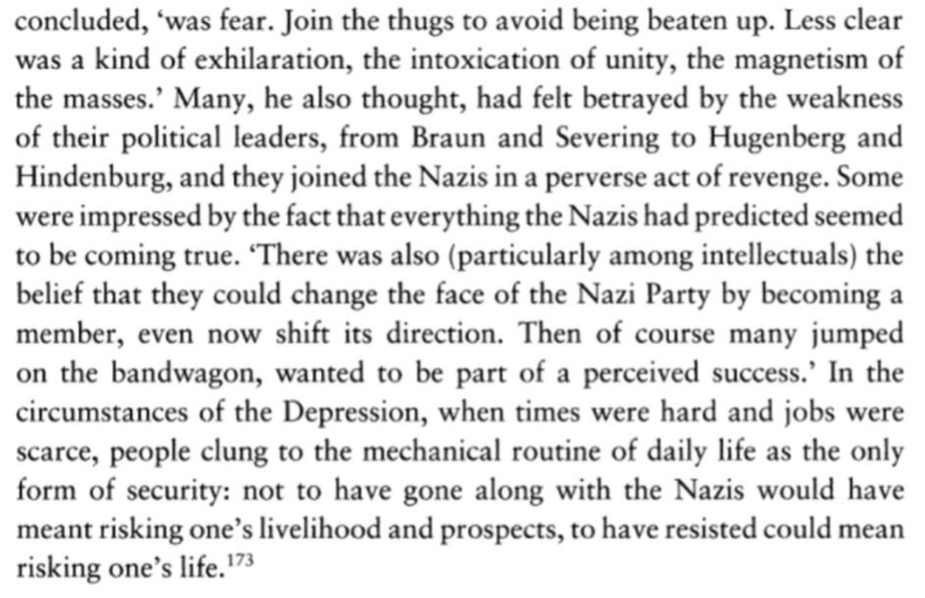
I know that many of us these days look to history to find ways to understand the crisis at hand. Adam Keiper, the executive editor of The Bulwark, recent posted a thread on an “underappreciated aspect of the Nazi rise”: how quickly German society fell into line. “In early 1933, a majority of German voters voted against the Nazis,” he wrote. “By late spring, pretty much the whole country backed them. How did that happen?” As many historians have noted, it took Hitler 53 days after that election to dismantle German democracy.
What’s happening in the United States is not the same as what transpired in post-WWI Germany. But looking back at that quick collapse from democracy to fascism can be instructive, especially in terms of figuring out what to keep an eye on these days. In his thread, Keiper provided a useful explanation for the demise of German democracy written in 1939 that was quoted in Richard Evans’ The Coming of the Third Reich:
|
In this moment, we do see the cowardice and fear of elites, be it prestigious universities agreeing to settlements in bogus cases brought against them by the Trumpists, high-powered law firms doing the same, and corporate titans turning into Trump lickspittles. (See Apple CEO Tim Cook.) This certainly weakens or removes important guardrails. And while most of the public has not rallied to Trump’s autocratic crusade, not enough Americans have expressed opposition. The road to American authoritarianism, if not blocked, will be different than what occurred in Nazi Germany. But there are parallels that can be instructive for those who wish to stop the rise of fascism here.
|
Tulsi Gabbard Wins the Trump Conversion Contest |
Several of Trump’s top aides are politicians who not long ago decried Trump as a menace to society. Yet to serve their ambitions—and to serve him—they jettisoned their harsh criticism and joined the cult. Of this bunch, Tulsi Gabbard might win the top prize for Trump-flipping. As a Democratic congresswoman from Hawaii, she was a proud member of the Congressional Progressive Caucus and a vice chair of the Democratic National Committee. In 2016, she endorsed socialist Sen. Bernie Sanders for president, and two years later she became a founding fellow of his policy shop, the Bernie Sanders Institute. Now she is Trump’s director of national intelligence—a post for which she had little relevant experience.
As I recently discovered and wrote about, when Gabbard was a Bernie Sanders Institute fellow, she was a ferocious critic of Trump. In a 2018 interview she did for the institute, she slammed Trump as a warmonger, blasting him for supporting Saudi Arabia’s war crimes in Yemen. She claimed Trump was running an “illegal” war with the Saudis to preserve $2 billion in US arms sales to Saudia Arabia and the United Arab Emirates.
In this interview, she also assailed Trump for threatening Syrian President Bashar al-Assad with “dire consequences” if he attacked Idlib province, a stronghold of the jihadist opposition in that nation’s civil war. And she promoted what was close to a conspiracy theory, claiming Trump was purposefully protecting al-Qaeda—one of the largest rebel groups in Idlib had historic ties to al-Qaeda—to keep the “regime-change war” in Syria going. Yes, Gabbard was asserting Trump was in cahoots with al-Qaeda, and she called this “a complete betrayal of the American people.”
By the way, as a Bernie Sanders Institute fellow, Gabbard indicated she supported Medicare for All and the Green New Deal and agreed with the view that Trump was seeking to rule as an autocrat. You can read the full story. But here’s a taste:
Trump’s current stable of top appointees includes several who were once fierce critics and who dumped their harsh views of Trump in order to serve him. On this roster are Secretary of State Marco Rubio (“a con artist”); Vice President JD Vance (either “a cynical a–hole like Nixon” or “America’s Hitler”) and Robert F. Kennedy Jr. (“a threat to democracy”). But only one of his senior aides previously accused Trump of making common cause with al-Qaeda, betraying the nation, and supporting war crimes for the sake of profits—and that person now comfortably works for Trump and oversees the entire US intelligence community.
|
|
|
The Watch, Read, and Listen List |
The Phoenician Scheme. Is Wes Anderson getting weirder? Or is it my imagination? In any event, I appreciate his imagination and how he transforms his bizarre stories into entrancing visuals. An Anderson film is an expedition into an alternative reality of meticulously organized tableaus and narrative oddities of a Pynchonian bent. And he’s been on quite a roll in recent years with The French Dispatch (an homage to The New Yorker of yore set in a small French town) and Asteroid City (a tale of UFOs, atomic tests, and Junior Stargazers set in the American southwestern desert in 1955).
His curious and twisty plots are not the main thing. It’s the look and feel of his movies. Anderson conjures up a world parallel to ours, but its colors are sharper, and its scenes often are organized along tight geometric patterns. Each one is composed as immaculately as a Mondrian painting. And his latest, The Phoenician Scheme, features a host of famous paintings—the actual works, not recreations made by the prop department—by Renoir, Magritte, van Schooten, and others. In the film, these works belong to a conniving arms dealer and industrialist named Anatole “Zsa-Zsa” Korda, who’s in the middle of a desperate effort to save his fortune.
It’s 1950, and Korda (Benicia del Toro), a target of an international alliance of governments who has survived multiple assassination attempts from a party or parties unknown, has reached out to his estranged daughter (he has nine sons), who is a Catholic nun. He has anointed her the heir of his far-flung business interests and recruited her for his rescue operation. The governments looking to take Korda down have orchestrated a rise in the price of bashable rivets—a building material—and somehow this has imperiled his entire enterprise. He must travel through the fictional land of Phoenicia and try to squeeze his various investors to fill “the gap” triggered by this market manipulation. Otherwise, it’s curtains.
The details almost don’t matter. The film has been described as an “espionage black comedy.” But that’s far too limited a characterization—and that suggests the story makes sense. The ins and outs of the plot are beside the point. Anderson has spun up a tale that allows him to create fantastical moving pictures that involve highly designed sets and wardrobes. (So many fezes!) He rounds up marquee names for his offbeat characters: Michael Cera, Riz Ahmed, Tom Hanks, Bryan Cranston, Richard Wright, Scarlett Johansson, Rupert Friend, Benedict Cumberbatch, Hope Davis, F. Murray Abraham, Willem Defoe, Bill Murray, and others. He gives them highly stylized dialogue to read. He pokes at themes of mortality, family, loyalty, and ethics. But it’s all about intricately building brick by brick a peculiar make-believe realm to amuse and delight.
And it works.
The Phoenician Scheme, like his previous outings, is fueled by Anderson’s considerable artistic ingenuity. It’s clever and witty, but, most of all, visually engaging. Or perhaps it would be better to say visually entrapping. I could watch Korda and the others traipse through the mansions, jungles, deserts, and infrastructure projects—which is where the money is being made—for hours. It might be easy for some to dismiss Anderson’s works as goofs. But these are tremendous flights of imagination, and I hope he continues this scheme of his.
|
|
|
Congratulations, you read all the way to the end! It's a great time to say "I'm in" and start your free 30-day trial. Make sure you don't miss out on what's next: Sign up to start getting Our Land in your inbox each week. We also want to hear from readers (especially those who read the whole thing!). So let us know what you think so far or share something interesting with David at ourland.corn@gmail.com.
|
|
|
|