FREE TRIAL VERSION. DON'T MISS OUT. |
FREE TRIAL VERSION. DON'T MISS OUT. |
|
|
“Woke” Superman Versus MAGA Whiners—Guess Who Won? |
By David Corn July 22, 2025 |
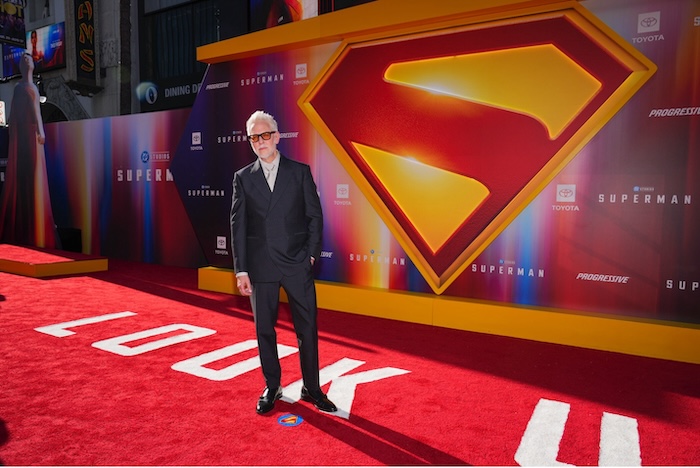
Director James Gunn at the Los Angeles premiere of Superman on July 7. Jordan Strauss/AP |
|
|
You're reading a free promotional version of Our Land, and we hope you enjoy David's exclusive writing and don't want to miss out on what's next. Sign up to start receiving a free 30-day trial of Our Land and enjoy all of the behind-the-scenes reports and interactive features with each issue.
|
|
|
There’s nothing like a $125 million opening weekend to overcome MAGA whining, and Superman just walloped the bad-faith culture warriors of the right.
The conservative movement has long relished ginning up moral panics to distract from more important matters, such as its never-ending assault on low- and middle-income Americans and its obeisance to plutocrats. The right resorts to culture warfare over abortion, guns, gay rights, immigration, and religion to win over voters who might otherwise recoil at GOP efforts to increase the power and wealth of corporate America and 1-percenters. And Trump and Co. have followed this playbook, with their crusades against wokeness, transgender rights, and demographic diversity. So when James Gunn, the director of the new Superman, told the Times of London that “Superman is the story of America, an immigrant that came from other places and populated the country,” cranky voices on the right leaped at the chance to accuse Hollywood of making Superman “woke” to advance a left-wing agenda.
Before the film hit theaters, Fox News informed its viewers that the new Superman embraced “pro-immigrant themes.” And MAGA pundit Kellyanne Conway, appearing on the network, huffed, “We don’t go to the movie theater to be lectured to and to have somebody throw their ideology on to us.” Fox host Jesse Watters half-joked, “You know what it says on his cape? MS-13.” For Fox, immigrant equals gang member.
|
|
|
No surprise, the MAGA pundits had no idea what they were talking about. The only pro-immigrant theme in the movie is rather basic and hardly objectionable. Superman (David Corenswet), an alien who fervently wants to help humans, is propelled by an elementary motivation: kindness. He is so empathetic that when his nemesis Lex Luthor (Nicholas Hoult)—in this telling, an Erik Prince-like character who’s an arms dealer and tech genius who has invented the “pocket universe” (don’t ask me to explain)—unleashes a 30-story-tall dinosaur-like beast (think Godzilla) in the middle of Metropolis, Superman insists on neutralizing, not killing, the monster so it can be taken to a sanctuary to be studied. Other superheroes helping him just want to blast it to smithereens.
There are certainly reflections of present-day crises in the movie. The film’s main tale is Luthor’s unrelenting attempt to destroy Superman, who stands in the way of Luthor’s diabolical schemes. One piece of Luthor’s plan is to delegitimize Superman, and he does this with the accusation that Superman is an untrustworthy alien who has a secret agenda to take over the Earth and claim as many wives as is needed to restore the Kryptonian race that perished on his home planet. In other words, this immigrant is an existential threat and a sex fiend. Luthor’s effort to demonize Superman does initially turn public opinion against the Man of Steel, showing how easy it is to other-ize and vilify a migrant.
The other callback to the real world is a burgeoning war between two fictitious nations, Boravia, an ally of the United States, and Jarhanpur, its neighbor. At the start of the film, Superman intervenes to prevent Boravia, which is being armed by Luthor’s transnational corporation, from invading Jarhanpur. But this leads to a superhuman created by Luthor defeating Superman in battle. Through the rest of the movie, the prospect of war looms, with Boravia’s high-tech army poised to slaughter the civilians of Jarhanpur at the border. It’s laser-guided weaponry versus pitchforks. And it’s nearly impossible not to think of the ongoing war in Gaza. Reporter Lois Lane (Rachel Brosnahan), Superman’s gal pal, tells him that his unilateral interference in the Boravia-Jarhanpur conflict raises questions of politics and morality. But Superman sees it more simply: What could be more important than preventing the bloodshed of war?
Gunn has pointed out that he wrote the script before the Gaza war broke out. He said that Superman “doesn’t have anything to do with the Middle East. It’s an invasion by a much more powerful country run by a despot into a country that’s problematic in terms of its political history, but has totally no defense against the other country. It really is fictional.” Yet the imbalance of power between these make-believe countries and the suggestion that one is poised to wipe out civilians in the other offers a strong example of art imitating life. No wonder Palestinian activists have hailed the work.
Put all the political chatter and sniping aside, Superman is a fun and smart take on an all-too-familiar story. It’s not a great film. The character of Superman—a tremendously non-dark superhero—does not lend itself to profound drama. This is no The Dark Knight with a brooding and conflicted hero (Batman) facing a nihilistic villain who seeks to illuminate and exploit the hypocrisies of modern society (Joker).
But Gunn does tease out for dramatic purpose the dilemmas and inner conflicts Superman/Clark Kent faces in dealing with both geopolitics and interpersonal relationships. The script is packed with creatively choreographed intense action scenes. Superman is confronted with challenges he might not be able to overcome—though you know he will. The side characters—particular superhero Mr. Terrific (Edi Gathegi)—are well drawn. The movie is infused with the same delightful sass that animated the Guardians of the Galaxy films Gunn previously directed. And, as you might have heard, the dog Krypto steals scene after scene.
Superman is a fine summer distraction for the tough times of the moment. You can munch popcorn and watch the ultimate good guy triumph over a villain who bears a resemblance to today’s tech billionaires. But if you want to look past the titanic fight scenes and gee-wiz CGI and be prompted to think about more, Gunn provides that opportunity, for Superman is a reminder of the pressing need to recognize and serve the basic commonality of our species—as sappy as that sounds.
It's an antidote to the perverted political culture Donald Trump has forged. Since he entered politics, Trump has presented mean-spiritedness as an asset. In the White House, he and his henchmen have implemented and celebrated policies of cruelty. And Elon Musk, the champion of Big Tech libertarianism, recently belittled the concept of empathy, dismissing it as weakness. Superman is a retort to all this.
In the Times interview, Gunn said the movie “is mostly a story that says basic human kindness is a value and is something we have lost…[O]bviously there will be jerks out there who are just not kind and will take it as offensive just because it is about kindness. But screw them.” It’s a sad comment on our present circumstances that such talk can spur controversy—which makes Gunn’s Superman more important and necessary than the average summer blockbuster. |
|
|
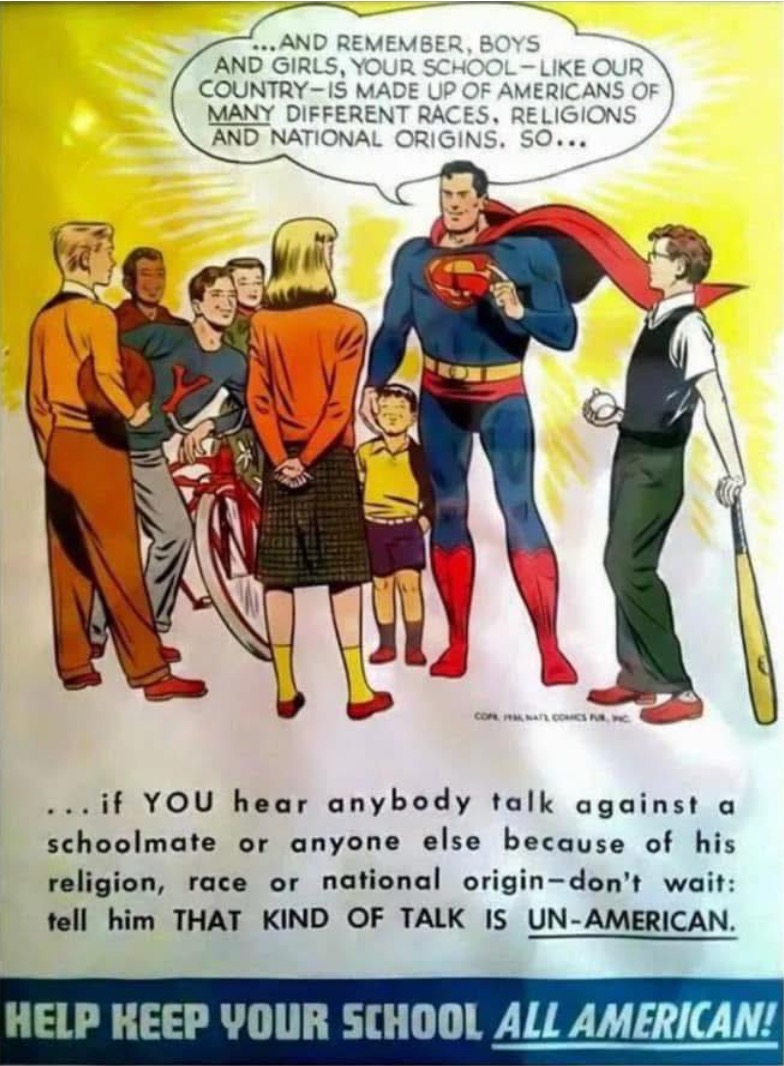
By the way, Superman, who was created by Jerry Siegel and Jospeh Shuster, each the son of Jewish immigrants, has always been woke: |
A Boost for Christian Nationalists |
In a move that didn’t get much notice, Trump’s IRS changed its rules to allow churches and other houses of worship to endorse political candidates. Since the 1950s, tax-exempt nonprofits—including religious entities—have been prohibited from giving an official thumbs up to a candidate. They could do a lot to help a politician of their liking—invite them to speak from the pulpit, distribute voter guides tilted in particular candidates’ favor, and the like. But not outright endorse. Now that restriction is gone, with the IRS creating a carve-out for churches. It argued that a church (or mosque or synagogue) telling a congregant who to vote for is akin to “a family discussion concerning candidates.” That’s BS. A minister’s endorsement of a candidate can be live-streamed, covered by the media, and featured in ads. It will go much further than a “family discussion” would.
This decision will be a big boom for those religious leaders who yearn to be political players and, thus, especially help Christian nationalists, who believe only Christian fundamentalists deserve to hold public office. As Trump declared last week during the White House Faith Luncheon, a gathering of faith leaders and CEOs whose companies support faith-based groups, “Now you’re able to speak about politics!” I recently wrote about this change in IRS regulations. You can read more about it here.
|
|
| The Watch, Read, and Listen List |
“I’m a Genocide Scholar. I Know It When I See It,” Omer Bartov, the New York Times. There once was a time when op-ed articles—especially within the New York Times—could shape public debate. With the rise of the internet, blogging, social media, etc., that’s less so these days. We are flooded with opinions and analyses, and the bigfoot commentators platformed by the Times and other establishment outlets now compete for attention with influencers and randos on TikTok, Instagram, YouTube, X, Blueksy, and elsewhere. The op-ed oligopoly is gone.
Yet once in a while a piece appears in one of these outlets that shakes rafters and has the potential to nudge opinion among those who pay attention to public affairs. Such an article was published by the Times this past week. It’s a heart-wrenching essay by Omer Bartov, a renowned professor of Holocaust and genocide studies at Brown University. It opens: “A month after the Hamas attack on Israel on Oct. 7, 2023, I believed there was evidence that the Israeli military had committed war crimes and potentially crimes against humanity in its counterattack on Gaza. But contrary to the cries of Israel’s fiercest critics, the evidence did not seem to me to rise to the crime of genocide.” But after reviewing Israeli actions since then, Bartov has changed his mind:
My inescapable conclusion has become that Israel is committing genocide against the Palestinian people. Having grown up in a Zionist home, lived the first half of my life in Israel, served in the I.D.F. as a soldier and officer and spent most of my career researching and writing on war crimes and the Holocaust, this was a painful conclusion to reach, and one that I resisted as long as I could. But I have been teaching classes on genocide for a quarter of a century. I can recognize one when I see one.
The rest of the article is a (sadly) well-argued defense of his conclusion. He notes that Israel’s horrific actions in Gaza undermine how Israel since its inception has used the Holocaust to justify its existence and its actions. While recognizing that nothing can compensate for the suffering and death of Palestinians, Bartov tries to find an iota of optimism:
Perhaps the only light at the end of this very dark tunnel is the possibility that a new generation of Israelis will face their future without sheltering in the shadow of the Holocaust, even as they will have to bear the stain of the genocide in Gaza perpetrated in their name. Israel will have to learn to live without falling back on the Holocaust as justification for inhumanity. That, despite all the horrific suffering we are currently watching, is a valuable thing, and may, in the long run, help Israel face the future in a healthier, more rational and less fearful and violent manner.
Anyone who cares about Israel and its future—as well as Palestinians and their future—ought to read this article. |
|
|
The Hard Way, Peter Yorn. Peter Yorn, hailed by Spin as one of the best songwriters of his generation, has been creating impressive albums since 2001, when his debut LP, musicforthemorningafter went gold with the single “Life on a Chain.” Since then, he has shared the bill with R.E.M., the Dave Mathews Band, Coldplay, the Foo Fighters, Crowded House, the Dixie Chicks, and other top acts. He combines Americana with twangy folk and dreamy rock. In 2009, he cut a fun single with Scarlett Johansson called “Relator.” Last year, Yorn, after dealing with a serious health matter and the death of his father, released The Hard Way, which included several tracks about confronting adversity. With the title track an ethereal break-up song and “Golden Dreams” a sweet farewell to a departed loved one, this is an intimate disc.
|
|
|
Congratulations, you read all the way to the end! It's a great time to say "I'm in" and start your free 30-day trial. Make sure you don't miss out on what's next: Sign up to start getting Our Land in your inbox each week. We also want to hear from readers (especially those who read the whole thing!). So let us know what you think so far or share something interesting with David at ourland.corn@gmail.com.
|
|
|
|