FREE TRIAL VERSION. DON'T MISS OUT. |
FREE TRIAL VERSION. DON'T MISS OUT. |
|
|
The CIA Tries to Provide Cover for Trump’s Original Sin |
By David Corn July 8, 2025 |
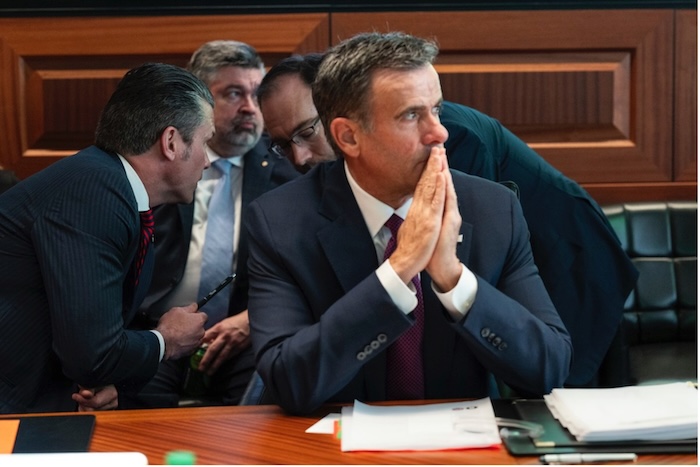
CIA Director John Ratcliffe in the White House Situation Room on June 21. The White House/AP |
|
|
You're reading a free promotional version of Our Land, and we hope you enjoy David's exclusive writing and don't want to miss out on what's next. Sign up to start receiving a free 30-day trial of Our Land and enjoy all of the behind-the-scenes reports and interactive features with each issue.
|
|
|
Autocratic regimes seek to control history. Authoritarians know that dictating reality is essential for maintaining tyrannical power. And Donald Trump and his minions have been busy with various attempts to reshape the past—especially Trump’s past. With his pardons of January 6 rioters, Trump has tried to diminish the horrors of that day and his own culpability for inciting an insurrectionist riot. His henchmen have discussed investigating the 2020 election—to legitimize Trump’s false, reckless, and destabilizing claims that the vote count was rigged against him. This past week, we saw his cult move to erase the original sin of his first presidency: Vladimir Putin’s covert attack on the 2016 election to help elect Trump, and Trump’s complicity in that assault via his vigorous echoing of Putin’s denials.
As you know, Trump for almost a decade now has brayed that the Russia investigation was a “hoax” and a “witch hunt.” He has never acknowledged he won that contest with secret Kremlin assistance. He has repeatedly said he accepted Putin’s lie that Russia did not intervene in that election.
But the US intelligence community has proclaimed otherwise. On January 6, 2017, a fortnight before Trump was to take office for the first time, the Office of the Director of National Intelligence released an unclassified report written jointly by the FBI, the CIA, and the NSA that concluded that “Putin ordered an influence campaign in 2016 aimed at the US presidential election”; its goals were “to undermine public faith in the US democratic process, denigrate Secretary [Hillary] Clinton, and harm her electability and potential presidency”; and the Kremlin had “developed a clear preference” for Trump. The report said, “We have high confidence in these judgments.” It added, “We also assess Putin and the Russian Government aspired to help President-elect Trump’s election chances.” For this assessment, the CIA and the FBI had “high confidence,” the NSA, “moderate confidence.”
To you and me, there may not seem to be a big difference between the Kremlin developing “a clear preference” for Trump and Moscow aspiring “to help” Trump’s chances. But these are the things intelligence analysts argue over. |
|
|
The report confirmed what had been obvious to anyone who had paid attention to the 2016 contest: Moscow had messed with the election in a way that benefited Trump. Still, Trump and his crew dismissed all talk of Russian interference as a Democratic and Deep State plot, aided by the media. They particularly assailed the notion that Trump had been Putin’s favored candidate.
Though subsequent investigations—including special counsel Robert Mueller’s probe and a bipartisan inquiry conducted by the Senate Intelligence Committee, which was chaired by a Republican—reached the same conclusions, Trump’s lieutenants have long yearned to diminish the intelligence community’s 2017 report. As soon as John Ratcliffe, Trump’s pick to be CIA chief, landed at Langley earlier this year, he unleashed the hounds, ordering a review of that old report, which was known as the ICA (short for Intelligence Community Assessment).
That new report was released by Ratcliffe’s CIA last week. It found what it called “multiple procedural anomalies” in the preparation of the ICA. These included “a highly compressed production timeline, stringent compartmentation, and excessive involvement of agency heads, all of which led to departures from standard practices in the drafting, coordination, and reviewing of the ICA. These departures impeded efforts to apply rigorous tradecraft, particularly to the assessment's most contentious judgment.”
At first glance, this seems an indictment of the ICA. But the tradecraft review, as it is called, does not challenge the findings of the ICA. It only says the production of that report did not follow all the guidelines for intelligence assessments. Conveniently for Trump, it does not explain the reasons for that.
At the time, many within the intelligence community were stunned by the success of the Russian attack on the election and by Trump’s apparent complicity. His repeated denials of Russian involvement, coupled with his long history of making positive comments about Putin, had them highly concerned. Had he been colluding with Russia? Was he working with Putin or merely a useful idiot for the Kremlin? Given his claim that Russia had done nothing untoward, it was reasonable to assume that he would have zero interest investigating Moscow’s attack once he became president. Consequently, senior intelligence officials reasonably believed that a review of Moscow’s skullduggery had to be completed before January 20, 2017. There was a need for speed.
The tradecraft review points out that an assessment of that nature usually takes months to complete. The ICA was finished within a few weeks. The “rushed timeline to publish both classified and unclassified versions before the presidential transition raised questions about a potential political motive behind the White House tasking and timeline,” the review says. Note the heavy lifting being done by the word “potential.” Was the desire to wrap up the ICA before Trump could kill it “political” or, perhaps, a national security concern? The new review does not probe this.
It states, “A more measured approach with expanded time for review and wider input would have better adhered to standard intelligence tradecraft practices and potentially deflected questions about White House motivations.” No doubt, more time would have been better. But that was not an available option.
The Ratcliffe-ordered review also raises a fuss about the handling of a key piece of intelligence during the ICA process: “Central to the judgment that Putin ‘aspired’ to help Trump win was one highly classified CIA report. [CIA director John] Brennan had tightly restricted access to this information within CIA; it had been collected in July but not disseminated in CIA serialized reporting.”
This is presumably reporting from a top-secret source within Putin’s inner circle. The CIA had an agent named Oleg Smolenkov, a Kremlin aide, who had long been providing the agency with the highest-quality intel on Putin and the Kremlin. He apparently informed the CIA that Putin, with his operation to target the US election, aimed to help land Trump in the White House. Smolenkov’s existence was one of the most important secrets of the US government. It’s understandable that Brennan wanted to keep knowledge of Smolenkov and his reporting tightly restricted. The tradecraft review questions whether it was necessary to limit access to this intelligence. But it hardly settles the question.
The new report also slaps Brennan, then-director of national intelligence John Clapper, and then-FBI Director James Comey for having been too involved in the ICA process, noting Brennan let it be known to the CIA workforce that he and the other two intelligence community leaders agreed on “the scope, nature, and intent of Russian interference in our recent Presidential election.” The tradecraft review suggests this created a politically charged climate and risked “stifling analytic debate.” Perhaps. But it does not conclude that analytic debate was stifled. It’s not hard to imagine why the heads of intelligence agencies, in such an unprecedented situation, would want to be involved in this crucial task.
The new review hits the ICA for having included in its annex a two-page summary of the Steele Dossier—the unconfirmed memos a former British intelligence officer had compiled on Trump and Russia. This material had been attached with a disclaimer that it was not used “to reach the analytic conclusions.” Still, the review points out that by referencing this material as support for the judgment that Putin “aspired” to help Trump triumph, “the ICA implicitly elevated unsubstantiated claims to the status of credible supporting evidence, compromising the analytical integrity of the judgment.”
The authors of the tradecraft review have a point here. The Steele papers were full of unproven allegations and probably should not have been referenced in this fashion. But this two-page summary did not appear in the unclassified version released to the public. And it was not the sole basis for any assertion in the ICA.
The bottom line: The new review doesn’t say the findings of the ICA were wrong. But it tries to undermine the “aspired” conclusion with something of a word game:
Without the highly classified CIA report [presumably the Smolenkov reporting], the ‘aspired’ judgment essentially rested on an assessment of the public behavior of senior Russian officials and state-controlled media, and on logic. Most analysts judged that denigrating Clinton equaled supporting Trump; they reasoned that in a two-person race the tradeoff was zero-sum. This logic train was plausible and sensible, but was an inference rather than fact sourced to multiple reporting streams.
Another way to put it: The ICA wasn’t wrong, but it could have used more backup.
This is not how Ratcliffe has portrayed the review publicly. After he declassified the review, it was handed to the New York Post on an exclusive basis. Rupert Murdoch’s rag sheet reported the review indicated the ICA “was corrupt from the start.” (The tradecraft review does not once use the word “corrupt.”) In an interview with the New York Post, Ratcliffe said, “This was Obama, Comey, Clapper and Brennan deciding ‘We’re going to screw Trump.’…They stamped it as Russian collusion and then classified it so nobody could see it.”
Ratcliffe wasn’t being careful with his outrage. The ICA did not address the issue of Trump colluding with Moscow. And an unclassified version of it was released to the public so that everyone could see it. He added, “It put the seal of approval of the intelligence community that Russia was helping Trump.”
But Russia was helping Trump. Its operators stole Democratic emails and documents that were then leaked to hurt Clinton and assist Trump. In fact, the most serious leak began half an hour after Trump’s “grab ’em by the pussy” tape was disclosed by the Washington Post, a month before Election Day. Besides, as I note above, much more thorough investigations subsequently affirmed the ICA’s conclusions. |
|
|
The tradecraft review does show that the process for the ICA varied from the norm and that some of the variances were problematic. But it was not a normal time. A foreign adversary had just attacked and influenced the outcome of a presidential election, and the incoming president, the beneficiary of that clandestine operation, was aiding and abetting Moscow’s subterfuge.
Ratcliffe is now trying to cover that up—and he’s not being too subtle. The goal of this review was not to improve CIA analytic methods. It was to undermine a fundamental truth and remove the taint on Dear Leader’s glorious first presidential victory. Looking for the politicization of intelligence? Well, here it is. Ratcliffe’s CIA is not searching for the truth; it is striving to protect Trump from it.
Got anything to say about this item—or anything else? Email me at ourland.corn@gmail.com. |
|
|
The Watch, Read, and Listen List |
Mountainhead. I readily believed that Logan Roy’s family in Jesse Armstrong’s Succession was a credible approximation of Rupert Murdoch’s clan: vainglorious, self-centered, scheming, deceitful, and, at times, pathetic. I’m not sure that the billionaire tech titans of Mountainhead, the recently released HBO film Armstrong wrote and directed, are as accurately drawn. At least, I sure as hell hope not, for they are doofuses whose dim-witttedness is cloaked by the mumbo-jumbo of Silicon Valley and the pretensions of ultrawealth.
Here's the setup: A trio of SV plutocrats arrive at the remote and palatial mountain estate of Hugo "Souper" Van Yalk (Jason Schwartzman), whose net worth of $521 million renders him the pauper of the bunch. The four are buddies from back in the day, reminiscent of the real-life Paypal Mafia, which bequeathed Elon Musk, Peter Thiel, David Sacks, and other modern-day robber barons who now bedevil us. Souper’s pals include Venis Parish (Cory Michael Smith), owner of Traam, apparently the world’s most popular social media platform; Randall Garrett (Steve Carell), a tech investor and a mentor to the other in this gang; and Jeff Abredazi (Ramy Youssef), owner of Bilter, a top-flight AI company.
The parallels to reality are not obtuse. Ven is a manic amalgam of Musk and Mark Zuckerberg. Randall, with his talk of transhumanism, is Thiel-ish. Jeff, who almost seems to have a conscience, reflects Sam Altman of OpenAI, which began as a nonprofit devoted to developing responsible AI but has become yet another profit-driven accelerator of this new technology. Souper—so named because he’s the soup kitchen of the group—represents the rest of the strivers and wannabes of SV.
The guys are supposed to be gathering for a male-bonding weekend of poker: “No deals, no meals, no high heels.” But life is intervening. Traam has just rushed out a set of AI-driven tools that allow anyone to concoct undetectable deep fakes, and as the gang arrives, disturbing news reports are showing that people around the globe are now using Traam to create videos and social media posts that are fueling sectarian violence and political unrest. Chaos, conflicts, and massacres are breaking out in Europe, Latin America, and elsewhere. Governments are teetering. What to do?
For Randall and Ven, this is a moment of immense disruption and opportunity that can lead to a new world ruled by the tech bros, which, perhaps in as little as five to 10 years, will produce a transhuman society, with our immortal consciousnesses living forever in data centers. (Randall doesn’t share with his buds that he has been diagnosed with an incurable cancer and only has a few years left—which has intensified his interest in turning humans into online bots.) But there’s a rub: To regulate the worldwide madness underway, Ven, who doesn’t want to throttle back Traam’s exciting new (and presumably profitable) tools, needs Jeff’s AI company to install filters on his platform. And Jeff doesn’t want to sell.
Over the course of a long day, the titans clash, as the conversation, overloaded with Valley lingo, ping-pongs between potential deal-making and highfalutin philosophical talk of power and authority. Who knows Kant the best? And who gets to decide how the world operates? Well, they do, of course.
The movie is much like a stage play, with the four characters sliding in and out of group interactions and engaging in side chats. It’s an unbearable bunch. They are full of themselves and full of shit. As you might expect, they quickly are plotting against one another, as the world burns. The stakes are high, but they bumble their way through this pivotal movement. An attempt to pull off a criminal act is botched. Masters of the universe? No, they are immature and idiotic bunglers. It’s hard to see how they became such successes—and that seems to be Armstrong’s point. You have to wonder: Can their real-life equivalents, geniuses of tech, be this stupid and detached from reality? Or has Armstrong gone overboard? The satire of Succession was entertaining. The satire of Mountainhead is far more alarming.
|
|
|
Tracks II: The Lost Albums, Bruce Springsteen. A few years back, a friend of Bruce Springsteen told me that the Boss had a shelf full of albums he had recorded and never released. They were in a variety of genres, he said, and one was Springsteen playing with a mariachi band. Though Springsteen has always had a vault crammed with unreleased songs—some of these hidden tracks were infamous among hardcore fans—the idea that he had crafted entire albums and then locked them up seemed far-fetched. But this summer—half a century after his breakthrough with Born to Run—Springsteen revealed he has indeed been hoarding albums. On June 27, he dropped Tracks II: The Lost Albums, a collection of seven records he made and then kept to himself. And, yes, one has a mariachi band on it.
Tracks II is a feast. It contains connective tissue for the story of the kid from Freehold, New Jersey, who became an American icon but also takes a listener on several side trips. All together, these once-withheld albums illuminate the journey of a singular artist who was always obsessively thinking about and rethinking his musical path. The first disc, LA Garage Sessions ’83, may sound the most familiar. It’s a bridge between the late-night contemplative darkness of Nebraska and the made-for-arena boldness of Born in the USA, and it features two superb songs that Springsteen has previously shared in other versions, “Johnny Bye Bye” (about the death of Elvis Presley) and “Shut Out the Light” (about a PTSD-struck Vietnam vet).
Streets of Philadelphia Sessions is exactly that, a group of songs concocted out of drum loops and synthesizers like the title track of the 1993 movie that won Springsteen a Grammy. Faithless is a soundtrack Springsteen recorded in the mid-2000s for a Western that was never made. It has a haunting and evocative feel—a slide guitar will do that—with many of the bluesy gospel-ish songs addressing themes of religion. Somewhere North of Nashville has the twangy and smooth, steel-pedal-guitar-infused sound of Music City. It was recorded at the same time Springsteen was working on The Ghost of Tom Joad and is a sunnier companion to the austere album that was released in 1995. “Janey Don’t You Lose Heart” from this lost disc is classic Springsteen country-fied.
Inyo could have been a follow-up to Tom Joad. It’s a series of folk-like stories of the border and migrant communities. The title track is a deeply researched masterpiece about the effort to irrigate Southern California—and the dislocation of Indigenous people. This is a lovely collection of poignant compositions that resonates deeply in the current moment, as the US government wages war on immigrants. Twilight Hours is the outlier of this compilation. Recorded while Springsteen was working on the 2019 Western Stars, which itself was a tribute to the songs of Jimmy Webb and the pop sound Webb embodied, this unreleased album has Springsteen crooning tunes reminiscent of Burt Bachrach-ish standards. And Perfect World is a bit of a cheat—a collection of rock songs Springsteen wrote from the 1990s into the 2010s that are ready-made for E Street Band blowouts, such as “Idiots’ Delight.”
As is often the case with “lost” material put out by an accomplished musician, not every track is a winner. But several songs across these albums are as good as anything that ever reached the public. Imagine sitting on such riches for decades. Tracks II is a good reminder of the days when albums were artistic statements, not mere collections of songs. That is occasionally true these days. See Beyoncé’s Cowboy Carter. But I wonder if the power of the album has waned. Each one of these discs—with the exception of Perfect World—sprouted from an idea Springsteen had at a particular moment. Together they expand his legacy and provide insight into his trek—and offer wonderful hidden gems that long deserved to see the light.
|
|
|
Congratulations, you read all the way to the end! It's a great time to say "I'm in" and start your free 30-day trial. Make sure you don't miss out on what's next: Sign up to start getting Our Land in your inbox each week. We also want to hear from readers (especially those who read the whole thing!). So let us know what you think so far or share something interesting with David at ourland.corn@gmail.com.
|
|
|
|