FREE TRIAL VERSION. DON'T MISS OUT. |
FREE TRIAL VERSION. DON'T MISS OUT. |
|
|
Trump Expands His War on Truth to Iran |
By David Corn June 24, 2025 |
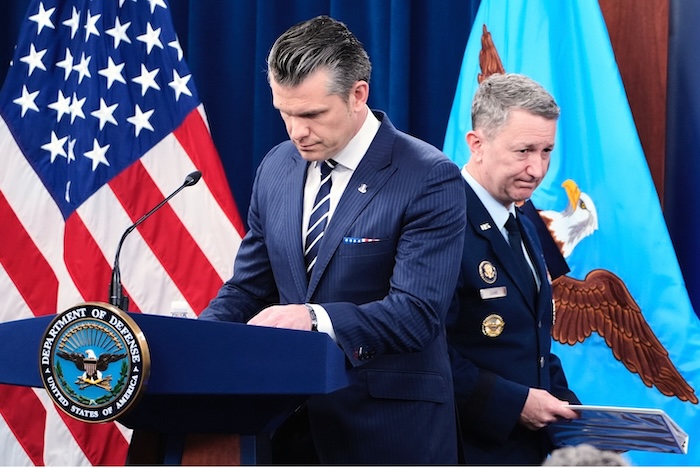
Defense Secretary Pete Hegseth and Joint Chiefs Chair Gen. Dan Caine at a Pentagon news conference on Sunday. Alex Brandon/AP |
|
|
You're reading a free promotional version of Our Land, and we hope you enjoy David's exclusive writing and don't want to miss out on what's next. Sign up to start receiving a free 30-day trial of Our Land and enjoy all of the behind-the-scenes reports and interactive features with each issue.
|
|
|
It was hard for me to ponder Donald Trump’s attack on Iran without thinking of this: |
In the immediate aftermath of the US bombing raid on Iranian nuclear facilities, a careful evaluation of the mission and its purported success was impossible because Trump and his team lie.
We can surely state—as have Democratic and Republican critics of the strike—that the assault violated both the Constitution, which hands Congress, not the president, the authority to declare war, and the War Powers Resolution of 1973, which compels the president to obtain specific authorization from Congress before launching a military strike (unless the United States is attacked) and which, unfortunately, has often been breached by Republican and Democratic presidents. |
|
|
We can also acknowledge there’s no way to judge the full results of a military action so quickly. Even if the US knocked out these nuclear sites, we can’t know what the consequences will be. “Cry ‘havoc!’ and let slip the dogs of war,” Shakespeare wrote. The 2003 invasion of Iraq looked like a success until it didn’t—and years of chaos and civil war ensued that consumed the lives of about 4,500 American troops and an estimated 200,000 Iraqi civilians. The 2001 invasion of Afghanistan routed the Taliban and dismantled the support system for al-Qaeda. But then came 20 years of fighting—and the loss of about 2,500 American soldiers and the spending of $2.3 trillion. For what? Throwing a strong first punch doesn’t always end the matter in war. There’s an old military saying: The enemy gets a vote.
As of now, the bombing raid has not yielded a larger war. But the dust has yet to settle. Iran has many avenues of retaliation available. Its counter may come soon, or in a while, or never at all. On Monday, it lobbed missiles at a US military base in Qatar and caused no reported injuries, in what was considered a just-for-show response. A few hours later, Trump issued a social media post announcing that Israel and Iran had agreed to a ceasefire. But the New York Times reported that a spokesperson for the Israeli military declined to confirm—or even comment on—Trump's statement. The newspaper noted, “this is all a fluid and unclear situation.”
However this shakes out, one reasonable expectation is that the raid will convince Iran that now more than ever it needs a nuclear weapon. Or perhaps a large cache of biological and chemical weapons—and an armada of advanced drones to deliver them. Or that it should answer with asymmetrical warfare—that is, acts of terrorism. There likely will be uncertainty on this front for some time. Don’t break out the champagne yet. (For a good preliminary and skeptical look at the US attack, check out this day-after thread posted by Jeffrey Lewis, an arms control expert.)
Moreover, we can’t believe anything Trump and his crew say about the strike. In announcing the attack, Trump declared Iran’s nuclear program had been “completely and fully obliterated.” But the next morning, Gen. Dan Caine, the chair of the Joint Chiefs of Staff, said the nuclear facilities had sustained “extremely severe damage and destruction.” That’s not annihilation. And other senior administration officials that day conceded that they did not yet have a read on what was left or even the whereabouts of Iran’s stockpile of highly enriched uranium. It was possible that Iran had moved enriched uranium and crucial equipment prior to the bombing raid. (Iran reportedly had no bomb-grade uranium but possessed uranium enriched far more than necessary for civilian use.)
The Trump gang even pulled out an old, discredited playbook: misrepresenting or ignoring intelligence. The intelligence community had been clear on Iran’s nuclear program. In March, it released its annual threat assessment, which stated: “We continue to assess Iran is not building a nuclear weapon and that Khamenei has not reauthorized the nuclear weapons program he suspended in 2003, though pressure has probably built on him to do so.” Director of National Intelligence Tulsi Gabbard, during congressional testimony that month, said the same.
But that conclusion did not matter. Trump, who has often boasted that with his big brain he’s smarter than the generals and the analysts, didn’t feel compelled to even bother to claim that there was new intelligence that supported the case for attacking Iran. He just disregarded this assessment and pulled the trigger.
The morning after the attack, Defense Secretary Pete Hegseth was asked what fresh intelligence had been acquired since the March report that showed Iran was now developing nuclear weapons and, thus, posed a pressing threat. He responded, “The president has made it very clear that he's looked at all the intelligence and come to the conclusion that the Iranian nuclear program is a threat.” In other words, there was no new intelligence. The president had tossed aside the intelligence community’s finding, and the administration didn’t care how this looked.
On Meet the Press, Vice President JD Vance was pushed on this point, as well. Asked if he and Trump trusted the intelligence community and its assessments, he replied, “Of course, we trust our intelligence community, but we also trust our instincts.” He was saying that Trump went to war on a hunch.
Maybe Vance realized this sounded ridiculous, for he added that the administration had gathered intelligence that the Iranians were “stonewalling” the ongoing negotiations. He did not elaborate. Yet on Friday, the day before the attack, the White House said it supported the ongoing European talks with Tehran, and earlier in the week Trump indicated he would give negotiations two weeks. It’s hard to believe that intel came in that indicated Iran was suddenly slow-walking the talks and, therefore, a strike had to be launched right away.
There was even double-talk about regime change—the bugaboo of the MAGA right with its association with so-called “forever wars.” Following the raid, Secretary of State Marco Rubio proclaimed, “This wasn’t a regime change move.” And Vance said, “Our view has been very clear that we don't want a regime change.” But then Trump shot out a social media post: It’s not politically correct to use the term, “Regime Change,” but if the current Iranian Regime is unable to MAKE IRAN GREAT AGAIN, why wouldn’t there be a Regime change??? MIGA!!
So who knows? Trump Sycophant No. 1 Lindsey Graham quickly jumped on this with a post that said, “President Trump is spot on with his desire to make Iran great again by changing the regime.” With this coy reference to regime change, Trump was undermining his top officials and suggesting to Iran (and the world) that these assurances meant nothing. |
|
|
After the attack, House Speaker Mike Johnson released a statement saying, “The military operations in Iran should serve as a clear reminder to our adversaries and allies that President Trump means what he says." It actually was a clear reminder of the opposite. Trump had indicated he was willing to give diplomacy a chance. Then he didn’t. He said the targets were completely destroyed. Maybe not. His team insisted the attack was not part of a war of regime change. He signaled it might be. How should other nations in the future—friends or foes—regard his statements? How should we? If Iran were now willing to engage in diplomacy, how could it cut a deal with a man whose word (or social media posts) means nothing? A major victim of this attack is American credibility.
“In war,” Aeschylus said, “truth is the first casualty.” Trump long ago killed the truth. Lies and disinformation are his most treasured weapons. Consequently, he paved the path to this war with erratic statements, disingenuousness, and dishonesty. Whatever the impact of the attacks on Iran’s nuclear program—we can’t believe what Trump will say about this—his deployment of such a toxic mix is unlikely to make the world a safer place.
Got anything to say about this item—or anything else? Email me at ourland.corn@gmail.com. |
|
|
The Watch, Read, and Listen List |
Surviving Ohio State. I’ll get right to the point and reveal the big news of this HBO documentary about the sexual abuse scandal at Ohio State University, which ain’t much of a spoiler: Jim Jordan knew.
Jordan, of course, is the combative, Trump-toadying, often-jacketless Republican congressman from Ohio. Once an NCAA Division I college wrestling champion, Jordan was an assistant wrestling coach at OSU for eight years before he entered politics in the mid-1990s. His time with the squad coincided with the stretch during which Richard Strauss, a physician for the wrestling team and other athletic programs at the school, routinely sexually abused—and in some cases raped—student athletes and students who did not play sports. His victims numbered in the thousands. When the scandal broke in 2018, Jordan claimed he had not known about Strauss, though Strauss’ conduct—showering with the athletes, groping them during physicals, insisting on genitalia exams that weren’t needed—had been widely known among wrestling team members and the OSU athletic staff. Surviving Ohio State, a powerful account of the scandal co-produced by George Clooney and directed by Eva Orner, who won the best documentary Academy Award for producing Alex Gibney’s Taxi to the Dark Side in 2008, makes it clear: There is no way that Jordan wasn’t aware of Strauss’ criminal conduct.
Jordan’s role in the scandal is not the sole focus of the documentary. With poignant and moving interviews of former students who were abused by Strauss, Orner chronicles a two-decade-long crime spree that was enabled by a coverup mounted by the school’s administration. Strauss, who killed himself in 2005, did not operate in the shadows. He assaulted and exploited these young men practically out in the open with impunity. And for years, he displayed what can be called excessively creepy behavior outside the examination room that prompted questions but no inquiries. When the coach of the fencing team—who happened to be a woman—heard what he was doing to male athletes, she raised a fuss and called for an investigation. Her concerns were not taken seriously, and the administration sidestepped the matter.
Why did these officials let Strauss continue to sexually assault the young men in their charge? Orner presents several reasons. Strauss was pumping steroids into the athletes on various teams. Had he been kicked out for his misdeeds, he might have blown the whistle and caused a scandal for the school. But it seems that the administration mostly wanted to prevent headlines reporting OSU was a school unsafe for its students. The abuse continued for two decades.
Orner also examines why the athletes never went public. Many were at OSU on scholarships that they feared losing if they caused a stir. For some, the machismo that came with being an athlete at a top-tier school presented a psychological barrier of humiliation and shame to admitting an older man had exploited them. Orner’s interviews with the former OSU students are heartbreaking, with several recounting that they quit their teams because of Strauss’ actions and forfeited their dreams of further athletic triumphs and, in some cases, professional sports careers.
That’s why Jordan’s phony denial stings so much. When the news was breaking on the scandal, he tried to lean on some of the wrestlers he once coached to back up his absurd claims of ignorance. The film shows how both Jordan and Russ Hellickson, the legendary head coach of the wrestling team, turned their backs on their athletes by going along with the coverup. What’s aggravating about Surviving Ohio State is that it demonstrates that Jordan got away with what appear to be bogus denials. He does not deserve to serve as an elected official. (He turned down an interview request for the film.) The school administration is just as bad. Even though it commissioned a report that confirmed the Strauss allegations, it refused to provide a fair settlement to the former students, forcing a lawsuit that is still ongoing.
Online I’ve seen grousing that HBO has not been heavily promoting Surviving Ohio State—though this past weekend it was touted on the Max streaming site as one of its Top 10 films. It’s an important work but a sad reminder that Jordan, who now chairs the House Judiciary Committee and who is widely believed to desire the speaker’s gavel, appears to have enabled an abuser and lied about it. Once upon a time, involvement in such a scandal would have ended a politician’s career. Now it’s just a footnote.
|
|
|
“Curtis Yarvin’s Plot Against America,” Ava Kofman, the New Yorker. It is tough to convey to people not deep into politics how extreme and bizarre the conservative movement has become. MAGA is not merely a further right version of, say, Reaganism. It is a coalition—or political cult—that happily incorporates fringe-ists and radicals propounding explicitly anti-democratic and hyper-authoritarian notions that are, in the language of political theory, bonkers. These notions are not reserved for the dark corners of the movement. They are center-stage and cheered on by its overlords. This is all made clear in a recent 11,000-word profile of Curtis Yarvin by Ava Kofman for the New Yorker.
You might have previously heard of Yarvin as something of a far-right political theorist who pooh-poohs democracy and celebrates monarchy and who is much in favor within the libertarian quarters of Silicon Valley that despise the strictures and messiness of regulatory democracy. But such a description does not do the man justice. He is a crackpot crank poseur who dresses up the basest of notions—people are fools, they need to be led by a strongman—with the highfalutin political rhetoric crafted by thinkers of previous centuries or obscure intellectuals. As a blogger and Substacker, he is easy to dismiss as a too-smart-for-his-own-good uber-elitist contrarian. Yet what makes his story—and this article—disturbing (terrifying?) is the entrée he enjoys with people who do hold power. We’re talking tech titans Peter Thiel and Marc Andreessen and JD Vance.
Let’s be specific. As Kofman notes, in a 2008 manifesto—and how pretentious must one be to write a manifesto?—Yarvin
proposed “the liquidation of democracy, the Constitution, and the rule of law,” and the eventual transfer of power to a C.E.O.-in-chief (someone like Steve Jobs or Marc Andreessen, he suggested), who would transform the government into “a heavily-armed, ultra-profitable corporation.” This new regime would sell off public schools, destroy universities, abolish the press, and imprison “decivilized populations.” It would also fire civil servants en masse (a policy [he] later called RAGE—Retire All Government Employees) and discontinue international relations, including “security guarantees, foreign aid, and mass immigration.”
Techies, libertarians, and so-called rationalists grooved to this. Thiel became a pal. So, too, the guy who is first in line to the presidency:
In a 2021 appearance on a far-right podcast, Vice-President JD Vance, a former employee of one of Thiel’s venture-capital firms, cited Yarvin when suggesting that a future Trump Administration “fire every single mid-level bureaucrat, every civil servant in the administrative state, replace them with our people,” and ignore the courts if they objected. Marc Andreessen, one of the heads of Andreessen Horowitz and an informal adviser to the so-called Department of Government Efficiency (DOGE), has started quoting his “good friend.”
In his verbiage-loaded writings, Yarvin has proclaimed Trump to be “biologically suited” to be an American monarch. And still people on the right take Yarvin seriously. In 2022, he suggested Trump, if he were to win, ought to install Elon Musk as the manager of the executive branch. (Hmmm.) Another time, he contended that an American Caesar would have shut down institutions of civil society, such as Harvard. So his unconventional (to be polite) views ought to be noted as an early warning signal.
He has hailed the Great Replacement conspiracy theory, which claims evil elites in the West are scheming to replace white people with those of darker skin. Perhaps as a sign of his daring, he has used the n-word. He has asserted that “ghetto Blacks” should be forced to live in a “traditional way.” (Think Orthodox Jews or the Amish.) He once wrote that it is crucial to find “a humane alternative to genocide,” an outcome that “achieves the same result as mass murder (the removal of undesirable elements from society) but without any of the moral stigma.”
None of this is a turn-off for his influential buddies, such as Thiel, who in 2009 wrote, “I no longer believe that freedom and democracy are compatible.” Andreessen, Kofman tells us, “has been known to urge his associates to read Yarvin’s blog.” And Vance follows Yarvin on X. Yarvin was feted at an exclusive and pricey inauguration party in January. (Don’t forget that Vance is where he is today in part because Thiel spent $15 million to help elect Vance to the US Senate in Ohio in 2022.)
Yarvin’s anti-democratic kvetching appeals to those who confuse politically incorrect contrarianism that defies convention (and polite society and constitutionalism) with courage. He’s the theorizer-in-chief for those who have no faith in the American experiment and who value outrage, disruption, bigotry, and meanness draped with smarty-pants esotericism. His princely status in the MAGA cosmos is further sign of its dangerous, autocratic, and racist currents that run straight into the White House.
|
|
|
Congratulations, you read all the way to the end! It's a great time to say "I'm in" and start your free 30-day trial. Make sure you don't miss out on what's next: Sign up to start getting Our Land in your inbox each week. We also want to hear from readers (especially those who read the whole thing!). So let us know what you think so far or share something interesting with David at ourland.corn@gmail.com.
|
|
|
|