FREE TRIAL VERSION. DON'T MISS OUT. |
FREE TRIAL VERSION. DON'T MISS OUT. |
|
|
Tulsi Gabbard Goes Crazy for Putin |
By David Corn June 17, 2025 |
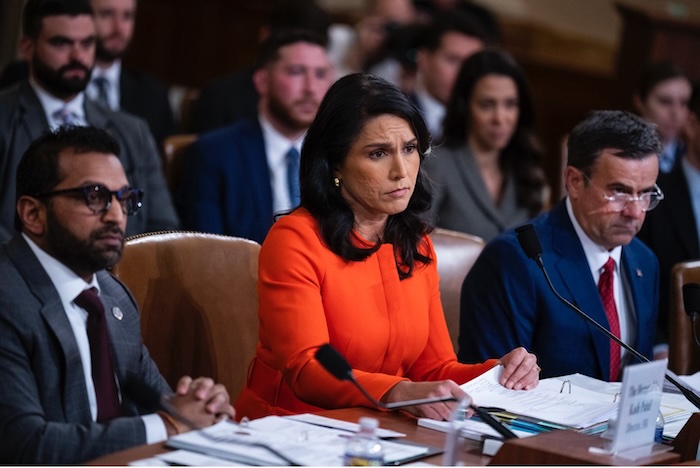
Director of National Intelligence Tulsi Gabbard, with FBI Director Kash Patel and CIA Director John Ratcliffe, testifying to Congress on March 26. Tom Williams/CQ Roll Call via AP |
|
|
You're reading a free promotional version of Our Land, and we hope you enjoy David's exclusive writing and don't want to miss out on what's next. Sign up to start receiving a free 30-day trial of Our Land and enjoy all of the behind-the-scenes reports and interactive features with each issue.
|
|
|
Iran and Israel are lobbing missiles at each other. The Ukraine-Russia war is not any closer to resolution. Tensions in the Taiwan Strait are increasing. And the woman in charge of US intelligence is a conspiracy nutter.
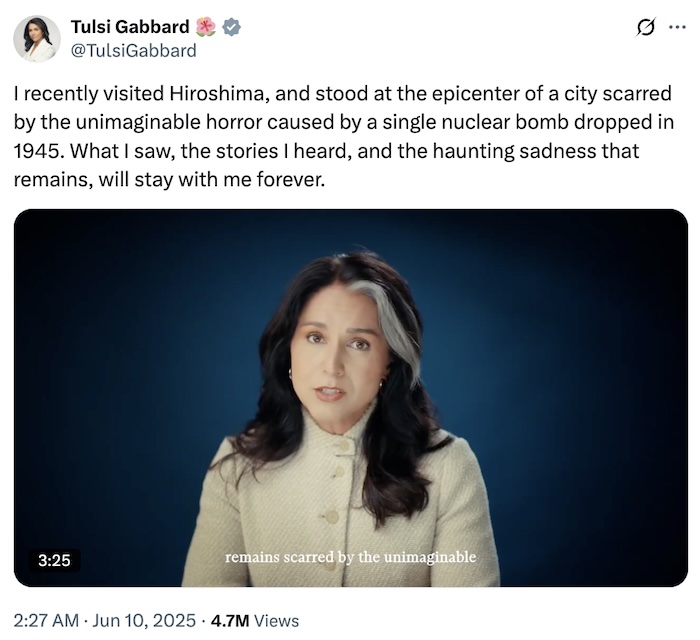
A few days ago, Tulsi Gabbard, the director of national intelligence, released a highly produced and bizarre video. Gazing into the camera, she noted she had recently visited Hiroshima, Japan, and had stood at the “epicenter of the city that remains scarred by the unimaginable horror caused by a single nuclear bomb dropped in 1945.” She said it was hard for her to “find the words to express what I saw.” The attack, she pointed out, “obliterated the city and killed over 300,000 people, and the survivors carried the pain of burns, radiation sickness, and cancer for decades.”
She accurately noted that the bomb that destroyed Hiroshima was “tiny compared to today’s nuclear bombs.” As this video displayed graphic imagery of a simulated nuclear attack on San Francisco, she explained that a single nuclear weapon now could kill millions in minutes and yield “a nuclear winter” that plunges the world into “darkness and cold, killing crops and starving billions.” |
|
|
This is a useful reminder of the tremendous threat to humanity and the planet that exists every day. Nuclear weapons and their continuing proliferation pose the greatest danger for Americans and people everywhere. Yet it’s a matter rarely prioritized in our national discourse, and Gabbard was right to call attention to this. But then in the video she shifted gears:
This isn’t some made-up science fiction story. This is the reality of what’s at stake, what we are facing now. Because as we stand here today, closer to the brink of nuclear annihilation than ever before, political elite and warmongers are carelessly fomenting fear and tensions between nuclear powers. Perhaps it is because they are confident that they will have access to nuclear shelters for themselves and for their families that regular people won’t have access to. |
What? Political elites are cavalierly pushing policies that could trigger nuclear war because they have their secret bunkers in which they could survive a nuclear conflagration? This is crazy. There have long been war hawks, but these misguided souls are not driven by the prospect of a clean getaway to a shelter or an underground city. They’re just wrong.
But there seems to be a belief in cuckoo land that there’s a Deep State cabal that has set up an escape plan for itself. Catherine Austin Fitts, a Housing and Urban Development official during George H.W. Bush’s presidency, recently claimed on Tucker Carlson’s internet show that the US government has covertly spent $21 trillion to build underground metropolises for the elites. This is Alex Jones–level stuff. It’s bonkers that Gabbard, the government’s top intelligence official, is asserting something similar. Let’s see the intel! It’s also dismaying that the person in charge of that nation’s most important secrets and the intelligence that is delivered to the president has such questionable judgment and evaluative powers.
And there’s something else going on—a not-so-hidden agenda for Gabbard. She closes the video with this: “So it’s up to us, the people, to speak up and demand an end to this madness. We must reject this path to nuclear war and work toward a world where no one has to live in fear of a nuclear holocaust.” That sounds fine. But what’s the “madness” she speaks of? What’s the source of the rising “tensions” between nuclear powers that prompts her concern?
It's all about Russia and Ukraine. What Gabbard is doing is amplifying a key talking point from Russian tyrant Vladimir Putin. He’s long contended that the West, by supporting Ukraine, is increasing the chance of nuclear war. Yet that’s because he himself has threatened to retaliate to a conventional attack on Russia with nuclear weapons. And with this message, Gabbard is essentially backing up Putin. The elites and warmongers who imperil the globe and whom she decries are people who support providing aid to Ukraine so it can counter Russia’s illegal invasion and preserve itself as a democracy. For her, Putin, who invaded Ukraine and now rattles his nuclear saber, is not the threat.
Gabbard has previously echoed Moscow talking points. When Putin invaded Ukraine, she blamed the West, not Russia, tweeting, “This war and suffering could have easily been avoided if Biden Admin/Nato had simply acknowledged Russia’s legitimate security concerns.” But she did that as a private citizen. She now is bolstering Russian propaganda as the most senior official in the US intelligence community.
The notion that a director of national intelligence would call on the public to rise up against unnamed but implied supporters of Ukraine is almost unbelievable. But not in the Trump administration. And why is Gabbard spending her time on paranoia peddling rather than doing her job overseeing the intelligence community?
In this Putin-aiding propaganda, Gabbard left out an important piece of the equation. In mid-February, President Donald Trump declared: “There’s no reason for us to be building brand new nuclear weapons. We already have so many.” Yet, as Politico noted recently, “Trump’s policies have set in motion the opposite trend: potentially the fastest and most dangerous acceleration of nuclear arms proliferation around the world since the early Cold War.” And the United States, on Trump’s watch, continues to modernize its nuclear arsenal. The Trump administration is currently requesting a huge increase in the annual budget for nuclear weapons from $19 billion to $25 billion. This includes money for designing and manufacturing new nuclear weapons.
Rather than fretting about shadowy elites and their Club Med bomb shelters, Gabbard could be pushing policies to reduce nuclear arsenals at home and around the globe. (Putin has been modernizing Russia’s nuclear arsenal, too.) |
|
|
It's been hard to convey to Americans just how extreme and barmy many Trump appointees are. Health and Human Services Secretary Robert F. Kennedy Jr., the anti-vaxxer and promoter of assorted conspiracy theories, is waging war on vaccinations and operating on a bogus theory of disease that dates back to ancient civilization (long before the discovery of germs). FBI Director Kash Patel, the right-wing provocateur who championed J6 rioters, still insists there was no Russian attack on the 2016 election. (The FBI disbanded its Foreign Influence Task Force—a win for Putin.) At the Department of Homeland Security, the White House appointed Thomas Fugate, a 22-year-old former intern of the far-right Heritage Foundation and MAGA activist, to head the government’s main office for terrorism prevention. This is all nuts and also dangerous, and Democrats have not been able to display to the public the full absurdity of these and other Trump appointments.
Gabbard is correct to highlight the profound threat of nuclear weapons. Unfortunately, she’s doing so to help Putin and undermine support for Ukraine. That’s not the way to a safer world. Got anything to say about this item—or anything else? Email me at ourland.corn@gmail.com |
Michael Flynn’s Big Discovery |
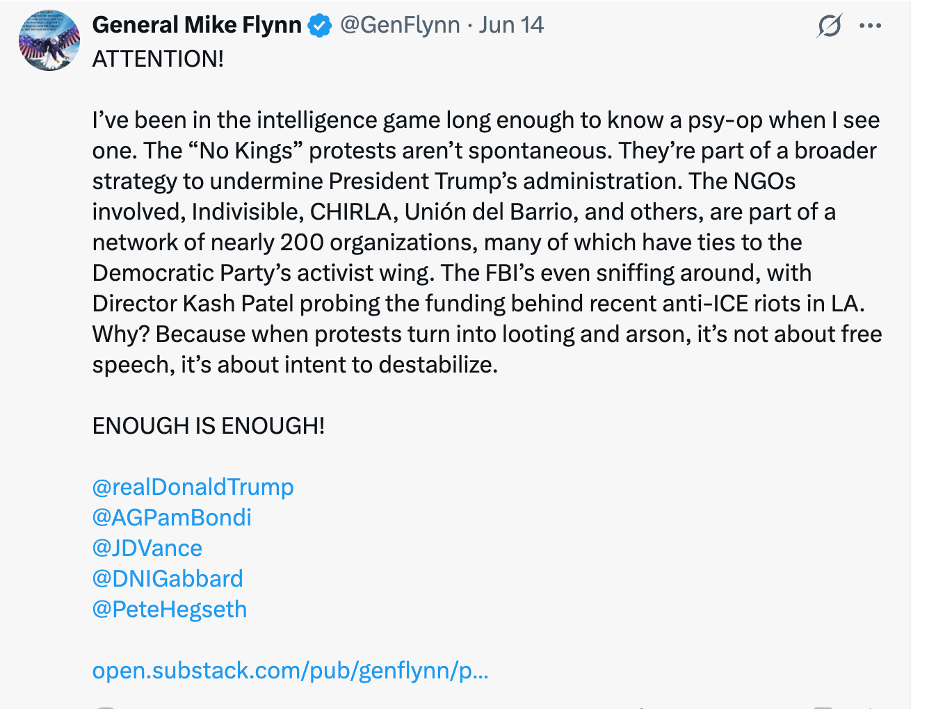
While we’re on the topic of screwballs in Trump’s orbit, don’t forget about retired Gen. Michael Flynn, Trump’s first national security adviser in his initial presidency who was bounced from the job (for lying about contacts with the Russian ambassador) and who went on to become a QAnon-lovin’ election denier, grifter, and Christian nationalist favorite. (I wouldn’t be surprised if somehow he worms his way into an official position in Trump 2.0.) Look at what he posted on the day of the "No Kings" protests:
|
So the big secret discovered by Flynn, who once (believe it or not) was the head of the Defense Intelligence Agency, is that the June 14 protests were…organized! And that they were organized by political groups that oppose the Trump administration. Oh my! What’s more, some of these outfits—gasp!—have ties to the Democratic Party.
There’s nothing for the FBI to be “sniffing” at. These entities pulled together peaceful protests, not riots. And the few violent melees that previously occurred in Los Angeles adjacent to anti-ICE demonstrations were hardly actions mounted to “destabilize” the nation. Flynn is trying to cook up his own conspiracy theory that’s a throwback to the 1960s when Richard Nixon and the FBI believed that antiwar and civil rights protests were not genuine expressions of public opinion but plots covertly orchestrated and funded by the Soviet Union, commies, and other nefarious players. Don’t be shocked if the Trumpers bite.
|
Last week, Maybe Happey Ending won the Tony award for best new musical. A few months ago, I wrote about this wonderful play for our “Watch, Read, and Listen List” (a feature only available in the premium edition of Our Land), and here’s that item again:
Profound creativity is inspiring. As I watched the new Broadway hit Maybe Happy Ending, I was moved by the extreme inventiveness of the production. It was hard to imagine how anyone had imagined such an imaginative musical—let alone turn it into reality on a stage. The story of Maybe Happy Ending is both a touch corny and thought-provoking. It’s 2064 in Seoul. Helperbot Oliver, a sentient android, is living in what’s essentially a retirement home for robotic domestic servants who have been put out to pasture. He likes listening to jazz and tending to his (plastic) plant, HwaBoon. It’s been 10 years since his owner James sent him to the Helperbot Yards, and Oliver still fervently believes that any day now James will arrive to retrieve him. (No spoiler alert: James is not coming.) Then he meets the Helperbot across the hall, Claire, who needs to borrow not a cup of sugar but a charger.
The two uneasily bond, and though they agree not to fall for one another, this being a musical, you know what’s coming. Eventually, the two go on a road trip in search of James and, for Claire, fireflies, which now only exist on one island in South Korea. And, of course, because they are robots, this is about human relationships and such weighty issues of love and death. But the poignancy—and there’s plenty of it—is never mawkish or overly sentimental. At one point, Oliver learns that Claire’s “shelf life” will end before his, and in anguish he asks, “How can people do this?” Yes, why do we invest so much in love, and how do we live with deep loss?
The show raises intriguing issues about artificial intelligence, memory, and what it means to be human—without being too highfalutin. And the tunes are catchy—“landing somewhere between Bacharach and Sondheim,” per the New York Times—especially as performed by the two winning stars, Darren Criss (who starred in Glee and won an Emmy for portraying killer Andrew Cunanan in The Assassination of Gianni Versace: American Crime Story) and Helen J. Shen, a Broadway newcomer. But what blows the audience away is how all this is packaged in one of the most innovative stagings in Broadway history. Using smart screens, sliding panels, video imagery, incredible lighting, and movable sets, Maybe Happy Ending, directed exquisitely and thrillingly by Michael Arden, is presented in multiple, size-and-shape-shifting boxes, as if you’re viewing it on a high-tech device. This is no gimmick. It is visually stunning.
First produced in Korea nine years ago, Maybe Happy Ending is clever, original, unique, accessible, and teeming with how-did-they-do-that creativity. I was in awe for an hour and 40 minutes. The below clip—one of the few available—doesn’t do it justice: |
|
|
The Watch, Read, and Listen List |
Sly Lives! (AKA The Burden of Black Genius). When Sly Stone (née Sylvester Stewart) died last week, the New York Times headlined its front-page obituary “Funk Maestro Who Provoked in Platform Shoes.” By citing just one musical genre, the Times did Stone a disservice, though the obit made clear the obvious point about him: He was an innovative pioneer who formed a multiracial and multigender band that fused soul, pop, funk, rock, R&B, and church music. He forged paths no other artist had traveled before and shaped the foundations of American music and culture.
Stone generated multiple hit albums in the late 1960s and early 1970s that appealed to white and Black music lovers. But it would be wrong to dub him a crossover act. He was a musician of immense gravity who pulled various audiences toward him. This included white hippies who dug his tremendous performance at Woodstock and Black soul fans who saw him as a beat-champion in the vanguard of Black culture. His rise as both a musician and symbolic figure was epic, as was his tragic descent into years of drug abuse and instability.
Sly Lives, the recently released documentary directed by Questlove, the highly accomplished filmmaker (Summer of Soul) and Grammy-winning co-frontman of The Roots (the house band for Late Night With Jimmy Fallon), poignantly captures the legendary ups and downs of Stone’s ride through the American cosmos. He started out as a San Francisco DJ who had great ears for the music of the day, producing hit singles for new bands. Once he formed his own group, Sly and the Family Stone, and hit the recording studio, he and his comrades created music like no one else had, churning out a string of irrepressible chart-topping songs: “Dance to the Music,” “Everyday People,” “Stand!” “Thank You (Falettinme Be Mice Elf Agin),” “I Want to Take You Higher,” and others. Until I saw this film, I never thought much about the fact that the first album I bought by a Black artist when I was a teen was a Sly and the Family Stone record.
Questlove gracefully covers Stone’s decline. He fell into a drug-laced abyss. He wouldn’t show up for gigs. The band disintegrated. The string of hits ended. From the outside, it appeared he couldn’t handle all that success. But Questlove doesn’t package this as a typical rise-and-fall tale. With the help of interviews with Black musicians who came along after Stone, he explores what he calls the “burden of Black genius,” suggesting that a Black person who reaches such heights faces a set of challenges not generally confronted by white artists. A Black phenom is expected to remain part of the hood, while leaving the hood, and, moreover, to represent his or her community. Did anyone ask Mick Jagger to be a leader for white people? Questlove shows us that Stone was one of the first Black musicians to reach this position and, thus, had no one he could look to as an example on how to get it right.
It's an intriguing framework for examining Stone’s life and for applying his story to Black culture today. What’s more obvious, in terms of Stone’s relevance, is how he paved the way to hip-hop. His treasure chest of imaginative beats and hooks was perfect for plundering by the record-scratchers and rappers of the 1980s and those who came later. As the film notes, Stone derived the alphabet for generations of Black music that followed. The triumph of Stone as a genius is inspiring. What makes the film sad, in part, is that he did not—or could not—better navigate the burden of success.
|
|
|
“Love & Mercy,” the Miraculous Love Kids with Brian Wilson and Roger Daltrey. About 15 years ago, musician Lanny Cordola formed a nonprofit called Miraculous Love Kids, which teaches guitar to children, particularly young girls, in war-torn and poverty-stricken countries, such as Afghanistan and Pakistan. The organization has produced songs and videos featuring the young beneficiaries of the program collaborating with musicians Tom Morello, Nils Lofgren, Sia, Blake Shelton, Nancy Sinatra, and others.
Last month, the Miraculous Love Kids released its latest track, which features Roger Daltrey of the Who and Brian Wilson, the master Beach Boy, who died a few days ago. The tune is “Love & Mercy,” which Wilson wrote and released in 1988 for a solo record. It’s also the title of a wonderful 2014 movie about Wilson and his troubles, with Paul Dano playing the young Wilson of Beach Boys days and John Cusack cast as the older and overly medicated Wilson, who was contending with mental disease and an oppressive therapist.
Like Sly Stone, Wilson was a musical genius burdened by his remarkable talent and excessive success. When he died, I observed, “Brian Wilson heard immensely beautiful things the rest of us do not. We can be grateful that he did the hard work to make all of that real for us. From his brilliant mind to our ears.” (I was delighted my comment made it on to a list of social media posts about Wilson compiled by the Wrap that included tributes from Stephen King, Mick Fleetwood, Cusack, Nancy Sinatra, Carole King, Ronnie Wilson, and Micky Dolenz.) I don’t know if Willson’s track with the Miraculous Love Kids is the final song of his to be released, but it is a fitting offering from an artist whose music impacted and inspired people around the world.
|
| |
Congratulations, you read all the way to the end! It's a great time to say "I'm in" and start your free 30-day trial. Make sure you don't miss out on what's next: Sign up to start getting Our Land in your inbox each week. We also want to hear from readers (especially those who read the whole thing!). So let us know what you think so far or share something interesting with David at ourland.corn@gmail.com.
|
|
|
|