FREE TRIAL VERSION. DON'T MISS OUT. |
FREE TRIAL VERSION. DON'T MISS OUT. |
|
|
Why the Comey “8647” Controversy Matters |
By David Corn May 20, 2025 |
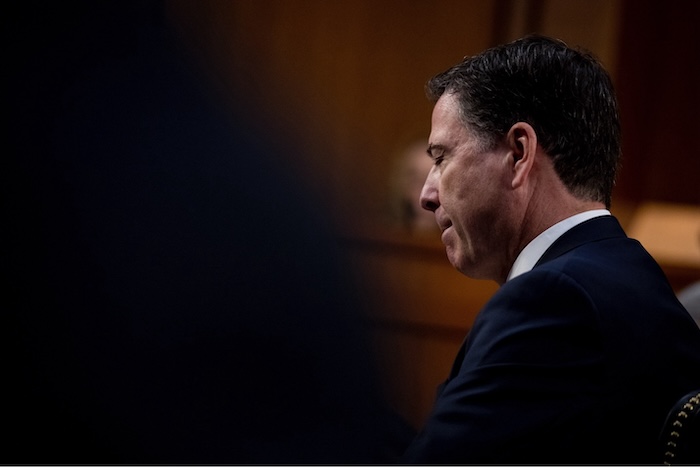
Then–FBI Director James Comey testifying on Capitol Hill on June 8, 2017. Andrew Harnik/AP |
|
|
You're reading a free promotional version of Our Land, and we hope you enjoy David's exclusive writing and don't want to miss out on what's next. Sign up to start receiving a free 30-day trial of Our Land and enjoy all of the behind-the-scenes reports and interactive features with each issue.
|
|
|
Lock her up! That mantra of Trumpism embodied the dark soul of this hate-fueled political movement. It was a pure expression of the loathing residing at MAGA’s core. This cheer did not merely state a desire for electoral triumph; it was a call for the annihilation of an enemy maligned and denigrated as a criminal unfit to live freely within American society. And for the Trumpified GOP base, this beyond-the-pale, over-the-top cry that violated the rules of acceptable debate generated a rush. One night, at the Republican presidential convention in Cleveland in 2016, as the crowd loudly and gleefully chanted those words, I asked an elected Texas official and delegate standing next to me what he thought of the moment. “This is fun!” he exclaimed, joining the throng in shouting this slogan.
MAGA-ites have been jonesing on vicious revenge fantasies ever since. Besides targeting Hillary Clinton, they have called for the imprisonment of Barack Obama, Joe Biden, Nancy Pelosi, and many others. In 2022, Kash Patel reposted an AI-generated video showing him using a chainsaw to chop off the heads of Biden, Chuck Schumer, Pete Buttigieg, Dr. Anthony Fauci, Merrick Garland, and other political foes. A year later, Donald Trump suggested that Gen. Mark Milley, the chair of the Joint Chiefs of Staff, ought to be executed. He boosted a post from Rep. Marjorie Taylor Greene that demanded Biden be handcuffed and hauled out of the White House. On Sunday, Trump amplified a social media post from a QAnon-aligned account that called for a military tribunal for Obama.
Each act of vicious reviling gives a jolt to Trump’s cult followers. They need the dopamine hit that comes from seeing their heroes vow to demolish (or behead) their political rivals. (Remember when MAGA strategist Steve Bannon called for putting the heads of Fauci and then–FBI Director Chris Wray “on a pike”?) It’s a red-meat addiction that demands more zealous enunciations of malice. Lock her up evolved into Hang Mike Pence.
|
|
|
It is within this context that we should look at the contretemps that occurred last week when former FBI Director Jim Comey posted on Instagram a photograph of seashells on a beach arranged to proclaim “8647.” What a cute dig at Trump, who fired him in 2017 to smother the Trump-Russia investigation, Comey probably thought. To “86” something—a term that originated in the restaurant industry—generally means to remove an item or refuse service. Yet Trumpland went bonkers, absurdly claiming that Comey’s post was a call to murder Trump. (Comey took down the post, noting, “I didn’t realize some folks associate those numbers with violence. It never occurred to me.”)
Trump, of course, seized the moment, telling Fox News that Comey “knew exactly what that meant. A child knows what that meant...That meant assassination.” That was a lie, but his henchwomen were quickly on the case. Tulsi Gabbard, the director of national intelligence, exclaimed that Comey should be jailed, and Secretary of Homeland Security Kristi Noem announced that the Secret Service would be investigating Comey. Referring to the Comey post, Ed Martin, the MAGA provocateur and defender of January 6 rioters whom Trump has appointed to a senior Justice Department position, tweeted, “their plan is killing: they are a clear and present danger.” And on Friday, Comey was interviewed by Secret Service agents—a pointless waste of resources.
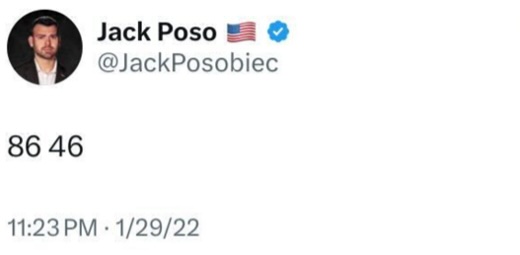
Leading the charge was MAGA provocateur Jack Posobiec, who years ago peddled the phony Pizzagate conspiracy theory and who has fashioned himself into a pro-Trump media figure. He declared, “The fmr director of the FBI is calling for left-wing assassins to target our president and kill him. Have no idea why he hasn’t been arrested yet.” Yet in 2022, Posobiec himself tweeted, “86 46.” Lock him up?
|
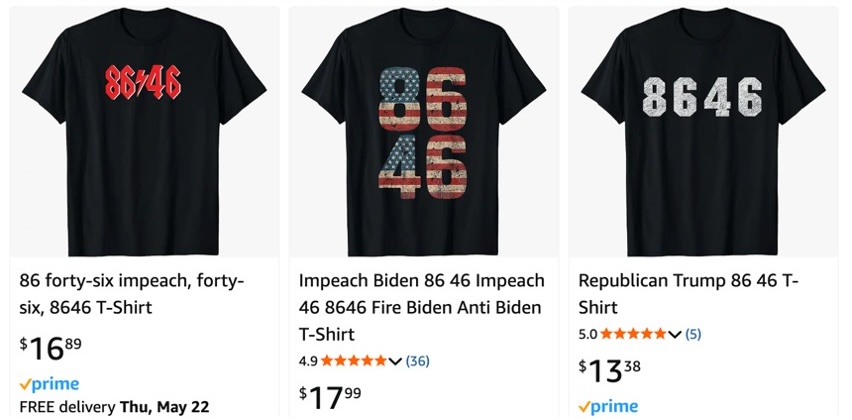
“86 46” had been a popular slogan on the Trumpist right. You can still order these T-shirts from Amazon: |
The one on the left with Nazi-like lettering is especially fetching.
This controversy might come across as yet one more of those silly distractions that Trump is constantly orchestrating to draw attention from his large and growing pile of transgressions and failed policies. The New York Times, for instance, buried a small report on it on page A26. And an NPR social media post treated this kerfuffle in too straightforward a manner: “The former FBI director posted—then deleted—a picture of seashells forming ‘8647.’ Trump and his allies view it as a call for his assassination, but Comey says he was unaware of that meaning.” This seemingly objective rendering of facts didn’t convey the real story. Trump and his crew were cooking up a spurious allegation to delegitimize critics and, once again, satiate MAGA bloodlust.
For almost a decade, Trump has been feeding the GOP base intense shots of animus tinged with violence, characterizing his rivals as evildoers who threaten the existence of the American family and who deserve eradication. (In a recent book, Posobiec demeaned liberals as “unhumans” and praised right-wing dictators—Francisco Franco of Spain and Augusto Pinochet of Chile—for mounting killing campaigns against leftists.) Trump, his sons Eric and Don Jr., Vice President JD Vance, and various MAGA Republicans in Congress have suggested that Democrats sought to have Trump assassinated at his campaign rally last summer in Butler, Pennsylvania. The goal: Vilify his opponents in a way that depicts them as warranting extreme treatment and punishment.
All of this keeps serving up those dopamine bursts for Trump’s devotees. Now that no-good Comey wants to kill Trump! Get him! It’s the old she’s-a-witch play, which has been effective for much of human history. Rile ’em up. George Orwell in 1984 gave us the Two Minutes Hate, in which the masses are whipped into a lather of hatred against Big Brother’s enemies. Trump does this routinely with social media posts. |
|
|
The Comey dustup is dumb but not unimportant. It afforded Trump and his cult the opportunity to cast his critics as murderous villains deserving, at the least, incarceration, and to advance their Manichean narrative of demonization in which Trump and MAGA are the victims of merciless and diabolical schemers and sociopaths. Trump is on a never-ending witch hunt, ever searching for scapegoats and bogus plots he can toss to his crowd for complete despisal—to give them a thrill. He will gin up false perils and concoct fake enemies to satisfy his MAGA junkies. More alarming, it’s not unthinkable he will also do so to justify extreme measures. That’s always been a go-to move for an aspiring autocrat. Phony threats are the currency of authoritarianism and, thus, must be watched closely and debunked immediately—before they can be acted upon.
Got anything to say about this item—or anything else? Email me at ourland.corn@gmail.com. |
Goodbye, Betsy Pochoda, and Thank You |
You may not recognize the name Elizabeth Pochoda, but if you ever read the Nation, Vanity Fair, Entertainment Weekly, Grand Street, Mirabella, Vogue, House & Gardens, the Daily News, the New York Post, or the Magazine Antiques, you probably came across her handiwork. She was a brilliant editor whose career over half a century landed her in what seemed to be incongruous circumstances. Yet at each publication she graced, she applied a tenacious independence of thought to the pieces she commissioned, eschewing predictability and searching for provocative but well-grounded approaches. (I bet she hated the word “take.”) Her range was formidable. She could edit a revolutionary look at Proust or assign a well-known jewelry designer to write an essay about a single object in a collection of Americana. “I don’t believe in different brows—high, low, middle,” she told the Chicago Reader in 1993.
Betsy passed away earlier this month of ALS at the age of 83. I was fortunate to have intersected with her in the 1980s, when I was an intern and then an editorial assistant at the Nation. She was the magazine’s book review editor and tough and intimidating, having turned that section of the magazine into her own duchy, essentially independent of oversight from editor Victor Navasky. You did not share an opinion with Betsy unless you had thought it through rather carefully, for, without a blink, she would tell you what she thought of it—never in a mean fashion, but in a direct manner that made you smarter, if you listened.
She stood out from other editors in an important aspect for me. Betsy realized that we young ’uns toiling at the magazine aspired to be writers. At the time—long before websites provided unlimited space for what we now call content—it was difficult to be published in the Nation or anywhere else. There were only so many pages. And the editors there, as at other magazines, did not waste much time pondering how lower-ranked staffers and (unpaid!) interns could make their way into its pages. But not Betsy.
She launched a section that featured short reviews of books, and she hand-picked a few of us who she deemed possibly competent enough to compose these three- or four-paragraph critiques. We were not handed the latest Roth, Sontag, or Mailer to contemplate. But to this day I remember several of the books I was assigned. One was a memoir of a prison guard; another was a history of the tradition of Native American running. (I looked up that book on Amazon two days ago, and the only copy was selling for $109.06.)
Though these reviews were short, I obsessively scrutinized each line I had written repeatedly before dropping my copy on Betsy’s desk. She edited these items thoroughly and, fortunately for me, found them worthy enough to publish—and would assign me my next book. It was a thrill to see my minor offerings—some of my first published works—in print. At one point, she offered a dash of editorial advice that has stayed with me all this time: “You have to be able to kill your little jewels.” She meant a good writer must be a fierce editor who could look at his or her copy and treat it as if it had come from a stranger, free of sentimentality or ego.
I like to believe I usually adhere to that guidance, and I have shared it with young writers who care what I think about the craft. I also like to believe that I have followed Betsy’s example of encouraging newcomers. I never thanked her for that advice or the kickstart she provided and now, obviously, wish that I had. I lost touch with her a long time ago and didn’t know she was ill. Those brief book reviews were but a blip for her, given her illustrious career. But they were so important for me, validating my presumption that I could be part of the literary journalism world. Her passing is a reminder that the help we provide others—no matter how small it might seem to us—can mean so much to them. Betsy, RIP. (You can read more about her here.)
|
|
|
The Watch, Read, and Listen List |
Deaf President Now! In March 1988, the board of trustees of Gallaudet University in Washington, DC, the only college for Deaf people in the world, had to select a new president for the school. Not once had the 124-year-old school been led by a non-hearing person. Yet now it seemed possible. Two of the three candidates were Deaf, the other, Elisabeth Zinser, a vice chancellor at the University of North Carolina at Greensboro, was not. The board picked Zinser, and the student body exploded in protest, shutting down the campus by chaining the entrance gates and barricading the entries with school buses. This eruption made headlines across the country, and for the first time a disability rights movement was in the national news.
With Deaf President Now!, streaming on Apple TV+, co-directors Nyle DiMarco (a Deaf activist and past winner of America’s Next Top Model) and Davis Guggenheim (an accomplished documentary-maker best known for An Inconvenient Truth) brilliantly chronicle the moving and inspiring tale of the Gallaudet rebellion. Weaving present-day interviews of its four student leaders with archival news footage, Deaf President Now! provides a fast-paced account of seven days that shook the Deaf world and an incisive examination of that community and the audism it long faced.
Watching the footage now, it’s hard to believe the board members—most of them hearing people—were so blind to the fundamental needs and aspirations of those they supposedly served. Shortly after Zinser was named, the students marched to the Mayflower Hotel to confront the board, and on the sidewalk, Jane Basset Spilman, the haughty board chair who had never bothered to learn sign language, explained the decision to hire Zinser by apparently saying, “Deaf people are not ready to function in a hearing world.” She later claimed she had been misinterpreted. But whether she said this or not, the board’s decision reeked of a patronizing attitude and seemed predicated on the insidious belief that the school could be best led by someone outside the Deaf community who had no experience with deafness.
Those of us who were around back then know how the story ends. Still, DiMarco and Guggenheim deftly capture the drama of the protests. Students debated the best tactics. A Deaf dean supported the protests before flip-flopping—twice. An appearance on Nightline by the student body president leading the protest was gripping and poignant. It’s exhilarating to watch him and his comrades come into their own during this tide-turning week. The students’ daring and their ability to outfox the hearing people in charge proved their main point: Deafness is not limiting. In one delicious scene, Spilman, a Southern philanthropist with a patrician bearing and seemingly no awareness of Deaf culture, tries to address a gathering of students in the gym, and a fire alarm is triggered. She complains that she can’t talk with all this noise. That’s not a problem for the students.
For context, the film delves into the ugly history of how the hearing world has addressed deafness, which includes cruel efforts, tracing back to Alexander Graham Bell, to force Deaf people to learn to speak rather than sign. At times, the documentary goes silent, and a hearing viewer can, in a way, experience how the students witnessed critical moments. These are powerful interludes, underscoring that the film’s strength extends far beyond telling this compact story. DiMarco and Guggenheim offer a glimpse into what is for most of us a foreign world, and they compel us to question what is—and what is not—a disability.
The Gallaudet action sparked a larger movement, and two years later the Americans With Disabilities Act was passed by Congress and signed into law by President George H.W. Bush. This was a smart protest led by smart young adults. These days we can use such an exhilarating and uplifting story. |
|
|
Dope Thief. Sometimes a caper show is just a caper show. Apple TV+’s Dope Thief is far from high-minded. It’s a classic crime drama of the crooks-versus-crooks variety. Two ex-cons in Philadelphia, Ray Driscoll (Brian Tyree Henry) and Manny Carvalho (Wagner Moura), have a good scam going. They’ve acquired DEA badges and windbreakers, and they “bust” low-level pushers in Philly’s dilapidated hoods, grabbing whatever cash, weapons, and drugs their targets have stashed. They sell the drugs to a big-time dealer, Son Pham (Dustin Nguyen), who slips them info on what drug-houses to hit.
It goes well—and Manny is tending to his recovery—until they hit the wrong rural farmhouse where meth is being cooked. There’s a shootout, an explosion, and a fire that kills the dealers and cooks, as well as a pal they brought along for the job. Worse, soon they discover this operation was tied to a major criminal outfit that is run by an ultra-vicious biker gang and that the real DEA has been pursuing. Now the bikers and the DEA are after Ray and Manny—and everyone they hold dear, which includes Theresa Bowers (Kate Mulgrew), Ray’s lottery-addicted adoptive mother.
Over the course of eight episodes, Ray must evade both the feds and the narcos and, most of all, figure out why the bikers are coming after him so fiercely. There’s obviously more to this than the money and drugs he and Manny made off with. Meanwhile, an undercover DEA agent named Mina (Marin Ireland), who survived the debacle at the farmhouse, is in her own rogue-ish way chasing after Ray because her lover, another undercover agent, perished at the farmhouse.
The show, created by Peter Craig and based on a novel by Dennis Tafoya, is, at times, confusing (at least it was for me). There are many plot pivots, though a big reveal at the end does explain a lot. But along the way, it was occasionally hard to keep up. What makes the show special is the acting. All the leads are utterly convincing. Henry is fabulous as Ray, a street-smart hoodlum with (mostly) a heart of gold and a psychologically complicated backstory. Moura captures Manny’s desperate need to make amends. Mulgrew gives us a tough ol’ broad who just can’t quit her imprisoned beau, who is Ray’s biological and much-estranged father—played superbly by Ving Rhames. The settings—from inner-city Philly to rural Pennsylvania—are gritty and mean. And there are good cops and bad cops. Dope Thief, ultimately, is the tale of a small-timer. But Henry makes him seem bigger than that.
|
| |
Congratulations, you read all the way to the end! It's a great time to say "I'm in" and start your free 30-day trial. Make sure you don't miss out on what's next: Sign up to start getting Our Land in your inbox each week. We also want to hear from readers (especially those who read the whole thing!). So let us know what you think so far or share something interesting with David at ourland.corn@gmail.com.
|
|
|
|