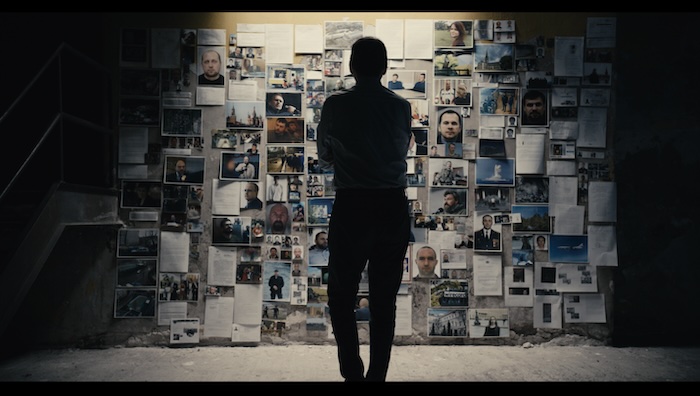
No doubt, the Kremlin was pissed off at Grozev. Prior to the Nalvany project, Grozev had identified thousands of Russian agents and revealed other Moscow assassination operations. But with Navalny, he had struck deep. And this placed him in Putin’s crosshairs. He was told by law enforcement officials in the United States and Europe that it was not safe for him to return to his home and family in Vienna. He hunkered down in New York City, and from there did what he does best: He investigated the plot against him.
Grozev was living a political thriller, coping with isolation and trying to identify shadowy operatives around the world—before they could reach him or his family. Antidote, a new documentary directed by Emmy-winning James Jones, covers this harrowing episode. The film is loaded with real-life intrigue involving Bulgarian spies in England, who were part of a secret Russian network and who schemed to kidnap or kill Grozev; an Austrian fugitive financier who fled to Russia; and the unexplained death of Grozev’s father in Austria.
Antidote is a masterful recounting of Putin-sponsored terror, and it’s timely, given the Trump administration’s unrelenting efforts to normalize Putin and make nice with this tyrant and war criminal. I attended a screening of Antidote last week at the Doc10 Film Festival in Chicago and afterward conducted a Q&A with Grozev and Jones. Here’s a lightly edited transcript. Antidote is scheduled to be broadcast by PBS’s Frontline tonight (May 6).
After watching Navalny, I would have assumed that you were a target of Russian intelligence. Soon into Antidote, you’re learning that you’re on what appears to be a Kremlin kill list, and you seemed surprised by that. I was surprised by your surprise.
Christo Grozev: I've been doing this sort of investigative work since 2014. We've exposed literally thousands of Russia spies. We disclosed that it was the Russians who in 2014 shot down Malaysian Airlines Flight 17, killing 300 people. We disclosed at least 10 assassination plots, some of them successful, some only attempted. We kept embarrassing the Russian government with these exposures. To me, the Navalny case was just one of many.
What I didn't know, as a print journalist, was the power of film. I didn't realize that Navalny, the film, had such an impact on the Russian society, and that it embarrassed Putin. It made a lot of people for the first time believe—because they saw it through the emotional vehicle of film—that Putin was trying to kill his opposition. That was a major turning point in my career, because I decided I will not just do print; I will also do film because that can anger Putin so much.
How did people in Russia even get to see Navalny?
There was a long debate between the producers, CNN Films, and Navalny’s Anti-Corruption Foundation. The foundation was saying they'll never be a market for the film in Russia. So why don't we just make it available for free in Russia? CNN said no. But ultimately somebody did it.
James, how many years did you work on this film? Was there a moment when the direction of the documentary changed?
James Jones: It feels like a lifetime, but almost three years. The initial concept of the film was Bellingcat’s greatest hits, all the investigations they've done. But as a filmmaker, it's always more interesting to make something that's in the present tense and ongoing, particularly when the level of threat is so high and the story is laced with tension. The first thing we filmed, which is the start of the film, was a Russian scientist who worked on its secret poison program—who Christo was helping to escape—running across the border. As an example of Christo’s work.
At that point, we thought the film was about this whistleblower and Putin’s poison program, understanding how they made the poison, how they targeted people. This scientist worked on novichok, which poisoned so many people. And he was taking this risk to escape and tell the world about this program, while his family was still inside Russia. This was the story of what you risk, what you sacrifice, and what the regime might do to stop you from speaking out. But in January 2023, I was with Christo in New York, when he got a message from the FBI saying you can't go home. The film took on a whole new direction at that point.
I've always thought the most important thing for a documentary maker, other than raising money, is luck. You start on one thing and then end up witnessing a story unfolding in real time, right? Though I don’t want to say this was fortunate for you, Christo.
JJ: As a filmmaker, I was committed by that point. I could see the stress and trauma that Christo was going through now, which was frightening. But we both understood that we needed to document what was happening.
CG: Luck is one thing, but having the bravery to actually pursue that luck is something else. James deviated from the original mandate with bold passion.
One of the lingering questions of this film is what happened with your father? He dies while you are dealing with the news the Russians have targeted you. The cause of his death was not certain. We now know that the Russian operatives who were plotting against you were surveilling him. Have you learned anything else about that since the film was made that?
CG: One of the hardest things of being filmed by James, when this was unraveling, was that I was forced to say things on camera or to make judgment calls on camera before I was mentally, emotionally ready to do that. I still haven't had the time to process what happened to me personally. So I decided to mark this for later. But it came back much sooner than I hoped, when the British police showed me a photograph that was not included in the film. It was a photograph of the Russian spies taking a selfie in front of my father's apartment in Austria. Even worse, there was an arrow painted on the selfie saying, “This way in.” I shook when I saw that. I don't have a conclusive answer about my father’s death. But you can imagine that after seeing that, after being 50-50 [on whether the Russian operatives were involved in his death]…Well, this just brought it all back in full color.
Why wasn’t that in the film?
JJ: We were filming with Christo when he received the text messages in which these operatives discussed putting up a camera and doing surveillance on this father's apartment. We weren't with him when he got that photo—
CG: They showed it to me in the police precinct. I'm happy it's not in the film.
This film isn't about what’s now happening with US-Russian relations, but it obviously will be viewed within that context. Recently, Steve Witkoff, Donald Trump's envoy to the Middle East, to Iran, and to Russia and Ukraine, said after meeting Putin, “I liked him. I thought he was straight up with me. I don't regard Putin as a bad guy.” And when he saw Putin recently, he greeted the Russian leader by putting his hand on his heart. What do you think when you see a representative of an American president acting this way toward Putin?
CG: I was told Witkoff in an interview with Tucker Carlson was even nicer toward Putin. I couldn't watch that. You can imagine how I feel about that. I mean, it's one thing to think that there's a negotiation strategy that requires flattery, right? But I know that's not the case. This flattery is a present to Putin that he didn't expect, that he didn't dream he would get. It’s terribly unethical flattering of a dictator who kills his own people. It’s also a sign of incompetence and gullibility. That’s why it's so painful for most of the world and for Ukrainians to hear the Trump administration parroting Russian propaganda and the obvious lies. Think not only about the impact this has on the Ukrainians; think about the impact it has on the good Russians struggling for democracy, who are thrown under the bus.
In Navalny, when you realize you’re about to expose Putin’s assassination plot against Navalny, you turn to Navalny and say, “You're going to be president someday.” And in Antidote, Russian opposition leader Vladimir Kara-Murza has a wonderful scene. He’s been released from prison and is leaving Russia, thanks to a prisoner swap arranged by the Biden administration. He tells his Russian minder, “I know history. I will be back. And sooner than you think.” These are expressions of optimism based on the belief that Putin will eventually fall. But looking at the situation now—and after last year’s death of Navalny in a Russian gulag—is it possible that you and others underestimated Putin’s ability to solidify his rule, as well as the evil extent to which he’s willing to go?
CG: No, he’s totally maxed out on the level of evilness. He’s psychopathic. It's not just a purely pragmatic use of evil. He’s somebody who derives pleasure from being evil. But I do think that Russia—and these are not my words, these are words of people close to the Kremlin—was about to tip over, when President Trump came in. It was going down. Russia was supposed to take over Ukraine within three days. So the fact that it still is trudging along is a failure from the point of view of the Russian establishment, right? But now there's the possibility a guilt-free exit from the war for Russia. Maybe, maybe not. The only optimism I have is that Putin and Trump will fall out of love because neither of them can deliver to the other side what the other side expects.
I've long believed that Trump has a specific psychological affinity for Putin. He likes strongmen in general. But there's something particular about Putin that attracts him. Christo, what are you working on these days? In the movie, while dealing with the threat from Russia, you separated from Bellingcat. Are you back to working with Bellingcat?
CG: I moved on from Bellingcat, partly because I realized that I had exposed a lot of my colleagues to risks. It turns out that these Russian spies had been at several hotels while Bellingcat was there holding working retreats. Bellingcat is doing less dangerous work than my investigations, and it should continue that. I work with what used to be our Russian-language partner, the Insider, which has an English version in which we publish our investigations. But I also am working in film now, because I realized that this is what makes dictators even angrier—and what makes people believe the stories. In fact, one of the stories I'm working on is a sequel to this movie: the story of Jan Marsalek, the fugitive Austrian businessman who ran the Bulgarian spies.
He comes off like a Bond villain. I want to see that movie. Let’s take a few questions from the audience.
Audience member: What gaps are you seeing in American journalism?
CG: I don't really see gaps in American journalism. I do see a change in the self-governance of liberal media that may not be the best outcome. I see that certain media impose pay walls, and that is a big problem because that leads to an even harsher division of society. Only the people who already believe a particular narrative will subscribe and get the details of it. CNN is heading in that direction, which I find very antisocial in a way. But if that's the only way to survive. And it may be something that the oligarchs are happy with, right? The only other thing I would say is to ask US media to draw parallels between what happened 15 years ago in Russia and what’s happening here in the US.
Audience member: Given that Russia has cells in London and Vienna and I'm sure dozens of other places, including the United States, and given our recent change in administration, do you feel that you may be more at risk now than you were six months ago?
CG: There has been a longstanding arrangement between the Soviet Union and the United States for them not to assassinate people in each other's territory. That usually is valid for their own nationals. A Russian should not be assassinated here or an American there. That arrangement hasn't been broken since the ’80s. That’s one of two reasons why law enforcement here keeps telling me I’m safe here. The second reason is that it's difficult to perpetrate a crime here and then run away—because of the size of the country, and you’d have to take a plane back to Europe. And there's also a third thing: During this détente, during this time of transition between the [American] regimes, Russia is probably not going to do something here. Then again, the risk is that a crazier version of Trump decides to hand me over as a present. We're not there yet.
Audience member: You’ve had a pretty good front-row seat to what an autocracy looks like. What does what’s happening in this country look like to you? Does this still look like democracy or are we edging toward something else?
CG: I will have to be somewhat diplomatic while waiting for a more permanent visa status here, but I've never been known to not be reckless. So I'll answer. I already hinted at that. I think I'm seeing some sort of a 2.0 version of what happened in Russia in terms of not only the fusion of oligarchic interests and government, but of the shamelessness of how that is done and an understanding that it doesn't matter what people think. This is a franchise that was tried in Russia, and it worked in small countries. It worked in Hungary. It worked in Slovakia and a lot of Eastern Europe. Sooner or later, somebody was going to try it in a bigger country, in the United States. What’s shocking to me is that American society is not able to react in a way that the myth of America suggests it should, and that what’s happening here is normal and natural. This sends a terrible signal to the rest of the world because if America cannot deal with this, then it's hopeless.
Audience member: What's the status of the opposition in Russia right now?
CG: It's probably at its weakest because they're fighting with one another. There's a lot of infighting, and this infighting is strategically fostered by the Russian security services. But because these people believe they are principled, they don't care that this is fostered by the security service. They believe they’re fighting on principle. They're fighting against their colleagues just because they made a mistake or came from an oligarchy background themselves. This is just another present for the Russian regime. I'm hoping that this is a transitional period. But the Russian opposition, back to the czarist time, has always had this problem. They destroy each other because they fight internally, more than against the external enemy.
JJ: You have in the film Vladimir Kara-Murza make an amazing speech at a press conference, saying I'm a student of history and I'll be back. Which is very rousing and moving. But if you have actually studied Russian history, there's not great grounds for that.
CG: Can we have another question, so we don’t end on that?