FREE TRIAL VERSION. DON'T MISS OUT. |
FREE TRIAL VERSION. DON'T MISS OUT. |
|
|
Kash Patel, From Russia With Love…and Cash |
By David Corn February 11, 2025 |
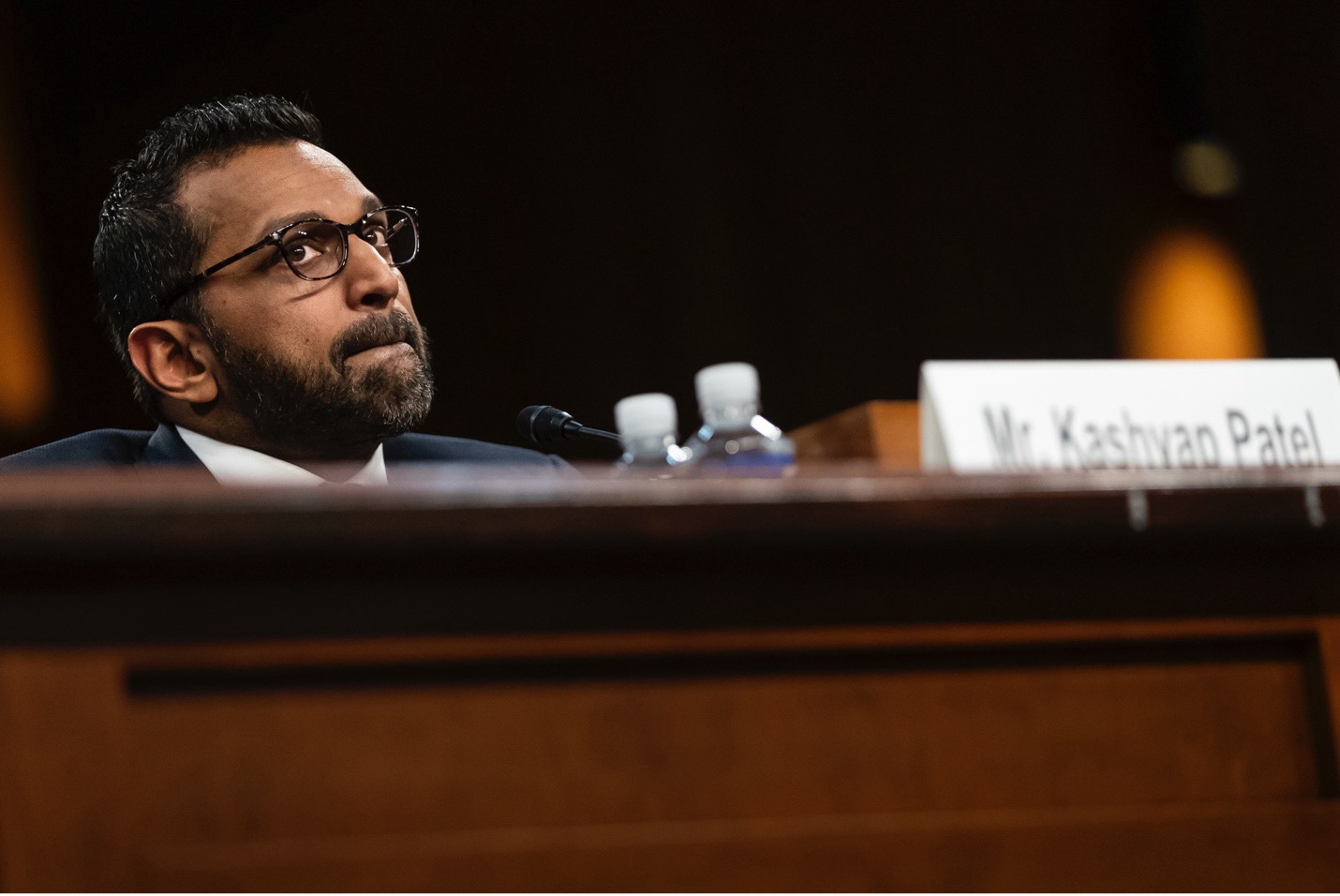
Kash Patel, Donald Trump's nominee for FBI chief, at his confirmation hearing in the US Senate on January 30. Allison Bailey/NurPhoto via AP |
|
|
You're reading a free promotional version of Our Land, and we hope you enjoy David's exclusive writing and don't want to miss out on what's next. Sign up to start receiving a free 30-day trial of Our Land and check out all of the behind-the-scenes reports and interactive features with each issue.
|
|
|
The issue of Russian influence in US politics is back in the news, thanks to Kash Patel, Donald Trump’s pick to head the FBI. This is not because Patel, during his confirmation hearing, addressed this ongoing threat. It’s because he represents it. And a recent revelation about Patel offers a reminder of how Vladimir Putin has intervened in US elections since 2016 to assist Trump.
On Friday, my colleague Dan Friedman and I broke the story that Patel, a MAGA provocateur, was paid $25,000 last year to appear in a documentary series that slammed the FBI. The payment came from a film production company based in Los Angeles and run by a Ukrainian Russian American named Igor Lopatonok. He and Russian-born film director Vera Tomilova produced a six-part series that promoted the all-too-familiar MAGA, paranoia-drenched conspiracy theory that a supposed Deep State cabal plotted against Trump in the 2016 election and afterward. The series, All the President’s Men: The Conspiracy Against Trump, which aired on Tucker Carlson’s website, included an episode that centered on Patel and his crusade to depict the Trump-Russia scandal as a hoax concocted by Democrats, the media, the FBI, the CIA, and other nefarious actors. In that episode—for which Patel was credited as an executive producer—Patel said the FBI headquarters in Washington should be shut down, and he pushed the made-in-Moscow propaganda line that Russia did not attack the American election in 2016.
As we reported—and as the Washington Post subsequently reported—Lopatonok had multiple Kremlin ties. He was a leader of a recent propaganda project funded by Putin’s office to produce online material encouraging Westerners to move to Russia. One of his colleagues in that endeavor was an American who obtained political asylum in Russia and who has been a key player in Russian disinformation operations aimed at the United States. Lopatonok also reportedly financed a 2019 documentary he made on Ukraine—which justified Putin’s aggression toward Russia’s neighbor—with money from a Ukrainian oligarch close to Putin. Another film Lopatonok produced last year served up debunked allegations about Joe Biden and Ukraine and highlighted a Ukrainian politician who had been identified by Trump’s Treasury Department as a “Russian agent” who spread disinformation in 2020 to harm Biden and aid Trump. Others who worked on the documentary featuring Patel had direct associations with Russian propaganda efforts.
|
|
|
It is not a good look for a future FBI director, who is supposed to oversee counterintelligence operations against Russia, to be pocketing thousands of dollars from a filmmaker connected to the Kremlin and its information warfare against the United States. Our story, I was informed, piqued the interest of Democratic members of the Senate Judiciary Committee, which is expected to vote on Patel’s nomination this week. Might it also interest a few Republican senators?
The Patel-Russia controversy extends far beyond this one payment. For eight years, he has been acting as a useful idiot for Moscow, as I noted when Trump selected him for the FBI job. After the election of Trump in 2016, Patel became a staffer for the House Intelligence Committee, then chaired by Rep. Devin Nunes (R-Calif.). His No. 1 mission was to mount a disinformation campaign claiming the Trump-Russia scandal was nothing but a scam orchestrated by Trump’s evil enemies. That was a false charge, but he largely succeeded in propagating this BS.
Patel obsessively focused on a thin slice of the matter: the FBI’s inappropriate use of the so-called Steele dossier, which was assembled by a former British intelligence officer, to obtain a secret surveillance warrant in 2016 for Carter Page, a foreign policy adviser for the Trump campaign who had extensive contacts in Russia. The bureau had misused the Steele memos (which were full of unconfirmed allegations about Trump and Russia) to win approval from a secret federal court for this warrant. That was a serious error and a violation of Page’s civil rights.
But Patel and others repeatedly lied that the FBI had used the Steele documents as the basis to open its investigation that examined both the Russian hacking operation, which sought to hinder Hillary Clinton and help Trump, and contacts between the Trump campaign and Russia. The Steele memos, as even special prosecutor John Durham conceded, were not a factor in the decision to launch the probe. That inquiry began—legitimately, Durham acknowledged—when the FBI learned a Trump campaign aide named George Papadopoulos had informed an Australian diplomat that the Trump team had been told the Russians could help Trump by anonymously releasing dirt on Clinton.
That tip turned out to be prescient. Russian hackers stole files and emails from Democratic sources and passed the stuff to Wikileaks, which strategically leaked the material to damage the Clinton campaign. (One leak was designed to deflect public attention from the emergence of a video in which Trump claimed he could get away with grabbing women “by the pussy” because he was a celebrity.) Moreover, as the Russian operation was going on throughout 2016, Trump and his campaign staff aided and abetted Putin by repeatedly denying the Russians were behind this attack.
Patel created for Trump and MAGA a phony narrative that distracted from the ugly truth that an American election was attacked by a foreign adversary to boost Trump and that Trump—whose campaign had been informed the Kremlin wanted to covertly assist him—tried to cover this up. He cooked up for Trump the story line that Trump employed to falsely proclaim the Russia investigation was a fraud and a “witch hunt.”
There were other complications. The publication by BuzzFeed of the Steele dossier—the existence of which I first reported, without fully revealing the contents—gave Trump ammo, and the Democrats went too far, on the basis of then-existing evidence, in insisting there had been direct collusion between the Trump campaign and the clandestine Russian operation to subvert the election.
But Trump, Patel, and others exploited the FBI’s inappropriate use of the Steele memos to smother the fundamentals: Trump had won with secret Russian backing, and he had helped Putin get away with it. And it's important to remember that this is not a feverish left-wing narrative. In 2020, the Senate Intelligence Committee, then chaired by Sen. Marco Rubio (R-Fla.), released a bipartisan 966-page report that concluded the Russians had covertly interfered in the 2016 election “to aid Trump's electoral prospects” and that Trump and his campaign had actively “undermined the attribution of the hack-and-leak campaign to Russia.” The report also noted that Paul Manafort, while he was chief executive of the Trump campaign, secretly and repeatedly met with a Russian intelligence officer who might have been involved in the clandestine Russian operation. That sounded like collusion. And the report branded Manafort a “grave counterintelligence threat.”
Patel prevented all of this from becoming the widely accepted understanding of the Trump-Russia scandal. His effort assisted Trump in promoting the hoax bunk and providing cover for Putin.
Years later, he’s still at it. In the episode of the Lopatonok series in which he stars, Patel blasts the Deep State for the Russia investigation and asserts that the FBI and the rest of the US intelligence community that investigated Russian interference in the 2016 election “knew it didn’t exist.” This outright denial is both crazy and troubling. We all saw with our own eyes that Democratic material was cyber-pilfered and released by WikiLeaks to hinder Clinton. Numerous sources stated this was the work of Russian operatives—including the House Intelligence Committee (when it was headed by Nunes), the Senate Intelligence Committee, the intelligence community, special counsel Robert Mueller’s investigation, and private cybersecurity firms. Yet Patel, like Trump, will not admit this.
We know why Trump will never do so. The Russin intervention taints his 2016 election victory. And he committed a profound act of betrayal by backing Putin’s denials. For his part, Patel is being a loyal lickspittle for Trump and, consequently, an abettor of Putin’s war against America. All of this has long been known to those who pay attention to such things. But the news of Patel’s for-profit collaboration with a pro-Kremlin disinformation outfit brings into sharp relief his history of being an asset, perhaps unwittingly, for Putin.
So we are on the brink of placing in charge of the FBI a fellow who received payment from a source connected to the Kremlin and who refuses to recognize the established fact that Russia launched a covert attack on a presidential election to affect the results. (He also has been a loud champion of Trump’s lie that the 2020 election was stolen from him, and he has hailed the violent January 6 rioters and cop-beaters as patriots.) |
|
|
This is dangerous. Putin mounted disinformation operations again in 2020 and 2024 on Trump’s behalf. One year it worked; one year it didn’t. Russia is likely to continue such clandestine warfare. It’s the job of the FBI to counter this. But you can’t counter what you can’t see—or refuse to see. If Patel becomes the FBI chief, the Russians will have free rein. His priority will be to protect not the nation but Dear Leader.
Here's a report on the Kash Patel scoop that Rachel Maddow aired on Friday night: |
“The Democrats Are Bringing a Teaspoon to a Gunfight.” |
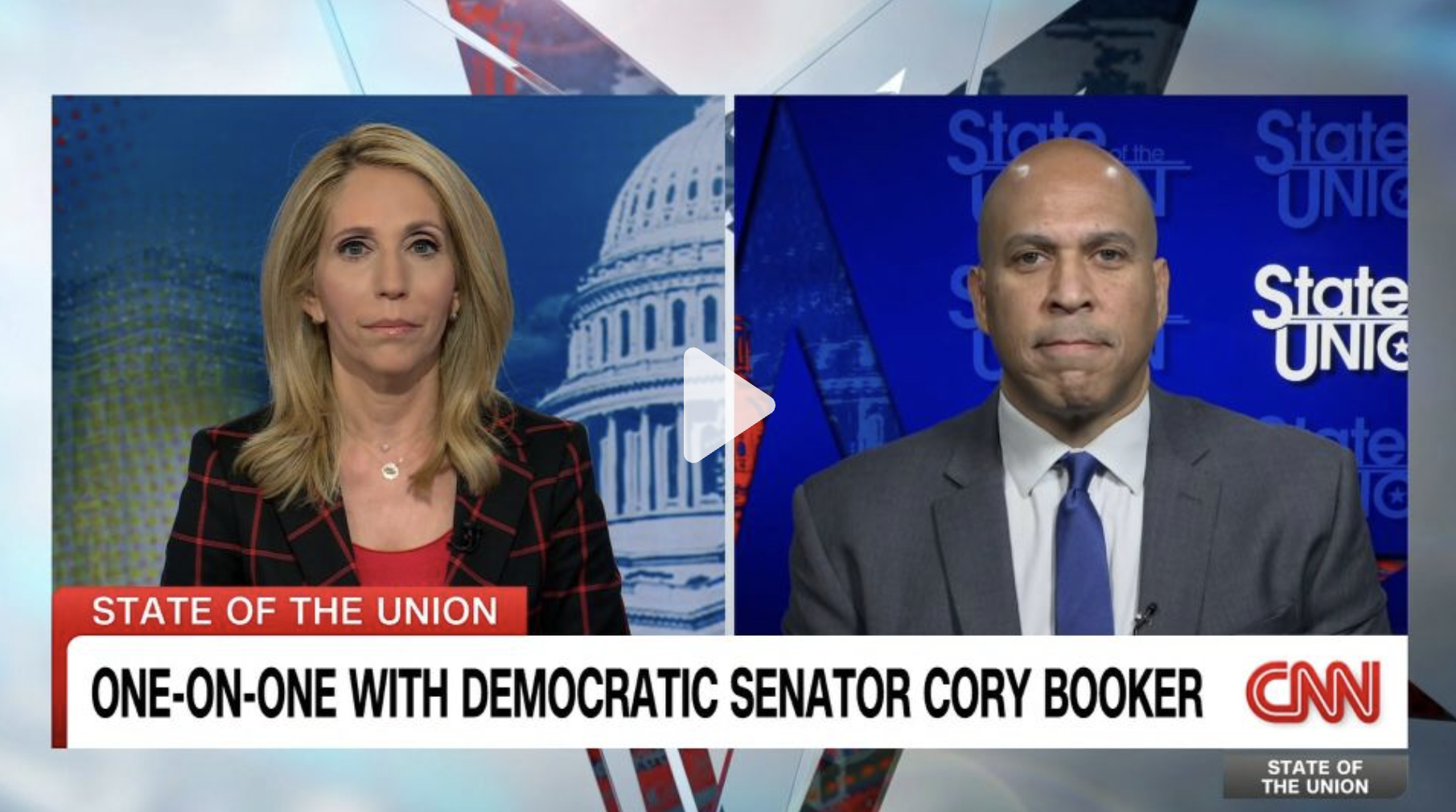
Two issues ago in Our Land, writing about the Democrats’ less-than-ferocious initial reaction to Trump’s blitzkrieg, I opined, “The Democrats are bringing a teaspoon to a gunfight.” On Sunday, CNN host Dana Bash asked Sen. Cory Booker (D-N.J.), who has been leading the Senate Democrats’ efforts on social media, to respond to that observation. You can see the exchange in the clip below, starting at 2:20. I’m not sure his answer will be reassuring to grassroots Democrats craving a more robust opposition.
|
|
|
It seems that Elon Musk has usurped the traditional vice president function: Pick an issue and run with it. In fact, he’s done far more than that. Meanwhile, JD Vance seems most active these days as a social media bad boy, posting ridiculous alt-right tweets in service to his master. It’s quite the journey for the lad who once suggested Trump might be “America’s Hitler.” In recent days, Vance the Tweeter has defended a racist and demonstrated he doesn’t understand the Constitution.
Last week, the Wall Stret Journal reported that a key Musk operative who gained access to the US Treasury’s central payment system—a 25-year-old named Marko Elez—maintained a social media account that posted racist messages. “Just for the record, I was racist before it was cool,” the account declared in July. A post in September stated, “You could not pay me to marry outside of my ethnicity.” Another that same month, responding to the presence of people from India in Silicon Valley, urged, “Normalize Indian hate.” After the WSJ contacted the White House for comment, Elez resigned from his post with Musk’s DOGE operation.
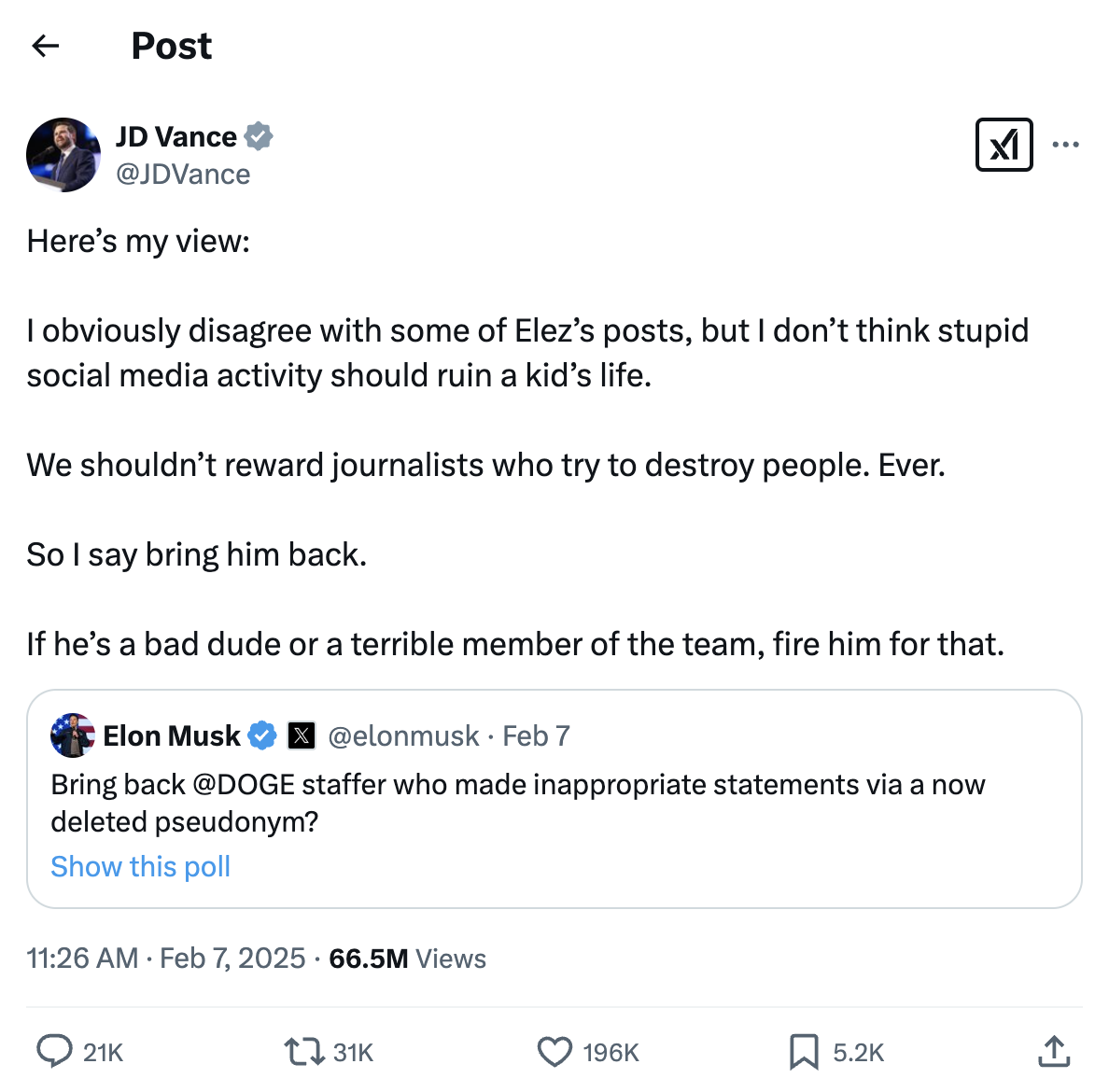
But Musk wanted to keep this racist as a government employee. He posted on X a poll that asked, “Bring back @DOGE staffer who made inappropriate statements via a now deleted pseudonym?” (Not surprisingly, the last time I looked the pro-racist side was winning 78 to 22 percent.) This is when Vance decided his vice presidential intervention was required in a personnel matter. He posted on X:
Here’s my view: I obviously disagree with some of Elez’s posts, but I don’t think stupid social media activity should ruin a kid’s life. We shouldn’t reward journalists who try to destroy people. Ever. So I say bring him back. If he’s a bad dude or a terrible member of the team, fire him for that. |
What a take! These tweets were not in a “kid’s” distant past. A 25-year-old man posted them a few months ago. And Vance was explicitly saying that if someone publishes racist posts and boasts he’s a racist, he’s still not “a bad dude” and perfectly acceptable in polite company. By the way, Vance is married to the daughter of two immigrants from India. He’d rather defer to Trump and Musk than to decry racists who target her ethnicity and the ethnicity shared by their children. In alt-right terms, what a cuck.
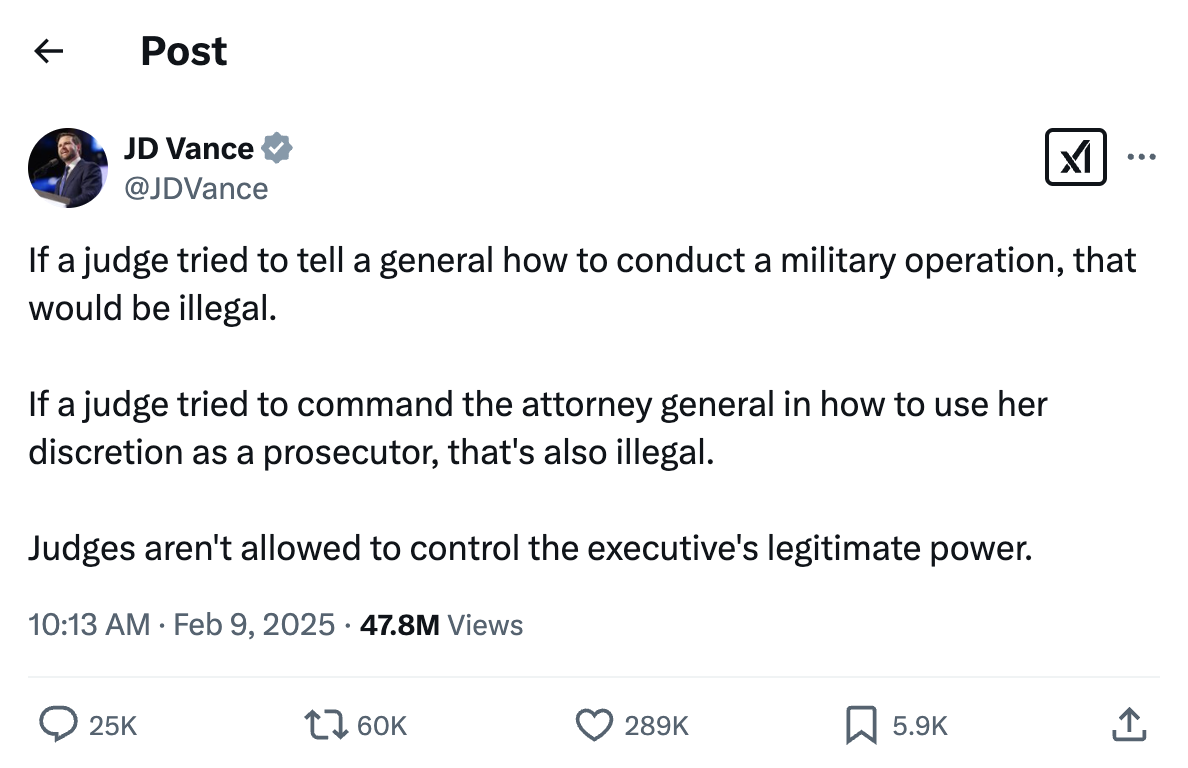
On Sunday, Vance then undermined the Constitution. He tweeted: If a judge tried to tell a general how to conduct a military operation, that would be illegal. If a judge tried to command the attorney general in how to use her discretion as a prosecutor, that's also illegal. Judges aren't allowed to control the executive's legitimate power. |
The basic foundation of the United States government is checks and balances. Judges often weigh in on—and occasionally block—actions of the executive branch. In fact, going back to Marbury v. Madison, the judiciary branch has determined what is a legitimate—that is, constitutional—exercise of executive power. Conservatives cheered when Trump-appointed judges blocked certain actions of President Joe Biden. Vance didn’t complain about those judicial decisions restraining executive power. But now Vance is part of the make-Trump-king crowd, and he and his fellow henchmen are irate that federal judges have blocked key initiatives in their war on government, including the dismissal of the workforce of the US Agency for International Development. It’s no secret that a critical page in the authoritarian playbook is attacking the judiciary, particularly if it seeks to counter a power grab by a wannabe autocrat. Worse, some legal experts on social media suggested this Vance tweet was a sign the Trump administration intends to ignore court orders, which would spark an all-out constitutional crisis.
It might be good for the nation if a senior official who swore to uphold and defend the Constitution understood it. Can Yale Law School ask for its diploma back? Meanwhile, here’s a video for Vance. Let’s hope he can take time out of his busy tweeting schedule to watch it. |
|
|
The Watch, Read, and Listen List |
Wicked, Part One. Of the best-picture nominees for the upcoming Academy Awards I’ve seen, I did not expect that Wicked would be the most political and progressive. As you know, the film is based—faithfully—on the Broadway smash musical that premiered in 2003. It’s the backstory of the Wizard of Oz’s Wicked Witch of the West and focuses on the school-days rivalry-turned-friendship of Elphaba (Cynthia Erivo), a green-skinned girl with uncontrollable psychokinetic powers who will become the WWotW, and Galinda (Ariana Grande), the perky queen of the cool kids who is destined to drop the first syllable of her name and grow into Glinda, the Good Witch of the South. As such, it’s a compelling tale of an underdog with interlacing themes—individuality, identity, discrimination, bullying, and self-empowerment—and wonderful catchy songs from Stephen Schwartz (“Popular,” “Dancing Through Life,” “Defying Gravity”). But the film, written by Winnie Holzman (who penned the musical) and Dana Fox, has a subversive subplot that seems as if it was composed for the Age of Trump.
In Oz, animals talk and are intelligent. So much so that many of them used to be among the professors at Shiz University, the prestigious Hogwarts-like school that Elphaba and Galinda attend. But there’s a shadowy force in Oz that has been forcing animals out of positions of power, denying them their civil rights, and taking away their ability to speak. Shiz is down to one animal professor, Dr. Dillamond, an old goat—literally—voiced by Peter Dinklage. Eventually, he, too, is booted from his job and dragged out of his classroom by shock troops in emerald-green uniforms. “They can take away my job, but I shall continue speaking out…You’re not being told the whole story!” he exclaims. A school administrator shrugs and says, “I’m afraid it’s out of our hands.” His replacement informs the students of a new invention: a cage for animals. It will, he notes, prevent them from learning to talk, and he adds, “It’s for the animals’ own good.” The question is, will anyone speak out against this othering of animals and the rise of authoritarianism? Will anyone in Oz resist?
The repression of the animals radicalizes Elphaba. Someone has to do something, and it’s going to be her. And here are some spoilers: During a trip to Emerald City, the Wizard (Jeff Goldblum) tricks her into using her powers to help him accelerate his cruel campaign against animals. The Wizard shares his political strategy: “When I first got here, there was discord. There was discontent. And back where I come from everybody know that the best way to bring folks together is to give them a real good enemy.” (Like, say, migrants.) Elphaba counters that the Wizard needs to demonize animals and imprison them in cages because “you have no real power.” When Elphaba rebels and vows to expose and oppose the Wizard, the Oz regime brands her a liar, an “enemy,” “evil,” and, yes, a “wicked witch.” Sound familiar?
In Wicked, Oz is very much like the place we call home. Though written years ago, it’s a parable for this moment. What will happen next in Elphaba’s fight against Trumpism—I mean, Ozism? Wicked, Part Two is scheduled to be released in November. |
American Primeval. Everybody likes a good Western, right? And the best ones are often dark. In Clint Eastwood’s 1992 Unforgiven, he played an aging gun-for-hire who after years of toiling as a prairie hitman is contemplating his life. “It’s a hell of a thing killing a man,” he tells a young gunslinger who just put the first notch on his gun belt. “You take all he’s got and all he’s ever gonna have.” More recently, Godless, a limited series from Netflix that hit screens in 2017, pitted a menacing one-armed gang leader played masterfully by Jeff Daniels against a New Mexico mining town comprised mostly of women after a mining accident claimed their men. The recently released American Primeval, another limited Netflix series, created by Mark L. Smith (who wrote The Revenant) and directed by Peter Berg (Friday Night Lights and Deepwater Horizon), deserves a spot in this pantheon and, in some ways, is reminiscent of the best dark Western ever: Deadwood, which ran on HBO from 2004 to 2006 and remains one of the best television shows in the history of the medium.
Deadwood, created by the incomparable David Milch, was, in part, the story of the birth of modern America and its capitalist order. It tracked the growth of its eponymous burg in South Dakota in the 1870s from a camp to a town, as assorted commercial interests vied for control in an environment shaped by violence and lawlessness. American Primeval has a touch of all that.
It starts decades earlier. The series is set in 1857 in the Utah Territory, where Manifest Destiny, the conquest of the Americas, and the westward trek of Mormonism have collided and led to ongoing conflict between Joseph Smith’s tribe, US government troops, settlers, and assorted Native American nations. Violence and conniving are everywhere. Much of the action in the series hinges on a real-life event: the Mountain Meadows Massacre, during which members of a Mormon militia disguised as Native Americans and assisted by actual Indians slaughtered at least 120 immigrants who were passing through territory the Mormon Church considered its province.
The series makes good use of a familiar trope: the damsel in distress. A woman from back East with a young son is trying to reach the boy’s father in a far-off outpost. They end up stranded in the Fort Bridger trading post (which did exist) near what is now the Wyoming-Utah border after one guide disappears and his replacement is shot and killed. Eventually, she persuades a mountain man—a white fellow raised among the Shoshone—to escort her and her son through the dangerous passage westward. Of course, this gal has a secret and is being pursued by bounty hunters, and the boy bonds with the mountain man, as this traveling party, which comes to include a mute Native American girl, faces one perilous situation after another. Meanwhile, the massacre has triggered bloody clashes between US troops, the Mormons, and Native American tribes.
It's not a subtle message: The American West was forged not merely in the can-do and entrepreneurial spirit of pioneers but in a cosmos of religious-fueled violence, genocide, greed, and general malevolence. (The Mormons look the worst by far.) During one massacre, slow melancholic music plays, and the melody line recalls “This Land Is Your Land.” Too obvious? But it works, as does the full series. American Primeval is a gritty and disturbing tale of how the West was really won—with much bloodshed and much wrongdoing.
|
| |
Congratulations, you read all the way to the end! It's a great time to say "I'm in" and start your free 30-day trial. Make sure you don't miss out on what's next: Sign up to start getting Our Land in your inbox each week. We also want to hear from readers (especially those who read the whole thing!). So let us know what you think so far or share something interesting with David at ourland.corn@gmail.com.
|
|
|
|