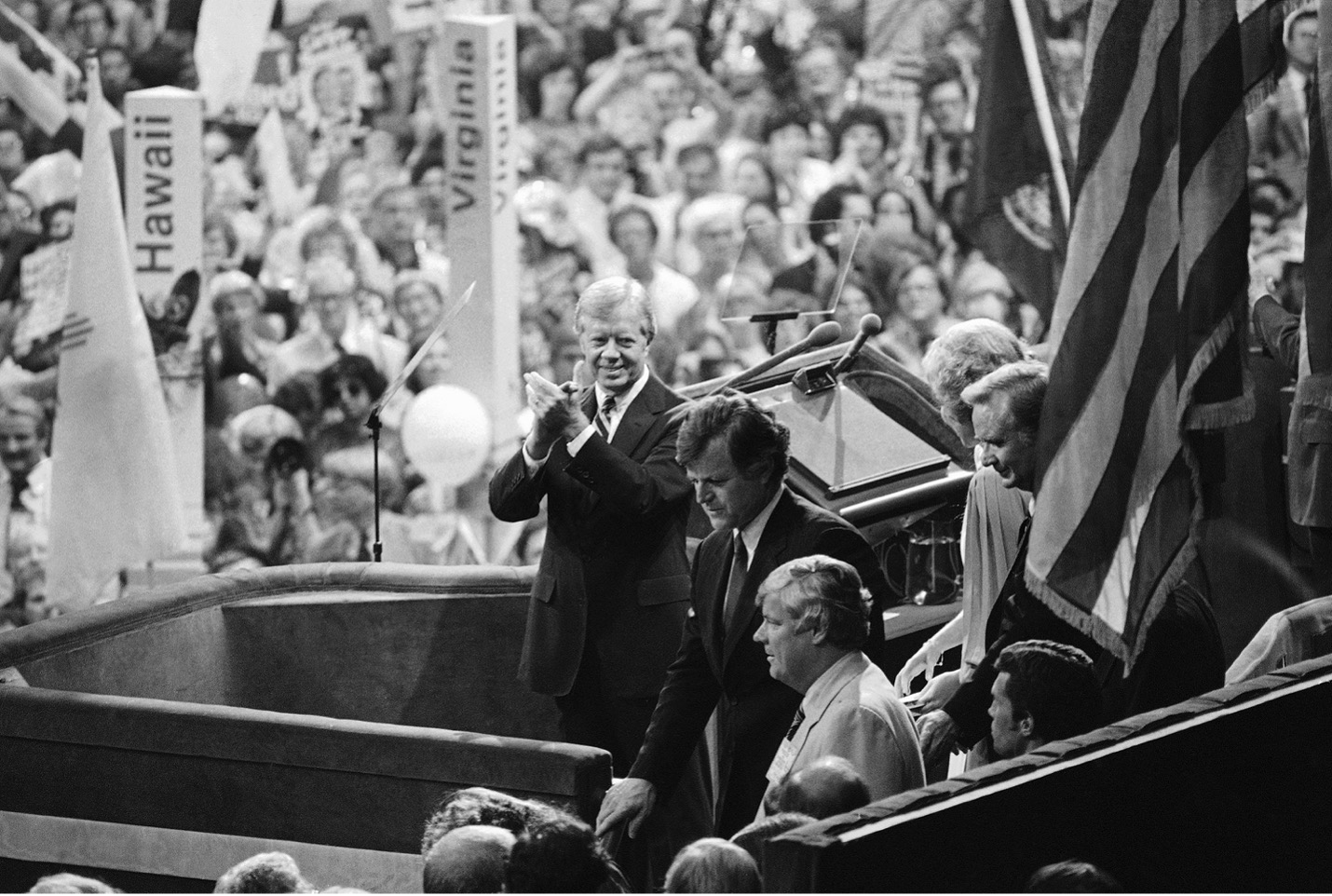
There’s something about political conventions that many people may not understand: They are conventions—just like, say, a Shriners convention or a national gathering of realtors. Thousands of members of the politics-media tribe assemble in search of connections and a good time. There are receptions, parties, conferences, and much meeting and greeting in overflowing hotel bars and lobbies. A tsunami of schmoozing ensues among party officials, journalists, donors, strategists, activists, candidates, elected officials and their aides, delegates, lobbyists, and others, including political tourists who gawk at their favorite media celebs. Contacts are made, gossip is traded. For those in these overlapping worlds, what goes on outside the hall—where often there are few surprises—can be as important as the official proceedings.
This summer, due to a back surgery I’ve mentioned previously, I am skipping both conventions. My titanium rods and pins are still fusing to my bones, and my surgeon has implored me to eschew this rodeo. The shindig underway this week in Chicago is the first Democratic convention I’ve missed in more than four decades. This has put me in a nostalgic frame of mind. Thus, since I am writing this issue prior to the start of the get-together in the City of Big Shoulders and you are receiving it after the kickoff (with President Joe Biden delivering the keynote on the first night), I’m going to share some reflections on the previous Democratic conventions I witnessed. This is hardly meant as a comprehensive history—just some personal remembrances, as I miss out on the hustle and bustle of this year’s gathering.
1980, New York City: My first convention. I don’t remember how, but I managed to wrangle a freelance gig as a cub reporter for Joe Conason and Jim Ridgeway, two columnists then at the Village Voice. The pair were jointly covering the Democrats, who that year had been bitterly divided by Sen. Ted Kennedy’s primary challenge to incumbent President Jimmy Carter. At the start of the week, Kennedy was mounting a last-ditch effort to persuade Carter delegates to jump ship. Though this uprising failed, Kennedy and his allies kept pressing for a more liberal party platform than Carter desired—one that included a major stimulus program and a jobs bill. And there was much concern among Democrats as to whether the party could unite and keep B-movie actor and former California Gov. Ronald Reagan out of the White House. Conason and Ridgeway dispatched me to various events across the Big Apple, where Democrats, liberals, labor activists, and other progressives were gabbing about the platform fight, what Carter would have to do to appeal to the left, and how the party could heal the wound. I filed notes, and, if I remember correctly, a few quotes I collected ended up in their copy. I was ecstatic.
The big moments of that convention included when TMK addressed the delegates and tried to keep the flames of Camelot and liberalism alive (“The cause endures, the hope still lives, and the dream shall never die”), and when he appeared on the stage with Carter on the last night and Carter chased him in search of that hands-clasped-together-over-heads photo that would signify party unity. Kennedy would not oblige. Happy days were not here again.
The ghost of 1980 hung over the early 2024 campaign for Democrats. The division caused by Kennedy’s bid—and the accepted wisdom that his primary challenge weakened Carter for the general election against Reagan—was much in mind when Ds talked about possible challenges to Biden. Did any Democrat want to run against Biden and, if unsuccessful, make it tougher for Biden to defeat Trump—and be blamed for that? And a coda: Decades later, I ended up working at Mother Jones with Ridgeway, who died in 2021, and this year Conason asked me to provide a blurb for his new book, The Longest Con: How Grifters, Swindlers, and Frauds Hijacked American Conservatism. The circle of (media) life.
1984, San Francisco: I attended the convention as a correspondent for the Nation and focused mainly on the issue of arms control. The nuclear freeze movement had emerged two years earlier, and anti-nuclear activists were a potent part of the Democratic coalition and pushed for planks in the platform aimed at reducing nuclear arsenals. But my biggest accomplishment was gaining a pass for a media lounge sponsored by some railroad trade association. This was where free food and beer could be acquired. One night at the lounge, I was befriended by Hunter S. Thompson, who was in full Hunter S. Thompson form: crazed, talking wildly about, well, everything, and thrashing about. At one point, he became so enthused about a point he was making that he waved his arms fiercely, unintentionally threw himself into the curtain that served as a wall, and ended up crashing into the next-door reception. I helped him to his feet and offered apologies to our neighbors that he would not.
This was the evening that the Rev. Jesse Jackson, who had won nearly 20 percent of the delegates during the primaries, was slated to speak. As Jackson was heading toward the stage, Thompson grabbed me and ran toward the convention floor. “I want to see blood!” he shouted, as we hurried along. “I want people at home to be scared as hell!” I don’t believe either of us had floor credentials, and at the entrance to the floor, we rushed past security. (This was pre-9/11.) “Panic—I want to see panic in the streets,” Thompson exclaimed. Around this point, he let go of me. I now have this image of him disappearing into the crowd, yelling “panic” over and over. I never saw him again that convention.
Jackson’s address did not incite the panic in Middle America that Thompson wanted. But he did talk about America as a “quilt” that included “the white, the Hispanic, the Black, the Arab, the Jew, the woman, the Native American, the small farmer, the businessperson, the environmentalist, the peace activist, the young, the old, the lesbian, the gay, and the disabled.” Not even Democrats at this point were accustomed to such statements of inclusion, and no one had ever before mentioned gays or lesbians in a national convention speech.
Few people believed that former Vice President Walter Mondale, the Democratic nominee, could defeat Reagan, and that gave a somewhat dreary tone to the proceedings. (“Mr. Reagan will raise taxes, and so will I,” Mondale said in his acceptance speech. “He won’t tell you. I just did.” Reporters let out a collective “ugh!”) Yet a highlight of the week was a mega-party put on at Fisherman’s Wharf by Willie Brown, the powerful and flamboyant California state assembly speaker. I had never seen such high piles of shrimp and crab legs. Democrats might have been depressed about their electoral prospects, but that night they were high on seafood and free booze—and perhaps other substances. It was a good time on the depressing march toward a blowout.
At that convention, I picked up a useful tip from Victor Navasky, the editor of the Nation. One important task at conventions was to gain entrance to the best parties and receptions. Each morning, a calendar was published listing the events of the day, including invitation-only gatherings. Navasky would identify the parties he wished to attend and call the groups sponsoring them. He would say that he’d like to be placed on the list, and invariably the person on the other end would say something like, “I can’t do that, but I will pass your message along to Susan.” Fine, he would reply. Later, he would show up at the event, and if asked if he was on the list, he would say, “I was told Susan was taking care of it.” Yes, this often worked.
1988, Atlanta: I was then the Washington correspondent for the Nation. It’s hard to believe now how triumphant Democrats were at this get-together. Massachusetts Gov. Michael Dukakis was way ahead in the polls against Vice President George H.W. Bush. When he hit the stage to deliver his acceptance speech, the PA system blared Neil Diamond’s “Coming to America,” a pro-immigration anthem. I doubt anyone can remember anything Dukakis said that night. But in an earlier speech, Texas Gov. Ann Richards brought down the house with her trash-talking of Bush. (“Poor George, he can’t help it—he was born with a silver foot in his mouth.”) The most consequential speech of the week—or so it seemed—came from the young governor of Arkansas, Bill Clinton. He droned on and on and on. Toward the end, when he said, “In closing…” the delegates cheered. Afterward, every political pundit said Clinton was toast. This rising star had set.
It's my recollection that after the Clinton speech—though it may have been another night—I was at a party thrown by New York Gov. Mario Cuomo, who had been a Democratic frontrunner that year until, after much hemming and hawing, this Hamlet of Albany declined to enter the race. At the massive soiree, I introduced Julius Genachowski, a future chair of the Federal Communications Commission, to Martha Raddatz, then a young reporter for ABC News. Three years later, they wed. (Eight years after that, they divorced.) At another party, I spotted actor Rob Lowe, who was immersed in a gaggle of young, adoring women. Maybe too young, I thought. In fact, Lowe’s exploits at the convention had been a hot topic of discussion. He was later charged in connection with making a sex tape that week involving a 16-year-old girl he met in Atlanta. (A year after the convention, he signed an agreement with local prosecutors in which he did not admit guilt but agreed to perform 20 hours of community service.)
The Democrats left Atlanta jazzed and brimming with confidence. Subsequently, Bush and his campaign operation—led by Roger Ailes and Lee Atwater—mounted a nasty crusade of personal slander against Dukakis. (Bush allies ran the infamous Willie Horton ad.) This effort would be deemed quaint by today’s standards. Yet at the time it was considered a new low in American politics—and it worked. What we’ve learned since is that there is no bottom.
I’ll end this jaunt down memory lane here, though there are plenty of tales to tell about subsequent Democratic hoedowns. But I’ll add that four years later at the 1992 convention in New York City—during which my car radio was stolen—the Democrats nominated the guy who had been pronounced politically dead by the pundits in Atlanta. No one had figured that Clinton’s good friend, Linda Bloodworth-Thomason, a television producer (Designing Women), would advise him to go on Johnny Carson’s show and make fun of himself for his disastrous speech and find a path to redemption that would lead to the White House. That convention had one of the best balloon drops I’ve seen, as Fleetwood Mac repeatedly reminded us over and over, “Don’t stop thinking about tomorrow.” The tune played multiple times as the Clintons and Gores waved to the hyped-up Democratic throng. I recall thinking: Finally, the first rock ‘n’ roll president, and they couldn’t come up with a better song?