I’ve long thought that for many Americans, the vote for president is driven by psychological factors—more so perhaps than the vote for governor, senator, representative, state legislator, mayor, or dog catcher. When it comes to selecting the chief executive, some citizens are moved to choose the person who symbolizes their vision of the United States. They are picking the leader of the American tribe—the candidate who best represents their fundamental idea of the nation. This is not a job interview. Qualifications and policy positions are only somewhat relevant. When it comes to other elections, a voter might focus on who can do better fulfilling the duties of the office. After all, you want a dog catcher who can catch dogs. But for the presidency, your vote tells a story: Who is the man or woman who captures and emulates your conception of your homeland? Our president is not only the politician who runs the federal government and commands the armed forces; he or she is our chieftain, our version of a king.
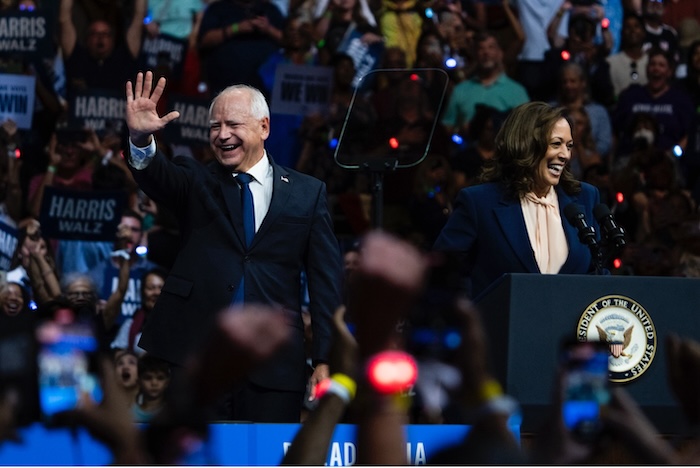
But with the recent flip of the script in the 2024 presidential contest, I’m wondering if there might be a slightly different dynamic underlying this race. As has been much noted, when Tim Walz, the Minnesota governor selected by Vice President Kamala Harris to be her running mate, appeared with her at a Philadelphia rally earlier this week, he thanked her for “bringing back the joy” to politics. And the two Democrats gave speeches in which they spoke fervently about the fight they wish to wage for their priorities, but they did so without anger. “Minnesota’s strength comes from our values, our commitment to working together, to seeing past our differences, to always being willing to lend a helping hand,” Walz said. “Those are the same values I learned on the family farm and tried to instill in my students. I took it to Congress and to the state capitol, and now Vice President Harris and I are running to take those very values to the White House.”
More than one pundit reached for that cliché of politics—“happy warriors”—to describe the pair. And the trope fit. In her short time as a presidential candidate this summer, Harris has tried to promote an inclusive message that echoes what Walz was saying: We’re all in this together. Sure, the Harris campaign is not going to find common ground with anti-abortion diehards, gun-rights fanatics, or Americans who first and foremost want to shut down the border and deport the 11 million or so undocumented immigrants in this country. But her thematic vision is of community. And she and Walz assail (and ridicule) Donald Trump and JD Vance but without demonizing them and their voters.
Compare that to the Trump-Vance playbook. Their core message is anger. The other side, in their perverted view, is actively trying to annihilate America. Their enemies are evil communists conspiring to impose socialism and destroy all that is good in this country. They must be crushed. They are “vermin,” as Trump says. They are “unhumans,” as claims a book that Vance recently endorsed. They must be squashed like bugs. Trump, who has made insult-comedy a critical element of his campaigns, amplified a social media post that included an illustration of Harris’ face—with the skin darkened—on the body of an insect. After Harris named Walz her veep pick, Trump declared, “Tim Walz will unleash hell on Earth”—as if Walz is the envoy of the apocalypse.
We’ve all become a bit inured to Trump’s hateful exaggerations. But they are essential for the GOP ticket—no matter how absurd. Walz has been the governor of Minnesota since 2019. The state is no hellscape. In fact, it is ranked the third happiest state in the nation. Under what version of reality could we expect Walz, a former high school social studies teacher and football coach who grew up in a small town in Nebraska and worked on his family farm, to “unleash hell on Earth”? But Trump’s goal is not to accurately critique a political rival. It is to keep hatred whipped up. When you’re propelled by anger, you say dumb shit. And when you’re relying on the politics of division, you do all you can to delegitimize and other-ize your foes.
Vance, who once positioned himself as a reasonable center-right public intellectual who slammed Trump (as “heroin” for aggrieved Americans) but respected his voters, has been eager to join Trump’s hate-a-thon. Campaigning in Atlanta a week ago, he lambasted the Democrats: “They couldn’t beat him politically, so they tried to bankrupt him. They failed at that, so they tried to impeach him. They failed at that, so they tried to put him in prison. They even tried to kill him.” The Democrats did not try to kill Trump. There is no evidence the would-be assassin who shot at Trump at the rally in Butler, Pennsylvania, was motivated by politics. Yet here was Vance cavalierly making this claim to diabolize the Democrats.
Much of politics is us-versus-them. But for Trump and Vance, the line between us and them is fixed, and those on the other side are heinous and malicious. They are a pernicious threat. They deserve no quarter. (Elon Musk idiotically called Harris a “communist” this past week.) And in this Manichean depiction of American politics, fury is justified. If you think the Dems, the libs, the elites, antifa, BLM, and woke corporations are all scheming together to devastate the United States, rage and resentment are appropriate, and there ought to be no compromise with these traitors.
Harris and Walz are more inviting. Join us to work together to strengthen America, they say, and we can bolster freedom, opportunity, and security for all. Yes, to do so means beating back Trump and the forces of MAGA that threaten the rights and economic well-being of many Americans. But let’s do this with a positive spirit.
So there is a stark choice between these two teams: angry and happy. Which side do you want to be on? The change in the Democratic ticket makes this delineation clear. Not every voter will approach the decision this way. But the election now poses the question: What tribe do you want to be part of? The one that emphasizes acrimony and rancor and sees America as a dark place on the precipice of collapse? Or the one that promotes joy in politics and celebrates a communal spirit? How one answers this question might have much to do with how he or she views the world and their place in it. That is, psychological factors.
There is much that will go into determining who wins this titanic face-off in November. In the past few days, the Trump-Vance camp has tried to Swift Boat Walz by challenging his account of his military service—which is quite rich given that Trump escaped the Vietnam draft with the cooked-up excuse of bone spurs and that Vance’s overseas tour as a Marine was as a public affairs specialist. (Remember, Chris LaCivita, the co-manager of the Trump campaign, ran the defamatory Swift Boat crusade against John Kerry in 2004.) And there’s no doubt that Trump and his allies will spend hundreds of millions of dollars to hurl tons of mud at Harris and Walz, hoping that something—be it true or false—sticks.
Yet one basic current in this campaign—which could determine the future of American democracy—is how it feels to be on either side. Do you want to be with the gang fueled by animosity and resentment or the squad that exudes delight and cooperation?
Joe Biden was right: The 2020 election was a battle for the soul of the nation. So has been the 2024 election, but his age-related issues and the persistence of high prices made that a tough sell while he was the Democrats’ meh nominee in a meh-versus-meh race. The Harris switcheroo returns the contest to this elemental choice, but the way she has burst out of the chute and her saddling up with America’s Dad render the contest something else as well: a referendum on America’s psyche.
Got anything to say about this item—or anything else? Email me at ourland@motherjones.com.